Showing posts with label Hungary. Show all posts

Thursday, September 28, 2023

Next Stop Transylvania

We're headed to Cluj-Napoca this weekend, the largest city in Transylvania.  #Draculaland 🧛‍♂️ Here's a bit about the region.


Transylvania is located in Romania.  On the region's east and south are the Carpathian Mountains and the Apuseni Mountains on the west.

The area was conquered by the Roman Empire in the 2nd century and it became part of the province of Dacia.  After the Romans, between the 3rd to 9th centuries came the Goths, Huns, Gepids, Avars and Slavs.  During the 9th century, it was conquered by Hungarian tribes.

From 1000 - 1526, Transylvania was part of the Kingdom of Hungary.  During this time, the elites were the Hungarian nobility, Székelys, and Saxons (Germans) while the Romanian majority were largely excluded from political representation. 

In 1526, it became the Principality of Transylvania which was an autonomous state under the Ottoman Empire.  After the Ottomans were defeated in 1699, it became part of the Habsburg Monarchy.  

After WWI, the fall of the Austro-Hungarian Empire and the Treaty of Trianon, and the fall of the Austro-Hungarian Empire, it became part of Romania.  Romanians see it as a moment of national unity.  Hungarians consider it a national loss since it was part of Hungary for centuries.

There are a little over 1 million ethic Hungarians living in Romania today.  While some nationalist Hungarian politicians may talk about "Historical Hungary", and the need to protect Hungarians living abroad, Hungary does not officially lay claim to Transylvania.  

Romania and Hungary are both members of the EU and NATO, and both countries recognise each other's borders.

A fun historical twist:  Béla Lugosi, the start who made Dracula famous in the 1931 film, was an ethnic Hungarian born in what is no Romaia.

For Americans, the classic "Dracula accent" is actually English spoken with a Hungarian accent, not a Romanian one - a cultural legacy of Lugosi's performance.

Wednesday, April 5, 2023

Finland Joined NATO

As of yesterday, Finland abandoned decades of neutrality and officially became NATO's 31st member. 

Following WWII, and throughout the Cold War, Finland acted as a buffer zone between NATO and the Warsaw Pact.  

In 1994, the country joined the Partnership for Peace programme to cooperate with NATO in peacekeeping and joint exercises without being a NATO member.  In 1995, Finland joined the EU.


When a country joins the EU, there is an obligation to aid any fellow member country that gets invaded.  It's legally binding that all EU members must assist but it allows each country to decide on how to help.  The aid a country provides could be military, political, humanitarian, etc.  This isn't the same thing as NATO Article 5, that says an attack on one is an attack on all.

Due to Article 5, every NATO member must approve any new member.  The USA approved Finland's accession in less than three months.  Czechland was also quick and gave approval in just over three months.

Hungary and Türkiye were the holdouts.  Hungary took 10 months, 1 week, and Türkiye approved after 10,5 months.

Putin didn't want NATO enlargement, but after Russia invaded Ukraine, it got the opposite.  Finland and Sweden both ditch neutrality and applied to join NATO.  Now Russia's direct border with NATO has doubled due to the 1.340 km (830 mile) border that Finland has with Russia.

The Finish military brings a lot to NATO.  While there are only about 24.000 active-duty personnel, it's wartime mobilisation is about 280.000 and they have a reserve pool of 870.000.  They spend about 2,3% of GDP on defence and they have one of the largest artillery forces in Europe.  The Finns are experts in cold weather and arctic operations, and the Gulf of Finland now became NATO territory.

Let's see how long it takes for Sweden to join.  Here's a short video I found out on YouTube.

©WSJ

Я за Україну. Ð¯ за Україною. Слава Україні  Stojím za Ukrajinou!  I stand with Ukraine. ðŸ‡ºðŸ‡¦

Tuesday, November 29, 2022

2022 World Happiness Report

This year is the 10th anniversary of the World Happiness Report. by the Sustainable Development Solutions Network of the United Nations.  The report factors in things like gross domestic product per capita, healthy life expectancy, freedom to make choices, perceived corruption and social support from friends and family. 


For the fifth year in a row, Finland came in first place.

Scandinavia did well as usual with the five countries all placing in the top eight places.  Finland #1, Denmark #2, Iceland #3, Sweden #7 and Norway #8.

Switzerland placed #4.

The BeNeLux countries did well too with the Netherlands #5, Luxembourg #6, and Belgium #19.

Europe is the happiest region with the eight of the top ten spots.  The only non-European countries to crack the top ten are Israel #9 and New Zealand #10.

The USA placed #16 and Czechland placed #18.

Czechland continues to be the happiest of the Visegrád Four with Slovakia #35, Poland #48, and Hungary #51.

Last place goes to Afghanistan, behind Botswana, Rwanda, Zimbabwe, and Lebanon.

Monday, May 16, 2022

Frontex

Frontex is the European Border and Coast Guard Agency.  Frontex comes from the French words frontières extérieures, which means "external borders."

Frontex is an EU agency that was established in 2004 as the European Agency for the Management of Operational Cooperation at the External Borders.  Due to the migrant crisis in Europe in 2015-2016, its role expanded to became the European Border and Coast Guard Agency.  In 2021, the European Border and Coast Guard standing corps was launched which is the EU's first uniformed service.  The corps expects to have 10.000 personnel by 2027. 

Frontex is headquartered in Warsaw.  The agency reports to the European Parliament and the European Council

Here's a just over 5½-minute video about what all the agency does.

©Frontex

Since the start of the Russian invasion of Ukraine, almost 5,65 million refugees have fled Ukraine and arrived in EU countries, especially Poland, Slovakia, Hungary, and Romania.  Moldova isn't part of the EU but has also seen many Ukrainian refugees arrive.

Frontex has deployed 520 standing corps to countries to help them with the influx of refugees.  They have also organised humanitarian flights to help non-Ukrainian citizens who were in Ukraine make it back safely to their home countries.


Я за Україну. Ð¯ за Україною. Слава Україні  Stojím za Ukrajinou!  I stand with Ukraine. ðŸ‡ºðŸ‡¦

Wednesday, April 13, 2022

Nat's Coming to Help

Well Natalie is on her way back to Europe but it's not for something good.  Well, she will do some good but the reason for her coming isn't good.  Natalie is part of the New Zealand Red Cross and they are sending her as part of the International Federation of Red Cross and Red Crescent Societies (IFRC) team supporting people affected by Russia's invasion of Ukraine.

I know that the IFRC has to be politically neutral so their stance is that they are helping people affected by the conflict in Ukraine.  I still say that they are helping people affected by Putin's invasion of a sovereign country.

So Natalie is headed to Budapest, Hungary to start her assignment.  I'm sure that she will end up in Poland, Slovakia, Romania, and maybe even Moldova.  Not so sure that she'll go to Ukraine but who knows?  I don't know how long she will be here because thanks to Brexit, her UK passport no longer gives her unlimited time in Schengen so I guess the max is 180 days.

Here's the New Zealand press release about her deployment.

Our second international delegate is on her way to join the International Federation of Red Cross and Red Crescent Societies (IFRC) team supporting people affected by the conflict in Ukraine.

Natalie is travelling to Budapest where she'll be focusing on the distribution of multipurpose cash support to the most vulnerable people.  Cash assistance provides funds for displaced people to buy the essentials they need, which could include rent assistance for housing.  Natalie will be working for the IFRC and Red Crescent Societies as part of the New Zealand Red Cross International Delegate Programme.

She will be travelling around the countries bordering Ukraine to help Red Cross teams assist people who have fled the conflict zones.

"I'll be focused on the data and systems side of the cash and voucher programme - helping ensure the cash support is going to where it's needed most," says Natalie.

Natalie has a background in information management.  She's part of the New Zealand Red Cross IT and Telecommunications Emergency Response Unit and has previously deployed to Indonesia and the Pacific. Recently, she has worked for the IFRC in Switzerland on the global COVID-19 response.

International Delegates are trained technical experts who provide humanitarian assistance and contribute to saving lives, alleviating suffering and maintaining human dignity in conflict and disaster zones.

We are so proud of our favourite Kiwi!!  Stay safe Nat!!

Я за Україну. Ð¯ за Україною. Слава Україні  Stojím za Ukrajinou!  I stand with Ukraine. ðŸ‡ºðŸ‡¦

Saturday, February 26, 2022

Я за Україну

Я за Україну is Ukrainian for "I stand with Ukraine."  Two days ago Russia invaded Ukraine almost eight years after it occupied Crimea.

Vladimir Putin is calling this a "special military operation" but he can call it whatever he likes but he's really declared war on Ukraine.  He invaded Ukraine in 2014 by annexing Crimea and his actions in the Donbas, and now with this full on invasion there is no doubt that he has invaded a sovereign country, the second-largest country in Europe.

In response, Czechland was the first EU country to stop issuing visas to Russian citizens, with the exception of humanitarian cases.  The Czech government has ordered that Russia must close its consulates in Brno and Karlovy Vary.  The Czechs are also suspending their consulates in St. Petersburg and Yekaterinburg.  Along with other countries, Czech airspace is closed to Russian aircraft.  In response, Russia had closed its airspace to Czech flights.

Czech Railways is permitting free travel throughout the country to anyone with a Ukrainian passport.  They are also running humanitarian trains to the Ukrainian-Polish and Ukrainian-Slovak borders where they drop off supplies and bring refugees back here.  Many Czech cities, including Brno, are providing free public transport to Ukrainians.  Vodafone and T-mobile are providing free calls to Ukraine.

Czech President Zeman, who has always been very pro-Russia, has changed his stance and condemned Putin for invading Ukraine.  

Russia's annexation of Crimea hits a never for most Czechs because it is similar to when Hitler annexed the Sudetenland from Czechoslovakia.

After WW2, there was an agreement that both American and Soviet troops would leave the country.  So Czechoslovakia was the only eastern block country where Soviet troops didn't remain after the war.  Then in 1968, the Soviet Union and Warsaw Pact allies, invaded Czechoslovakia to put an end to the Prague Spring.  When they invaded in 1968, the Soviets said they were only staying temporarily.  That turned out to be 23 years.  

After the Velvet Revolution, one of the goals of the new government was to get the Soviet army out of Czechoslovakia.  The Soviets had over 73.000 soldiers, 18.500 officers and their families, plus over 44.000 civilians, stationed here and they were in no hurry to leave.  Logistically the Soviets didn't have enough facilities to take back all of their troops from all of its satellite countries at the same time.  The last troops didn't leave Czechoslovakia until 1991.

It was pretty much the same in other countries.  Soviet troops left Hungary in 1991 and they left Poland in 1993, 54 years after they invaded in 1939.  Soviet troops had been stationed in East Germany.  Germany reunified in 1990 but they didn't leave Germany until 1994.

I've got Covid and I'm home on quarantine.  It seems that all I can do is watch the news which is 24/7 coverage of what's going on in Ukraine.  Here's a 32 minute video on YouTube that really shows why Putin invaded Ukraine.  #standwithukraine ðŸ‡ºðŸ‡¦

©RealLifeLore

Я за Україну. Ð¯ за Україною. Слава Україні  Stojím za Ukrajinou!  I stand with Ukraine. ðŸ‡ºðŸ‡¦

Tuesday, November 23, 2021

Nutri-Score

When I first moved here I made a comment at work that I was going to get so fat here with this being the land of beer and potatoes.  A friend sniped back with, "but I thought that all Americans were already fat."  Well not quite right but not wrong either.

In 2016, the World Health Organisation put the USA's obesity rate at 33,8%.  Czech Republic was 24,2%.  Czechs have been getting bigger.

In 2019, the five EU countries with the highest percentage of obesity were Croatia, Malta, Czechland, Hungary, and Slovakia.  France has the lowest obesity levels in the EU, followed by the Netherlands, Italy, Belgium, and Sweden.  Czechs were had the 3rd highest levels of obscenity in the EU.

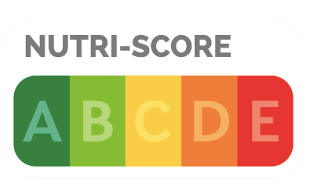
Here's where I think that Nutri-Score would be a good thing.  Nutri-Score is a "traffic light system" that ranks food products on a scale from A to E, where A is the best and E is the worst, and it is clearly visible of the front of the food's packaging.  

Food products get a lower rating if there is:

  • high energy density per 100 g or per 100 ml
  • high sugar content
  • high content of saturated fatty acids
  • high salt content.
There's a higher rating when:
  • contains fruits, vegetables, nuts and legumes
  • contains fiber
  • contains protein
  • contains rapeseed, walnut and olive oil
Nutri-Score was founded in France in 2013 and in 2017 the French Health Ministry officially recommended it.  Since then it has rolled out in Belgium, Spain, Germany, Switzerland, the Netherlands, and Luxembourg.  The system has been recommended by the European Commission and the World Health Organization.

So far it's not mandatory across the EU but I'm sure that it will be eventually.  Some companies such as Nestlé and Danone have announced that they will start using Nutri-Score in Portugal, Slovenia, and Austria even though it's not required in those countries.  

Not all countries are onboard with the system.  Poland, Czechland, Cyprus, Greece, Hungary, Latvia, and Romania all oppose it.  Italy believes that the system puts the traditional Mediterranean diet at a disadvantage.  

The Czech Ministry of Agriculture isn't in favour of the system but it will tolerate international labels with Nutri-Score.  The ministry is not in favour of a mandatory front-of-package label and believes that the Nutri-Score formula is too simplistic because it doesn't consider the size of a portion or how food is prepared. 

Nestlé will start using Nutri-Score in Czechland in 2023.  

Here's an interesting video I found out on YouTube where CNN talks about some of the differences between the US and Czech health care systems.  Not exactly Nutri-Score or Obesity related but still kind of fitting.  While the video is at least 12 years old already it's still pretty accurate.

©CNN

Update:  August 2022.  Here's a short TV commercial for Nestle that shows the Nutri-Score label.

©Nestlé Cereálie CZ

Monday, July 12, 2021

The Turkic Council

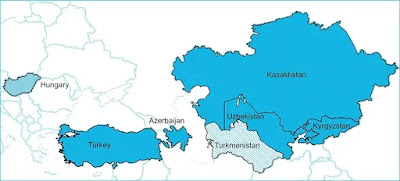
The Turkic Council is an organisation of independent Turkic countries whose aim is to promote cooperation among Turkic-speaking countries.  The council was founded in 2009 by Azerbaijan, Kazakhstan, Kyrgyzstan, and Turkey.  The council's headquarters are in Istanbul.

In 2019, Uzbekistan joined the council.

In 2018, Hungary joined the council as an observer member.  Hungary isn't a Turkic nation so, to me, it seems real odd that Hungary is a part of the club.  Hungarian Prime Minister Viktor Orbán probably did it to taunt the EU.  I suppose Orbán needs additional allies and the Turkic countries aren't exactly known for being liberal democracies.  Besides, Orbán has a track record of going on about how Europe has a Christian history and he's not known as being exactly welcoming to Islam.  All of the other council member countries are more Muslim than not.

In 2021, Turkmenistan also joined as an observer member so now, except for Tajikistan, four of the five of the "Stans" are members of the council. 

Earlier this year, the Islamic Republic of Afghanistan applied for observer status but no decision has been made public yet.

While not an official language, English is a working language of the council.


Here's a short video I found out on YouTube that talks about the council.

©Organization of Turkic States

Update:  In November 2021, the Turkic Council changed its name to the Organization of Turkic States.

Saturday, May 29, 2021

Radio Free Europe

Radio Free Europe (RFE) was established in 1949 and Radio Liberty (RL) was established in 1951.  In 1976 the two organisations merged together.  These radio stations were run by the United States and they broadcast American propaganda in Eastern Europe during the Cold War.  The goal was to inspire independence movements within the Warsaw Pact countries and to counter Soviet propaganda within these countries.

During the Cold War, Radio Liberty targeted the Soviet Union while Radio Free Europe broadcast to Czechoslovakia, East Germany, Hungary, Poland, Romania, Bulgaria, and the three Soviet Baltic states.  The communist governments weren't keen on American propaganda and they routinely tried to jam the transmissions.  In 1959, an StB agent attempted, but failed, to poison the salt shakers in RFE's cafeteria.  

RFE was headquartered in Munich, West Germany until 1995.  In 1995, the headquarters were moved to Prague.

Here's an old 1960's or 1970's public service announcement about RFE broadcasting to Hungary that I found out on YouTube.

Following the end of the Cold War, operations in Europe were decreased.  RFE stopped broadcasting to Czechoslovakia in 1992 but Czech programming lasted until 2002 and Slovak programming ended in 2004.

Broadcasts to Hungary ended in 1993 while broadcasts to Poland ended in 1997.  Broadcasts began in 1994 in Bosnian, Croatian, and Serbian to the former countries of Yugoslavia.  In 1999, Albanian broadcasts began in Kosovo.  In 2000 broadcasts began in Montenegrin and Macedonian broadcasts began in 2001.  In 2004, broadcasts ended in Estonia, Latvia, Lithuania, Slovakia, Croatia, Montenegro, Bulgaria, and Romania.  In 2019, programming resumed in Bulgaria and Romania.  In 2020, programming resumed in Hungary.

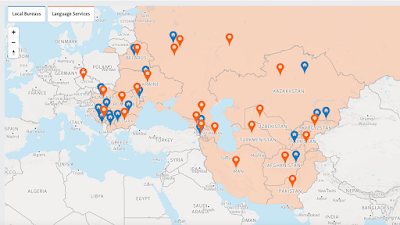
Today, RFE/RL broadcast to 23 countries in 27 languages.  Its headquarters remain in Prague even though no content is produced in Czech.  Here's where they currently produce material for.

Saturday, March 20, 2021

2020 World Happiness Report

Today is the International Day of Happiness.  The United Nations started this back in 2013 to promote the idea that feeling happy is a global human right.  Clearly 2020 was a challenging year due to COVID-19 so this year's theme is "Keep Calm.  Stay Wise.  Be Kind."

The 2020 World Happiness Report was released today.  Czechland came in at #18 and the USA came in at #19.  This is the first time that Czechland outranked the USA.  

Like last year, Finland came in #1 again and 14 of the 20 world's happiest countries are in Europe.  At #9, New Zealand is the only non-European country to crack the top 10.

Scandinavia is the happiest region in Europe with #1 Finland, #2 Denmark, #4 Iceland, #6 Norway, and #7 Sweden.

BeNeLux did well with #5 Netherlands, #8 Luxembourg, and #20 Belgium.

The only Middle Eastern country to make the top 20 was #12 Israel.  Even with Brexit the UK came in at #17.

At #18 Czechland was the clear happiness leader of the Visegrad countries with #34 Slovakia, #44 Poland, and #53 Hungary.

Many of the most unhappiest counties are in East and Southern Africa including #137 Zambia, #140 Burundi, #142 Tanzania, #144 Malawi, #145 Lesotho, #146 Botswana, #147 Rwanda, and #148 Zimbabwe.

The world's most unhappiest country is #149 Afghanistan.  

The rankings are based on the combined scores for the last three years.  

Not much changes overall if you only go by the 2020 scores instead of the three year average.  Although then the USA would have been #14 and Czechland #16.

Monday, February 15, 2021

Visegrád Group Turns 30

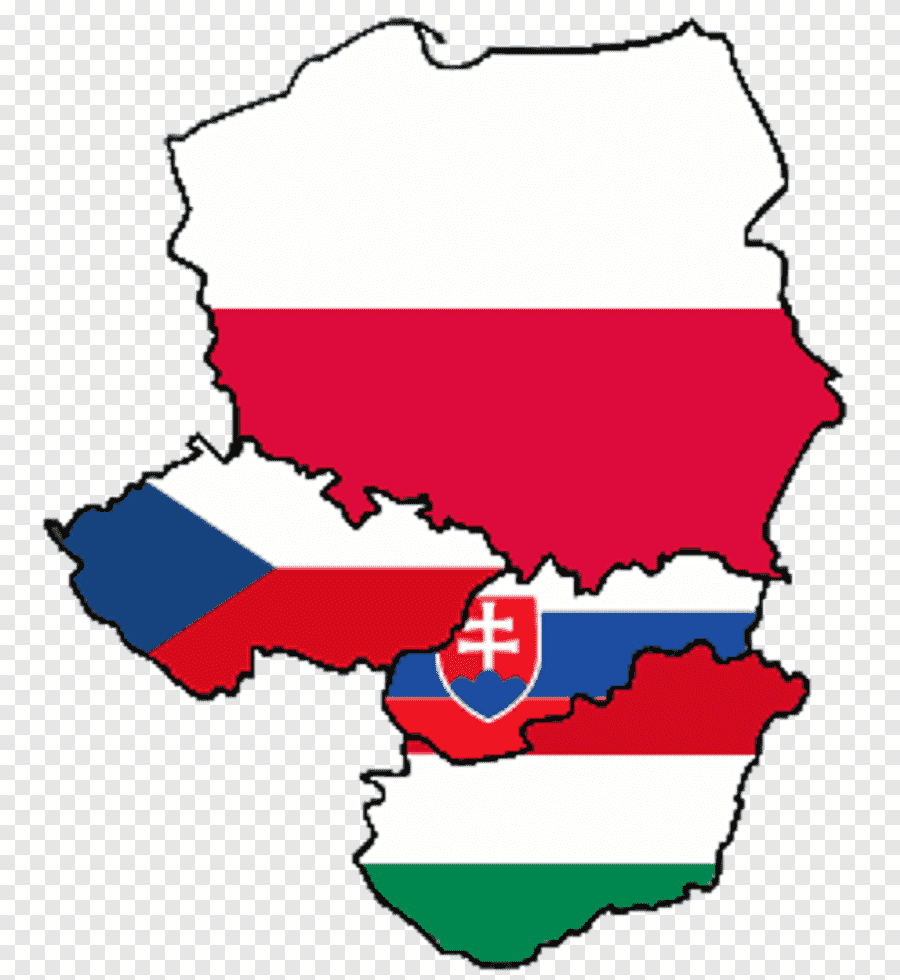
Today is the 30th anniversary of the Visegrád Group.  This is the partnership between the V4 countries of Czech Republic, Slovakia, Poland, and Hungary

Czechland even issued a commemorative stamp.  Though to be fair I think the other three countries did as well.  

Currently Poland holds the rotating presidency of the group so to commemorate the 30th anniversary the Polish Ministry of Foreign Affairs post a short video out on YouTube.

©Ministry of Foreign Affairs of the Republic of Poland

Friday, August 16, 2019

CEFTA

The Central European Free Trade Agreement, or CEFTA, was formed in 1992 by the Visegrád countries - Czechoslovakia, Poland, and Hungary.  After the Velvet Divorce both Czech Republic and Slovakia became independent members.  The purpose was to work together towards integrating political, economic, security, and legal systems with western free-market economies.

Over the years, other countries have joined CEFTA.  However, once a country joins the European Union it must leave CEFTA.  Former members include Bulgaria, Croatia, Romania, and Slovenia.  Basically being a CEFTA member servers as good preparation for eventually joining the EU.

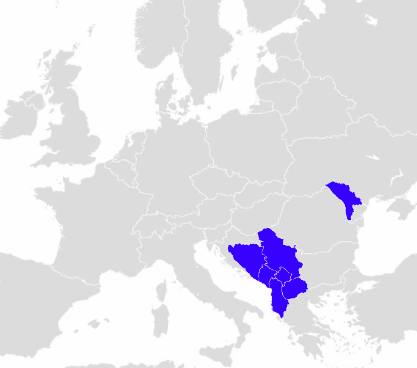
Current CEFTA members
CEFTA seems less "Central Europe" and more "Balkans" to me.  The seven current members are Albania, Bosnia and Herzegovina, Kosovo, Moldova, Montenegro, Macedonia, and Serbia.  Combined the CEFTA countries have a combined population of about 21,5 million people and a GDP over $290 billion.

Wednesday, June 26, 2019

The Warsaw Pact

The Warsaw Pact was the communist version of NATO.
Officially it was the Treaty of Friendship, Cooperation, and Mutual Assistance.

In 1955, West Germany joined NATO so a military alliance was established to counter it.


Like NATO, one of the main principles was that an attack on one country was an attack on all members of the alliance.  The Warsaw Pact countries were the Soviet Union, Poland, East Germany, Hungary, Romania, Bulgaria, Albania, and Czechoslovakia.

When I grew up the Cold War was NATO vs the Warsaw Pact.

Ironically, its largest military engagement wasn't against NATO but "Operation Danube" which was the invasion of Czechoslovakia that put down the Prague Spring.
Romania and Albania didn't participate in the invasion.  Shortly afterwards, Albania left the alliance.
At the last minute it was decided that East Germany would not invade because it was the 30th anniversary of Germany annexing the Sudetenland.  

Here's a video I found out on YouTube called "March of the Warsaw Pact".  The lyrics are in Russian but there are English subtitles.  It's basically the alliance's anthem but I find it interesting that the East Germans aren't mentioned.

©YugoslavianHeros 1943

The Warsaw Pact became less relevant following the fall of communism in 1989 and the breakup of the Soviet Union in 1991.  Except that there were still Soviet troops stationed across Eastern Europe.  East Germany left the pact in 1990 following the reunification of Germany.

It's fitting that the Warsaw Pact was formally ended, in Prague, on 1 July 1991 by Czechoslovak President Václav Havel

Over the next 20+ years former Warsaw Pact countries ended up joining NATO.  Czech Republic, Hungary, and Poland joined in 1999.  Slovakia, Bulgaria, and Romania joined in 2004, along with the former Soviet Baltic states Estonia, Latvia, and Lithuania.  Albania joined in 2009.  

NATO just celebrated its 70th anniversary and continues to expand.

Update 2025: Here's a short video I found that explains, prior to the Warsaw Pact, the USSR actually tried to join NATO.  Who know?

©History Matters

Sunday, March 24, 2019

2019 World Happiness Report

The 7th World Happiness Report was released by the Sustainable Development Solutions Network of the United Nations and Czechland was ranked at the 20th happiest out of 156 countries.

The report factors in things like gross domestic product per capita, healthy life expectancy, freedom to make choices, perceived corruption and social support from friends and family.

No surprise that the Scandinavian countries ranked so high.  For the second year in a row, Finland come in 1st, followed by Denmark, Norway, and Iceland.  The Netherlands came in 5th place.  Of the 20 happiest countries in the world, 14 of them are in Europe.

The USA came in 19th.  At 20th, Czechland scored the best of the Visegrád Group with Slovakia at 38th, Poland at 40th, and Hungary at 62nd.

Czechs continue to rank higher each year.  In 2015 they were 31st, in 2016 they were 27th, in 2017 they were 23rd, and last year they were 21st.

The most unhappiest countries are South Sudan, the Central African Republic, Afghanistan, Tanzania, Rwanda, and Yemen.


2019 Top 30 Happiest Countries