Showing posts with label France. Show all posts

Saturday, March 25, 2023

2023 World Happiness Report

This year's World Happiness Report is in and just like last year Europe continues to be the happiest place to be with Israel and New Zealand being the only non-European countries to crack the top 10.

Finland came in first place for the sixth year in row.  This year's top ten countries are the same as last year.

The five Nordic / Scandinavian countries all placed in the top seven with Finland #1, Denmark #2, Iceland #3, Sweden #6, and Norway #7.

The BeNeLux countries did well again too.  The Netherlands came in at #5, Luxembourg was #9, and Belgium was #17.

Czechland again was the highest ranked of the Visegrád countries.  Half of Central Europe placed in the top 20.

Switzerland #8, Austria #11, Germany #16, Czechland #18, Slovenia #22, Slovakia #29, Poland #39, and Hungary #51.


Czechland kept its #18 place from last year.  The USA moved up to #15 from #16.
This year Lithuania #20 cracked the top 20; bumping France from #20 to #21.
Here's a short CBS News video I found out on YouTube.

©CBS News

Given Russia's invasion of Ukraine, it's no wonder that neither country ranks as happy.  Russia came in at #70 and Ukraine ranked #92.

Я за Україну. Я за Україною. Слава Україні  Stojím za Ukrajinou!  I stand with Ukraine. 🇺🇦

Sunday, January 22, 2023

Brno City Break in 2023

Last year, Time Out magazine published their list of the 16 best city breaks in Europe for 2022.  Brno came in second place.  

This year Brno made the list again but fell to seventh place.  A few spots lower but still in the top ten.

The write up for Brno was pretty much exactly the same as last year.  

Here are the top 18 places.  Several of these are still on my list of places to visit.

  1. Marseille, France
  2. Sheffield, UK
  3. Buhać, Bosnia and Herzegovina
  4. Milan, Italy
  5. Bilbao, Spain
  6. Arles, France
  7. Brno, Czech Republic
  8. Liverpool, UK
  9. Kaunas, Lithuania
  10. Oslo, Norway
  11. Hamburg, Germany
  12. Dublin, Ireland
  13. Inverness, UK
  14. Trikala, Greece
  15. Rotterdam, Netherlands
  16. Freiburg, Germany
  17. Turku, Finland
  18. Valencia, Spain


Monday, November 7, 2022

The Channel Islands

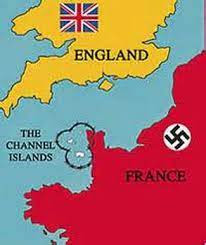
The Channel Islands consist of the Bailiwick of Guernsey and the Bailiwick of Jersey.  They are two of the three Crown Dependencies and they are located in the English Channel, off the coast of France

Each of the two bailiwicks have their own money, legal and healthcare systems, as well as, their own individual immigration policies.  Since 1290, they have been Crown Dependencies which means that they are not part of the United Kingdom, but the UK is responsible to represent them internationally and to provide for their defence.  Together the two bailiwicks have a population of almost 172.000 people.

The Bailiwick of Jersey consists of the island of Jersey plus the uninhabited islets Écréhous and Minquiers, with Jersey being a single jurisdiction.  Jersey the is largest and southernmost island with 118 km² (46 square miles).  It is 23 km (14 miles) from the coast of Normandy and 160 km (100 miles) south of England.  There are almost 108.000 people living in Jersey.  About a third of the population lives in the capital Saint Helier.

People have been living on Jersey since at least 12.000 BC.  The island has Bronze and Iron Age settlements and the islands have controlled by the Romans, Vikings, and Normans.

The official languages are English, French, and Jèrriais which is a Norman French dialect.

The Bailiwick of Guernsey consists of the islands of Alderney, Brecqhou, Guernsey, Herm, Jethou, Lihou, and Sark.  Guernsey is the second-largest and westernmost island with 78 km² (30 square miles).  It is roughly 48 km (30 miles) off the coast of Normandy.  Guernsey is home to about 64.000 people with roughly 20.000 living in the capital St. Peter Port.

There are actually three different jurisdictions.  Guernsey, Alderney and Sark, each have their own parliaments but they do work closely together.

History on Guernsey goes back to at least 6000 BC.  There's evidence that Neolithic farmers lived here, plus the Romans, Vikings, and Normans.

Flag of Guernsey.svgGuernsey has jurisdiction over the islands of Herm, Jethou, Limo, and a few other small uninhabited islands.

Flag of Alderney.svgAlderney is a small island that is only 7,7 km² (3 square miles) and home to over 2000 people.  It is the northernmost Channel Island and the closest to France which is only 13 km (8 miles) west of La Hague.  Saint Anne is the capital.  English is the only official language.  Auregnais was a Norman French language spoken here but it is now extinct.

Flag of Sark.svgSark is an even smaller island that is just 5,4 km² (2,1 square miles) and home to about 500 people.  It is about 32 km (20 miles) from France.  Sark also has jurisdiction over the island Breqhou which is almost uninhabited, plus some other smaller uninhabited islands.  There's no official capital city but the de facto capital is La Seigneurie.  English is the only official language but a few people still speak Sercquiais which is another Norman French dialect.

Sark became a democracy in 2008 and until then it was Europe's last feudal political entity.

The official currency in the Channel Islands is the pound sterling.  However, both Jersey and Guernsey issue their own pounds which are pegged one-to-one to the UK pound.  British £ are valid in the Channel Islands but the Jersey and Guernsey pounds aren't accepted in the UK.

Guernsey £ on top and Jersey £ below

The Channel Islands were occupied by Nazi Germany during WWII.  The only part of the British Islands to be occupied by Germany.

Here's a short video I found on YouTube that talks about how the Channel Islands came to be.

©History HQ

And here's another short video specifically about the German occupation during the war.

©Smithsonian Channel

There was a 2017 film, takes place in Jersey during the occupation that was based on a true story.  Here's the movie trailer for Another Mother's Son

©Vertigo Releasing

On Netflix I saw the 2018 film, The Guernsey Literary and Potato Peel Pie Society that also takes place during the occupation. 

©Netflix

Update 2025:  Here's a short YouTube video about why France doesn't have the Channel Islands.

©History Matters

Tuesday, October 25, 2022

Basque Country

In a few days Kája and I are headed to Bilbao, Spain, for a few days.  Neither of us have been to the Basque Country before and we're looking forward to our first trip away together.  Here's a bit about the Basque Country.

Euskal Herria, also known as the Basque Country, is kind of a mystery.  The region lies within the borders of France and Spain.  It is made up of seven districts with three in southwestern France and four in northern Spain.


The entire region is 20.664 km² (7978 square miles) making it a little smaller than New Jersey.  It's home to more than 3 million people.  Bilbao is the largest city. 

No one knows where the Basques come from.  There is debate if they have been in Europe since the Stone Age or even earlier.  

Here's a short three-minute Rick Steves video that I found on YouTube that talks about Basque culture.

©Rick Steves

The Basque language is called Euskara, and it is spoken by about 25% of the population.  It's an official language along with either Spanish or French depending on which side of the Spanish-French border you're on.  Euskara is not related to any other language in the world. 

Euskara - Spanish - English

When I was in Madrid in 2015, I saw Picasso's Guernica at the Reina Sofia museum.  While in the Basque Country we have a day trip planned to actually go see Guernica.  Here's another three-minute Rick Steves video about it.

©Rick Steves

The region has seen its share of troubles.  The Basque separatist group, ETA, which most countries labeled as a terrorist group, was active from 1959 and 2018.  They wanted a unified, independent Basque Country and led a violent campaign over the years.  About 850 people were killed prior to its last ceasefire.  I'm sure that there won't be any problems while we're there.

Monday, September 12, 2022

Eurocorps

My 2000th blog post.  I can't believe that I've been at this for over 13 years or that people still seem interested in my Czechland adventure.  Thank you to everyone who continues to follow along.

Eurocorps is a European army, of about 60.000 troops, that can be deployed on very short notice.  It was founded in 1992 by France and Germany and it went operational in 1995.  This month it celebrates its 30th anniversary.  Eurocorps' headquarters are in Strasbourg, France.
Eurocorps is at the service of the EU and NATO and in 2002, it was certified as one of NATO's nine High Readiness Land Headquarters.  Eurocorps considers requests for support from the UN and OSCE.  It can also be deployed at the request of the framework nations.

There are six framework nations - France, Germany, Belgium, Luxembourg, Spain, and Poland.  

Any EU country can join with the unanimous approval of the framework countries.  There are also five associated nations - Austria, Greece, Türkiye, Italy, and Romania

Finland was an associated member from 2002 - 2006 and Canada was from 2003 - 2007.  Czech Republic isn't a member but I believe that they have participated is some military exercises with Eurocorps in the past.  I'm not aware of Czechland having any plans to join. 

Eurocorps has participated in peacekeeping missions in the Balkans as part of SFOR in Bosnia and Herzegovina and KFOR in Kosovo.  It was deployed to Afghanistan as part of the UN's International Security Assistance Force (ISAF).  It's even been deployed to Africa as part of EU training missions in Mali and the Central African Republic.

Poland became the newest framework member this year in January.  From 2023-2025, a Polish general will take command of Eurocorps.  With all of the support Poland has given Ukraine during the Russian invasion, I'm sure that Russia isn't thrilled with Poland soon to lead Eurocorps.

What's interesting to me Austria and Türkiye being associate members.  Türkiye is a member of NATO but not the EU so until it actually becomes an EU member, if ever, then it can't be one of the framework nations.  Austria's constitution prohibits it form entering into military alliances.  So I guess that by being an associate member it can participate in Eurocorps without violating its constitution, in the same way that it is a member of NATO's Partnership for Peace programme without being a NATO member.

Here's a France24 video I found on YouTube from 2009 that talks about Eurocorps.

©France24

Sunday, September 4, 2022

Czechoslovak Government-in-Exile

The second President of Czechoslovakia was Edvard Beneš.  Following the 1938 Munich Agreement, he resigned from office bringing an end to the First Republic.  He went to the USA and became a visiting professor at the University of Chicago.  After a few months he returned to Europe to organise a government-in-exile.


While in Paris he formed the Czechoslovak National Liberation Committee, Výbor Československého Národního Osvobození, in October 1939.  Since Slovakia split from Czechoslovakia to become a Nazi puppet state, France had a problem with the committee representing all of Czechoslovakia.  The impending Nazi occupation of France probably didn't help so the committee moved to London in 1940.

The committee gained British recognition as the Provisional Government of Czechoslovakia, Prozatímní vláda Československa, which was basically the Czechoslovak Government-in-Exile, and it gained international recognition by other Allied governments. 

While all of this was going on, following the annexation of the Sudetenland, Emil Hácha was President of the Second Czechoslovak Republic which what was left of Czechoslovakia after it was carved up.  This lasted until 15 March 1939 and then he became the state president of the Protectorate of Bohemia and Moravia.

Jan Šrámek

With Beneš as the President and Jan Šrámek as Prime Minister, the worked to return Czechoslovakia to its 1937 borders which was a big goal considering the country had been basically wiped from the map.  The. government-in-exile also tried to assist Czechoslovak Jews.

In 1941, there was pressure from the Allies for the Czechs to play a greater role in the resistance, especially in the Protectorate.  In late September 1941, Reinhard Heydrich launched a major crackdown on the resistance when he took over as Reichsprotektor.   

After almost six months of planning, Operation Anthropoid went into action.  Jan Kubiš and Jozef Gabčík went to Prague and assassinated Heydrich.

Jan Kubiš and Jozef Gabčík

At Porchester Gate in London, there's a plaque marking where the Czech government-in-exile was based in the UK, and this is where the assassination was planned.  I guess I need to go find the plaque the next time I'm back in London.

Tuesday, August 30, 2022

2028 European Capital of Culture Nominations

In 2028, Czechland and France will each host a European Capital of Culture.  A third city will come from outside of the EU, either an EEA country or from an EU-candidate country.  

Czech cities have to submit applications by 1.9.2022.  
The winning cities will be announced in December 2023.

Yesterday, a group of three cyclists left Brno to ride 230 km (143 miles) to deliver Brno's application to the Ministry of Culture in Prague.  They should arrive tomorrow afternoon.  There's a a lot on the line.  Being selected as a European Capital of Culture comes with a €1,5 million prize.

The four Czech cities in the running are Brno, Broumov, České Budějovice, and Liberec.

The Frech cities in contention are Nice, Clermont-Ferrand, Reims, Rouen, Bourges, Saint-Denis, Amiens, and Bastia.

The non-EU cities up for consideration are Budva, Montenegro and Skopje, North Macedonia.

Good luck Brno!  Fingers crossed!

Update October 2022:  Well that didn't take long.  Brno is out of contention.  There was a 12-member panel of experts that narrowed the Czech application list down to Broumov and České Budějovice.  

The Frech cities now on the short list are Rouen, Bourges, Clermont-Ferrand, and Montpellier.

Saturday, August 27, 2022

English in Czechland

English is the most common spoken language across the EU.  About 44% of people in the EU can speak English.  And that's post-Brexit, as now only 1% of the EU are native English speakers.  However, Czechs rank among the worst in Europe at foreign languages.

Czechs are among the least likely Europeans to know a foreign language.  While about 45% can communicate at some level of English, only one in 10 Czechs have minimal English-language skills.  Just 7% speak English proficiently.

The only countries worse at English than Czechia are France, Italy, and Spain.  The top five countries with the best English foreign language skills are the Netherlands, Austria, Norway, Denmark, and Belgium.

One of the primary staffing agencies here has confirmed that English is required for four of to 10 job offers here.  English is demanded five times more than all other foreign languages combined.  After English, the top requested languages by employers are German, French, Italian, and Dutch.

The Czech Statistical Office, ČSÚ,  states that only a minimum of Czechs speak English at a professional level.  30% can't speak a foreign language.  

English is most frequently taught foreign language in EU secondary schools, followed by Spanish, French, German, and Italian.  

In Czechland, by law, students are taught two foreign languages.  English is the most popular, followed by German.  

There has been some controversy in the press about the new government's ability to speak English.  Five of 18 cabinet ministers have admitted to only being able to speak "tourist level" English only.  This is a big deal now that Czechland currently holds the rotating presidency of the EU.  

The new prime minister, Petr Fiala, speaks both English and German fluently.

Jana Černochová, the defence minister, and Zbyněk Stanjura, the finance minister have admitted to having weak English skills but both have at least passive Russian and Polish.

Sunday, May 15, 2022

2022 Eurovision Finals

Last night were the grand finals of the 2022 Eurovision Song Contest in Italy.  This year's competition had 40 countries enter and compete in two semi-final rounds with 25 in the grand finale.  Again, Russia was not allowed to compete due to its invasion of Ukraine earlier this year.

Kalush Orchestra, who won the first semi-final, won this year's contest.  They won with 631 points which is incredible.  Their song "Stefania" is the first song sung entirely in Ukrainian.  It's also the first song to ever win with hip-hop elements.  Here's their winning performance.

©Eurovision Song Contest

The UK came in second place.  Sam Ryder's song "Space Man" received 466 points.  This sets a record for the UK with 16 second place finishes.

©Eurovision Song Contest

The winner of the second semi-final, Sweden, finished in fourth place behind Spain.

Czechland didn't do so well.  We Are Domi earned just 38 points and ended up in 22nd place.  But at least we made the grand finale and beat Iceland, France, and Germany.

©Eurovision Song Contest

If anyone's interested in watching the full grand finale then here's the complete 4,25 hour show that's available on YouTube.

©Eurovision Song Contest

Well done Ukraine!  I hope that this isn't the only thing that they win this year.  Я за Україну. Я за Україною. Слава Україні  Stojím za Ukrajinou!  I stand with Ukraine. 
🇺🇦

Tuesday, November 23, 2021

Nutri-Score

When I first moved here I made a comment at work that I was going to get so fat here with this being the land of beer and potatoes.  A friend sniped back with, "but I thought that all Americans were already fat."  Well not quite right but not wrong either.

In 2016, the World Health Organisation put the USA's obesity rate at 33,8%.  Czech Republic was 24,2%.  Czechs have been getting bigger.

In 2019, the five EU countries with the highest percentage of obesity were Croatia, Malta, Czechland, Hungary, and Slovakia.  France has the lowest obesity levels in the EU, followed by the Netherlands, Italy, Belgium, and Sweden.  Czechs were had the 3rd highest levels of obscenity in the EU.

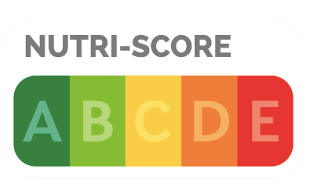
Here's where I think that Nutri-Score would be a good thing.  Nutri-Score is a "traffic light system" that ranks food products on a scale from A to E, where A is the best and E is the worst, and it is clearly visible of the front of the food's packaging.  

Food products get a lower rating if there is:

  • high energy density per 100 g or per 100 ml
  • high sugar content
  • high content of saturated fatty acids
  • high salt content.
There's a higher rating when:
  • contains fruits, vegetables, nuts and legumes
  • contains fiber
  • contains protein
  • contains rapeseed, walnut and olive oil
Nutri-Score was founded in France in 2013 and in 2017 the French Health Ministry officially recommended it.  Since then it has rolled out in Belgium, Spain, Germany, Switzerland, the Netherlands, and Luxembourg.  The system has been recommended by the European Commission and the World Health Organization.

So far it's not mandatory across the EU but I'm sure that it will be eventually.  Some companies such as Nestlé and Danone have announced that they will start using Nutri-Score in Portugal, Slovenia, and Austria even though it's not required in those countries.  

Not all countries are onboard with the system.  Poland, Czechland, Cyprus, Greece, Hungary, Latvia, and Romania all oppose it.  Italy believes that the system puts the traditional Mediterranean diet at a disadvantage.  

The Czech Ministry of Agriculture isn't in favour of the system but it will tolerate international labels with Nutri-Score.  The ministry is not in favour of a mandatory front-of-package label and believes that the Nutri-Score formula is too simplistic because it doesn't consider the size of a portion or how food is prepared. 

Nestlé will start using Nutri-Score in Czechland in 2023.  

Here's an interesting video I found out on YouTube where CNN talks about some of the differences between the US and Czech health care systems.  Not exactly Nutri-Score or Obesity related but still kind of fitting.  While the video is at least 12 years old already it's still pretty accurate.

©CNN

Update:  August 2022.  Here's a short TV commercial for Nestle that shows the Nutri-Score label.

©Nestlé Cereálie CZ

Sunday, April 4, 2021

Erasmus

Brno is a student city and, under more normal times, there are many foreign students here under the Erasmus Programme.  Erasmus is the EU student exchange programme that was established in 1987.  It provides educational exchanges across the EU.  Some non-EU countries like Turkey, Iceland, Serbia, Norway, and Macedonia pay to participate in the programme as well.  Erasmus is the acronym for the EuRopean Community Action Scheme for the Mobility of University Students.  

In 2014, all of the EU's programmes for education, training, youth and sport were combined under Erasmus Plus.

Under Erasmus Plus students don't pay any more tuition than what they pay at their home institution.  Students receive grants to help cover living expenses to study abroad and for work placements/internships.  Teachers and educational staff are also able to attend training courses across Europe.  

Every year around 300.000 students participate in the programme at over 4.000 institutions in 37 countries.  Spain sends the most participants followed by France, Germany, and Italy.  The most popular receiving countries are Spain, Germany, Italy, and France.

I don't know how true it is but I've heard that some 25% of Erasmus participants meet their future spouse/partner while on the programme.

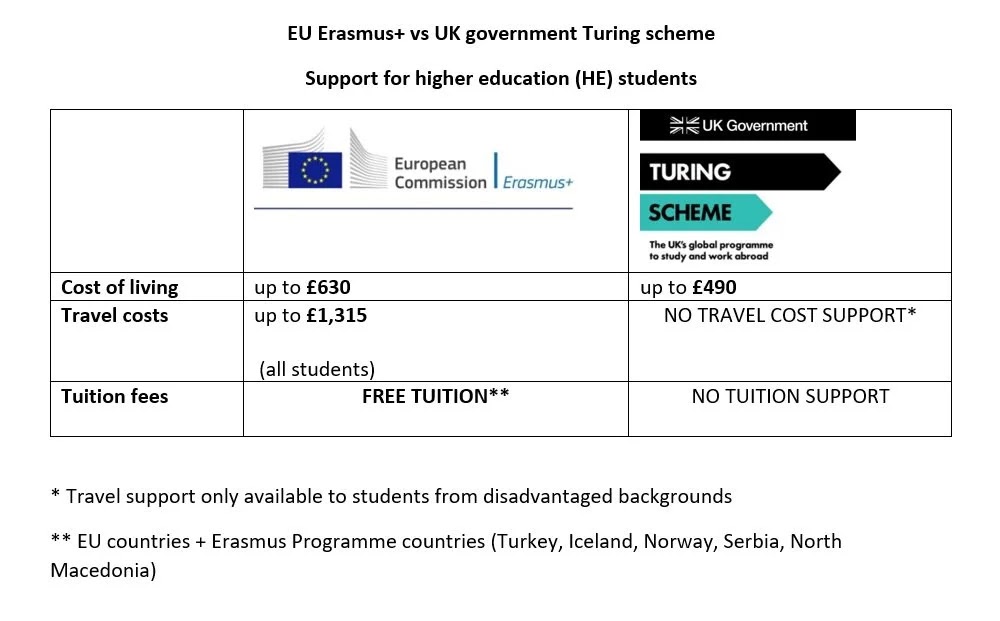
After Brexit the United Kingdom decided to no longer participate in Erasmus.  So UK students can no longer study in the EU and EU students aren't able to study at UK institutions.  The UK has rolled out the Turing Scheme, named after Alan Turing, as its replacement for Erasmus.  It will allow up to 35.000 UK students to study and work worldwide.   

Erasmus provides more money to students than Turing to subsidise their foreign placements.  

Ireland has announced that it will fund students from Northern Ireland to continue to participate in Erasmus even though the UK pulled out of the programme.

Wednesday, January 27, 2021

New Integration Course Requirement

There's now a new requirement in Czechland for foreigners who have been issued long-term residence permits, since 1 January 2021, to complete a four-hour integration course.  

The course covers the rights and obligations that come with residency here as well as Czech culture and values.  The class is conducted in Czech, with interpretation into English, French, Spanish, Arabic, Mongolian, Russian, Serbian, Ukrainian or Vietnamese.  There's no exam but participants receive a certificate when they complete the entire course.  It costs 1500 Kč ($70) and is available at 18 centres across the country.  You have up to one year from receiving your residency permit to complete the course.  The fine for not completing it in time is up to 10.000 Kč ($467).

This is only for third-country nationals as EU citizens are exempt.  It's not required if you are under 15 or over 61 years of age.  Those here on study or investment visas are also exempt.

Aside from this, the education minister has submitted draft legislation that will increase the Czech language requirement for permanent residency from A1 to A2.  When I received my permanent residency back in 2015 I only had to prove A1 level Czech.  This isn't official yet but I think it's for sure coming as there's been talk of raising the level of Czech required for at least the past eight years.  I don't know if they will raise it this year with COVID-19 but for sure by next year.

I was surprised to find out that Czechland and France are the only two EU countries that only require A1 for permanent residency.  I would have thought that the level of language proficiency would have been more unified across Europe but each has its own requirements.

In Czechland, A2 will be required for permanent residency while B1 is required for citizenship.

Germany requires B1 level for either permanent residency or citizenship.

Austria requires B1 for permanent residency and B2 for citizenship.  This means that for Austrian citizenship you need to speak better German than a German citizen.  Albeit Austrian German.

France requires A1 for permanent residency and B1 for citizenship.

Poland requires B1 for both permanent residency and citizenship.

I don't know about permanent residency but Italy requires B1 for citizenship.  The Netherlands, Portugal, and Spain only require A2 for citizenship in Dutch, Portuguese, or Spanish respectively.  Denmark requires B2 for citizenship.

For countries with multiple official langues the rules seem to vary more.  For citizenship in Finland, B1 is required but it can be in either Finnish or Swedish since both are official languages.

Belgium has three official languages so for citizenship you only have to prove A2 in either French, Dutch, or German.

Luxembourg has three official languages - French, German, and Luxembourgish.  But if you want citizenship than only Luxembourgish counts.  You need A2 level speaking and B1 level listening.

Switzerland has four official languages - German, French, Italian, and Romansh.  For permanent residency you need A1 writing and A2 speaking in any one of the four languages.  For citizenship, A2 writing and B1 speaking are required.

I'm still waiting to find out when I get to take my B1 Czech exam.