Showing posts with label Scotland. Show all posts

Sunday, January 22, 2023

Brno City Break in 2023

Last year, Time Out magazine published their list of the 16 best city breaks in Europe for 2022.  Brno came in second place.  

This year Brno made the list again but fell to seventh place.  A few spots lower but still in the top ten.

The write up for Brno was pretty much exactly the same as last year.  

Here are the top 18 places.  Several of these are still on my list of places to visit.

  1. Marseille, France
  2. Sheffield, UK
  3. Buhać, Bosnia and Herzegovina
  4. Milan, Italy
  5. Bilbao, Spain
  6. Arles, France
  7. Brno, Czech Republic
  8. Liverpool, UK
  9. Kaunas, Lithuania
  10. Oslo, Norway
  11. Hamburg, Germany
  12. Dublin, Ireland
  13. Inverness, UK
  14. Trikala, Greece
  15. Rotterdam, Netherlands
  16. Freiburg, Germany
  17. Turku, Finland
  18. Valencia, Spain


Thursday, December 16, 2021

Brno City Break in 2022

A couple of weeks ago, Time Out magazine published their list of "The 16 best city breaks in Europe for 2022."  Brno came in second place.  While it's great for Brno to get the recognition I kind of hope that it retains its status as a hidden gem.  They even mentioned my favourite cafe for breakfast.


Here's what the article said about Brno.

Although sandwiched between Prague and Vienna, self-confident Brno is no middle Child.  Once a powerhouse dubbed the "Moravian Manchester", the laidback Czech second city has repositioned itself as a post-industrial science and tech hub.  But you'll find plenty of clues to Brno's layered past at a clutch of offbeat underground attractions, including the mysterious brick cisterns at. Žlutý Kopec, communist-era nuclear bunker 10-Z, and the "Denis" bomb shelter under the cathedral.  The food and drink scene is reinventing itself to, from contemporary international at Element to Výčep na Stojáka, a modern take on a trad pub.

The perfect day:  After breakfast at Café Momenta, head up to Špilberk Castle and grab lunch at Cafe Placzek.  Explore the historical centre before dinner at Atelier Bar &Bistro and a nightcap at Rotor Bar.

Plan your trip:  The Industrial project celebrates Brno's manufacturing tradition, with several former industrial buildings opening to the public for the first time in 2022.  Káznice, a Habsburg-era prison, is also being redeveloped and will host events in the summer. --David Creighton

Here are the rankings.

  1. Arles, France
  2. Brno, Czech Republic
  3. Kaunas, Lithuania
  4. Odense, Denmark
  5. Bihać, Bosnia and Herzegovina
  6. Ljubljana, Slovenia
  7. Turku, Finland
  8. Inverness, Scotland
  9. Valencia, Spain
  10. Sheffield, England
  11. Trikala, Greece
  12. Oslo, Norway
  13. Rotterdam, Netherlands
  14. Liverpool, England
  15. Milan, Italy
  16. Freiburg, Germany

A few of these spots have already been on my list of places to visit.  Hopefully I'll get a chance to do a bit more travel in 2022.

Update: 2023 rankings.

Sunday, July 11, 2021

Cheesecake and More

A friend had a cookout today and asked if I would bring real American cheesecake.  Well as "real" as possible given that the ingredients here in Euroland aren't exactly the same.  I originally thought that this would be a simple post about me making cheesecake but it's going to be way more complicated than just that so bare with me.

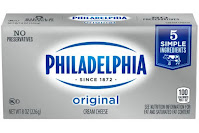
There are two types of cheesecake, the kind you bake and the no-bake kind.  I prefer the no-bake version.  The key ingredient to cheesecake, at least in the USA, is Philadelphia cream cheese.  Which of course you can't get over here in Czechland.  

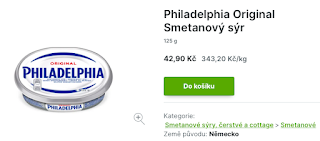
What you can get is Philadelphia cream cheese spread.  First, the spread is not the same thing as regular cream cheese.  I do know people who make cheesecake with the spread but it doesn't taste the same.  A 125g (4.4oz) container here costs 43Kč ($2).  This would be kind of pricey to use for cheesecake plus it's not the right ingredient so it would not turn out right.

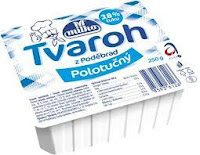
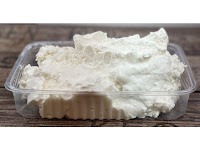
In Czechland most people use tvaroh which is kind of like American cottage cheese but drier and not as milky.  Tvaroh is used heavily for baking here.  One of my favourite dishes are plum or apricot dumplings with tvaroh.

Tvaroh

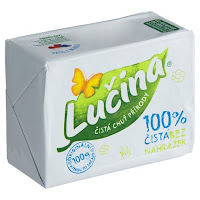
The closest thing I've found to cream cheese is lučina.  Lučina entered the Czechoslovak market in 1981.  It's almost like cream cheese but a little drier and a bit tangier than traditional cream cheese    

I use lučina for all of my U.S. recipes that requires cream cheese.  Lučina comes in little 100g (3.5oz) blocks for 23Kč ($1.08).

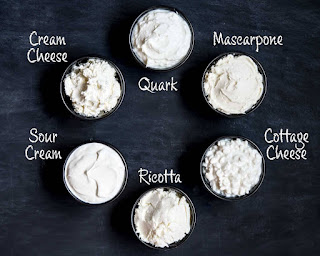
In Germany, people use quark.  Quark always messes with people because there is no translation for it.  When you type the German word "quark" into Google Translate the English translation you get back is "quark".  Quark is kind of like cream cheese but not really.  It's a soft, fresh cheese that can be used for either cream cheese, ricotta, or even sour cream.

Side note...every child in the USA learns the nursery rhyme about Little miss Muffet.

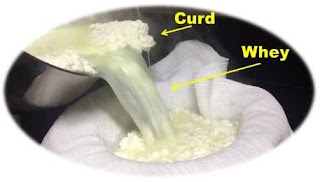
Little miss Muffet, sat on her tuffet, eating her curds and whey

Along came a spider who sat down beside her

And frightened miss Muffet away

The kick is that kids in the USA don't know what curds and whey are.  When kids ask what are curds and whey we just say it is cottage cheese.  


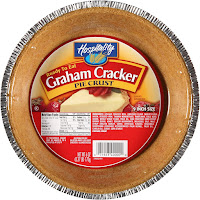
OK...now back to the cheesecake.  The other key ingredient that doesn't exist over here are graham crackers.  A graham cracker is a sweet cracker made with graham flour that originated in the USA and dates back to the 1880s.  

Graham flour is just whole wheat flour that is ground more coarsely.  It has just slightly less protein than white wheat flour.  

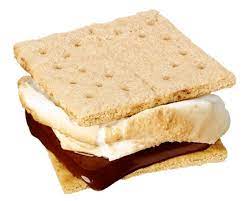
Graham crackers are eaten as a snack.  They are often flavoured with honey or cinnamon but they are most famous for being one of the key ingredients to make s'mores.  No camping trip or bonfire is complete without s'mores.  You roast a marshmallow over an open fire.  You then put the marshmallow and a piece of Hershey's chocolate between two graham crackers and enjoy the ooey gooey treat.  The reason that it's called a s'more is because once you'e had one you always want some more.  

Graham crackers are one of the most popular pie crusts in the USA.  You can even buy pre-made graham cracker pie crusts that come in a disposable aluminium pie pan.


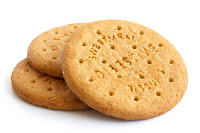
With no graham crackers over here, people use digestive biscuits.  Now comes the British English.  

What we call a 'cookie' in the USA is called a 'biscuit' in the UK.  Sušenka in Czech.  What the USA calls a 'biscuit' is almost a 'scone' in the UK.  No equivalent of either in Czechland. 

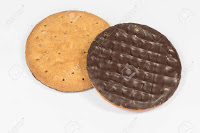
A digestive biscuit is a semi-sweet "cookie" that dates back to 1839 in Scotland.  The "digestive" part was that they acted like an antacid because they were first baked with sodium bicarbonate.  The digestive biscuit is one of the most popular biscuits in the UK.  I prefer the ones with chocolate on side.  They are perfect for dunking in to your tea.

In Euroland, people grind up digestive biscuits to use for pie crusts.

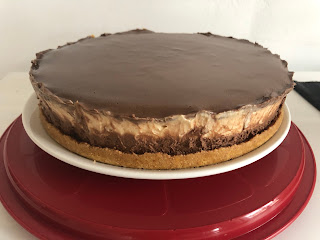
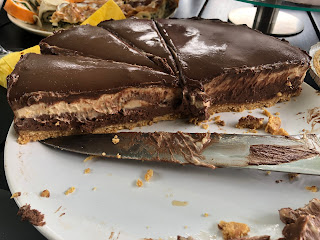
The first cheesecake I made for my friend's party was a chocolate peanut butter cheesecake.  I used a recipe that I found on YouTube.  Here's the video but to be fair I did make a couple of changes.

©El Mundo Eats

 I didn't use digestive biscuits for the crust.  I have a bag of graham cracker crumbs from a care package so I did make a proper graham cracker curst for the cheesecake.

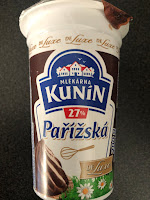
When it came to making the chocolate layer, I didn't use regular cream.  Instead, I used pařížská which is chocolate cream.  

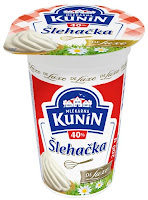
The regular cream, šlehačka, that I used in the peanut butter layer was 40% but the chocolate was only 27%.  This helped make it even more chocolatey tasting.

This thing took hours to make but it turned out really well.

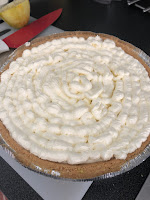
I also made a smaller vanilla lemon cheesecake.  Whipped cream in a can here isn't the same as it is back in the USA.  In the USA it is sweet but not here.  Here it tastes more like air.  I took the šlehačka, whipped it up, added a little vanilla and put it in a bag and piped it on top of the cheesecake.

I also used one of the pre-made graham cracker pie crusts that I had from another care package.

Both of the cheesecakes were popular but the chocolate peanut butter one was the winner.

Tuesday, January 5, 2021

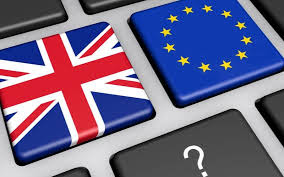
Post-Brexit EU Trade Deal

Thanks to Brexit, the UK is no longer part of the single customs union.  The UK and the EU did manage to agree on a last minute trade deal right before Christmas.  The impact of which is already starting to be felt and I believe that more problems will continue to pop up as Brexiters begin to realise the implications of voting to leave the EU.

The deal maintains the Good Friday peace deal so there is no hard border between Ireland and Northern Ireland.  In order to do this, Northern Ireland remains in the EU single market for goods, which means that Northern Ireland has to follow the EU's customs rules.  So now there's a customs border in the Irish Sea which basically separates the UK, between Northern Ireland and England/Scotland/Wales.

All goods moving between Great Britain and Northern Ireland now require a customs declaration, and additional certification on some goods and products, just as it does between the UK and any other EU-member country.

There's no more unlimited freedom to work and live between the UK and the EU.  UK citizens are free to visit Europe but have to follow the Schengen rules which means they can only be in the EU for up to 90 days in a 180-day period.  Any stay over 90 days will require a visa.

Not that there's a whole lot of travel now due to COVID-19 but when arriving in the EU, UK citizens no longer get to use the EU/EEA queues.  They have to use the non-EU citizen queues.

There are now additional customs duties, import fees and VAT when you purchase something online from the UK.  EU consumer protection rules no longer apply to purchases made from the UK.  So I won't be buying anything any longer from Amazon.co.uk.  I need to switch to Amazon in Germany

Mail will be more complicated.  Both from the UK to the EU and vice versa.  All customs fees, duties and taxes need to be paid in order to pick up any packages.  Some shipping companies have already increased their fees to cover the cost of the extra paperwork required.

The UK has set new tax rules where taxes must be collected at the point of sale which means that a business in the EU must collect taxes on sales made to UK customers which means a lot of tax headaches because now the EU firm must establish an account with the UK tax authorities and keep up with ever changing UK tax laws.  There are already cases where EU firms are no longer selling goods to UK customers.

I'm still not sure what's going to happen with surcharge-free roaming.  I have no idea what I'll pay to use my mobile whenever I actually make it back to the UK for a visit.

Booze cruises to the wine shops in Calais, France, were popular because there was an unlimited allowance on alcohol.  That comes to an end because now, there's a limit on the amount of alcohol allowed from the EU for personal consumption.  UK citizens can now only take back home up to 42 litres of beer, 18 litres of wine and 4 litres of spirits, plus up to 200 cigarettes.

On top of all of the this the UK still has to settle a £25 billion ($X) divorce bill by 2057.  It will be interesting to see what other unintended headaches pop up as a result of Brexit

Here are a few short videos already showing up on YouTube showing some of the consequences of the post-Brexit trade deals.

©Al Jazeera

©9 News Australia

©Sky News

There was speculation that with the UK out of the EU, that English would no longer be an official EU language.  Every country gets to put up an official language and Ireland chose Irish and Malta chose Maltese so now there's no EU country with English as its official language.  English is the most widely taught foreign language in the EU.  It appears that English will be kept on as an official EU language.

©Euronews

Update:  Here's a short story on Brexit's impact on the music industry.  I never even thought about this one.  What a mess.
©Euronews

Saturday, September 12, 2020

Absentee Ballot Status

Back in May I mailed in my application for an absentee ballot so that I can vote in the U.S. Presidential election in November.  My last address in the USA was in Atlanta so I get to vote still as a Georgia resident.  At least for federal offices.  As a non-resident, I don't get to vote in state or local elections.

There are only seven weeks until the election but Georgia won't issue my ballot until next week.  Due to COVID-19, the mail is delayed and it took +7 weeks to get birthday cards from the USA.  

So soon as my ballot arrives I head to the Prague Embassy to submit my ballot.

As an American citizen I get to vote in federal elections even though I live overseas.

An EU national living in another EU country has the right to vote in municipal and European elections held in the country they live in.  For example, an Irish citizen living in Czechland get to vote for a Czech MEP.  But an Irish citizen doesn't get to vote in Czech national elections because he or she is not a Czech citizen.

Not all EU countries allow citizens to vote in national elections if they are not residents.  Ireland doesn't allow citizens to vote in national elections if they don't live in Ireland.  

I remember Scottish friends in Brno saying that they didn't get to vote on Scottish independence because they weren't living in Scotland at the time of the election.

To me this always seems odd that a citizen doesn't get to vote in national elections if they aren't a resident. But then again, they don't have to pay taxes at home on income earned abroad.  They pay taxes only where they earned the income.  Americans get to vote while living abroad but we also pay taxes in the USA on income earned abroad.

I don't know if Czech citizens get to vote in national elections if they live abroad.  Probably not, but if someone knows then please let me know.

Update:  My absentee ballot didn't arrive until 4 November, the day after the election.

Saturday, February 1, 2020

The UK Left the EU

Well Brexit finally happened.  Yesterday, after 47 years, the United Kingdom officially left the European Union

Now starts the transition period which will last until 31 December 2020. Everything should stay the same for the rest of the year.  

27 EU members minus the UK
The UK has to continue following EU laws and continue putting money in to the EU coffer.  The big difference is that the UK no longer gets to vote in the EU Parliament.

EU citizens are still allowed to live and work in the UK.  UK citizens can still live and work in the EU.  At least until the end of the year.  Then there need to be agreements on the rights of EU and UK citizens residing in each other's territory.  For example, what happens to all of the British who have bought homes and retired in Spain?

The UK and the EU will have to agree on a new trade deal.  Plus individual trade deals with the rest of the world.


The biggest sticking point is going to be the Irish border.  The Good Friday Agreement opened the border and put an end to the Troubles.  


During the Troubles there were only 20 border crossings between the Republic of Ireland and Northern Ireland.  Today there are 208 border crossings.

It's quite the mess.  The UK wanted to close its borders with the EU.  Now Northern Ireland is the new physical border between the UK and EU.  No one wants the Irish border closed or a return of the Troubles. 

Pre-Brexit vs My Future UK Prediction

Who knows what the end result will end up looking like?  Personally I think Brexit will result in the eventual breakup of the UK.  Eventually, the two Irelands are going to end up as a united Ireland.  Scotland voted to remain in the EU during the last referendum but they voted overwhelmingly to remain in the EU so it's just a matter of time before Scotland eventually leaves the UK.  The future UK will probably just be the United Kingdom of England and Wales.  This is just my personal opinion.  I don't have a crystal ball but this is what I'd bet on.

Wednesday, May 15, 2019

Glasgow, Scotland

Glasgow is the biggest city in Scotland and the third biggest in the UK.  It is home to 626,000 people with more than 1,65 million people in the greater metro area.

Glasgow is in central west Scotland on the River Clyde.  It is about 412 miles northwest of London and 46 miles west of Edinburgh.

The city was founded in the late 6th century and gained city status in 1170.

In 1990 it was a European City of Culture, in 2008 it was named a UNESCO City of Music, in 2014 it hosted the Commonwealth Games and the first European Championships in 2018.

Scottish English can take some getting used to but the Glaswegian accent can be quite difficult to understand.  I had to laugh when I was told by a local that I have a "soft American accent".  I've defiantly never heard that one before.

George Square is the city's main square and it's filled with statues and monuments.  The City Chambers were completed in 1889.


The Cenotaph monument on the east side of the square honours the soldiers who died in WWI.  The monument was unveiled in 1925.


The Gallery of Modern Art opened in 1996 and it is housed in a building completed in 1778.


In front of the gallery is the Duke of Wellington statue.  Since the 1980s the statue has been capped with a traffic cone.  

The Royal Concert Hall opened in 1990.

St. George's Tron Church opened in 1808.  It belongs to the Church of Scotland and extensive refurbishments completed in 2009.

The Trades House was established back in 1605.

The Beresford was a hotel that opened in 1938.  At 10 stories it was the city's first skyscraper and built between the wars.  During WWII it was used to house American servicemen.  Today the building has privately owned flats.

The Kelvingrove Art Gallery and Museum was established in 1901.  Following a three year refurbishment it reopened in 2006.

The museum houses Salvidor Dalí's Christ of Saint John of the Cross.  In 1951 the purchase price of £8,200 was controversial.  Today it is valued at over £60 million.

The Mitchell Library was established in 1877.  It houses over 1,2 million volumes.

St. Andrew's Cathedral, the Roman Catholic Church, was consecrated in 1816.

Hutchesons' Hall was built in 1805.

Glasgow Green is a 55 hectares (136 acres) public park.  It was established in the 15th century and is the city's oldest park.

The Doulton Fountain, at the Green, was built for an exhibition in 1888.  It is the world's largest terracotta fountain.

The oldest cathedral in Scotland is Glasgow Cathedral.  Also known as St. Mungo's cathedral and it opened in 1136. It was a Roman Catholic Church until the 1500s and now it is Church of Scotland.

The Britannia Panopticon was built in 1858.  It is one of Britain's oldest remaining music halls.


The Glasgow Botanic Gardens are in the city's West End.  The Kibble Palace is a 19th century wrought iron framed glasshouse.

The Central Gurdwara is the country's biggest place of worship.  Not just as a Sikh temple but of any faith.

The Riverside Museum opened in 2011.  It is the Museum of Transport and in 2013 it was the European Museum of the Year.


The Royal Conservatoire of Scotland was founded in 1847.  It is the busiest performing arts venue in Scotland with over 500 performances each year.


Bingham's Pond is on the West End.  It was built in the 1880s on the site of old brick and coal pits.


Kelvingrove Park began in 1852 as the West End Park.  It is 34 hectares (85 acres) with several statues and fountains.


The Harbour Tunnel Rotundas were built in 1896 on the River Clyde.


The SEC Armadillo opened in 1997.  The venue seats 3000 people.


The SSE Hydro seats 14,300 people and it is one of the world's busiest arenas.


The city council commissioned huge murals throughout the city with many of them by Smug, aka Sam Bates, the Australian street artist.


It's a great alternative to people tagging the city's buildings.

Glasgow was supposed to be an anniversary trip but it didn't work out.  I had already paid for my flights and the hotel so my only options were to go alone or stay home and be out the money.  Breakups suck but at least there was enough in the city to keep me busy and my mind off of things.  I definitely want to give the city another go under better circumstances.