Showing posts with label United Kingdom. Show all posts

Sunday, May 14, 2023

2023 Eurovision Finals

Last night were the 2023 Eurovision finals and what a show!  I think that this was my favourite one so far.  This was the first year that there were no phone numbers for people to call and vote.  Everyone used the Eurovision app.  This was also the first worldwide voting.  Between the first and second semi-finals, plus the Big Five, there were 26 countries battling it out for the win.

Sweden placed 1st with 583 points and won the jury vote.  While Finland won the televote, the combined score was 526 points which was enough for 2nd place.  Israel placed 3rd with 362 points, followed by Italy, Norway, Ukraine, Belgium, Estonia, and Australia.  With 129 points, Czechland placed 10th, just 2 points ahead of Lithuania.

Loreen won with "Tattoo".  This was her second win after having won back in 2012.
©Eurovision Song Contest

Käärijä from Finland sang "Cha Cha Cha".

©Eurovision Song Contest

Noa Karel from Israel sang "Unicorn".

©Eurovision Song Contest

This was the first time that Czechland competed as Czechia, and not Czech Republic.  Vesna sang "My Sister's Crown".  Still pretty cool that Czechland finished in the top 10.
©Eurovision Song Contest

With only 18 points, Germany came in last.  Lord of the Lost performed "Blood & Glitter."  It's a good thing that Germany automatically qualifies to the finals due to being part of the Big Five, because otherwise I don't see how this song would have made it past the semi-final round at all.

©Eurovision Song Contest

Here's a short U.S. news clip explaining this year's Eurovision contest to Americans, prior to the final.  

©CBS

Wednesday, May 10, 2023

2023 Eurovision Semi-Final 1

It's Eurovision time!!  It's hard to believe that it's already been a year since Ukraine won last year.  Since Ukraine won last year they should host this year's competition but they can't due to Russia's invasion.  Therefore, the UK, last year's runner-up is hosting in Liverpool on behalf of Ukraine.

This is the 67th edition of the Eurovision Song Contest and there are 37 countries competing this year.  Russia and Belarus are banned due to the invasion while Bulgaria, Montenegro, and North Macedonia opted not to participate due to cost reasons.

Last night, 15 countries participated in the first semi-final with 10 advancing to Saturday's final.  Finland came in first followed by Sweden and Israel.  

Czechland came in 4th place.  Way to go Vesna!!

©Eurovision Song Contest

Rounding out the top 10 were Moldova, Norway, Switzerland, Croatia, Portugal, and Serbia.  

Latvia, Ireland, Netherlands, Azerbaijan, and Malta failed to qualify and are out.

Aside from Czechland, my favourites last night were Sweden, Moldova, and Switzerland.  Plus France who automatically qualifies to the finals as one of the Big 5 countries.  Here are their performances from YouTube.  Let's see you makes it to the finals from tomorrow night's second semi-final.

©Eurovision Song Contest

©Eurovision Song Contest

©Eurovision Song Contest

©Eurovision Song Contest

Tuesday, April 11, 2023

25th Anniversary of the Good Friday Agreement

Yesterday was the 675th anniversary of Charles University and it was also the 25th anniversary of the Good Friday Agreement.

The Good Friday Agreement, known also as the Belfast Agreement, signed on 10 April 1998, brought peace to Ireland.

The agreement was signed by the UK and Irish governments and was confirmed by referendums in both Ireland and Northern Ireland.  It allowed for devolved government in Belfast but more importantly, it brought an end to The Troubles which was the 30 years of violence between nationalists and unionists.

The Troubles began in the late 1960s as violent conflicts between Catholic Unionists and Protestant Loyalists.  During this time more than 3,500 people were killed and more than 50,000 injured.

The agreement acknowledged that the majority of people in Northern Ireland wanted to remain a part of the UK.  It also acknowledged that many people in Northern Ireland, and the majority in the Republic of Ireland want a united Ireland.  If and when a day comes that the majority of people in Northern Ireland want to be united with Ireland, then both the Irish and British governments must comply.

Everyone in Northern Ireland has the right to UK or Irish citizenship, or may have both passports.

Paramilitary gourds had to decommission weapons and the British and Irish governments committed to the early release of about 400 prisoners.  The British had to normalise security arrangements at the border.

One of the biggest problems of Brexit is that there's now a land border in Ireland between the UK and the EU.  Many people have been concerned that putting a hard border between Ireland and Northern Ireland could bring back the Troubles.

Here are a few videos I found on YouTube.

BBC News

RTÉ News

RTÉ News

Wednesday, February 8, 2023

Seven Wonders of the World


There have been a few versions of the "seven wonders of the world."  The oldest list, known as the "classic" seven wonders were located around the Mediterranean and the Middle East.  Of the classic wonders, only one, the Great Pyramid of Giza, still exists.
1.  Great Pyramid of Giza in El Giza, Egypt.
2.  Colossus of Rhodes, was located in Rhodes, Greece.
3.  Hanging Gardens of Babylon, in Babylon, Iraq.
4.  Lighthouse of Alexandria, in Alexandria, Egypt.
5.  Mausoleum at Halicarnassus in present-day Turkey.
6.  Statue of Zeus in Olympia, Greece.
7.   Temple of Artemis in Ephesus, Turkey.   

Next month, we're off to Kuşadasi for a week and will visit Ephesus.  I'll get to see what's left of the Temple of Artemis and will be the only item on the classic list I'll have seen.

The Seven Wonders of the Middle Ages include:
1.  Catacombs of Kom el Shoqafa in Alexandria, Egypt.
2.  Colosseum in Rome, Italy.   
3.  Great Wall of China, in China.
4.  Hagia Sophia in Istanbul, Turkey.
5.  Leaning Tower of Pisa in Pisa, Italy.
6.  Porcelain Tower of Nanjing, in Nanjing, China.
7.  Stonehenge in Wiltshire, England, UK.

So far I've managed to see four of seven from this list.  I missed out on going to Nanjing during my Shanghai trip due to rain.

In 1994, the American Society of Civil Engineers paid tribute to the what they thought were the greatest civil engineering achievements of the 20th century by releasing their list of Seven Wonders to the Modern World.
1.  Channel Tunnel, between the UK and France.
2.  CN Tower in Toronto, Canada.
3.  Empire State Building in New York City, USA.
4.  Golden Gate Bridge in San Francisco, California, USA.
5.  Itaipú Dam between Brazil and Paraguay.
6.  Delta and Zuiderzee Works in the Netherlands.
7.  Panama Canal in Panama.

From this list I've been to the Empire State Building and the Golden Gate Bridge.  Toronto's been on my list of places to visit for years but who knows when I'll get a chance to visit Canada.

In 2001, a New Seven Wonders of the World was released.  The Great Pyramid of Giza didn't make the list but was added later as an honorary mention.
1.  Great Wall of China.
2.  Petra in Jordan.
3.  Christ the Redeemer in Rio de Janeiro, Brazil.
4.  Machu Picchu in Peru.
5.  Chichén Itzá in Mexico.
6.  Colosseum in Italy.
7.  Taj Mahal in India.  

From this list I've been to the Great Wall, Petra, Christ the Redeemer, and the Colosseum.  Back in 2007, Steven and I were getting our MBAs from Georgia State University.  We did a two-week study abroad programme in Argentina and Brazil.  One of my favourite memories is of us in a helicopter flying around Jesus's head in Rio.

Ephesus for sure will be the next place from all of these lists that I'll see.  Beyond that, who knows?  The Taj Mahal and the Great Pyramid are both on my bucket list.  Stonehenge would probably be the easiest to visit.

Sunday, January 22, 2023

Brno City Break in 2023

Last year, Time Out magazine published their list of the 16 best city breaks in Europe for 2022.  Brno came in second place.  

This year Brno made the list again but fell to seventh place.  A few spots lower but still in the top ten.

The write up for Brno was pretty much exactly the same as last year.  

Here are the top 18 places.  Several of these are still on my list of places to visit.

  1. Marseille, France
  2. Sheffield, UK
  3. Buhać, Bosnia and Herzegovina
  4. Milan, Italy
  5. Bilbao, Spain
  6. Arles, France
  7. Brno, Czech Republic
  8. Liverpool, UK
  9. Kaunas, Lithuania
  10. Oslo, Norway
  11. Hamburg, Germany
  12. Dublin, Ireland
  13. Inverness, UK
  14. Trikala, Greece
  15. Rotterdam, Netherlands
  16. Freiburg, Germany
  17. Turku, Finland
  18. Valencia, Spain


Tuesday, November 22, 2022

More New Quid

Due to Covid-19, the last time I was in the UK was in 2019 for a weekend in Glasgow.  I'd come across the new fiver and the tenner but I haven't come across the new polymer £20 or £50 polymer banknotes.

The new £20 went in to circulation on 20 February 2020.
 

©Bank of England

The new £50 went in to circulation on 23 June 2021.

The back of the £50 banknote features Alan Turing, the "father of modern computing" whose code breaking is believed to have shortened the war in Europe by at least two years.  In 1952 he was prosecuted for being gay and in 2021 he's featured on the back of the new £50.


Like in Czechland, the British are also retiring their old banknotes.  Here's a short video about it that I found on YouTube.

©Bloomberg Quicktake

Tuesday, November 8, 2022

Bailiwick of Jersey

The Bailiwick of Jersey is a self-governing British Crown Dependency in the English Channel.  The bailiwick is made up of Jersey, the largest island, plus the surrounding islands and rocks Les Dirouilles, Les Écréhous, Les Minquiers, and Les Pierres de Lecq.


Jersey, the largest and southernmost of the Channel Islands, is 23 km (14 miles) off the coast of Normandy, France.  It's actually closer to France than it is to England which is 160 km (100 miles) north.

Jersey has a total area of 188 km² (46 square miles) so it's about ⅔ the size of Washington DC.  About ⅓ of the island's 108.000 inhabitants live in the capital city Saint Helier.  The island is divided into 12 parishes.

Jersey is not a part of the UK, nor is it a part of the Commonwealth of Nations but it does compete in the Commonwealth Games.  It is a self-governing parliamentary democracy whose constitutional relationship is with the Crown.  Jersey has a Bailiff who is the civil head, the president of the states, and the head of the judiciary.  The Lieutenant Governor represents the British monarch, Charles III, while the Chief Minister is the head of the government.

While not a part of the United Kingdom, the UK is responsible for its defence and to represent it internationally.

Jersey is a part of the Common Travel Area so there is free movement of travel with the UK, Ireland, the Bailiwick of Guernsey and the Isle of Man.

The currency is the Jersey Pound Sterling which is pegged one-to-one against the British £.  While British money is accepted in Jersey, the Jersey Pound isn't accepted in the UK.

The official languages are English, French, and Jèrriais which is a Norman French dialect.  Here's a short video that I found on YouTube that talks about Jèrriais.

©AFP News Agency

During WWII, Jersey was invaded and occupied by Nazi Germany for five years.  The island wasn't liberated until 9 May 1945 which today is the island's national day.  So while the vast majority of Western Europe celebrates the end of WWII in Europe on 8 May, Jersey celebrates 9 May like Russia and many post-Soviet republics do. 

Next week I'm off to Saint Helier for a few days which will be my first trip to the Channel Islands.

Monday, November 7, 2022

The Channel Islands

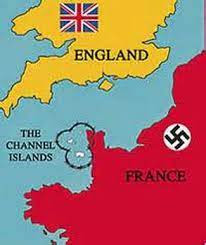
The Channel Islands consist of the Bailiwick of Guernsey and the Bailiwick of Jersey.  They are two of the three Crown Dependencies and they are located in the English Channel, off the coast of France

Each of the two bailiwicks have their own money, legal and healthcare systems, as well as, their own individual immigration policies.  Since 1290, they have been Crown Dependencies which means that they are not part of the United Kingdom, but the UK is responsible to represent them internationally and to provide for their defence.  Together the two bailiwicks have a population of almost 172.000 people.

The Bailiwick of Jersey consists of the island of Jersey plus the uninhabited islets Écréhous and Minquiers, with Jersey being a single jurisdiction.  Jersey the is largest and southernmost island with 118 km² (46 square miles).  It is 23 km (14 miles) from the coast of Normandy and 160 km (100 miles) south of England.  There are almost 108.000 people living in Jersey.  About a third of the population lives in the capital Saint Helier.

People have been living on Jersey since at least 12.000 BC.  The island has Bronze and Iron Age settlements and the islands have controlled by the Romans, Vikings, and Normans.

The official languages are English, French, and Jèrriais which is a Norman French dialect.

The Bailiwick of Guernsey consists of the islands of Alderney, Brecqhou, Guernsey, Herm, Jethou, Lihou, and Sark.  Guernsey is the second-largest and westernmost island with 78 km² (30 square miles).  It is roughly 48 km (30 miles) off the coast of Normandy.  Guernsey is home to about 64.000 people with roughly 20.000 living in the capital St. Peter Port.

There are actually three different jurisdictions.  Guernsey, Alderney and Sark, each have their own parliaments but they do work closely together.

History on Guernsey goes back to at least 6000 BC.  There's evidence that Neolithic farmers lived here, plus the Romans, Vikings, and Normans.

Flag of Guernsey.svgGuernsey has jurisdiction over the islands of Herm, Jethou, Limo, and a few other small uninhabited islands.

Flag of Alderney.svgAlderney is a small island that is only 7,7 km² (3 square miles) and home to over 2000 people.  It is the northernmost Channel Island and the closest to France which is only 13 km (8 miles) west of La Hague.  Saint Anne is the capital.  English is the only official language.  Auregnais was a Norman French language spoken here but it is now extinct.

Flag of Sark.svgSark is an even smaller island that is just 5,4 km² (2,1 square miles) and home to about 500 people.  It is about 32 km (20 miles) from France.  Sark also has jurisdiction over the island Breqhou which is almost uninhabited, plus some other smaller uninhabited islands.  There's no official capital city but the de facto capital is La Seigneurie.  English is the only official language but a few people still speak Sercquiais which is another Norman French dialect.

Sark became a democracy in 2008 and until then it was Europe's last feudal political entity.

The official currency in the Channel Islands is the pound sterling.  However, both Jersey and Guernsey issue their own pounds which are pegged one-to-one to the UK pound.  British £ are valid in the Channel Islands but the Jersey and Guernsey pounds aren't accepted in the UK.

Guernsey £ on top and Jersey £ below

The Channel Islands were occupied by Nazi Germany during WWII.  The only part of the British Islands to be occupied by Germany.

Here's a short video I found on YouTube that talks about how the Channel Islands came to be.

©History HQ

And here's another short video specifically about the German occupation during the war.

©Smithsonian Channel

There was a 2017 film, takes place in Jersey during the occupation that was based on a true story.  Here's the movie trailer for Another Mother's Son

©Vertigo Releasing

On Netflix I saw the 2018 film, The Guernsey Literary and Potato Peel Pie Society that also takes place during the occupation. 

©Netflix

Update 2025:  Here's a short YouTube video about why France doesn't have the Channel Islands.

©History Matters

Sunday, November 6, 2022

Crown Dependencies

The Crown Dependencies are the Isle of Man, the Bailiwick of Guernsey, and the Bailiwick of Jersey.  The Bailiwicks of Guernsey and Jersey make up the Channel Islands.  

Like the UK, sovereignty over the Crown Dependencies are vested in the Crown and Charles III is now sovereign following the passing of Queen Elizabeth II.  

Each of them have wide powers of self-government but they aren't independent countries, and they aren't British Overseas Territories either.  The United Kingdom is responsible for them in terms of defence and foreign relations, and each dependency pays an annual fee to the UK for this.

They aren't members of the Commonwealth of Nations.  However, they do get to send their own athletes every four years to the Commonwealth Games. 

As these three island territories are not part of the UK, Brexit didn't impact them because they were never a part of the EU.  

The Crown Dependencies were part of the EU customs territory there they participated in the free movement of goods but they did not have the free movement of people, services or capital.  While they were still European citizens they never took part in the European Parliament.  

They were not part of the Schengen area but they are a part of the Common Travel Agreement with the UK and Ireland.  After Brexit, the passports changed from the Red EU colour to the new British Blue.

In ten days I'm headed to Saint Helier, the capital of Jersey, which will be my first visit to the Channel Islands.

Saturday, November 5, 2022

Commonwealth of Nations

Today is the 5th of November which is Guy Fawkes night.  So Happy Bonfire night to all of my Commonwealth peeps.  

Here's a bit about the Commonwealth of Nations.

The Commonwealth of Nations is a political association of 56 countries, most of which, 52 of them, were once part of the British Empire either as colonies or dependencies.

With the passing of Queen Elizabeth II's passing, Charles III immediately succeeded his mother as monarch of the Commonwealth realm even though he has not yet be crowned king.

Once Charles III will be king, he will be both monarch and head of state, of the 15 countries of the Commonwealth realm.

These 15 countries are the United Kingdom, Antigua and Barbuda, Australia, the Bahamas, Belize, Canada, Grenada, Jamaica, New Zealand, Papua New Guinea, Saint Kitts and Nevis, Saint Lucia, Saint Vincent and the Grenadines, the Solomon Islands, and Tuvalu.

There are five countries that have other monarchs but are still a part of the Commonwealth.  These five are Brunei, Eswatini, Lesotho, Malaysia, and Tonga.

The remaining 36 members of the Commonwealth are all republics.  They include Bangladesh, Barbados,  Botswana, Cameroon, Cyprus, Dominica, Fiji, Gabon, The Gambia, Ghana, Guyana, India, Kenya, Kiribati, Malawi, Maldives, Malta, Mauritius, Mozambique, Namibia, Nauru, Nigeria, Pakistan, Rwanda, Samoa, Seychelles, Sierra Leone, Singapore, South Africa, Sri Lanka, Tanzania, Togo, Trinidad and Tobago, Uganda, Vanuatu, and Zambia.

The Commonwealth consists of 31,5 million km² (12.2 million square miles) which is about 21% of the world's total land area.  The Commonwealth countries are home to 2,4 billion people which is about ⅓ of the world's population with 94% living in Asia and Africa.

There's no requirement that a member has to have been a British colony.  Mozambique, Rwanda, and Gabon never were.  The Commonwealth Charter states that members have shared values of democracy, human rights and the rule of law.

The human rights thing is a bit funny to me.  The UK left a legacy of anti-homosexuality laws, particularly during the 19th century, at the height of the British Empire.  Being gay is still a criminal offence in more than 30 Commonwealth countries.  There's a direct link between anti-gay law and increased rates of HIV.  While the Commonwealth accounts for about a ⅓ of the world's population it has more than 60% of the world's HIV cases.    

Membership in the Commonwealth isn't forever.  Ireland was the first country to leave.  It left when the country became a republic.  Prior to India becoming a republic the rules were changed so that India could remain a member.  Zimbabwe left in 2003 but it is now trying to rejoin.  Other potential members currently include Somaliland, South Sudan, Suriname, and Burundi.

The three Crown dependencies of Jersey, Guernsey, and the Isle of Man aren't happy with only being represented by the UK.  All three want to have direct representation with the Commonwealth.

The Commonwealth Games are held every four years.  They began in 1930 as the Empire Games.  They contain the usual Summer Olympic events plus "British" sports like bowls, netball and rugby sevens.  The next games take place in 2026 in Victoria, Australia.

Update August 2023:  Looks like it's getting too expensive for cities to host the Commonwealth Games.  Two cities have withdrawn their bids for upcoming games.  Here's a BBC report about it.

©BBC News

Thursday, September 15, 2022

EUFOR

The European Union Force Bosnia and Herzegovina (EUFOR) is a military deployment to help keep the peace in Bosnia and Herzegovina (BiH).  At least it used to be called EUFOR.  Now it is Operation ALTHEA.


The United Nations put a peacekeeping force called UNPROFOR in BiH  back in 1992.  As part of the 1995 Dayton Peace Accords between BiH, Croatia, and Serbia (with Serbia also representing Srbska Republika), there was a one-year mandate for a multinational peace enforcement force.  The Implementation Force (IFOR), which replaced UNPROFOR, was led by NATO under the codename Operation Joint Endeavour.  

After the one year, IFOR was replaced by the Stabilisation Force in Bosnia and Herzegovina (SFOR).  SFOR was another NATO-led peacekeeping force, with several non-NATO countries contributing troops.  IFOR was replaced by EUFOR in December 2004.


NATO handed over its peacekeeping mission to the EU which is how EUFOR took over in 2004.  Operation ALTHEA ensures compliance with the Dayton Peace Agreement and contributes to safe and secure environment in BiH.

There are about 1000 troops currently stationed in BiH from 19 different countries, including Czechland.  The countries are all EU and/or NATO member states with the exception of Chile which isn't either.  In December 2020, the UK withdrew its troops from EUFOR after 16 years due to Brexit

The EU also has an Intermediate Reserve Force based in Europe that can be deployed on short notice to reinforce EUFOR in BiH if needed.

The first five years each saw a commanding general from a different country.  For some reason, since December 2009, each year the commanding general comes from Austria.

Here are a couple of short videos I found on YouTube.

©EUFOR Althea
©EUFOR Althea

Update March 2023:  Here's the new EUFOR video.

©EUFOR Althea

Sunday, September 4, 2022

Czechoslovak Government-in-Exile

The second President of Czechoslovakia was Edvard Beneš.  Following the 1938 Munich Agreement, he resigned from office bringing an end to the First Republic.  He went to the USA and became a visiting professor at the University of Chicago.  After a few months he returned to Europe to organise a government-in-exile.


While in Paris he formed the Czechoslovak National Liberation Committee, Výbor Československého Národního Osvobození, in October 1939.  Since Slovakia split from Czechoslovakia to become a Nazi puppet state, France had a problem with the committee representing all of Czechoslovakia.  The impending Nazi occupation of France probably didn't help so the committee moved to London in 1940.

The committee gained British recognition as the Provisional Government of Czechoslovakia, Prozatímní vláda Československa, which was basically the Czechoslovak Government-in-Exile, and it gained international recognition by other Allied governments. 

While all of this was going on, following the annexation of the Sudetenland, Emil Hácha was President of the Second Czechoslovak Republic which what was left of Czechoslovakia after it was carved up.  This lasted until 15 March 1939 and then he became the state president of the Protectorate of Bohemia and Moravia.

Jan Šrámek

With Beneš as the President and Jan Šrámek as Prime Minister, the worked to return Czechoslovakia to its 1937 borders which was a big goal considering the country had been basically wiped from the map.  The. government-in-exile also tried to assist Czechoslovak Jews.

In 1941, there was pressure from the Allies for the Czechs to play a greater role in the resistance, especially in the Protectorate.  In late September 1941, Reinhard Heydrich launched a major crackdown on the resistance when he took over as Reichsprotektor.   

After almost six months of planning, Operation Anthropoid went into action.  Jan Kubiš and Jozef Gabčík went to Prague and assassinated Heydrich.

Jan Kubiš and Jozef Gabčík

At Porchester Gate in London, there's a plaque marking where the Czech government-in-exile was based in the UK, and this is where the assassination was planned.  I guess I need to go find the plaque the next time I'm back in London.