Showing posts with label Passport. Show all posts

Sunday, November 6, 2022

Crown Dependencies

The Crown Dependencies are the Isle of Man, the Bailiwick of Guernsey, and the Bailiwick of Jersey.  The Bailiwicks of Guernsey and Jersey make up the Channel Islands.  

Like the UK, sovereignty over the Crown Dependencies are vested in the Crown and Charles III is now sovereign following the passing of Queen Elizabeth II.  

Each of them have wide powers of self-government but they aren't independent countries, and they aren't British Overseas Territories either.  The United Kingdom is responsible for them in terms of defence and foreign relations, and each dependency pays an annual fee to the UK for this.

They aren't members of the Commonwealth of Nations.  However, they do get to send their own athletes every four years to the Commonwealth Games. 

As these three island territories are not part of the UK, Brexit didn't impact them because they were never a part of the EU.  

The Crown Dependencies were part of the EU customs territory there they participated in the free movement of goods but they did not have the free movement of people, services or capital.  While they were still European citizens they never took part in the European Parliament.  

They were not part of the Schengen area but they are a part of the Common Travel Agreement with the UK and Ireland.  After Brexit, the passports changed from the Red EU colour to the new British Blue.

In ten days I'm headed to Saint Helier, the capital of Jersey, which will be my first visit to the Channel Islands.

Wednesday, January 19, 2022

2022 Passport Power

The Henley Passport Index is out and once again, Japan has the world's most powerful passport.  Since 2018, it has held the #1 spot.  Having a Japanese passport allows one to travel to 193 countries either visa-free or visa on arrival.  Only 34 destinations require a visa or an e-visa.  Last year, a Japanese passport "only" got you to 191 countries and 35 countries required a visa.  

There's no such thing as an EU passport.  There are just passports issued by EU member countries and they tend to dominate the rankings.  22 EU countries rank amongst the 11 most powerful passports.  

  1. Japan (193)
  2. Singapore, South Korea (192)
  3. Germany, Spain (190)
  4. Finland, Italy, Luxembourg (189)
  5. Austria, Denmark, NetherlandsSweden (188)
  6. France, Ireland, Portugal, UK (187)
  7. Belgium, New Zealand, Norway, Switzerland, USA (186)
  8. Australia, Canada, Czechia, Greece, Malta (185)
  9. Hungary (183)
  10. Lithuania, Poland, Slovakia (182)
  11. Estonia, Latvia, Slovenia (181)

The three weakest EU member passports belong to the three most recent joiners.  Romania ranks at #16 with 174 countries while Bulgaria and Croatia both come in at #17 with 173 countries.

My American passport is still ranked in 7th place with only 41 countries requiring a visa to visit.  In 2006 and 2014, the U.S. passport was ranked #1.

A U.S. passport gets you in to Australia, Central African Republic, Equatorial Guinea, Guyana, Mongolia, and Pakistan.  Czechs need a visa to visit these countries.  Americans are still eligible for a 3-year visa for Russia which isn't available to Czechs.

A Czech passport will still ranked in 8th place with only 42 countries requiring a visa to visit.  In 2006, a Czech passport was ranked #21.  In 2014, it cracked the top 10 and has stayed there since.  Czechs are able to visit Belarus, Iran, Turkey, Myanmar, and Venezuela while Americans need a visa to visit them.

I need to get on the ball and submit my paperwork for Czech citizenship so that I can get my Czech passport.

Update:  Here's a 10½ minute video from Faultline that I found out on YouTube that talks about passports, visas, and travel.

©Faultline

Update: 2023 passport power rankings.

Monday, May 17, 2021

Vaccine #1

So on Tuesday night I was able to register online for my vaccine even though Wednesday was the day that people 45+ were eligible.  My appointment was for 10 am out at the Brno Exhibition Centre. 


I arrived a little before 9:30 and I was able to register.  There was a control where I had to show my ID and my health insurance card.  I also had my temperature taken and had to fill out a short form.


I then had to wait in a small queue to be called to see a nurse.  The nurse needed to see my passport.  We were speaking Czech but as soon as she saw my American passport she immediately switched to English.  I had to answer a few simple questions and then she directed me to where I needed to actually get my shot.  As I was walking to where I needed to go she yelled out "anglicky" and I was immediately greeted and told what to do in English.  

Even though I failed my Czech exam I was still comfortable doing everything in Czech so I didn't need anyone to speak English.  For many of the foreigners here I'm sure that having volunteers speaking English would be very comforting.  

It's amazing just how much the city has changed in the past almost 12 years.  When I first arrived it wasn't so common for people to speak English.  Your ears would perk up if you overheard someone speaking English in the city.  Now, not so much.

Anyway, back to the story.  I was directed to take a seat and a few minutes later another nurse came by with a trolley.  I received the Pfizer BioNTech vaccine and I then had to wait 15 minutes.  I was then given my immunisation card showing that I received my first dose on 15.5., and I will get my second dose six weeks later on 26.6.  By 10:05 I was walking out of the building.  Everything was really well organised I was impressed by how smooth the entire process was.

I didn't have any real side effects to the vaccine.  On Sunday my arm was a little sore but nothing severe.  On Sunday evening I started to feel like I was beginning to come down with a cold.  I took some over-the-counter cold tablets and went to bed early.  This morning I woke up completely fine.  Now I just have to wait the six weeks until I get my second dose.

Wednesday, January 13, 2021

2021 Passport Power

The new passport rankings are in and Japan now has the world's most powerful passport.  A Japanese passport allows a citizen to travel to 191 countries either visa-free or visa on arrival.  Only 35 destinations require a visa or an e-visa.

Here are the top ten most powerful passports for travel.


  1. Japan
  2. Singapore
  3. Germany, South Korea
  4. Finland, Italy, Luxembourg, Spain
  5. Austria, Denmark
  6. France, Ireland, Netherlands, Portugal, Sweden
  7. Belgium, New Zealand, Norway, Switzerland, UK, USA
  8. Australia, Czech Republic, Greece, Malta
  9. Canada
  10. Hungary
Last year my American passport was ranked 8th and now it's moved up to 7th place. A U.S. passport will get you in to 185 countries with 41 countries requiring a visa.

A Czech passport allows entry to 184 countries with 42 countries requiring a visa.  The two passports are pretty close but the mix of countries is a bit different.

An American passport gets you in to Australia, Central African Republic, Equatorial Guinea, Guyana, and Mongolia whereas Czechs must get a visa.  Americans are also eligible for the 3-year visa for Russia which is not available to Czechs.

A Czech passport allows for entry to Iran, Myanmar, and Turkey which Americans must get a visa in order to visit.

One important thing to note is that temporary travel restrictions use to COVID-19 aren't considered which is a good thing because otherwise a U.S. passport would come in around 71st place.

The world's weakest passport is Afghanistan.  This passport allows for travel to only 26 countries without a visa.

Now we just need to get past COVID-19 so that I can take my passport out for a spin.  As well as, work on getting Czech citizenship so that I can have a Czech passport too.

Update: 2022 passport power rankings.
Update: 2023 passport power rankings.

Saturday, August 1, 2020

Cancelled U.S. Passports

During the start of the COVID-19 pandemic, flights were cancelled and people were stranded trying to get back home.  Many countries chartered repatriation flights to bring their citizens home from around the world.  Some countries provided free flights to get their citizens home and some countries billed the travellers.

The U.S. State Department arranged flights for about 100,000 Americans who were stranded at a cost of $196 million.  This was just to get people back to the USA.  People then still had to secure commercial travel to actually get home.

Now people need to pay the money back.  The problem is that it could have been handled better.  Some flights were quoted an "up to amount" and passengers had to sign promissory notes agreeing to pay whatever the final cost would be.  Some people have been waiting three months and they still don't know the final amount they need to pay.

While people are waiting to be informed of the final amounts they owe, the government has cancelled their passports.  New passports can not be issued until the debts are cleared. 

Wednesday, March 7, 2018

Eilat Trip Summary

We had a great time on our Middle East adventure last week.  Eilat was the perfect place for some quiet beach time.  Especially last week when a cold blast of snow and freezing wind set record low temperatures across Europe.

Thanks to the Sibiřská zima, Siberian cold, Brno was -14℃ (7℉).  I definitely felt friends freezing back home while it was 28℃ (82℉) on the beach.


On Monday we went to Egypt and visited Saint Catherine's Monastery.

Egypt has long been a popular beach holiday destination for Czechs.  The number of tourists declined after the revolution in 2011 but have steadily increased the last couple of years.

On Wednesday we took our long day trip to Jerusalem and the Dead Sea.

I can definitely see going back to spend some more time at the Dead Sea.  Quite the experience.

Then we went in to Palestine to visit the Church of the Nativity in Bethlehem.

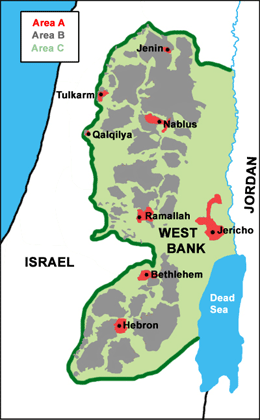
Something I didn't understand was that the Oslo II Accord actually divided up the West Bank into three different areas.  Area A is where the Palestinian Authority has administrative control, Area B is co-administered with Israel, and Area C contains settlements only controlled by Israel.

Israelis are not allowed to enter Area A.  This sign warns that it is both dangerous and against the law for Israeli citizens to enter Area A.


On Friday we took our tour to Petra.  It was even better than I thought it would be.  The carvings were so cool.  I wish we had more time to really explore Petra but we hit the major highlights.  I'm glad that we didn't stay over though because Jordan is ridiculously expensive.

Since 2013, Israel no longer stamps your passport.  Instead you receive a paper ticket every time you enter or exit the country which you hold on to.  There are several counties which won't let you enter if there's any evidence in your passport that you've been to Israel.

Taba visa stamps
The thing is that Egypt and Jordan do stamp your passport.  So there's now evidence in my passport that I used the Taba border crossing in Egypt, and since the only country that one can get to from here is Israel, which means it's pretty easy to figure out where I've been.

Israeli border crossing to Jordan
It's the same story with the Jordanian border crossing.  My passport now won't let me enter Iran, Iraq, Kuwait, Lebanon, Libya, Pakistan, Saudi Arabia, Sudan, Syria, or Yemen.

Aqaba, Jordan, across the Red Sea
While not immediate travel destinations I would like to eventually go to Iran and Lebanon.  I'll either have to get a second U.S. passport, which will only be valid for two years, but won't show evidence of having been in Israel.  Or I wait until I eventually get a Czech passport.


The rest of the time we just relaxed on the beach and enjoyed our time in Eilat.

Mall security


Mall security is no joke in Israel.  According to the law, you can enter only a shopping centre after clearing security.  Your bags will be searched and you go through a metal detector.  It's quick and easy and you don't have to remove your shoes like at an airport.

The biggest surprise actually came when we left.  Ryanair says to be at the airport at least two hours before your flight.  However, Israeli airport regulations state that passengers should arrive at least three hours prior to your flight in order to clear security.  It took us about 2,5 hours to make it to the gate.

First you get in line to talk to a security who asks a few questions and looks through your passport.  I think there's a bit of racial profiling that goes on as well.  We were then split up and asked the same questions again separately.  It didn't seem to be a problem that we had gone to Egypt or Jordan but security had lots of questions about out visit to Morocco a year ago.  Why did I go to Morocco?  Do I know anyone there? What did I do?  Did I meet anyone there?  It took a while to explain that it was just a day trip and again, a year ago.

"2" is low risk but "6" is the highest risk
After about five minutes they put a yellow sticker on my passport and I could then get in the queue for baggage inspection.  All of your bags go through a screening machine.  Some people were told to remove iPads but I wasn't so I left it in the bag.  Depending on the number on the yellow passport sticker, some people had to then go to another bag check where they had open their bags and watch an official inspect every item.  I'm glad that this didn't happen to me.  Then you go to the airline counter and check in your bag.  After this you then go through "normal airport security" where you remove your liquids from your carry-on, take off your shoes and pass through metal detectors.  Then you go to passport control and then finally you are cleared to go to the gate.  Super thorough but you can definitely feel safe at an Israeli airport.

Wednesday, August 16, 2017

Registered Traveller

The UK and Ireland have their own common travel area and are not part of Schengen.  Every time that I land in the UK, along with every other non-EU traveller, I have to complete a landing card.

You have to provide your passport details, along with how long you will be in the UK, where you're staying, and your incoming flight or ferry information.

What has always driven me crazy is that I've had to complete this for a connecting flight in London Stansted.  Ryanair doesn't have connecting flights so when I fly Brno-Stansted-Dublin I have to go through UK immigration, get a stamp in my passport, pick up my bag and then proceed to departures so that I can drop off my bag for the next flight and go through security again.

In these cases, I write that my address in the UK is "Stansted Airport" and that my stay in the UK is "4 hours".  Sometimes the immigration officer writes "IT" for "in transit" over the stamp in my passport.  All of this stamping takes up valuable space in my passport.

These paper landing cards don't make much sense in a digital age and they cost the UK £3,6 million (+$4.7 million) per year.  Sometime this fall, the UK is supposed to scrap these cards.

I've been accepted as a Registered Traveller which will not let me get through the UK border much faster.  The service costs £70 ($92) to apply and £50 each year to renew.  You have to be at least 18 years old, have an ePassport, and have visited the UK at least four times in the last 24 months.

The benefits of being a registered traveller is that now when I arrive in the UK, I (a) no longer have to complete a landing card, and (b) I get to use the arrival lines reserved for UK/EU citizens.  No more having to use the non-EU lanes which all require a conversation with an immigration officer and tend to take much longer to get through.  There's also no fingerprint check.

I'll get to use the UK lines at the following airports:  Birmingham, East Midlands, Edinburgh, Glasgow, London City, London Gatwick, London Heathrow, London Luton, London Stansted, and Manchester.  At all other UK airports I will still need to use the non-EU arrival lines.  But these are the major airports so not a big deal.  It will also work at the Eurostar terminals in Brussels, Lille, and Paris.

The registered traveller service is open to citizens of Argentina, Australia, Belize, Brazil, Brunei, Canada, Chile, Costa Rica, El Salvador, Guatemala, Honduras, Hong Kong, Israel, Japan, Malaysia, Mexico, New Zealand, Nicaragua, Panama, Paraguay, South Korea, Singapore, Taiwan, Uruguay, and the USA.

I understood that I should have received some kind of card but they ran out.  Instead a sticker was placed on the back of my passport.

If only Ireland would come up with something similar because I get annoyed with the third degree every time I arrive at Dublin Airport.

Update: 20 May 2019 - Americans get to use the ePassport gates so my registered traveller status is no longer needed.

Friday, November 18, 2016

Macau, China

Today we had a day tour of Macau.  From Hong Kong the easiest way to get to Macau is by ferry.  The TurboJet takes about an hour to cover the 64 km (40 miles).

As a Special Administrative Region of China, Macau (and Hong Kong) have their own immigration policies, so passport checks are required when travelling between the two former colonies.  We had to exit through Hong Kong immigration before boarding the ferry.  Once in Macau we went through immigration again.  

There are no passport stamps because both issue paper tickets that you have to hold on to instead.

Macau澳門, is home to about 651,000 people, all of them in about an area of 30,5 km² (11,8 miles²) making it the most densely populated place in the world.  Unlike Hong Kong, in Macau there are height restrictions on the buildings so there's not a sea of skyscrapers.

Macau's currency is the pataca.  Fortunately, almost everyplace accepts Hong Kong dollars (or debit cards) so we didn't need to exchange money.

The Historic Centre, which includes around 25 sites which were collectively declared a UNESCO World Heritage Site in 2005.

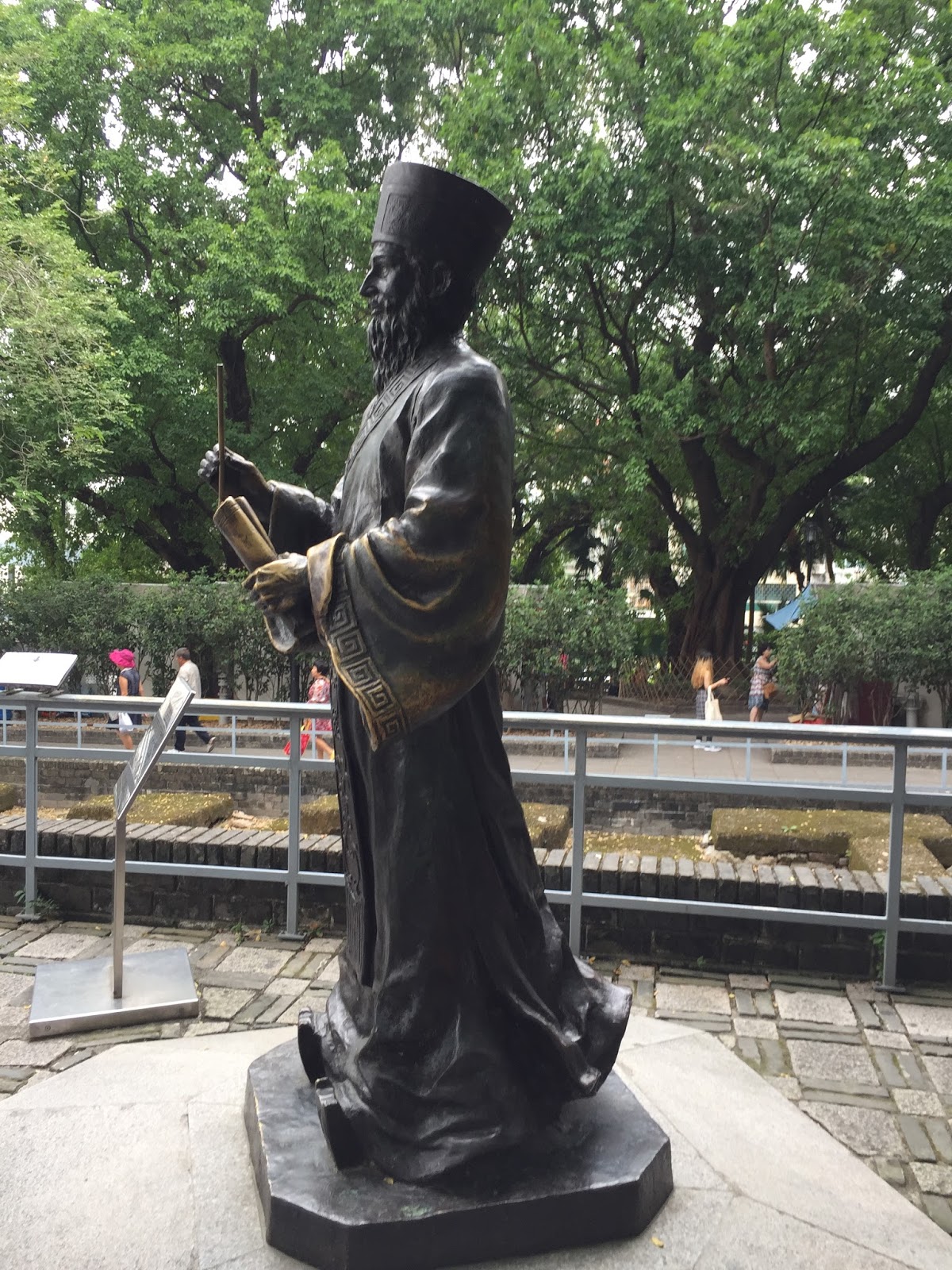
The Ruins of St. Paul's is what's left of a 17th-century complex.  The Jesuits built it from 1602 to 1640.  At the time it was one of the largest Catholic churches in Asia.  It was destroyed by a fire in 1835 and only the façade remains.

The Fotaleza do Monte was a fort built from 1617 to 1626 to protect the Jesuits from pirates.  From the top of the fort are great views of Macau.
The Macau Museum opened in 1998 and covers the city's history as a former Portuguese colony.  The museum is on the hill of the Fortaleza do Monte.


The Na Tcha Temple was built in 1888.  It was built for the child god of war and people believed that it ended a plague which was effecting the region back then.

The Cathedral of the Nativity of Our Lady, known as the Sé Cathedral, was rebuilt in 1937.

St. Dominic's Church was completed in 1587.  The current building dates back to the early 17th century.

The A-Ma Temple was built in 1488 and is one of the oldest in Macau.

Gambling is huge in Macau.  Lots of Chinese millionaires come over here to gamble.

It's the Asian version of Las Vegas but I believe that Macau is even more profitiable.  One of the major casinos is Casino Lisboa.

The Maritime Museum opened in 1987 and the current building, which opened in 1990, is built on the site where the Portuguese explorers first landed here back in 1553.


Santa Sancha, also called Macau Government House, was built in 1846.  It is the home of the Chief Executive of Macau.

Macau Tower opened in 2001.  It is 338 meters (1,109 feet) tall making it the 10th tallest freestanding tower in the world.  It was based on the Sky Tower in Auckland.

Senate Square is located in the old town.  The wave-patterned stones definitely has a Lisbon feel to it.  Many tourists really seemed to like the area because it feels like Europe in Asia.  While it's a nice area, I already get to see the real Europe in Europe.


The Macau Grand Prix takes place every November and it is the biggest event of the year.