Showing posts with label Egypt. Show all posts

Thursday, April 13, 2023

Universal Healthcare

One of our friends visiting Brno this week came down with Conjunctivitis, Zánět spojivek, normally called "pink eye" in English.  So we made the decision to go visit Bohunice Hospital.  

Going to the hospital on day 2 of a 4-day weekend?  Not something that sounded like a fun time but we headed to the emergency room.

When we got to the hospital the receptionist told us to go directly to the eye clinic on the 16th floor.  Within five minutes the nurse had taken some personal information and our friend was seen by a resident.  

A senior doctor joined, multiple x-rays just to rule things out, and a prescription for medicine and we were headed home.  Everything done in just one hour.  Our friend doesn't have a Czech health card but does have a European health card.  In a situation like this, you have to pay for the visit and medicine, you submit a claim with your country's health insurance system and get reimbursed.  

The visit, with the x-rays, cost 500 Kč (~$21) and the medicine was another 500 Kč.  In the USA, even with good insurance, it would have cost way more.  

I never understand why universal healthcare is seen as a bad thing by so many Americans (Republicans).  It's not something radical.  There are 73 countries in the world that offer universal healthcare coverage and all but 43 countries in the world have free healthcare or access to universal healthcare for at least 90% of their citizens.  

In the USA there is national defence but the moment national healthcare is brought up, you would think that people were advocating for the downfall of the country.  

Sure, no system is perfect and there's always room for improvement, but I've never seen a country with universal healthcare trying to repeal it.  It's as if universal healthcare is a good thing.

The USA is the largest country without universal healthcare and to put this in perspective, some other countries without free healthcare are Nigeria, Yemen, South Africa, Egypt, Afghanistan, Pakistan, and Iran. 

I'm very happy that I live here in Czechland where we have a very good healthcare system.  And I've never heard of anyone in a country with universal healthcare going bankrupt due to medical bills.  That's just an American thing.  Most Americans are one major disease from losing everything due to medical bankruptcy. 

Update:  Our friend was fully reimbursed for the 1000 Kč within a week.

Wednesday, February 8, 2023

Seven Wonders of the World


There have been a few versions of the "seven wonders of the world."  The oldest list, known as the "classic" seven wonders were located around the Mediterranean and the Middle East.  Of the classic wonders, only one, the Great Pyramid of Giza, still exists.
1.  Great Pyramid of Giza in El Giza, Egypt.
2.  Colossus of Rhodes, was located in Rhodes, Greece.
3.  Hanging Gardens of Babylon, in Babylon, Iraq.
4.  Lighthouse of Alexandria, in Alexandria, Egypt.
5.  Mausoleum at Halicarnassus in present-day Turkey.
6.  Statue of Zeus in Olympia, Greece.
7.   Temple of Artemis in Ephesus, Turkey.   

Next month, we're off to Kuşadasi for a week and will visit Ephesus.  I'll get to see what's left of the Temple of Artemis and will be the only item on the classic list I'll have seen.

The Seven Wonders of the Middle Ages include:
1.  Catacombs of Kom el Shoqafa in Alexandria, Egypt.
2.  Colosseum in Rome, Italy.   
3.  Great Wall of China, in China.
4.  Hagia Sophia in Istanbul, Turkey.
5.  Leaning Tower of Pisa in Pisa, Italy.
6.  Porcelain Tower of Nanjing, in Nanjing, China.
7.  Stonehenge in Wiltshire, England, UK.

So far I've managed to see four of seven from this list.  I missed out on going to Nanjing during my Shanghai trip due to rain.

In 1994, the American Society of Civil Engineers paid tribute to the what they thought were the greatest civil engineering achievements of the 20th century by releasing their list of Seven Wonders to the Modern World.
1.  Channel Tunnel, between the UK and France.
2.  CN Tower in Toronto, Canada.
3.  Empire State Building in New York City, USA.
4.  Golden Gate Bridge in San Francisco, California, USA.
5.  Itaipú Dam between Brazil and Paraguay.
6.  Delta and Zuiderzee Works in the Netherlands.
7.  Panama Canal in Panama.

From this list I've been to the Empire State Building and the Golden Gate Bridge.  Toronto's been on my list of places to visit for years but who knows when I'll get a chance to visit Canada.

In 2001, a New Seven Wonders of the World was released.  The Great Pyramid of Giza didn't make the list but was added later as an honorary mention.
1.  Great Wall of China.
2.  Petra in Jordan.
3.  Christ the Redeemer in Rio de Janeiro, Brazil.
4.  Machu Picchu in Peru.
5.  Chichén Itzá in Mexico.
6.  Colosseum in Italy.
7.  Taj Mahal in India.  

From this list I've been to the Great Wall, Petra, Christ the Redeemer, and the Colosseum.  Back in 2007, Steven and I were getting our MBAs from Georgia State University.  We did a two-week study abroad programme in Argentina and Brazil.  One of my favourite memories is of us in a helicopter flying around Jesus's head in Rio.

Ephesus for sure will be the next place from all of these lists that I'll see.  Beyond that, who knows?  The Taj Mahal and the Great Pyramid are both on my bucket list.  Stonehenge would probably be the easiest to visit.

Sunday, April 24, 2022

Organization for Security and Co-operation in Europe (OSCE)

The Organisation for Security and Co-operation in Europe (OSCE) is the world's largest regional security-oriented intergovernmental organisation.  It even has observer status as the United Nations.  It began in 1973 as a forum between the west and the east during the Cold War.  The OSCE focuses on arms control, promotion of human rights, freedom of the press, and free and fair elections.  

Its headquarters are in Vienna and today the OSCE consists of 57 participating countries plus 11 observer/partner countries.  The six official languages are English, French, German, Italian, Spanish, and Russian. 

It's basically every country in Europe plus the USA and Canada.  The 11 partner countries are Afghanistan, Australia, Algeria, Egypt, Israel, Japan, Jordan, Morocco, South Korea, Thailand, and Tunisia. 

Each year a different country assumes the chairmanship for a calendar year and that country's minister of foreign affairs is the Chairperson-in-Office.  Czechoslovakia held the chairmanship in 1992.  An independent Czechland hasn't held the chairmanship yet but Slovakia held it in 2019.  

The chairmanship is with Poland this year.  North Macedonia has it next year followed by Estonia in 2024 and Finland in 2025.

Here's a short video I found out on YouTube about the OSCE.

©The Organisation for Security and Co-operation in Europe

Thursday, June 21, 2018

State of Qatar

The State of Qatarدولة قطر  is located on the Persian Gulf in the Middle East.  Qatar is a little smaller than Connecticut.  It borders Saudi Arabia, and is across the sea from Bahrain and the UAE.  Saudi Arabia just announced a bid to build a canal on the border which will basically turn Qatar into an island nation.


Qatar is home to 2,6 million people but only 12% are Qatari citizens.  There are 2,3 million expats, mostly non-Arab, living and working in the country.  You're a Qatari citizen only if your father was a citizen.  It takes at least 20 years for a foreigner to get citizenship.

The Al Thani dynasty has ruled Qatar since 1825.  Once a part of the Ottoman Empire, it became a British protectorate and gained independence in 1971.

The country is an absolute monarchy and Islam is the official religion.  Qatar has a mixed legal system blending civil law with Sharia (Islamic law) when it comes to family and personal matters.  Political bodies and trade unions are not permitted by law.

This is not a place to be if you're gay.  Homosexuality is illegal and is punishable by fines, up to 7 years in prison or even the death penalty.  

©Test Tube News

Arabic is the official language.  With so many expats, English is a common foreign language.

Until 1966, the Indian Rupee was used as the country's currency.  It briefly spotted the Saudi Riyal before adopting the Qatar and Dubai Riyal.  In 1973 the Qatari Riyal became the official currency and it is pegged to the U.S. Dollar.

Due to having the world's third-largest natural-gas reserves and oil reserves, Qatar is a very rich country.  It has the highest per capita income in the world.

Qatar is home to the Al Jazeera television station which opened in 1996. 


Qatar Airways is the state-owned national carrier and it began operations in 1994.  Hamad International Airport opened in 2014 and is the airline's hub which provides routes to more than 150 international destinations.  In 2013 the airline joined Oneworld.  The airline is using Doha to compete with Emirates and it's Dubai base.

Qatar is probably the most open country in the Middle East when it comes to travel.  Citizens of more than 80 countries are able to visit without needing to arrange a visa in advance.
©Al Jazeera

In 2017, Saudi Arabia, the UAE, Bahrain, and Egypt broke diplomatic ties with Qatar.  This included closure of their seaports and airspace which makes flights in and out of Doha longer.  The countries have accused Qatar of supporting terrorism which Qatar denies.  Here are a couple of YouTube videos I found that talks about the 1-year anniversary of the blockade and the impact of the economic blockade.

©France24

©Al Jazeera

Wednesday, March 7, 2018

Eilat Trip Summary

We had a great time on our Middle East adventure last week.  Eilat was the perfect place for some quiet beach time.  Especially last week when a cold blast of snow and freezing wind set record low temperatures across Europe.

Thanks to the Sibiřská zima, Siberian cold, Brno was -14℃ (7℉).  I definitely felt friends freezing back home while it was 28℃ (82℉) on the beach.


On Monday we went to Egypt and visited Saint Catherine's Monastery.

Egypt has long been a popular beach holiday destination for Czechs.  The number of tourists declined after the revolution in 2011 but have steadily increased the last couple of years.

On Wednesday we took our long day trip to Jerusalem and the Dead Sea.

I can definitely see going back to spend some more time at the Dead Sea.  Quite the experience.

Then we went in to Palestine to visit the Church of the Nativity in Bethlehem.

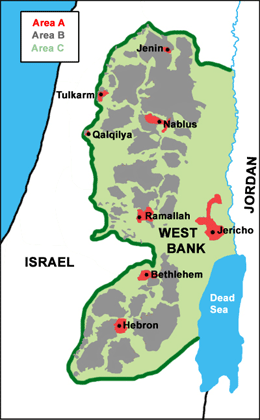
Something I didn't understand was that the Oslo II Accord actually divided up the West Bank into three different areas.  Area A is where the Palestinian Authority has administrative control, Area B is co-administered with Israel, and Area C contains settlements only controlled by Israel.

Israelis are not allowed to enter Area A.  This sign warns that it is both dangerous and against the law for Israeli citizens to enter Area A.


On Friday we took our tour to Petra.  It was even better than I thought it would be.  The carvings were so cool.  I wish we had more time to really explore Petra but we hit the major highlights.  I'm glad that we didn't stay over though because Jordan is ridiculously expensive.

Since 2013, Israel no longer stamps your passport.  Instead you receive a paper ticket every time you enter or exit the country which you hold on to.  There are several counties which won't let you enter if there's any evidence in your passport that you've been to Israel.

Taba visa stamps
The thing is that Egypt and Jordan do stamp your passport.  So there's now evidence in my passport that I used the Taba border crossing in Egypt, and since the only country that one can get to from here is Israel, which means it's pretty easy to figure out where I've been.

Israeli border crossing to Jordan
It's the same story with the Jordanian border crossing.  My passport now won't let me enter Iran, Iraq, Kuwait, Lebanon, Libya, Pakistan, Saudi Arabia, Sudan, Syria, or Yemen.

Aqaba, Jordan, across the Red Sea
While not immediate travel destinations I would like to eventually go to Iran and Lebanon.  I'll either have to get a second U.S. passport, which will only be valid for two years, but won't show evidence of having been in Israel.  Or I wait until I eventually get a Czech passport.


The rest of the time we just relaxed on the beach and enjoyed our time in Eilat.

Mall security


Mall security is no joke in Israel.  According to the law, you can enter only a shopping centre after clearing security.  Your bags will be searched and you go through a metal detector.  It's quick and easy and you don't have to remove your shoes like at an airport.

The biggest surprise actually came when we left.  Ryanair says to be at the airport at least two hours before your flight.  However, Israeli airport regulations state that passengers should arrive at least three hours prior to your flight in order to clear security.  It took us about 2,5 hours to make it to the gate.

First you get in line to talk to a security who asks a few questions and looks through your passport.  I think there's a bit of racial profiling that goes on as well.  We were then split up and asked the same questions again separately.  It didn't seem to be a problem that we had gone to Egypt or Jordan but security had lots of questions about out visit to Morocco a year ago.  Why did I go to Morocco?  Do I know anyone there? What did I do?  Did I meet anyone there?  It took a while to explain that it was just a day trip and again, a year ago.

"2" is low risk but "6" is the highest risk
After about five minutes they put a yellow sticker on my passport and I could then get in the queue for baggage inspection.  All of your bags go through a screening machine.  Some people were told to remove iPads but I wasn't so I left it in the bag.  Depending on the number on the yellow passport sticker, some people had to then go to another bag check where they had open their bags and watch an official inspect every item.  I'm glad that this didn't happen to me.  Then you go to the airline counter and check in your bag.  After this you then go through "normal airport security" where you remove your liquids from your carry-on, take off your shoes and pass through metal detectors.  Then you go to passport control and then finally you are cleared to go to the gate.  Super thorough but you can definitely feel safe at an Israeli airport.

Tuesday, February 27, 2018

Saint Catherine's Monastery Tour, Egypt

Yesterday was an interesting day trip from Eilat to St. Catherine's Monastery in Egypt.  We booked a tour and as it turned out we were the only two people so we got our own private tour.  Yeah for us!

The first stop was the Taba border crossing which is about 10 km (6,5 miles) south of Eilat.  As part of the peace agreement between Israel and Egypt, when Israel returned the Sinai Peninsula, it is possible to travel between the two countries.

As long as you are just travelling in the Sinai you can stay for up to 14 days without a visa.  Any further south than Sharm El Sheikh or up to Cairo and you'll need to get an Egyptian visa in advance.

Bedouin village


After crossing the border we started the 181 km (113 mile) drive to St. Catherine's.


After passing the beach resort town of Nuweiba, we had a long desert route where we saw Bedouin villages, camels, and went through numerous security checkpoints.


The Greek Orthodox Sacred Monastery of the God-Trodden Mount Sinai, is also known as the Monastery of the Transfiguration, and as the Monastery of St. Catherine.

The monastery was founded in 527 AD on the spot where God appeared to Moses in the Burning Bush and received the Ten Commandments.

This is the world's oldest continuously inhabited Christian monastery.  It is also home to the world's continuously operating library and, after the Vatican library, has the second largest collection of early codices and manuscripts.

The Burning Bush
During the Middle Ages the monastery was a favourite pilgrimage site.


A chapel was converted to a mosque and used until the 13th century.  It was restored in 20th century and is used on special occasions.

Well of Jethro's Daughters
In 2002 the monastery became a UNESCO World Heritage site.


On a hill before arriving at the monastery is the Tomb of Aaron.  Aaron (the Prophet Haroun) was Moses' older brother who went with Moses to warn the Pharaoh about God's punishment for not freeing the Jews.  The tomb was built in the 13th century.

Saudi Arabia in the background
On the way back to Eilat we stopped off at Nuweiba to have lunch at a restaurant on the beach.

It was an interesting experience having lunch and seeing Saudi Arabia across the Red Sea.

After lunch we continued back to Taba and passed back in to Israel.

Thursday, January 11, 2018

The Middle East

There are no hard rules about where exactly the Middle East is.  Some consider it to be a geographical term and others consider it a political one.  The term "Middle East" began as a Eurocentric term for the area separating Europe from the Far East.  Most agree that the area consists of the transcontinental region from Turkey to Central Asia, plus the Gulf Area.  Many also include Egypt due to its territory in the Sinai Peninsula.  Others consider North Africa to be part of the Middle East as well.

Definite Middle East countries include: Bahrain, Cyprus, Egypt, Iran, Iraq, Israel, Jordan, Kuwait, Lebanon, Oman, Palestine, Qatar, Saudi Arabia, Syria, Turkey, United Arab Emirates, and Yemen.

North African countries that often get lumped in are Libya, Tunisia, Algeria, Morocco, Mauritania, and Sudan.

Middle East history goes all the way back to ancient times.  It is the birthplace of Judaism, Christianity, and Islam.  Many other ancient belief systems such as Zoroastrianism were also established here.

Islam is the largest religion in the area.  Almost every country, except Cyprus and Israel, have Muslim majorities.  Iran, Iraq, and Bahrain are mostly Shia while most of the other countries are predominately Sunni.  Islam plays a huge role here as the legal systems in most of these countries are influenced by Islamic law.

©Test Tube News

It's a scary place for gays.  Being gay is illegal and punishable by imprisonment in Egypt, Kuwait, Oman, Qatar, and the U.A.E.  In Iran, Iraq, Saudi Arabia, Syria, and Yemen, it is punishable by death.   Most of these places aren't high on my travel bucket list anyway.

Arabs are the largest ethnic group in the Middle East.  The five most spoken languages are Arabic, Farsi, Turkish, Kurdish, and Hebrew.

With such a large region there are of course many problems.  One of the biggest problems is the Israeli-Palestinian conflict.  One of the biggest mistakes lately was President Trump, going against years of U.S. prescient and recognising Jerusalem as the Israeli capital.  Almost every other country in the world recognises Israeli occupation of East Jerusalem as illegal which is why all of the foreign embassies are in Tel Aviv.  Here's an NBC video I found out on YouTube showing some of the reaction to the U.S. action.

©NBC

There's currently a big regional power struggle in the Middle East between Iran and Saudi Arabia.  Each wants to be calling the shots in the region.

©Test Tube News

Update 2025:  Here's a short YouTube video about why didn't the Arab world unite.

©History Matters