Showing posts with label Al Jazeera. Show all posts

Wednesday, February 1, 2023

New Czech President

The results are in and Czechland is getting a new president.  Petr Pavel will replace incumbent president Miloš Zeman.  When he takes office in March he will be country's fourth president.

Here's what's gone over here.  Following the election in 2021,  Petr Fiala became prime minister and Andrej Babiš was out of a job.  For some reason he decided to run for president.

The first round of presidential elections took place on 13-14 January.  General Pavel ran as an independent candidate and won the first round of elections with 35,4% of the vote.  Babiš came in second with 34,99%.

Most of the other candidates put their support behind Pavel and he won the second round of voting with 58,33%.  He won by more than a million votes.  There was just over 70% voter turnout which was the highest turnout in any national election since 1998.   

President-elect Pavel enlisted in the Czechoslovak People's Army after graduating high school in 1983.  Following the Velvet Divorce, he served in the Czech Army and from 2012 to 2015 he was the Chief of the General Staff of the Czech Armed Forces. From 2015 to 2018 he was the Chairman of the NATO Military Committee; the first military officer from the former Warsaw Pact to hold the position.

While he doesn't have any political experience he does have a master's degree in international relations from King's College London and speaks English, French, and Russian. 

Pavel is a social progressive who supports gay marriage, euthanasia, and rejects the death penalty.  He is pro-Western, pro-EU, pro- NATO, and he supports Ukraine.  He was endorsed by Spolu, the centre-right governing alliance.

Following the Velvet Revolution, people chanted "Havel na Hrad" ("Havel to the Castle") for Václav Havel to become president (because Prague Castle is the official office of the president).

During the campaign, it became "Pavel na Hrad".

Babíš was endorsed by outgoing president Zeman and the Communist Party of Bohemia and Moravia.  Babiš tried to portray Pavel as a warmonger.  Babiš also caused additional controversy when he said that if Poland was attacked by Russia, then he would not comply with NATO's article 5, and would not go to Poland's defence.

Here's a short video I found on YouTube about the election.

©Al Jazeera

Friday, September 2, 2022

Sanctions Against Russia

When Russia annexed Crimea from Ukraine, it triggered a show of support from Czechs for two reasons.  One because the annexation was very similar to Hitler's annexation of the Sudetenland, and two because Czechs, and Slovaks, still remember the Soviet-ed, Warsaw Pact 1968 invasion of Czechoslovakia following the Prague Spring.

When Russia invaded Ukraine, the Czech government introduced a number of unilateral sanctions against Russia, plus the sanctions introduced by the EU.

Czechland was the first EU country to stop issuing visas to Russian citizens except for humanitarian cases.  Plus the government started to review already-issued residency permits for Russians living here.

The Ministry of Finance began inspecting Russian companies, and companies with Russian owners, to make sure none were receiving public funds.

The government sped up the process of withdrawing from two Russian banks - the International Bank for Economic Cooperation and the International Investment Bank.

In addition, the cabinet approved the potential deployment of up to 580 Czech troops to NATO's Rapid Reaction Force. The  government also earmarked 300 million Kč (~$13,8 million) for emergency humanitarian aid in Ukraine.

It's important to note that the EU has had sanctions against Russia going back to 2014 when it first illegally annexed Crimea.  But with the invasion, additional sanctions have been levied.

The first package of EU sanctions against Russia came on 23 February when Russia recognised the separatist regions of Donetsk and Luhansk as independent countries as an excuse to send in Russian troops.
  • There were targeted sanctions against the 351 members of Russia's Duma, plus another 27 individuals
  • The restriction of economic relations with the separatist regions of Donetsk and Luhansk
  • The restriction of Russia's access to the EU's capital and financial markets
When Russia invaded the rest of Ukraine on 24 February, the EU stepped up its sanctions to include:

  • the financial sector
  • the energy and transport sectors
  • dual-use goods
  • export control and export financing
  • visa policy
  • additional sanctions against Russian individuals
  • new listing criteria
The second package of sanctions were initiated on 25 February.
  • Vladimir Putin's assets were frozen
  • Sergey Lavrov, the Russian Minister for Foreign Affairs, had his assets frozen
  • restrictive measures were imposed on members of Russia's National Security Council and members of the Duma who supported recognition of Donetsk and Luhansk as independent countries
  • an additional package of individual and economic measures were introduced covering finance, energy, transport and technology sectors plus visa policy
The third package of sanctions came on 28 February.
  • a ban on transactions with the Russian Central Bank
  • €500 million support package to finance military equipment and supplies for Ukraine's armed forces
  • closure of EU airspace and no access to EU airports by Russian carriers
  • new sanctions on another 26 people and one entity
On 2 March, the EU excluded seven Russian banks from SWIFT preventing them to operate globally.
The second package of sanctions were initiated on 25 February.  The EU also banned:
  • investing, participating, or continuing to future projects co-financed by the Russian Direct Investment Fund
  • selling, supplying, transferring or exporting Euros to Russia or to any person or entity in Russia
  • broadcasting of Russia Today and Sputnik
Here's an Al Jazeera video I found on YouTube that talks about some of the sanctions and explains more about SWIFT.

©Al Jazeera

On 3 March, the existing asset freezes of those people identified as responsible for the misappropriation of Ukrainian state funds was extended for another year.

On 9 March, restrictions were put in place halting the export of maritime navigation goods and radio communication technology to Russia.  Plus restrictions on an additional 160 people including:
  • 14 Russian oligarchs
  • 146 members of the Russian Federation Council
In total, at this point the EU had measures in place on 862 individuals and 53 entities.  

Also on 9 March, the EU put sanctions in place against Belarus to include:
  • restrict three Belarusian banks from SWIFT
  • prohibit transactions with the Central Bank of Belarus
  • prohibit transactions by Belarusian state-owned entities in EU trading venues
  • significantly limit the financial inflows from Belarus to the EU
  • prohibit the provision of Euros to Belarus
The fourth package of sanctions were initiated on 15 March on an additional 15 people and 9 entities plus a ban on:
  • all transactions with certain state-owned enterprises
  • the provision of credit rating services to any Russian person or entity
  • new investments in the Russian energy sector
  • trade involving iron, steel or luxury goods
The fifth package of sanctions were initiated on 8 April.  This package included a ban on:
  • imports from Russia of coal and other solid fossil fuels
  • all Russian vessels from accessing EU ports
  • Russian and Belarusian road transport operators from entering the EU
  • imports of other goods such as wood, cement, seafood and liquor
  • exports to Russia of jet fuel and other goods
  • deposits to crypto-wallets
On 21 April, the EU sanctioned two more businesspeople.

The sixth package of sanctions were initiated on 3 June.  The sixth package includes:
  • a ban on imports from Russia of crude oil and refined petroleum products, with limited exceptions
  • a SWIFT ban for another three Russian banks and one Belarusian bank
  • suspension of broadcasting in the EU by three more Russian state-owned outlets
  • sanctions against an additional 65 people and 18 entities including those responsible for atrocities committed in Bucha and Mariupol
On 21 July, the seventh package of sanctions were put in place to prohibit the purchase, import or transfer of Russian-origin gold, including jewellery.  The ban on port access was extended to include locks, with sanctions against another 54 individuals and 10 entities including Sberbank.

On 4 August, sanctions were placed on Viktor Yanukovych, the former pro-Russian President of Ukraine, and his son Oleksandr.

It probably won't be that long until an eighth package of sanctions is announced by the EU.

Я за Україну. Я за Україною. Слава Україні  Stojím za Ukrajinou!  I stand with Ukraine. 🇺🇦

Update:  On 6 October, came the EU's eighth package of sanctions which included:
  • a price cap related to the maritime transport of Russian oil for third countries
  • additions to the list of restricted items prohibited for Russia's military and technological enhancement
  • additional restrictions on trade and services with Russia
  • sanctions on an additional 30 individuals and 7 entities.

Monday, August 29, 2022

Electricity in Czechland

Since the Russian invasion of Ukraine, prices have soared across Euroland.  

Looking at the cost of electricity in capital cities across Euroland, Prague comes in as having the 5th most expensive electricity at €0,41 per kilowatt-hour.  The top 4 are London, Copenhagen, Rome, and Amsterdam

However, when you account for purchasing power parity then Prague has the most expensive electricity in Europe.  Followed by Rome, Berlin, Dublin, and London.  One of the reasons for electricity being so expensive is that the Czech government taxes it at 24% while the average across Europe is 18%.


What's odd is that Czechland is one of Europe's biggest exporters of electricity.  This year, the country has exported more than 5 million megawatt-hours more than was consumed.  Only Sweden, Germany, France, and Spain have exported more electricity than Czechland.  I wasn't aware than in 2020, Czechland was the 9th-largest exporter of electricity in the world.

In order to cut the country's dependency on gas from Russia by one-third, the government and ČEZ, a Czech energy company, have secured storage capacity for LNG, liquefied natural gas, in the Netherlands.  Construction of the space is underway and it should be complete in September.  This is just for the storage space which should cost tens of millions of Czech Crowns per year.  The Czech government still needs to secure the LNG to be stored there.  

Here's a video I found on YouTube that talks about the high cost of energy right now in Europe, especially in neighbouring Germany.

©NBC

Я за Україну. Я за Україною. Слава Україні  Stojím za Ukrajinou!  I stand with Ukraine. 🇺🇦

Update: Here's an interesting Al Jazeera story I found on YouTube that talks about the high cost of electricity and its impact on the Czech glass industry.

©Al Jazeera

Tuesday, January 5, 2021

Post-Brexit EU Trade Deal

Thanks to Brexit, the UK is no longer part of the single customs union.  The UK and the EU did manage to agree on a last minute trade deal right before Christmas.  The impact of which is already starting to be felt and I believe that more problems will continue to pop up as Brexiters begin to realise the implications of voting to leave the EU.

The deal maintains the Good Friday peace deal so there is no hard border between Ireland and Northern Ireland.  In order to do this, Northern Ireland remains in the EU single market for goods, which means that Northern Ireland has to follow the EU's customs rules.  So now there's a customs border in the Irish Sea which basically separates the UK, between Northern Ireland and England/Scotland/Wales.

All goods moving between Great Britain and Northern Ireland now require a customs declaration, and additional certification on some goods and products, just as it does between the UK and any other EU-member country.

There's no more unlimited freedom to work and live between the UK and the EU.  UK citizens are free to visit Europe but have to follow the Schengen rules which means they can only be in the EU for up to 90 days in a 180-day period.  Any stay over 90 days will require a visa.

Not that there's a whole lot of travel now due to COVID-19 but when arriving in the EU, UK citizens no longer get to use the EU/EEA queues.  They have to use the non-EU citizen queues.

There are now additional customs duties, import fees and VAT when you purchase something online from the UK.  EU consumer protection rules no longer apply to purchases made from the UK.  So I won't be buying anything any longer from Amazon.co.uk.  I need to switch to Amazon in Germany

Mail will be more complicated.  Both from the UK to the EU and vice versa.  All customs fees, duties and taxes need to be paid in order to pick up any packages.  Some shipping companies have already increased their fees to cover the cost of the extra paperwork required.

The UK has set new tax rules where taxes must be collected at the point of sale which means that a business in the EU must collect taxes on sales made to UK customers which means a lot of tax headaches because now the EU firm must establish an account with the UK tax authorities and keep up with ever changing UK tax laws.  There are already cases where EU firms are no longer selling goods to UK customers.

I'm still not sure what's going to happen with surcharge-free roaming.  I have no idea what I'll pay to use my mobile whenever I actually make it back to the UK for a visit.

Booze cruises to the wine shops in Calais, France, were popular because there was an unlimited allowance on alcohol.  That comes to an end because now, there's a limit on the amount of alcohol allowed from the EU for personal consumption.  UK citizens can now only take back home up to 42 litres of beer, 18 litres of wine and 4 litres of spirits, plus up to 200 cigarettes.

On top of all of the this the UK still has to settle a £25 billion ($X) divorce bill by 2057.  It will be interesting to see what other unintended headaches pop up as a result of Brexit

Here are a few short videos already showing up on YouTube showing some of the consequences of the post-Brexit trade deals.

©Al Jazeera

©9 News Australia

©Sky News

There was speculation that with the UK out of the EU, that English would no longer be an official EU language.  Every country gets to put up an official language and Ireland chose Irish and Malta chose Maltese so now there's no EU country with English as its official language.  English is the most widely taught foreign language in the EU.  It appears that English will be kept on as an official EU language.

©Euronews

Update:  Here's a short story on Brexit's impact on the music industry.  I never even thought about this one.  What a mess.
©Euronews

Friday, December 18, 2020

BER Finally Opens

Well it finally happened.  The new Berlin Brandenburg Airport opened on 31 October 2020.  It was supposed to open back in 2011.  Six later opening dates were also missed.  So much for German engineering.

BER was supposed to be a hub for Airberlin, Germania, Germanwings, Easyjet, and Lufthansa.  Well Airberlin closed in 2017, Germania closed in 2019, and Germanwings closed in April 2020. 

There were two airports in Berlin.  Tegel (TXL) in the north and Schönefeld (SXF) in the south-east part of the city.

BER has three terminals.  Terminal 1 is the brand new terminal.  Terminal 2 was supposed to be for the low cost airlines but it's currently closed due to the COVID-19 pandemic.  Terminal 5 is actually the former Schönefeld Airport which is primarily for Ryanair and some charter flights but it too is currently closed due to decreased demand due to COVID-19.

I remember that the first European protest I saw was about the airport.  The original cost was supposed to be €2,83 billion ($3.47 billion) but in the end it was around €7 billion ($8.59 billion).

Here's a short video I found out on YouTube that gives a bit of the history of Berlin's airports.


©Al Jazeera

Here's a really good 7 minute video that goes in to all of the problems and what all exactly went wrong.

©DW News

Thursday, June 21, 2018

State of Qatar

The State of Qatarدولة قطر  is located on the Persian Gulf in the Middle East.  Qatar is a little smaller than Connecticut.  It borders Saudi Arabia, and is across the sea from Bahrain and the UAE.  Saudi Arabia just announced a bid to build a canal on the border which will basically turn Qatar into an island nation.


Qatar is home to 2,6 million people but only 12% are Qatari citizens.  There are 2,3 million expats, mostly non-Arab, living and working in the country.  You're a Qatari citizen only if your father was a citizen.  It takes at least 20 years for a foreigner to get citizenship.

The Al Thani dynasty has ruled Qatar since 1825.  Once a part of the Ottoman Empire, it became a British protectorate and gained independence in 1971.

The country is an absolute monarchy and Islam is the official religion.  Qatar has a mixed legal system blending civil law with Sharia (Islamic law) when it comes to family and personal matters.  Political bodies and trade unions are not permitted by law.

This is not a place to be if you're gay.  Homosexuality is illegal and is punishable by fines, up to 7 years in prison or even the death penalty.  

©Test Tube News

Arabic is the official language.  With so many expats, English is a common foreign language.

Until 1966, the Indian Rupee was used as the country's currency.  It briefly spotted the Saudi Riyal before adopting the Qatar and Dubai Riyal.  In 1973 the Qatari Riyal became the official currency and it is pegged to the U.S. Dollar.

Due to having the world's third-largest natural-gas reserves and oil reserves, Qatar is a very rich country.  It has the highest per capita income in the world.

Qatar is home to the Al Jazeera television station which opened in 1996. 


Qatar Airways is the state-owned national carrier and it began operations in 1994.  Hamad International Airport opened in 2014 and is the airline's hub which provides routes to more than 150 international destinations.  In 2013 the airline joined Oneworld.  The airline is using Doha to compete with Emirates and it's Dubai base.

Qatar is probably the most open country in the Middle East when it comes to travel.  Citizens of more than 80 countries are able to visit without needing to arrange a visa in advance.
©Al Jazeera

In 2017, Saudi Arabia, the UAE, Bahrain, and Egypt broke diplomatic ties with Qatar.  This included closure of their seaports and airspace which makes flights in and out of Doha longer.  The countries have accused Qatar of supporting terrorism which Qatar denies.  Here are a couple of YouTube videos I found that talks about the 1-year anniversary of the blockade and the impact of the economic blockade.

©France24

©Al Jazeera

Friday, May 25, 2018

Commonwealth of Australia

In November I'm off to the Land Down Under.  Two weeks in "Oz" followed by a few days in Wellington (hopefully minus an earthquake) and Hong Kong. I'm well excited for this holiday.  So here's a bit about Australia.

The Commonwealth of Australia consists of mainland Australia, the island of Tasmania, and a few smaller islands including Ashmore and Cartier Islands, Christmas Island, Cocos Islands, Coral Sea Islands, Heard Island and McDonald Islands, and Norfolk Island.  I grew up learning that Australia is the both the world's biggest island and the smallest continent.  But it seems to be the biggest country in Oceania.

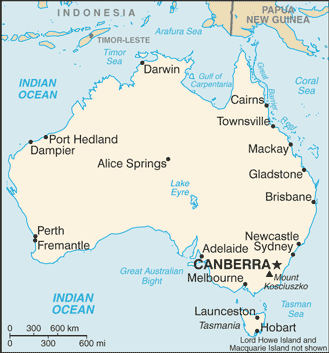
Australia is +7,68 million km² (2.9 million sq miles) making it the world's 6th biggest country.  It's slightly smaller than the 48 contiguous states.  It is located between the Indian Ocean and the South Pacific Ocean.  With no land borders, the closest neighbouring countries to the north are Papua New Guinea, Indonesia, and East Timor.  To the north-east are the Solomon Islands and Vanuatu.  To the south-east is New Zealand.

Australia was inhabited by indigenous people for about 60,000 years before Dutch explorers landed in 1606.  About 150 years later the French landed and in 1770 Great Britain claimed the eastern half.  The British settled New South Wales as a penal colony.

In 1901, Australia formally became the Commonwealth of Australia.  It is a federal parliamentary democracy and a constitutional monarchy.  It is made up of six states and several territories.  Australia is home to more than 23 million people.  The capital is Canberra and Sydney is the largest city.  Other notable cities include Melbourne, Brisbane, Perth, Adelaide, Cairns, and Alice Springs.

Australia is a long way from everywhere and almost everyone arrives by plane.  A flight to New Zealand takes three hours.  Most Asian countries take 7 to 11 hours to fly there and it can take about 24 hours or more to get there from Euroland.    

The country has the world's 9th largest immigrant population.  About 26% of the population was born outside of the the country.  Those seeking asylum, and arriving by boat, have a difficult time as all asylum seekers are housed and processed on the island nation of Nauru.  Some applicants have been redirected to Cambodia instead.  Here's a short video I found out on YouTube talking about immigration in Australia.
©Al Jazeera

$1
Australia has no official language.  However, the de facto language is English, with that charming Crocodile Dundee accent.  

The Australian Dollar (AUD) is the official currency.  The currency is also used in Kiribati, Nauru and Tuvalu.  Australia has the world's 12th-largest economy and the 10th-highest per capita income.

Here's a short video about how powerful the country is.  
©Test Tube News

Wednesday, May 23, 2018

Africa

Since I made it to every country in Europe, many people have asked me if my new goal is to see every country in Asia or Africa.  The short answer is "no", but there is a bit more to it.  Whilst I have been to every county in Europe, I for sure haven't seen everything.  Heck, I still manage to see new things here in Brno so I'm not going anywhere anytime soon.  With that being said, I am excited about my July trip to Johannesburg and Cape Town.  I've been on day trips to Morocco and Egypt, but to me this will be my first real trip to Africa.  Here's a bit about it.

Africa is huge!!  It's the second largest continent, both in size and population.  It's home to more than 1.2 Billion people.  Africa has 30,370,000 km² (11,730,000 sq miles).

Within its borders it could basically fit Belgium, Netherlands, Spain, Germany, Switzerland, Italy, Eastern Europe, India, China, Japan, the USA, and the UK.

There's a lot of diversity in Africa.  Starting with the 54 independent  countries.

North Africa - Algeria, Egypt, Libya, Morocco, South Sudan, Sudan, and Tunisia.  Western Sahara is disputed territory.  Many people include parts of Northern Africa as the Middle East.

West Africa - Benin, Burkina Faso, Cape Verde, Ivory Coast, The Gambia, Ghana, Guinea, Guinea-Bissau, Liberia, Mali, Mauritania, Niger, Nigeria, Senegal, Sierra Leone, Togo.  Saint Helena is a British dependency.

Central Africa - Angola, Cameroon, Central African Republic, Chad, Republic of the Congo, the Democratic Republic of the Congo, Equatorial Guinea, Gabon, Sāo Tomé and Principe.

East Africa - Burundi, Comoros, Djibouti, Eritrea, Ethiopia, Kenya, Madagascar, Malawi, Mauritius, Mozambique, Rwanda, Seychelles, Somalia, Tanzania, Uganda, Zambia, Zimbabwe.  Réunion and Mayotte are French dependencies.  Eastern Africa is widely accepted as the place of human origin.

Southern Africa - Botswana, Lesotho, Namibia, South Africa, Swaziland.

While the continent if rich in natural resources, it is the poorest and most underdeveloped continent.  Of the world's 28 poorest countries, 23 of them are in Africa.

In the 19th century, European powers scrambled to lay claim to parts of Africa and established colonies.  Here's a film clip from Uganda Rising that I found on YouTube that briefly talks about the European colonies in Africa.


Following the end of WWII, with European power weakened, most colonial powers starting gaining formal independence.  

©Test Tube News

The cities of Ceuta and Melillla are Spanish exclaves in North Africa so they belong to Spain.  The Plazas de Soberanía are small islands off the coast of Morocco that also belong to Spain.  Off the northwest coast of Africa is Madeira, an archipelago that is an autonomous region of Portugal, and the Canary Islands, an archipelago belonging to Spain.


There are more than 1000 languages spoken in Africa.  Almost every country has a European language as an official language with English and French being the most popular.  Portuguese is official in six countries.

Islam is the largest religion in Africa followed by Christianity and traditional beliefs.

Africa is not a great place to be gay.  Homosexuality is against the law in 34 countries.  Being gay in Uganda, Tanzania, and Sierra Leone can result in imprisonment for life.  The death penalty is in place in Sudan, southern Somalia and northern Nigeria.  The exception is South Africa which was the first country in the world to protect sexual orientation in its constitution.  South Africa, the Spanish and French territories all permit same-sex marriage.

You can't talk about Africa without considering the impact of slavery on the continent.  Between the 7th and 20th centuries, the Arab slave traders took 18 million slaves Africa.  Between the 15th and 19th centuries, between 7 to 12 million slaves were taken to the the Caribbean, North and South America during the Atlantic slave trade.

The continent has its share of current problems including authoritarian governments, political instability, corruption, armed conflicts, human rights violations, illiteracy and high levels of HIV/AIDS.

©Al Jazeera

Africa is home to just over 15% of the world's population.  Yet, more than two-thirds of the world's HIV/AIDS cases are in here.  Over 15 million people have died which has left many orphans and quite a young population.

Prevalence of HIV/AIDS in Africa, total (% of population ages 15–49), in 2011 (World Bank)
  over 15%
  5-15%
  2-5%
  1-2%
  0.5-1%
  0.1-0.5%
  not available


The African Union is their version of the European Union.  Except that every African country is a member of the AU.

©Test Tube News

Many believe that Africa is the future of economic growth.  Over the past years China has invested lots of money and today it is Africa's largest trading partner.  Ghana, Ethiopia, Ivory Coast, Djibouti, Senegal, and Tanzania, are among the world's fastest growing economies.  

Update 2025:  Here's a short video about why the Russian Empire never scrambled to colonise Africa like other European powers.

©History Matters

Wednesday, February 28, 2018

Jerusalem and Dead Sea Tour, Israel

This morning we set off from Eilat on a tour to Jerusalem and the Dead Sea.

The southern part (the Israeli section) of the Dead Sea is 220 km (137 miles) from Eilat through the Negev desert.  Along the way we passed Mount Sodom and the rock that is said to resemble Lot's wife.

The Dead Sea, יָם הַמֶּלַח, in Hebrew is Yam ha-Melah which translates to the Sea of Salt.  It's a salt lake bordering Israel, Palestine, and Jordan.


At 394,6 metres (1269 feet) below sea level, it's the lowest point in the world.  It is super salty!  It's 9.6 times more salty than the ocean which makes it impossible for plants and animals to survive which is why it's called the Dead Sea.  Because it is so salty you can't really swim.  Since you can't sink you just pretty much float there.

It's an awesome experience.  But when you get out you notice that the water has a sort of greasy feel to it.  Also be sure to wear waterproof sandals or aqua socks because the the salt crystals on the shore are jagged and will hurt your feet getting in and out of the water.

After a shower and change we got back on the bus and headed to Jerusalem which was about an hour's drive away.


Temple Mount
We only had a couple of hours in Jerusalem.  Our guide hit the major sites and showed us the Church of the Holy Sepulcher and the Wailing Wall.

We saw the Temple Mount at a distance but some day I actually want to go inside it.

The Church of the Holy Sepulchre is jointly managed by the Greek Orthodox, Armenian Apostolic, and Roman Catholic Churches, and it's considered the holiest site in Christianity.  It contains the last four Stations of the Cross, was the spot where Jesus was crucified and is where he is said to have been buried.

Jerusalem's municipality believes that tax exemptions have been incorrectly given to the church-owned commercial properties, which are not places of worship, so they want their tax revenue which I heard was several million dollars.  In protest, the church leaders closed the Church of the Holy Sepulcher on Sunday.  Obviously this didn't go well with all of the tourists.  After the mayor backed down, the church was reopened at 4 AM this morning.  The church was extra busy this today as everyone was trying to get in.  There were lots of reporters there interviewing various church leaders.

Here's a video I found out on YouTube about the situation.

©Al Jazeera

In the late afternoon we took an optional tour to Bethlehem to see the Church of the Nativity.