Showing posts with label Brexit. Show all posts

Tuesday, September 26, 2023

European Day of Languages 2023


Today is the European Day of Languages again.  The EU promote linguistic diversity and encourages everyone to speak multiple foreign languages.  There are 27 EU member countries and the EU has 24 official languages.   

The official EU languages are Bulgarian, Croatian, Czech, Danish, Dutch, English, Estonian, Finnish, French, German, Greek, Hungarian, Irish (Gaelic), Italian, Latvian, Lithuanian, Maltese, Polish, Portuguese, Romanian, Slovak, Slovenian, Spanish, and Swedish.

This means that EU legislation must be published in all 24 languages.  All EU citizens have the right to communicate with EU institutions in any of the official languages.

Within the EU, the European Parliament is the most linguistically diverse institution.  All 24 EU languages are used as MEPs may speak any official language.  Very diverse but it's expensive to have interpreters and translators to handle all 24 languages.  

The European Commission values efficiency over linguistic diversity.  While legally bound to all 24 languages of the EU, in practice the three main working languages are English, French and German.

Adding or removing a language to the official list requires the approval of all 27 EU members.  This is normally a part of the ascension process when a country joins the EU.  For example, Croatian became an official language when Croatia joined the EU in 2013.

When Luxembourg joined the EU in 1957, back when it was originally the European Economic Community (EEC), the national languages were French and German.  Both of which were official languages.  In 1984, Luxembourg made Luxembourgish an official national language.  However, it is not an official EU language because (a) Luxembourg didn't submit it as a language when it joined, and (b) to add it now would require all 27 countries to agree.

In Cyprus, both Greek and Turkish are official languages but only Greek is an official EU language.  More or less, kind of for the same reason as in Luxembourg.  

Last month, Spain formally requested that Catalan, Basque, and Galician all become official EU languages.  I don't think that this will happen anytime soon because all 27 countries have to agree, plus the associated administrative cost of adding three new languages.

English is an official language in Ireland and Malta, which is why English stayed an official EU language even after the UK left the EU

Tuesday, April 11, 2023

25th Anniversary of the Good Friday Agreement

Yesterday was the 675th anniversary of Charles University and it was also the 25th anniversary of the Good Friday Agreement.

The Good Friday Agreement, known also as the Belfast Agreement, signed on 10 April 1998, brought peace to Ireland.

The agreement was signed by the UK and Irish governments and was confirmed by referendums in both Ireland and Northern Ireland.  It allowed for devolved government in Belfast but more importantly, it brought an end to The Troubles which was the 30 years of violence between nationalists and unionists.

The Troubles began in the late 1960s as violent conflicts between Catholic Unionists and Protestant Loyalists.  During this time more than 3,500 people were killed and more than 50,000 injured.

The agreement acknowledged that the majority of people in Northern Ireland wanted to remain a part of the UK.  It also acknowledged that many people in Northern Ireland, and the majority in the Republic of Ireland want a united Ireland.  If and when a day comes that the majority of people in Northern Ireland want to be united with Ireland, then both the Irish and British governments must comply.

Everyone in Northern Ireland has the right to UK or Irish citizenship, or may have both passports.

Paramilitary gourds had to decommission weapons and the British and Irish governments committed to the early release of about 400 prisoners.  The British had to normalise security arrangements at the border.

One of the biggest problems of Brexit is that there's now a land border in Ireland between the UK and the EU.  Many people have been concerned that putting a hard border between Ireland and Northern Ireland could bring back the Troubles.

Here are a few videos I found on YouTube.

BBC News

RTÉ News

RTÉ News

Thursday, September 15, 2022

EUFOR

The European Union Force Bosnia and Herzegovina (EUFOR) is a military deployment to help keep the peace in Bosnia and Herzegovina (BiH).  At least it used to be called EUFOR.  Now it is Operation ALTHEA.


The United Nations put a peacekeeping force called UNPROFOR in BiH  back in 1992.  As part of the 1995 Dayton Peace Accords between BiH, Croatia, and Serbia (with Serbia also representing Srbska Republika), there was a one-year mandate for a multinational peace enforcement force.  The Implementation Force (IFOR), which replaced UNPROFOR, was led by NATO under the codename Operation Joint Endeavour.  

After the one year, IFOR was replaced by the Stabilisation Force in Bosnia and Herzegovina (SFOR).  SFOR was another NATO-led peacekeeping force, with several non-NATO countries contributing troops.  IFOR was replaced by EUFOR in December 2004.


NATO handed over its peacekeeping mission to the EU which is how EUFOR took over in 2004.  Operation ALTHEA ensures compliance with the Dayton Peace Agreement and contributes to safe and secure environment in BiH.

There are about 1000 troops currently stationed in BiH from 19 different countries, including Czechland.  The countries are all EU and/or NATO member states with the exception of Chile which isn't either.  In December 2020, the UK withdrew its troops from EUFOR after 16 years due to Brexit

The EU also has an Intermediate Reserve Force based in Europe that can be deployed on short notice to reinforce EUFOR in BiH if needed.

The first five years each saw a commanding general from a different country.  For some reason, since December 2009, each year the commanding general comes from Austria.

Here are a couple of short videos I found on YouTube.

©EUFOR Althea
©EUFOR Althea

Update March 2023:  Here's the new EUFOR video.

©EUFOR Althea

Wednesday, April 13, 2022

Nat's Coming to Help

Well Natalie is on her way back to Europe but it's not for something good.  Well, she will do some good but the reason for her coming isn't good.  Natalie is part of the New Zealand Red Cross and they are sending her as part of the International Federation of Red Cross and Red Crescent Societies (IFRC) team supporting people affected by Russia's invasion of Ukraine.

I know that the IFRC has to be politically neutral so their stance is that they are helping people affected by the conflict in Ukraine.  I still say that they are helping people affected by Putin's invasion of a sovereign country.

So Natalie is headed to Budapest, Hungary to start her assignment.  I'm sure that she will end up in Poland, Slovakia, Romania, and maybe even Moldova.  Not so sure that she'll go to Ukraine but who knows?  I don't know how long she will be here because thanks to Brexit, her UK passport no longer gives her unlimited time in Schengen so I guess the max is 180 days.

Here's the New Zealand press release about her deployment.

Our second international delegate is on her way to join the International Federation of Red Cross and Red Crescent Societies (IFRC) team supporting people affected by the conflict in Ukraine.

Natalie is travelling to Budapest where she'll be focusing on the distribution of multipurpose cash support to the most vulnerable people.  Cash assistance provides funds for displaced people to buy the essentials they need, which could include rent assistance for housing.  Natalie will be working for the IFRC and Red Crescent Societies as part of the New Zealand Red Cross International Delegate Programme.

She will be travelling around the countries bordering Ukraine to help Red Cross teams assist people who have fled the conflict zones.

"I'll be focused on the data and systems side of the cash and voucher programme - helping ensure the cash support is going to where it's needed most," says Natalie.

Natalie has a background in information management.  She's part of the New Zealand Red Cross IT and Telecommunications Emergency Response Unit and has previously deployed to Indonesia and the Pacific. Recently, she has worked for the IFRC in Switzerland on the global COVID-19 response.

International Delegates are trained technical experts who provide humanitarian assistance and contribute to saving lives, alleviating suffering and maintaining human dignity in conflict and disaster zones.

We are so proud of our favourite Kiwi!!  Stay safe Nat!!

Я за Україну. Я за Україною. Слава Україні  Stojím za Ukrajinou!  I stand with Ukraine. 🇺🇦

Wednesday, October 13, 2021

VAT on all Packages Now

Within the EU, the price of all goods that are shipped between EU-member states includes VAT.  VAT is value-added tax.  For Americans this is the sales tax.  By including the VAT, countries know that the correct amount of tax has been collected which allows goods to ship without having to go through customs.

This isn't the case for goods shipped in from outside the EU.  Things have to go through customs in order to calculate the VAT and usually some processing fees.  Prior to this month goods valued below 560 Kč (€22) were exempt from VAT.  Well as of 1 October 2021, that exemption is now gone.

This is a good news / bad news sort of thing.  The good news is that the Czech government has somewhat simplified the customs procedure.  The bad news is that now you have to pay the VAT on everything coming in from outside the EU and currently the VAT in Czechland is 21%.  Remember that due to Brexit, the UK is now out of the EU so this applies here too.

This was supposed to rollout across the EU on 1 January 2021 but it was pushed to 1 July to give EU countries time to get ready for it.  The Czechs needed a little longer so it didn't take effect until this month.

If you haven't paid VAT at the point-of-sale then you will need to deal with customs but you can always authorise the delivery provider to handle this for you for a fee.

So now all items under 3800 Kč (€150) are subject to VAT.  Items above 3800 Kč have to go through a separate customs procedure because you have to pay the VAT and you have to pay a separate duty tax which is dependent on the type of product.

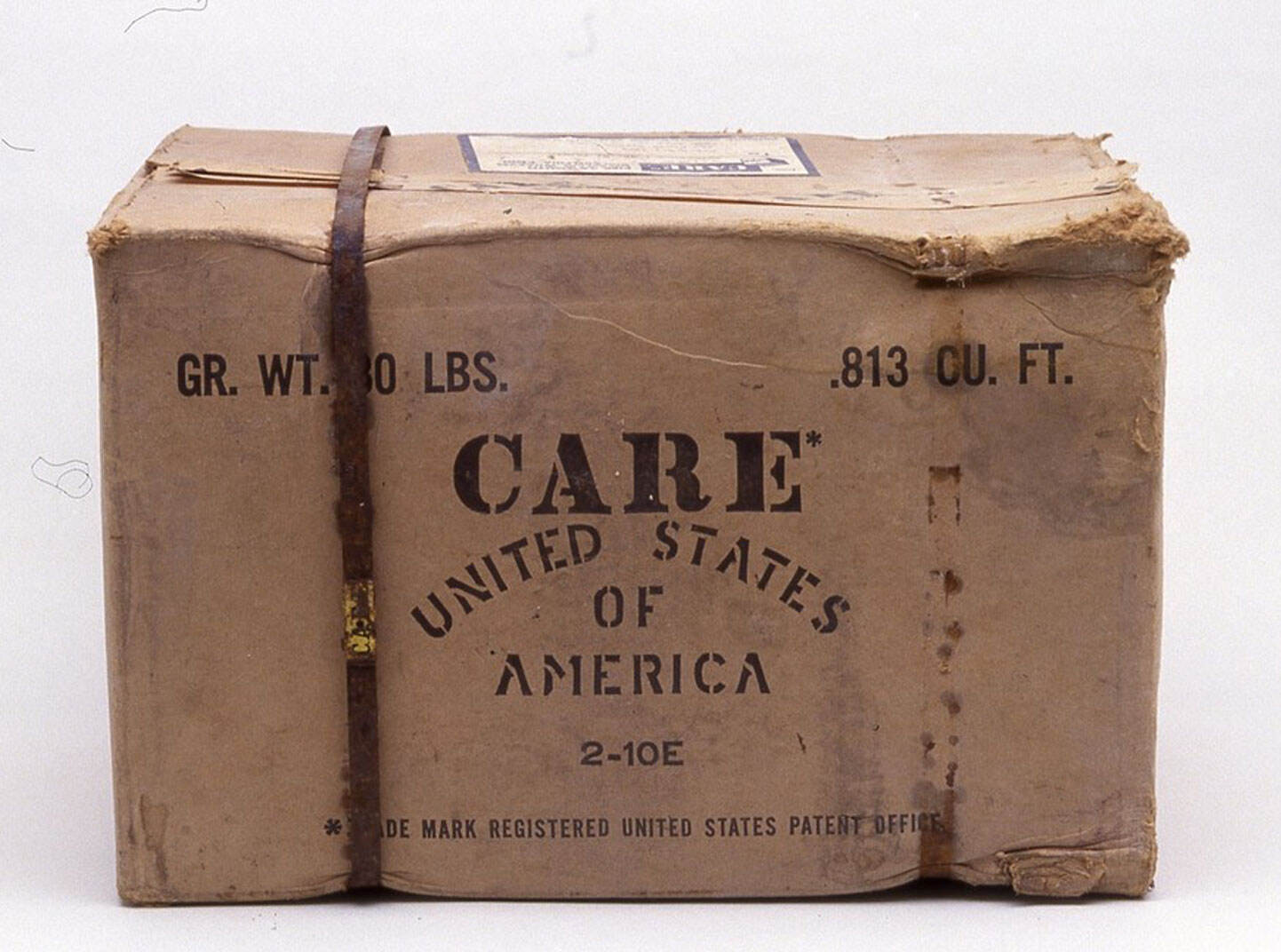
This will also impact care packages.  I believe that many people would receive things from outside the EU and no matter what was sent would just declare the value as less than €22 so that they would not have to pay any VAT.  This takes care of that and ensures that the government will get its share of tax revenue.  Česká pošta processed 28 million VAT-exempt packages from outside the EU in 2019 and the Czech government expects this change to generate an additional 182 billion Kč (€7 billion) of revenue each year.

It's been a while since I've even received a care package from back home.  Mainly because the cost of shipping increased so much in the USA.  In 2013, the cost jumped up from $55 to $77.  Who knows what it costs now in 2021?  Plus, I'd much rather receive hand-delivered care packages.

Update:  In November 2022, the postage cost of a 20 lb (9 kg) care package from the USA to Czechland is $115.70, from the USA.

Sunday, April 4, 2021

Erasmus

Brno is a student city and, under more normal times, there are many foreign students here under the Erasmus Programme.  Erasmus is the EU student exchange programme that was established in 1987.  It provides educational exchanges across the EU.  Some non-EU countries like Turkey, Iceland, Serbia, Norway, and Macedonia pay to participate in the programme as well.  Erasmus is the acronym for the EuRopean Community Action Scheme for the Mobility of University Students.  

In 2014, all of the EU's programmes for education, training, youth and sport were combined under Erasmus Plus.

Under Erasmus Plus students don't pay any more tuition than what they pay at their home institution.  Students receive grants to help cover living expenses to study abroad and for work placements/internships.  Teachers and educational staff are also able to attend training courses across Europe.  

Every year around 300.000 students participate in the programme at over 4.000 institutions in 37 countries.  Spain sends the most participants followed by France, Germany, and Italy.  The most popular receiving countries are Spain, Germany, Italy, and France.

I don't know how true it is but I've heard that some 25% of Erasmus participants meet their future spouse/partner while on the programme.

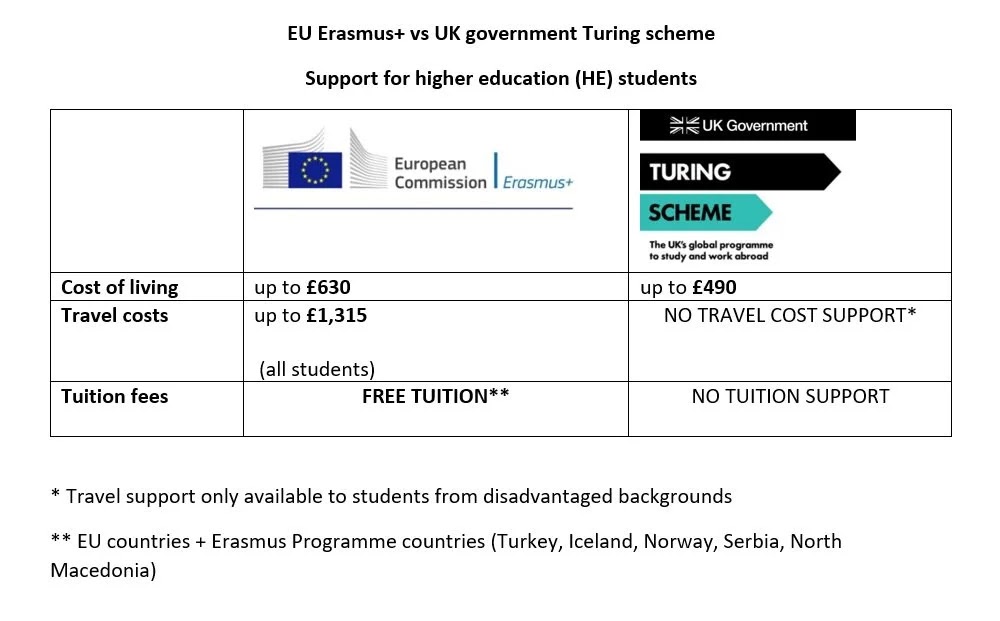
After Brexit the United Kingdom decided to no longer participate in Erasmus.  So UK students can no longer study in the EU and EU students aren't able to study at UK institutions.  The UK has rolled out the Turing Scheme, named after Alan Turing, as its replacement for Erasmus.  It will allow up to 35.000 UK students to study and work worldwide.   

Erasmus provides more money to students than Turing to subsidise their foreign placements.  

Ireland has announced that it will fund students from Northern Ireland to continue to participate in Erasmus even though the UK pulled out of the programme.

Thursday, April 1, 2021

Postage Price Increases

Česká pošta increased prices for some services today.  The price changes are mainly for registered letters, insured letters, and for money orders.  Prices didn't change for regular domestic letters or packages.

Doporučené psaní (registered letters) and cenné psaní (insured letters) up to 50 grams both increase 5 Kč (23¢).  Registered economy now costs 52 Kč ($2.40) and priority is 59 Kč ($2.73).  Insured letters are now 57 Kč ($2.64).

Normal domestic letters and post cards remain 19 Kč (88¢) for economy and 26 Kč ($1.20) for priority.  

A small package, up to 35 cm, is 89 Kč ($4.12) for economy and 99 Kč ($4.58) for priority.

There are four different types of postal money orders and they all increased 5 Kč for money orders up to 5.000 Kč ($231.19).  There are higher fees for higher value money orders.

Type A lets someone transfer the amount to a Czech bank account.  This costs 44 Kč ($2.03).

Type B lets someone send money from an account to be delivered in cash.  This costs 35 Kč ($1.62).

Type C lets someone pay in cash and have cash delivered.  This costs 53 Kč ($2.45).

Type D is a cash transfer in one working day and it costs 112 Kč ($5.18).

I don't know if it's due to Brexit but economy class is no longer available for packages going to the UK.

Tuesday, January 5, 2021

Post-Brexit EU Trade Deal

Thanks to Brexit, the UK is no longer part of the single customs union.  The UK and the EU did manage to agree on a last minute trade deal right before Christmas.  The impact of which is already starting to be felt and I believe that more problems will continue to pop up as Brexiters begin to realise the implications of voting to leave the EU.

The deal maintains the Good Friday peace deal so there is no hard border between Ireland and Northern Ireland.  In order to do this, Northern Ireland remains in the EU single market for goods, which means that Northern Ireland has to follow the EU's customs rules.  So now there's a customs border in the Irish Sea which basically separates the UK, between Northern Ireland and England/Scotland/Wales.

All goods moving between Great Britain and Northern Ireland now require a customs declaration, and additional certification on some goods and products, just as it does between the UK and any other EU-member country.

There's no more unlimited freedom to work and live between the UK and the EU.  UK citizens are free to visit Europe but have to follow the Schengen rules which means they can only be in the EU for up to 90 days in a 180-day period.  Any stay over 90 days will require a visa.

Not that there's a whole lot of travel now due to COVID-19 but when arriving in the EU, UK citizens no longer get to use the EU/EEA queues.  They have to use the non-EU citizen queues.

There are now additional customs duties, import fees and VAT when you purchase something online from the UK.  EU consumer protection rules no longer apply to purchases made from the UK.  So I won't be buying anything any longer from Amazon.co.uk.  I need to switch to Amazon in Germany

Mail will be more complicated.  Both from the UK to the EU and vice versa.  All customs fees, duties and taxes need to be paid in order to pick up any packages.  Some shipping companies have already increased their fees to cover the cost of the extra paperwork required.

The UK has set new tax rules where taxes must be collected at the point of sale which means that a business in the EU must collect taxes on sales made to UK customers which means a lot of tax headaches because now the EU firm must establish an account with the UK tax authorities and keep up with ever changing UK tax laws.  There are already cases where EU firms are no longer selling goods to UK customers.

I'm still not sure what's going to happen with surcharge-free roaming.  I have no idea what I'll pay to use my mobile whenever I actually make it back to the UK for a visit.

Booze cruises to the wine shops in Calais, France, were popular because there was an unlimited allowance on alcohol.  That comes to an end because now, there's a limit on the amount of alcohol allowed from the EU for personal consumption.  UK citizens can now only take back home up to 42 litres of beer, 18 litres of wine and 4 litres of spirits, plus up to 200 cigarettes.

On top of all of the this the UK still has to settle a £25 billion ($X) divorce bill by 2057.  It will be interesting to see what other unintended headaches pop up as a result of Brexit

Here are a few short videos already showing up on YouTube showing some of the consequences of the post-Brexit trade deals.

©Al Jazeera

©9 News Australia

©Sky News

There was speculation that with the UK out of the EU, that English would no longer be an official EU language.  Every country gets to put up an official language and Ireland chose Irish and Malta chose Maltese so now there's no EU country with English as its official language.  English is the most widely taught foreign language in the EU.  It appears that English will be kept on as an official EU language.

©Euronews

Update:  Here's a short story on Brexit's impact on the music industry.  I never even thought about this one.  What a mess.
©Euronews

Sunday, July 12, 2020

The European Commission

The European Commission, the EC, is the executive branch of the European Union.  The EC sits in Brussels and it is responsible for the day-to-day running of the EU.  The EC initiates new legislation as it alone has the power to propose laws for debate.  Another responsibility of the EC is to maintain that treaties are running efficiently and to police them.  Basically, the EC acts as the cabinet government for the EU.  The working languages of the EC are English, French, and German.

The commissioners are to think European as each must pledge to be independent of their home countries while acting in the general interest of the EU and not be subservient to their home countries.  There are 27 commissioners, one from each of the EU member countries.  It was 28 until the UK left the EU following Brexit.  

The path to become a commissioner seems kind of complicated.  Candidates are proposed by the Council of the European Union, based on suggestions coming from the various national governments.  Once approved by the European Parliament then they are appointed by the European Council, which isn't the same thing as the Council of the European Union. 

Here's a five minute video I found on YouTube that explains the how the European Commission works.

©Ciceroni

In December 2019, Ursula von der Leyen became the first woman to hold the presidency of the EC.  She used to be the German Defence Minister and her term is for five years.  Here's a bit about her.

                                   ©France 24


The Czech member of the European Commission is Věra Jourová.  

She is one of seven vice-presidents and she is responsible for Values and Transparency.

Update 2025:  Here's short video I found on YouTube about the European Commission.

©EU Made Simple

Saturday, February 1, 2020

The UK Left the EU

Well Brexit finally happened.  Yesterday, after 47 years, the United Kingdom officially left the European Union

Now starts the transition period which will last until 31 December 2020. Everything should stay the same for the rest of the year.  

27 EU members minus the UK
The UK has to continue following EU laws and continue putting money in to the EU coffer.  The big difference is that the UK no longer gets to vote in the EU Parliament.

EU citizens are still allowed to live and work in the UK.  UK citizens can still live and work in the EU.  At least until the end of the year.  Then there need to be agreements on the rights of EU and UK citizens residing in each other's territory.  For example, what happens to all of the British who have bought homes and retired in Spain?

The UK and the EU will have to agree on a new trade deal.  Plus individual trade deals with the rest of the world.


The biggest sticking point is going to be the Irish border.  The Good Friday Agreement opened the border and put an end to the Troubles.  


During the Troubles there were only 20 border crossings between the Republic of Ireland and Northern Ireland.  Today there are 208 border crossings.

It's quite the mess.  The UK wanted to close its borders with the EU.  Now Northern Ireland is the new physical border between the UK and EU.  No one wants the Irish border closed or a return of the Troubles. 

Pre-Brexit vs My Future UK Prediction

Who knows what the end result will end up looking like?  Personally I think Brexit will result in the eventual breakup of the UK.  Eventually, the two Irelands are going to end up as a united Ireland.  Scotland voted to remain in the EU during the last referendum but they voted overwhelmingly to remain in the EU so it's just a matter of time before Scotland eventually leaves the UK.  The future UK will probably just be the United Kingdom of England and Wales.  This is just my personal opinion.  I don't have a crystal ball but this is what I'd bet on.

Tuesday, May 21, 2019

No More Registered Traveller

Two years ago I became a registered traveller for the UK and it has been awesome.  Year one cost me £70 ($92) but last year's renewal was on £50 ($62).  It's so worth it to be able to no longer fill out landing cards and to be able to us the ePassport gates.  No more filling up my passport with UK entry stamps.  Yeah!

As of yesterday I won't need to renew my registered traveller status anymore.  Now all Americans get to use the ePassport gates.  The gates have also been opened to travellers from Australia, Canada, Japan, New Zealand, Singapore, and South Korea.  So much for being in an exclusive club but at least I'll now save £50 a year.

As I understand it, if and when Brexit happens, EU citizens will still be able to use the gates.

Here's short video I found out on YouTube about how to use the gates.
©UK Home Office

Saturday, March 23, 2019

European Capital of Culture

The European Capital of Culture is awarded by the EU to a city for one calendar year.  During the year, the city organises a series of cultural events and winning the title tends to be very good for the city economically when it comes to increased tourism.  There's also a cash prize of €1,5 million.

The award was launched in 1985 when Athens was selected as the first title-holder.  Until 1999, only one city held the title per year.  In 2000, the millennium year, nine cities shared the title including Prague which was expected to join the EU in 2004.

Since 2001, two cities are selected to share the title.  In 2015 Plzeň shared the title with Mons, Belgium.

In 2021, and then every three years, a third city will be selected that is either from a country in the EEA or from a country that is a potential EU member.

The UK was supposed to hold the title in 2023.  However, due to Brexit, the UK wasn't expected to be in the EU by then so only Hungary will hold the title in 2023.  Who knows if the UK will actually leave by then or not?

In 2028, Czechland and France will each host a European Capital of Culture.

Brno wants the title bad and has announced it will hire five new employees as it expands the Department of Culture.

Czech cities expected to submit bids are Ostrava, Zlín, and Liberec.  Other cities may possibly submit bids but the deadline for nominations is at the end of 2022.  Then a 12-person panel will decide the winner.  The panel will be made up of ten people appointed by the EU and two people selected by the Czech Ministry of Culture.  Let's go Brno!!

Update:  Brno is out of contention.  The short list of the Czech title is down to Broumov and České Budějovice.

Saturday, January 12, 2019

Another New EU Rule

As of two days ago, there's a new EU rule in place that I'm very happy about.

Banks can now only charge as much for cross-border payments as they charge for domestic payments.  Yeah lower fees!


If your bank charges you €1 every time you withdraw money in your home country (outside of your bank's network), then they can't charge you any more than that when you make a withdrawal in any other EU country.  This includes transfers between bank accounts in different EU countries.

Brexit still hasn't happened so this applies to the UK as well.  Once, if ever, the Brexit does happen then here's another thing that will need to be worked out.

Thursday, March 2, 2017

Gibraltar

Gibraltar, also known as the Rock, is a British Overseas Territory on the Iberian Peninsula.  While it is physically connected to Spain, it is a part of the United Kingdom.  Gibraltarians (Gibs) hold UK passports.

Gibraltar is small.  It is only 6,7 km² (2.6 sq mi) which is more than 10 times the size of The National Mall in Washington, D.C.  However, it is densely populated as it is home to 30,000 people.

Phoenicians inhabited the area around 950 BC.  Over time it has been held by the Carthaginians, Romans, and Vandals.

In 1704, Gibraltar was captured from the Spanish during the War of the Spanish Succession.  In 1713, the territory was given to the UK in perpetuity.  Spanish monarchs have unsuccessfully attempted to regain the territory.

Strategically it is quite important because it's only 13 km (8 miles) to Africa, which means from Gibraltar the British Navy can control entry and exit to the Mediterranean Sea.  Today, almost half the world's seaborne trade passes through the strait.

Gibraltar has its own money, sort of.  It issues Pound Sterling coins and banknotes, like Scotland and Northern Ireland do.  It's easiest to just use £ Sterling as it may not be accepted back in the UK.

English is the official language but most people speak Spanish.  Many people also speak Llanito which is a mix of Andalusian Spanish and British English, plus bits of Maltese, Portuguese, Genoese Italian and others.  When people speak it they flip back and forth mid-sentence.  This is where the term "gibberish" comes from.  Here are a few examples but where I grew up in California we call this Spanglish.

Gibraltar is the only British Overseas Territory that is part of the EU which is a problem now.  Gibraltar voted overwhelming to stay in the EU so Spain may use Brexit as a way to get back control.  Although time and again, the people remain fiercely loyal to the UK.

Here's a video I found on YouTube that helps share some more insight.

©SeekerDaily

Later this month I'll be in Málaga for a week's holiday and we've already booked a day trip to Gibraltar.  Here's a Rick Steven video I found that highlights more of the touristy stuff.

©Rick Steves

Update 2025:  Here's a short video about why the UK has Gibraltar.

©History Matters