Showing posts with label Iceland. Show all posts

Saturday, June 10, 2023

2023 Global Peace Index

The 17th edition of the Global Peace Index was released.  The Institute for Economics and Peace (IEP) uses 23 qualitative and quantitative indicators across three different domains: Societal Safety and Security, Ongoing Domestic and International Conflict, and Militarisation.

For the 17th year in a row, Iceland maintains the top spot.  Here are the top 15 countries and the variance from last year's results.

  1. Iceland
  2. Denmark +1
  3. Ireland -1
  4. New Zealand +2
  5. Austria -1
  6. Singapore +4
  7. Portugal +1
  8. Slovenia -4
  9. Japan
  10. Switzerland +1
  11. Candada +2
  12. Czechia -5
  13. Finland +3
  14. Croatia +1
  15. Germany +2
Europe continues to be the most peaceful region, with 7 of top 10 countries.  Although Europe did go down in all three domains over the past year.  Mainly due to the Russian invasion of Ukraine, Europe is now less peaceful than it was 15 years ago.

I'm not sure what happened here in Czechland, with the five spot drop and falling out of the top 10.  But even in 12th place I feel much safer living in Euroland than anywhere else.

The USA remains at 131st place.  Behind Haiti and South Africa, but ahead of Brazil, Eritrea, and Palestine.

The USA recorded the 4th largest overall increase in its homicide rate, which is more than 6 per 100.000 people.  This is more than six times higher than most Western European countries.

The Middle East and North Africa is the world's least peaceful region.  

Ukraine dropped 14 places to 157, just ahead of Russia at 158.  Followed by the five least peaceful countries, with no change from last year.

159. Democratic Republic of the Congo
160. South Sudan
161. Syria
162. Yemen
163. Afghanistan

Я за Україну. Я за Україною. Слава Україні  Stojím za Ukrajinou!  I stand with Ukraine. 🇺🇦

Wednesday, November 30, 2022

2022 Global Peace Index

The Global Peace Index ranks the level of peacefulness and this year was the 16th edition.  Iceland continues to come in first place which it has been since 2008.  New Zealand came in second place again.   

  1. Iceland 
  2. New Zealand
  3. Ireland +3
  4. Denmark -1
  5. Austria +2
  6. Portugal -1
  7. Slovenia -3
  8. Czechland +1
  9. Singapore +1
  10. Japan +1
Europe continues to be the most peaceful area with seven of the top ten spots and 14 of the top 20.

No surprise that Russia and Ukraine are two of the five countries with the biggest drop in peacefulness.

The USA dropped one spot to #129, behind Azerbaijan and ahead of Brazil.

The Middle East and North Africa are the least peaceful regions.

For the fifth year in a row, Afghanistan came in last place, ahead of Yemen, Syria, Russia, and South Sudan.

Я за Україну. Я за Україною. Слава Україні  Stojím za Ukrajinou!  I stand with Ukraine. 🇺🇦

Tuesday, November 29, 2022

2022 World Happiness Report

This year is the 10th anniversary of the World Happiness Report. by the Sustainable Development Solutions Network of the United Nations.  The report factors in things like gross domestic product per capita, healthy life expectancy, freedom to make choices, perceived corruption and social support from friends and family. 


For the fifth year in a row, Finland came in first place.

Scandinavia did well as usual with the five countries all placing in the top eight places.  Finland #1, Denmark #2, Iceland #3, Sweden #7 and Norway #8.

Switzerland placed #4.

The BeNeLux countries did well too with the Netherlands #5, Luxembourg #6, and Belgium #19.

Europe is the happiest region with the eight of the top ten spots.  The only non-European countries to crack the top ten are Israel #9 and New Zealand #10.

The USA placed #16 and Czechland placed #18.

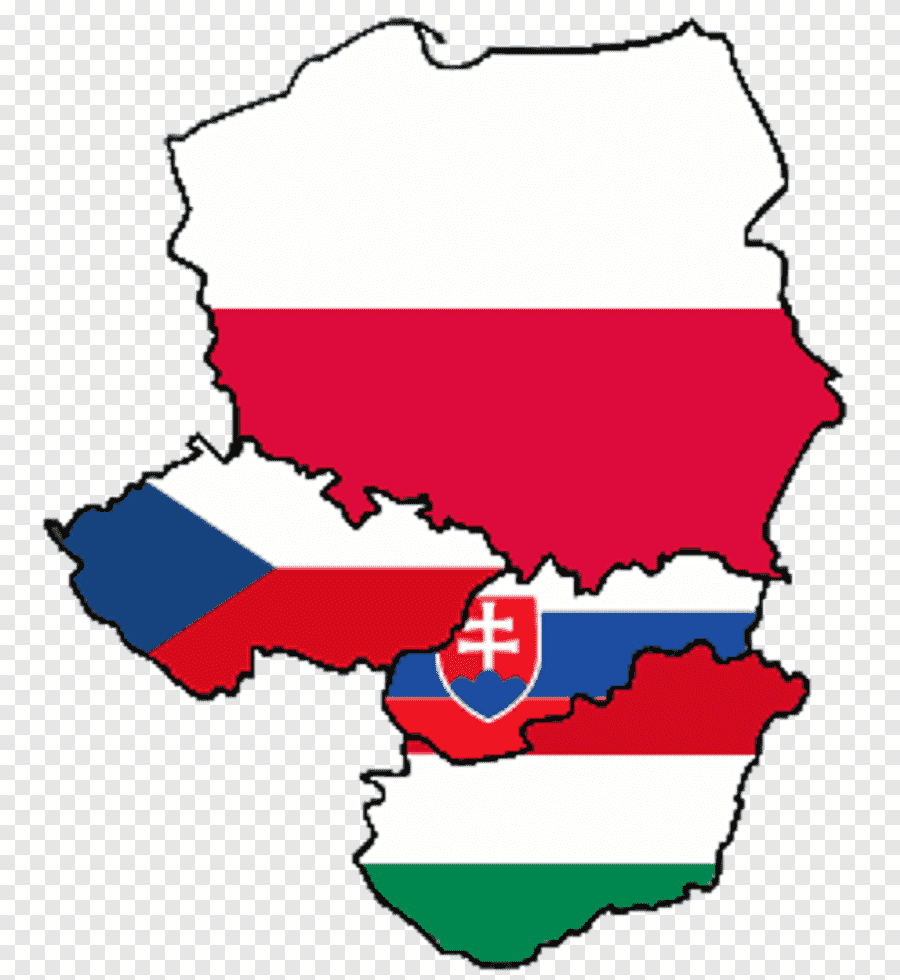
Czechland continues to be the happiest of the Visegrád Four with Slovakia #35, Poland #48, and Hungary #51.

Last place goes to Afghanistan, behind Botswana, Rwanda, Zimbabwe, and Lebanon.

Sunday, May 15, 2022

2022 Eurovision Finals

Last night were the grand finals of the 2022 Eurovision Song Contest in Italy.  This year's competition had 40 countries enter and compete in two semi-final rounds with 25 in the grand finale.  Again, Russia was not allowed to compete due to its invasion of Ukraine earlier this year.

Kalush Orchestra, who won the first semi-final, won this year's contest.  They won with 631 points which is incredible.  Their song "Stefania" is the first song sung entirely in Ukrainian.  It's also the first song to ever win with hip-hop elements.  Here's their winning performance.

©Eurovision Song Contest

The UK came in second place.  Sam Ryder's song "Space Man" received 466 points.  This sets a record for the UK with 16 second place finishes.

©Eurovision Song Contest

The winner of the second semi-final, Sweden, finished in fourth place behind Spain.

Czechland didn't do so well.  We Are Domi earned just 38 points and ended up in 22nd place.  But at least we made the grand finale and beat Iceland, France, and Germany.

©Eurovision Song Contest

If anyone's interested in watching the full grand finale then here's the complete 4,25 hour show that's available on YouTube.

©Eurovision Song Contest

Well done Ukraine!  I hope that this isn't the only thing that they win this year.  Я за Україну. Я за Україною. Слава Україні  Stojím za Ukrajinou!  I stand with Ukraine. 
🇺🇦

Sunday, April 4, 2021

Erasmus

Brno is a student city and, under more normal times, there are many foreign students here under the Erasmus Programme.  Erasmus is the EU student exchange programme that was established in 1987.  It provides educational exchanges across the EU.  Some non-EU countries like Turkey, Iceland, Serbia, Norway, and Macedonia pay to participate in the programme as well.  Erasmus is the acronym for the EuRopean Community Action Scheme for the Mobility of University Students.  

In 2014, all of the EU's programmes for education, training, youth and sport were combined under Erasmus Plus.

Under Erasmus Plus students don't pay any more tuition than what they pay at their home institution.  Students receive grants to help cover living expenses to study abroad and for work placements/internships.  Teachers and educational staff are also able to attend training courses across Europe.  

Every year around 300.000 students participate in the programme at over 4.000 institutions in 37 countries.  Spain sends the most participants followed by France, Germany, and Italy.  The most popular receiving countries are Spain, Germany, Italy, and France.

I don't know how true it is but I've heard that some 25% of Erasmus participants meet their future spouse/partner while on the programme.

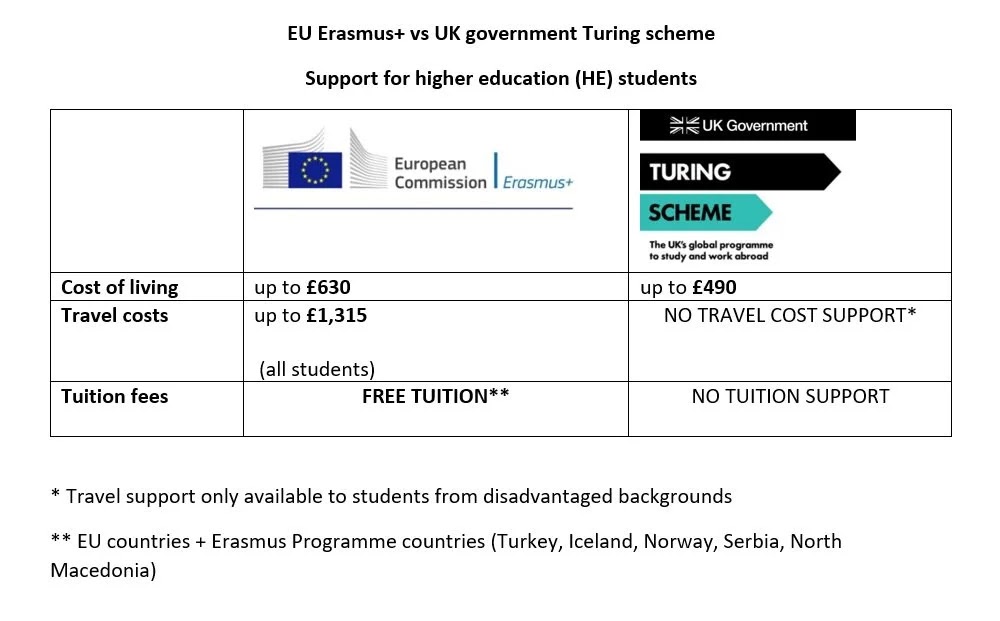
After Brexit the United Kingdom decided to no longer participate in Erasmus.  So UK students can no longer study in the EU and EU students aren't able to study at UK institutions.  The UK has rolled out the Turing Scheme, named after Alan Turing, as its replacement for Erasmus.  It will allow up to 35.000 UK students to study and work worldwide.   

Erasmus provides more money to students than Turing to subsidise their foreign placements.  

Ireland has announced that it will fund students from Northern Ireland to continue to participate in Erasmus even though the UK pulled out of the programme.

Saturday, March 20, 2021

2020 World Happiness Report

Today is the International Day of Happiness.  The United Nations started this back in 2013 to promote the idea that feeling happy is a global human right.  Clearly 2020 was a challenging year due to COVID-19 so this year's theme is "Keep Calm.  Stay Wise.  Be Kind."

The 2020 World Happiness Report was released today.  Czechland came in at #18 and the USA came in at #19.  This is the first time that Czechland outranked the USA.  

Like last year, Finland came in #1 again and 14 of the 20 world's happiest countries are in Europe.  At #9, New Zealand is the only non-European country to crack the top 10.

Scandinavia is the happiest region in Europe with #1 Finland, #2 Denmark, #4 Iceland, #6 Norway, and #7 Sweden.

BeNeLux did well with #5 Netherlands, #8 Luxembourg, and #20 Belgium.

The only Middle Eastern country to make the top 20 was #12 Israel.  Even with Brexit the UK came in at #17.

At #18 Czechland was the clear happiness leader of the Visegrad countries with #34 Slovakia, #44 Poland, and #53 Hungary.

Many of the most unhappiest counties are in East and Southern Africa including #137 Zambia, #140 Burundi, #142 Tanzania, #144 Malawi, #145 Lesotho, #146 Botswana, #147 Rwanda, and #148 Zimbabwe.

The world's most unhappiest country is #149 Afghanistan.  

The rankings are based on the combined scores for the last three years.  

Not much changes overall if you only go by the 2020 scores instead of the three year average.  Although then the USA would have been #14 and Czechland #16.

Tuesday, August 18, 2020

2019 Global Peace Index

The results of the 13th annual Global Peace Index are in. Europe maintained its position as the world's most peaceful region for the 13th year in a row.

Iceland and New Zealand kept the first two spots again.

  1. Iceland
  2. New Zealand
  3. Portugal
  4. Austria
  5. Denmark
  6. Canada
  7. Singapore
  8. Slovenia
  9. Japan
  10. Czech Republic
The USA came in at #128, out of 163 countries, behind South Africa but ahead of Saudi Arabia.  

Afghanistan and Syria swapped positions as the least peaceful countries.  The bottom five are:
159.  Iraq
160.  Yemen
161.  South Sudan
162.  Syria
163.  Afghanistan

Friday, June 14, 2019

2018 Global Peace Index

The 2018 Global Peace Index was just released.  Czechland continues to be one of the most peaceful countries to live it.
Even though it slipped a few spots from last year, Czech Republic is the tenth most peaceful country in the world.  The sixth most peaceful in Europe.

Europe continues to be the world's most peaceful region as it has every year this index has been released.  The USA dropped seven spots to place 128th (out of 163 countries).

For the sixth year in a row, Syria is the world's least peaceful country.  Followed by Afghanistan, South Sudan, Iraq, and Somalia.

The Top 10 countries are:
1.  Iceland
2.  New Zealand
3.  Portugal
4.  Austria
5.  Denmark
6.  Canada
7.  Singapore
8.  Slovenia
9.  Japan
10. Czech Republic

Sunday, March 24, 2019

2019 World Happiness Report

The 7th World Happiness Report was released by the Sustainable Development Solutions Network of the United Nations and Czechland was ranked at the 20th happiest out of 156 countries.

The report factors in things like gross domestic product per capita, healthy life expectancy, freedom to make choices, perceived corruption and social support from friends and family.

No surprise that the Scandinavian countries ranked so high.  For the second year in a row, Finland come in 1st, followed by Denmark, Norway, and Iceland.  The Netherlands came in 5th place.  Of the 20 happiest countries in the world, 14 of them are in Europe.

The USA came in 19th.  At 20th, Czechland scored the best of the Visegrád Group with Slovakia at 38th, Poland at 40th, and Hungary at 62nd.

Czechs continue to rank higher each year.  In 2015 they were 31st, in 2016 they were 27th, in 2017 they were 23rd, and last year they were 21st.

The most unhappiest countries are South Sudan, the Central African Republic, Afghanistan, Tanzania, Rwanda, and Yemen.


2019 Top 30 Happiest Countries

Thursday, September 13, 2018

Turning 100

This 11 November will commemorate 100 years since the end of WWI.  In the United Kingdom, and most Commonwealth countries it is known as Armistice Day.  The USA changed Armistice Day to Veterans Day, in 1954, to honour all U.S. veterans.

In Europe, the end of WWI changed the landscape as long-standing empires fell and newly independent countries emerged.  So this year, several countries will celebrate their centenary.

On 28 October, Czechland will celebrate the 100 years of the founding of Czechoslovakia.  Specifically the First Republic, which was the twenty years between WWI and WWII.  Even though Czechoslovakia hasn't existed for 25 years, the Czechs still celebrate independence from the Austro-Hungarian Empire.

The three Baltic countries of Estonia, Latvia, and Lithuania are also celebrating 100 years of independence.  Even though they haven't been independent nations the whole time.  Each declared independence at the end of WWI.

However, their independence was brief because they were occupied by the Soviet Union, then the Germans, and eventually were annexed as Soviet republics.  They eventually gained independence in 1991 as the Soviet Union broke apart.

Lithuania already celebrated its 100th, known as #LT100 on 16 February.  Estonia celebrated on 24 February.

Latvia celebrates on 11 November.

Poland had been an independent country but following partitions and 123 years of serfdom the country ceased to exist until 1918.  On 11 November, the Second Polish Republic declared independence from the German, Austrian, and Russian Empires.  This is when Poland, as a country, got back on the map.

On 11 November 1918, Emperor Charles I renounced the throne of the Austro-Hungarian Empire.  The next day, Austria declared itself a republic.  Like many countries, Austria's independence was interrupted during WWII as it had been annexed by the Third Reich.

Like Austria, Hungary became independent but they aren't so happy.  On 1 December 1918, Hungary lost Transylvania to Romania.  So while Hungary isn't celebrating anything, in Romania they are celebrating the "Great Unification".

On 1 December 1918, Iceland became a free and sovereign state after it signed the Act of Union with Denmark which kept the Danish King as head of state.  Iceland actually became an independent country in 1944, but this year they are celebrating 100 years as a sovereign state.

Following WWI, the Kingdom of Serbs, Croats, and Slovenes was established which became Yugoslavia.  I'm not aware of anyone celebrating 100 years of Yugoslavia as it only lasted 75 years and has been gone for a generation.

Finland celebrated its 100th last year on 6 December.


In 1922, 26 counties formalised the independence of the  Irish Free State.  While it became Ireland in 1937 and declared itself a republic in 1949, I bet there will still be a 100th party of some kind in 2022.

Tuesday, June 6, 2017

2017 Global Peace Index

The 2017 Global Peace Index was released the other day.  Once again, Czechland remains one of the most peaceful countries to live in.  It maintained it's 6th place standing it earned last year.

Europe remains the safest region in the world with 15 of the top 20 spots.

Once again, Iceland came out on top.

Last year the USA placed 103rd.  This year it fell to 114th.

For the fifth year in a row, Syria is the world's least peaceful country, followed by South Sudan, Iraq, Afghanistan, and Somalia.

The top 10 countries are:
1.  Iceland
2.  New Zealand
3.  Portugal
4.  Austria
5.  Denmark
6.  Czech Republic
7.  Slovenia
8.  Canada
9.  Switzerland
10.  Ireland

Friday, January 13, 2017

Off to the Arctic Circle

I'm off to the Arctic Circle this weekend.  Specifically, I'm on the way to Tromsø, Norway.

The Arctic Circle is about 16,000 km (9,900 miles).  About 4% of the Earth's surface lies north of the Circle.  The Circle crosses Norway, Sweden, Finland, Greenland (Denmark), Iceland, Russia, Canada, and the USA.  Due to the severe cold, only around four million people live there.

The Arctic Circle isn't fixed.  The latitude depends on the axial tilt of the planet.  The Circle is drifting north about 15 metres (49 feet) per year.

At this time of year there will be very little daylight, maybe only five or six hours per day.  The reason for going this weekend is to try to see the Northern Lights.  Fingers crossed for good weather.

Friday, July 1, 2016

Midnight Sun

We're in Helsinki this weekend for Eiko and Tommi's wedding tomorrow.  It feels like we were just at Liz and Jame's wedding and now it's time for Eiko to walk down the aisle.

One interesting thing going on, besides this also being Helsinki's Pride weekend, is the midnight sun.  Also called "white nights", this is when sunsets are late, sunrises are early, and it never really gets completely dark.  While the sun sets for a while, light can be seen on the horizon.

Around the summer solstice the sun is visible for 24 hours but this is way up north closer at the Artic Circle.  Most of Scandinavia experiences these white nights, Iceland, Finland, Norway and Sweden, plus Greenland, Russia, Alaska, and parts of Canada.

This photo was taken at 11 PM and as you can see it is still very much light outside.  The night sky is defiantly more blue than black.

Our hotel has blackout curtains so I don't think it will be a problem getting a solid night's sleep before all of the festivities begin tomorrow.

Monday, June 13, 2016

2016 Global Peace Index

The results of the 2016 Global Peace Index are in.  Despite last year's terror attacks in Paris and Brussels, and instability in Turkey, Europe remains the world's most peaceful region.  European countries make up 14 of the the world's top 20 peaceful countries.

For the third year in a row Iceland is the most peaceful country.

Last year, Czechland cracked the top 10.  This year it moves up four spots to #6.  The USA fell out of the top 100 to come in at #103.

Syria is the least peaceful country followed by, South Sudan, Iraq, Afghanistan, and Somalia.

Here are the top 20 countries.

  1. Iceland
  2. Denmark
  3. Austria
  4. New Zealand
  5. Portugal
  6. Czech Republic
  7. Switzerland
  8. Canada
  9. Japan
  10. Slovenia
  11. Finland
  12. Ireland
  13. Bhutan
  14. Sweden
  15. Australia
  16. Germany
  17. Norway
  18. Belgium
  19. Hungary
  20. Singapore

Saturday, May 30, 2015

2015 Global Peace Index

The 2015 Global Peace Index results are in.  Europe remained the world's most peaceful geographical region.  No real surprise there as 15 of the top 20 countries are in Europe.

Iceland remained the most peaceful country in the world.

Both Czechland and the USA improved from last year's results.  Czech Republic moved up to 10th place (the 6th most peaceful country in Europe).

The USA moved up to 94th place.  Not the best of scores but it's an improvement.


Here are the top 20 countries.
1.  Iceland
2.  Denmark
3.  Austria
6.  Finland
7.  Canada
8.  Japan
9.  Australia
10.  Czech Republic 
11.  Portugal
12.  Ireland
13.  Sweden
14.  Belgium
15.  Slovenia
16.  Germany
17.  Norway
18.  Bhutan
19.  Poland
20.  Netherlands

Update:  The 2016 results.

Tuesday, May 12, 2015

Same-Sex Marriage

On 22 May, Irish voters decide on a constitutional amendment that will allow for same-sex marriage.  If it passes then Ireland will be the first country in the world to legalize same-sex marriage via the ballot box.


There are posters up all through out Dublin right now.  Both for and against; mostly for.

The amendment is supported by the government as well as by every major political party.  Hopefully the measure will pass.


The referendum is only for Ireland.  It does not include Northern Ireland which is the only part of the United Kingdom where same-sex marriage is not recognized.  Here's a great TV commercial I found on YouTube about the upcoming vote.


In 2001 the Netherlands became the first country in the world to legalize same-sex marriage.  Belgium followed in 2003 and in 2005 so did Spain and Canada.  South Africa passed legislation in 2006.  In 2009 it became legal in Norway and Sweden.  Gay marriage became legal in 2010 in Portugal, Iceland, and Argentina.  In 2012 it became legal in Denmark.  Brazil, France, Uruguay, and New Zealand all passed legislation in 2013.  Same-sex marriage became legal in 2014 in England, Wales, and Scotland.  So far in 2015 only Luxembourg has legalized same-sex marriage.  It becomes legal in Finland in 2017.

These are just the countries that permit same-sex marriage.  Other countries such as Germany allow for civil unions/domestic partnerships that allow for many of the same benefits as marriage but not equal protection.  Let's see what happens this year in Ireland and the USA.

While Czechland does not recognise same-sex marriage it has allowed for registrované partnerství (registered partnerships) since 2006.  While not perfect, Czech registered partnerships grant equal status when it comes to inheritance, alimony, and hospital privileges but it does not allow for joint adoption, widow's pensions or joint property rights.  That's still way more benefits than many parts of the USA allow for. 

Since 1999 gays are allowed to serve openly in the Czech military.  In 2009, a law was passed that prohibits discrimination on the basis of sexual orientation in employment, education, housing, and access to goods and services.  Again, way more than what most American states have.

While more and more countries are recognizing gay marriage there are still many more that want to limit equal rights.  In February there was a motion in Slovakia to restrict marriage to only between a man and a woman.  Fortunately it failed but most likely only because not enough Slovaks went to the polls.

Update:  Another reason for me to like my favorite island even more! Ireland became the first country in the world to legalize same-sex marriage by popular vote on Saturday.  In politics it was a landslide with 62,07% of Irish voters choosing "Yes/Tá" for equality.

Update:  Gay marriage actually became legal in the USA.
Update:  In July 2017, gay marriage became legal in Malta.

Update:  Here's the current 2019 status.  Gay marriage is now legal in Columbia, Greenland, Australia, Germany, Austria, Ecuador, and Taiwan.  

Update:  Northern Ireland passed it in October 2019 and it becomes effective in January 2020.  In 2020, it became law in Costa Rica.

Update:  Switzerland had a referendum in 2021 that passed with 64% of the vote.  So equal marriage in Switzerland becomes legal on 1 July 2022.