Showing posts with label Soviet Union. Show all posts

Monday, August 21, 2023

55th Anniversary of the Invasion

Today was the 55th anniversary of the Soviet led Warsaw Pact invasion of Czechoslovakia

The invasion ended the reforms of the Prague Spring and ushered in the era known as "normalisation" which was the strict alignment of Soviet policy that didn't end until the Velvet Revolution in 1989.

In 2019, the Czech Senate declared 21 August as a Significant Day that's officially known as "The Day of Memory of the Victims of the 1968 Invasion and Subsequent Occupation of Czechoslovakia by Warsaw Pact Troops."

Different Time Same Occupation

There were memorials across Czechland today and there are clear parallels between the invasion of Czechoslovakia and the Russian invasion of Ukraine.

1. The aggressor fabricated internal threats to justify invading an independent country.

  • In 1968, it was framed not as an invasion but as "fraternal assistance" to protect communism from alleged Western interference and counter-revolution.
  • Today, Russia's narrative is that it's not a war but a "special military operation" to "protect Russian speakers" from alleged Nazism and NATO control.
2. Both the Soviet Union and Russia deny the sovereignty of smaller countries. 
  • The Soviets asserted that communist countries had "limited sovereignty" that later became known as the Brezhnev Doctrine.
  • Vladimir Putin claims that Ukraine is a historical part of Russia so therefore doesn't believe it is a real state.
3. Use of propaganda.
  • In 1968, the Soviet media claimed that the military was invited.  They suppressed independent media and forced agreements signed under duress.
  • Today, the Russian media, which is under state control, claims that they were asked to come help by Russian-speaking Ukrainians.  There are heavy disinformation campaigns and staged referenda in occupied territories like when Russian annexed Crimea.  

Many people here in Czechland see Ukraine living out 1968.  A common phrase I hear is My už toile jednou zažili which means "We've lived through this once already."  The difference I see though is that Ukraine is fighting back where as Czechoslovakia never had the chance to.

Я за Україну. Я за Україною. Слава Україні  Stojím za Ukrajinou!  I stand with Ukraine. 🇺🇦

Sunday, March 5, 2023

The Russian Empire

The Russian Empire was founded in 1721 by Czar Peter I, also known as Peter the Great.  It lasted until 1917, almost two hundred years, and stretched from Central/Eastern Europe to Siberia, Central Asia and even Alaska.  It was the third largest empire in history, only behind the the Mongol Empire and British Empire.

Peter the Great, a member of the Romanov dynasty, wanted to transform Russia into a modern European state.  Here's a ten minute video I found on YouTube on Peter the Great and the Russian Empire with a bit of background on Russia prior to the Russian Empire.

©History Matters

Following Peter the Great's death, there came a number of Romanov czars and czarinas but the next great ruler wasn't until 1762, with Catherine II, known as Catherine the Great became empress.  

Following defeats of the the Ottoman Empire and the Polish-Lithuanian Commonwealth in a number of wars, the Russian Empire's borders expanded into Crimea, Belarus, Central Ukraine, and Lithuania.  Catherine the Great ensured the empire's status as one of the great European powers.

Catherine the Great ruled from 1762 to 1796.  Here's a short video about her.

©Biography

Alexander II was czar from 1855 to 1881.  Almost half of the people living in the empire were serfs, peasant labourers tied to particular parcels of land they worked or to the Russian nobleman who owned it.  In 1861 he emancipated all 23 million serfs.  The newly freed serfs received 2/3rds of the land they had worked but in return had to pay annual compensation to the state.  
In 1867, he sold Alaska and the Aleutian Islands to the United States for $7.2 million.

Nicholas II took the throne in 1894 and was the last Romanov czar.  In 1917 the Russian Revolution took place which overthrew the czarist government and the Bolsheviks under Vladimir Lenin took control in the October Revolution. 
During the 19th century, the empire was multilingual and multireligious with only about half of the population native Russian speakers and Russian Orthodox.  Russia had fought on the side of the allies in WWI.  In 1918 they exited WWI and gave up Finland, Poland, Latvia, Estonia, and Ukraine.  Later that same year, Nicholas II and his family were executed by the Bolsheviks and the Russian civil war broke out.  

Here's a short video about why Nicholas II wasn't able to flee Russia after his abdication and his eventual execution.

©History Matters

The civil war ended in 1922 and the Soviet Union was established which was one of the world's superpowers almost until the end of the twentieth century.  

Russian President Vladimir Putin has lamented that the breakup of the Soviet Union was the "greatest geopolitical catastrophe of the 20th century".  Putin has compared the invasion of Ukraine to the conquests of Peter the Great.  I think that it is safe to say that things have not gone to plan.

Putin expected to take over Ukraine in a few days.  He got that one way wrong.  But this also has an impact on his goal of either creating a new Russian Empire or just returning to the days of the Soviet Union as more former Soviet republics distance themselves from Russia.
  • Russia has lost tens of thousands of troops in Ukraine.  The blow to the prestige of the Russian military can not be underestimated.
  • Russia has been a peacekeeper between Armenia and Azerbaijan by maintaining a large military presence in Armenia.  Due to the war in Ukraine, Russia isn't able to maintain the peace and Armenia is reconsidering its relations with Russia.
  • Since the invasion, Kazakhstan is strengthening its ties with China, Turkey, the EU and the USA.  The country is also questioning its membership in the CSTO.
Я за Україну. Я за Україною. Слава Україні  Stojím za Ukrajinou!  I stand with Ukraine. 🇺🇦

Update 2025: Here's a short, interesting video I found that's worth a look at.

©History Matters

Thursday, February 2, 2023

80th Anniversary of the End of the Battle of Stalingrad

Today is the 80th anniversary of the end of the Battle of Stalingrad.  It lasted from 23 August 1942 to 2 February 1943.  The Battle of Stalingrad was the largest and deadliest battle ever known with approximately 2 million people killed on both sides. 

The Battle of Stalingrad was the first major defeat for Hitler's army and is regarded as the turning point in the war in Europe.

In 1925, Tsaritsyn was renamed Stalingrad, after the Soviet dictator Joseph Stalin.  In 1961, the city was renamed Volgograd.

Here's a five-minute YouTube video about the Battle of Stalingrad.

©Simple History

There have been a few movies about the Battle of Stalingrad.  Stalingrad was a German language film released in 1993.  It follows a platoon of German soldiers transferred to the Eastern Front in WWII and they find themselves fighting in Stalingrad.  Here's the movie trailer with English subtitles.

©Strand Releasing


Another well-known film is the 2001 release of Enemy at the Gates.  

It tells the story of Vasily Zaitsev, a young sniper who killed over 225 enemy soldiers.  Here's the movie trailer.  

©Paramount Pictures

Vasily Zaitsev was a celebrated Hero of the Soviet Union for his service in WWII, which in Russia is known as "the Great Patriotic War".  Following the war, he settled in Kyiv and lived there until he died in 1991, just 11 days before the Soviet Union broke apart.  He was buried in Kyiv but he had wished to be be buried in Stalingrad so in January 2006 he was reburied in Volgograd.

Volgograd has been on my list of places to visit.  At the Stalingrad Museum his sniper rifle is on display which I'd like to see one day.  However, I don't think that it's going to be anytime soon.

Apparently Russia is glamorising Stalin again and have put up a new bust of him in Volgograd.  Although he was responsible for the deaths of 6-9 million people.

©EuroNews

Who knows how Putin will try to spin the 80th anniversary into a propaganda event trying to further justify his war in Ukraine.

Я за Україну. Я за Україною. Слава Україні  Stojím za Ukrajinou!  I stand with Ukraine. 🇺🇦

Update:  Here's two minutes of CCTV coverage of the anniversary.

©CCTV

Friday, October 7, 2022

Ukrainian Ministry of Defence Video

Ukrainian Ministry of Defence 

On 28 September, Czech Statehood Day, the Ukrainian Mistry of Defence posted a video on social media thanking Czechland for its support.  

The video opens up with a quote from Václav Havel - All human suffering concerns each human being.

Then it intertwines footage of the Russian invasion of Ukraine with archival footage of the 1968 Soviet-led invasion of Czechoslovakia.  

©Ukrainian Ministry of Defence

The video I pretty powerful.  To date, Czechland has provided Ukraine with about 4 billion Kč ($186.5 million) in military arms and equipment. 

Я за Україну. Я за Україною. Слава Україні  Stojím za Ukrajinou!  I stand with Ukraine. 🇺🇦

Tuesday, September 6, 2022

Slovak National Uprising

The Slovak National Uprising, Slovenské národné povstanie, usually just abbreviated as SNP, was a revolt organised by the Slovak resistance during WWII.  It lasted from 29 August to 28 October 1944.  Here's what happened...

Romania had been an Axis ally of Nazi Germany and the Slovak puppet state but on 23 August 1944, it switched sides and joined the Allies.  On 28 August, in Martin, a group of partisans killed 24 German soldiers that were returning from Romania.  So the next day, Germany essentially invaded and took over Slovakia.

The next day, on 29 August, an uprising started in Banská Bystrica to resist the Germany occupation and to overthrow the puppet state and to re-establish Czechoslovakia.

The uprising's headquarters were in Banská Bystrica which is about halfway between the country's cities.  It's 208 km (129 miles) from Bratislava and 217 km (135 miles) from Košice.


On 5 September, Ján Golian was given the rank of General and became commander of all of the rebel forces in Slovakia.


Many groups fought in the uprising - units of the Slovak Army, democratic resistance, communist partisans, and some international forces.  However, it the end it wasn't able to overthrow the government due to bad timing of the uprising and a lack of support from the Soviet Union.  

On 3 November 1944, General Golian was captured and sent to the Flossenbürg concentration camp in Bavaria.  He was officially listed as missing for two years after the war but it is believed that he was tortured and murdered in Flossenbürg.

While the uprising was put down by the Germans, resistance continued until the Red Army, Czechoslovak Army and Romanian Army occupied Slovakia in 1945.

SNP Square in Bratislava

In Slovakia, 29 August is a public holiday to commemorate the Anniversary of the Slovak National Uprising.  There are many streets and parks across the country that are named after SNP.

In 1955, the SNP Museum opened in Banská Bystrica.  Here's a video I found on YouTube about it.

©Govisty & Tipnatrip

Banská Bystrica has actually been on my list of places to visit.  I've heard that it's a lovely small town in central Slovakia and worth a weekend visit.  Now I need to make sure that check out the museum whenever I eventually go check it out.

Monday, June 27, 2022

EU and NATO Enlargement

When Russia invaded Ukraine, Putin wanted to prevent EU and NATO expansion in the east.  Well four months into the war and he's accomplished the opposite of what he wanted.  
Ukraine and Moldova have formally applied to join the EU and both are now official candidate countries.  Georgia has also applied and is now a potential candidate member.

Ukraine and Georgia were on track to apply in 2024 but the war has fast tracked their applications.

Joining the EU is not an easy thing to do and it takes years.  Türkiye applied in 1999, North Macedonia in 2005, Montenegro in 2010, Serbia in 2012, and Albania in 2014.  

Slovakia applied on 27 June 1995 and Czechland appleid on 17 January 1996.  Both joined on 1 May 2004.  So over eight years and neither country had Russian troops occupying part of their territories.

©The EU made SIMPLE

What's really significant is that Finland and Sweden have now both officially applied to join NATO.  While both countries are part of the the Partnership for Peace programme, both countries have long histories of neutrality.  Russia's invasion of Ukraine has really changed things.

©CNBC

©WSJ

Russia really can't be surprised that countries want to join NATO.  Take a look at the countries that the Soviet Union or Russia has invaded in the last 100 years.

Я за Україну. Я за Україною. Слава Україні  Stojím za Ukrajinou!  I stand with Ukraine. 🇺🇦

Update:
 The USA approved both Finland's and Sweden's NATO applications on 3 August 2022.  Czechland approved both on 27 August 2022.

Update:  December 2022 - Bosnia and Herzegovina is now an official candidate member for EU membership.

Update: 4 April 2023 - Finland became the 31st member of NATO.

Wednesday, June 1, 2022

Pride Month and Ukraine

Happy Pride Month!  June is LGBT Pride Month in the USA and it honours the 1969 Stonewall riots which is considered the birth of the Gay Rights Movement.  This is when you see the majority of Gay Pride events worldwide.  Although pride events are held outside of June as well.  For example, it is way too hot in Atlanta in June so Atlanta Pride takes place in October, when it is cooler, on the weekend closest to 11 October which is National Coming Out Day.

Due to the war in Ukraine, Kyiv Pride won't take place this year in Kyiv.  Instead, Ukrainians will participate in Pride events in other cities like Riga and Warsaw.  

Here's the legal status for the LGBT community in Ukraine.  When it comes to LGBTQ equality, Ukraine ranks 39th in Europe.  Czechia comes in at 32.

The Criminal Code in the Soviet Union banned same-sex relations.  The law was changed in 1991 following Ukraine's independence.  So now's it not illegal to be gay but there's plenty of prejudice especially coming from the Orthodox Church and LGBTQ people lack many legal rights.

Article 51 of the Ukrainian Constitution defines marriage as voluntary union between a man and a woman so gays have no option for marriage or even any type of civil union.  President Volodymyr Zelensky is looking at civil partnerships but this would require a change to the constitution which can't be done while the country is under martial law.

Aside from not being able to marry, or adopt, gays and lesbians in Ukraine do not have a right to inheritance, hospital visitations or to make medical decisions for an ill partner.  

Discrimination in the workplace was banned in 2015.  

In 2016 the law was changed now allowing gay and bisexual men to donate blood.

Being trans is classified as a psychiatric disorder.  

Same-sex couples are not allowed to adopt because of Clause 211 of the Family Code.  This applies to foreign adoptions as well and only married heterosexual couples are allowed to adopt children from Ukraine.

In 2013, Russia passed its "gay propaganda" law and since then hate crimes against the LGBT community have soared.  Gay Ukrainians don't want similar legislation passed in Ukraine if Russia should win the war.

Under Ukrainian law, all able-bodied male citizens, ages 20-27, must server one year in the army or 18 months in the navy.  After serving on active duty, they become part of the inactive reserve and can be called up for mobilisation until they reach age 55 for enlisted or age 60 for officers.  Homosexuality is not a reason for exemption from military service.  So it is mandatory to defend the country but not for the country to provide equal rights to those defending it.

Since same-sex relationships are not legal this impacts the LGBT community that's fighting for Ukraine right now.  Their partners will not be notified if their loved ones are killed while fighting for the country and will not be eligible for any type of survivor benefits.

Some gay soldiers serving in the Ukrainian army display military chevron with a unicorn which has become a symbol for gays and lesbians serving in the military.

Here's a Voice of America video I found out on YouTube that talks about the brave gay men and women fighting in Ukraine.

©Voice of America

Я за Україну. Я за Україною. Слава Україні  Stojím za Ukrajinou!  I stand with Ukraine. 🇺🇦

Update December 2022:  Here's a short France24 video I found about this on YouTube.

©France24

Saturday, February 26, 2022

Я за Україну

Я за Україну is Ukrainian for "I stand with Ukraine."  Two days ago Russia invaded Ukraine almost eight years after it occupied Crimea.

Vladimir Putin is calling this a "special military operation" but he can call it whatever he likes but he's really declared war on Ukraine.  He invaded Ukraine in 2014 by annexing Crimea and his actions in the Donbas, and now with this full on invasion there is no doubt that he has invaded a sovereign country, the second-largest country in Europe.

In response, Czechland was the first EU country to stop issuing visas to Russian citizens, with the exception of humanitarian cases.  The Czech government has ordered that Russia must close its consulates in Brno and Karlovy Vary.  The Czechs are also suspending their consulates in St. Petersburg and Yekaterinburg.  Along with other countries, Czech airspace is closed to Russian aircraft.  In response, Russia had closed its airspace to Czech flights.

Czech Railways is permitting free travel throughout the country to anyone with a Ukrainian passport.  They are also running humanitarian trains to the Ukrainian-Polish and Ukrainian-Slovak borders where they drop off supplies and bring refugees back here.  Many Czech cities, including Brno, are providing free public transport to Ukrainians.  Vodafone and T-mobile are providing free calls to Ukraine.

Czech President Zeman, who has always been very pro-Russia, has changed his stance and condemned Putin for invading Ukraine.  

Russia's annexation of Crimea hits a never for most Czechs because it is similar to when Hitler annexed the Sudetenland from Czechoslovakia.

After WW2, there was an agreement that both American and Soviet troops would leave the country.  So Czechoslovakia was the only eastern block country where Soviet troops didn't remain after the war.  Then in 1968, the Soviet Union and Warsaw Pact allies, invaded Czechoslovakia to put an end to the Prague Spring.  When they invaded in 1968, the Soviets said they were only staying temporarily.  That turned out to be 23 years.  

After the Velvet Revolution, one of the goals of the new government was to get the Soviet army out of Czechoslovakia.  The Soviets had over 73.000 soldiers, 18.500 officers and their families, plus over 44.000 civilians, stationed here and they were in no hurry to leave.  Logistically the Soviets didn't have enough facilities to take back all of their troops from all of its satellite countries at the same time.  The last troops didn't leave Czechoslovakia until 1991.

It was pretty much the same in other countries.  Soviet troops left Hungary in 1991 and they left Poland in 1993, 54 years after they invaded in 1939.  Soviet troops had been stationed in East Germany.  Germany reunified in 1990 but they didn't leave Germany until 1994.

I've got Covid and I'm home on quarantine.  It seems that all I can do is watch the news which is 24/7 coverage of what's going on in Ukraine.  Here's a 32 minute video on YouTube that really shows why Putin invaded Ukraine.  #standwithukraine 🇺🇦

©RealLifeLore

Я за Україну. Я за Україною. Слава Україні  Stojím za Ukrajinou!  I stand with Ukraine. 🇺🇦

Thursday, September 30, 2021

German Spy Museum, Berlin

Today Claudia surprised me with a visit to the German Spy Museum which is just a short walk from Potsdamer Platz where the Berlin Wall once divided the city between West Berlin and East Berlin.  The museum actually sits in what used to be the "death strip" between the inner and outer perimeter of the Berlin Wall.

It is a private museum that opened in September 2015 as the Spy Museum Berlin and it was relaunched in July 2016 as the German Spy Museum.

The Deutsches Spionage Museum is actually one of the most visited museums in Berlin.  There are more than a 1.000 exhibits focusing on the history of spies and espionage.  While there are exhibits about how intelligence has been gathered throughout history, infamous spies such as Mata Hari, and even exhibits about James Bond, the primary focus is on espionage in Berlin from WW2 and during the Cold War.  Berlin is often referred to as the Capital of Spies because this is where Capitalism and Communism faced off during the Cold War.  A standoff between Nato and the Warsaw Pact.  

Here's a video about the museum that I found on YouTube.

©Deutsches Spionage Museum

It's a pretty cool museum with lots of interactive exhibits where you can play with Morse code, look for hidden listening devices in a room, and try to navigate a laser maze.

This replica is of a small film-carrying statue once used by Alfred Frenzel, a West German member of Parliament, who was unmasked in 1960 as an undercover StB agent working for Czechoslovakia.  The statue's pedestal was hollow and used to smuggle film.  It was rigged with a mercury switch to explode, destroying the film, if it was improperly opened.  


East Germany's secret police, the Ministerium für Staatssicherheit, or Stasi, was one of the world's most ruthless intelligence services.  There's lots of what used to be high-tech recording equipment.  

The Stasi and the GRU (Soviet military intelligence) established a state-of-the-art listening post on the highest mountain in East Germany.  
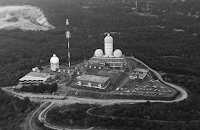
©Phil Jeren 1979In 1961, the Americans and British set up a listening post on Teufelsberg in West Berlin and eavesdropped on Eastern bloc radio traffic.  Here, military intelligence personal listened to all radio and telephone traffic within a 500 km (310 mile) radius while monitoring the Warsaw Pact command and control systems.  The NSA closed the listening post in the early 90s but you can still visit the abandoned site which we plan to do tomorrow.

The Glienicker Bridge between Potsdam and West Berlin was the spot for famous spy swaps between the west and the east.  In 1962, this is where the trade was made for American U-2 pilot Francis Gary Powers and KGB spy Rudolf Ivanovich Abel.  This was the plot of the 2015 movie Bridge of Spies.  Here's the movie trailer.


On display in the museum is one of the early models of the Enigma machine which was the most famous encryption machine of WW2.  It looks like a typewriter with rotors and wheels that can encode a message 150 different ways.  Germany used the machine to secure communications but the Allies had secretly cracked the code, in a huge part, thanks to Alan Turing.  He is regarded as the "father of modern computing" and is often credited by shortening the war in Europe by at least two years and saving more than 14 million lives.  In 1952, he was prosecuted for being gay and chemically castrated before he ultimately committed suicide.  In 2013, Queen Elizabeth II posthumously pardoned him.
This has nothing to do with the museum but the United Kingdom decriminalised same-sex relationships in 1967.  However, there was a ban on gay people serving in MI5, MI6 or GCHQ until 1991.  Just this February, the MI6 Chief publicly apologised for the "misguided, unjust and discriminatory" ban on gay spies.  The apology came 30 years after the ban was lifted.  A little late but at least it came.

In the USA, we had the "lavender scare" where Senator Joseph McCarthy's anti-communist campaign targeted gays which painted homosexuals as subversives and Soviet sympathisers.  In 1953, President Eisenhower signed Executive Order 10450 which ruled that gay people were security risks.  The logic being that if you were gay then you could be blackmailed into giving away state secrets.  I get that at the time people were more vulnerable because the law offered them no protection. 

I've never understood the logic that gay people were more of a threat to national security than straight people.  It's not like straight people have been immune to honeytraps and blackmail.  I had a security clearance when I was in the U.S. military and I would have lost it if I had come out while serving.  So I stayed in the closet until after my enlistment was over.  My argument was if everyone knows that someone is gay then how can they be blackmailed for being gay?  Anyways, back to the museum.

I had never heard of "Operation Infektion" before.  This was a disinformation campaign thought by the KGB and carried out by the Stasi.  In the 1980s, East German biologist and KGB agent, Dr. Jakob Segal, presented false "evidence" that the HIV virus was created at Fort Detrick, Maryland, as part of a biological weapons research project.  I'd heard the conspiracy story before but I never knew that the Stasi was behind it.  

Mikhail Gorbachev ordered the KGB to stop the disinformation campaign and the Stasi followed suit.  At the time the USA and the Soviet Union had a meeting on AIDS research collaboration and the U.S. Surgeon-General insisted on an end to all further disinformation as an absolute requirement for any further collaboration.

The museum is well worth the €17 price of admission and you'll need at least 3 hours to really check everything out.