Showing posts with label Kazakhstan. Show all posts

Sunday, March 5, 2023

The Russian Empire

The Russian Empire was founded in 1721 by Czar Peter I, also known as Peter the Great.  It lasted until 1917, almost two hundred years, and stretched from Central/Eastern Europe to Siberia, Central Asia and even Alaska.  It was the third largest empire in history, only behind the the Mongol Empire and British Empire.

Peter the Great, a member of the Romanov dynasty, wanted to transform Russia into a modern European state.  Here's a ten minute video I found on YouTube on Peter the Great and the Russian Empire with a bit of background on Russia prior to the Russian Empire.

©History Matters

Following Peter the Great's death, there came a number of Romanov czars and czarinas but the next great ruler wasn't until 1762, with Catherine II, known as Catherine the Great became empress.  

Following defeats of the the Ottoman Empire and the Polish-Lithuanian Commonwealth in a number of wars, the Russian Empire's borders expanded into Crimea, Belarus, Central Ukraine, and Lithuania.  Catherine the Great ensured the empire's status as one of the great European powers.

Catherine the Great ruled from 1762 to 1796.  Here's a short video about her.

©Biography

Alexander II was czar from 1855 to 1881.  Almost half of the people living in the empire were serfs, peasant labourers tied to particular parcels of land they worked or to the Russian nobleman who owned it.  In 1861 he emancipated all 23 million serfs.  The newly freed serfs received 2/3rds of the land they had worked but in return had to pay annual compensation to the state.  
In 1867, he sold Alaska and the Aleutian Islands to the United States for $7.2 million.

Nicholas II took the throne in 1894 and was the last Romanov czar.  In 1917 the Russian Revolution took place which overthrew the czarist government and the Bolsheviks under Vladimir Lenin took control in the October Revolution. 
During the 19th century, the empire was multilingual and multireligious with only about half of the population native Russian speakers and Russian Orthodox.  Russia had fought on the side of the allies in WWI.  In 1918 they exited WWI and gave up Finland, Poland, Latvia, Estonia, and Ukraine.  Later that same year, Nicholas II and his family were executed by the Bolsheviks and the Russian civil war broke out.  

Here's a short video about why Nicholas II wasn't able to flee Russia after his abdication and his eventual execution.

©History Matters

The civil war ended in 1922 and the Soviet Union was established which was one of the world's superpowers almost until the end of the twentieth century.  

Russian President Vladimir Putin has lamented that the breakup of the Soviet Union was the "greatest geopolitical catastrophe of the 20th century".  Putin has compared the invasion of Ukraine to the conquests of Peter the Great.  I think that it is safe to say that things have not gone to plan.

Putin expected to take over Ukraine in a few days.  He got that one way wrong.  But this also has an impact on his goal of either creating a new Russian Empire or just returning to the days of the Soviet Union as more former Soviet republics distance themselves from Russia.
  • Russia has lost tens of thousands of troops in Ukraine.  The blow to the prestige of the Russian military can not be underestimated.
  • Russia has been a peacekeeper between Armenia and Azerbaijan by maintaining a large military presence in Armenia.  Due to the war in Ukraine, Russia isn't able to maintain the peace and Armenia is reconsidering its relations with Russia.
  • Since the invasion, Kazakhstan is strengthening its ties with China, Turkey, the EU and the USA.  The country is also questioning its membership in the CSTO.
Я за Україну. Я за Україною. Слава Україні  Stojím za Ukrajinou!  I stand with Ukraine. 🇺🇦

Update 2025: Here's a short, interesting video I found that's worth a look at.

©History Matters

Thursday, July 15, 2021

Collective Security Treaty Organization

The Collective Security Treaty Organization (CSTO) is a collective defence organization amongst former Soviet republics following the dissolution of the Soviet Union.  The CTSO was spawned from the Commonwealth of Independent States.  It's basically the new Warsaw Pact except made up of former Soviet republics.  The CSTO is Russia's largest military alliance.

Current members include Armenia, Belarus, Kazakhstan, Kyrgyzstan, Russia, and Tajikistan.  Even though not a former Soviet republic, Serbia became an observer member in 2013.  

Former members include Azerbaijan, Georgia, and Uzbekistan.  

Here's a short video I found out on YouTube about the CSTO.

©Test Tube News

Wednesday, July 14, 2021

Commonwealth of Independent States

The Commonwealth of Independent States (CIS) was formed in 1991 following the dissolution of the Soviet Union.  It's not the successor to the Soviet Union but it kind of is even though it's not. 

Today the CIS consists of Armenia, Azerbaijan, Belarus, Kazakhstan, Kyrgyzstan, Moldova, Russia, Tajikistan, and Uzbekistan.  In 2005, Turkmenistan became an observer member.  In 2008, Afghanistan and Mongolia became observer members.

Georgia withdrew its membership in 2008 following the five-day war when Russia invaded and took control of South Ossetia.

Ukraine withdrew in 2018 following the Russian annexation of Crimea in 2014 and Russian support of two separatist regions in Eastern Ukraine.

The three Baltic states, Estonia, Latvia, and Lithuania, chose not to participate because they viewed their being in the Soviet Union was an illegal occupation.

Headquarters for the CIS are in Minsk, Belarus.

The goal of the CIS is to coordinate policies regarding its members' economies, foreign relations, defence, immigration policies, environmental protection, and law enforcement.

The CIS spawned three organisations.  

The Collective Security Treaty Organization is a military alliance.  Kind of like the new Warsaw Pact but made up of former Soviet republics.  

The Eurasian Economic Union is basically the Eurasian version of the EU but only consisting of Armenia, Belarus, Kazakhstan, Kyrgyzstan, and Russia.

The Union State is the union of Belarus and Russia with the goal of common government, flag, currency, etc.

Following the breakup of the USSR, athletes competed at the 1992 Winter and Summer Olympics in team events as part of the CIS "Unified Team".  Athletes competed under the Olympic flag.  Since 1992, athletes no longer compete as a unified team and compete for their home countries. 

Monday, July 12, 2021

The Turkic Council

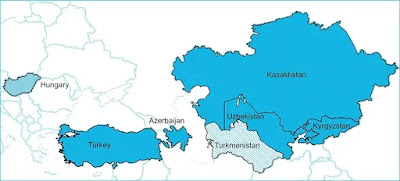
The Turkic Council is an organisation of independent Turkic countries whose aim is to promote cooperation among Turkic-speaking countries.  The council was founded in 2009 by Azerbaijan, Kazakhstan, Kyrgyzstan, and Turkey.  The council's headquarters are in Istanbul.

In 2019, Uzbekistan joined the council.

In 2018, Hungary joined the council as an observer member.  Hungary isn't a Turkic nation so, to me, it seems real odd that Hungary is a part of the club.  Hungarian Prime Minister Viktor Orbán probably did it to taunt the EU.  I suppose Orbán needs additional allies and the Turkic countries aren't exactly known for being liberal democracies.  Besides, Orbán has a track record of going on about how Europe has a Christian history and he's not known as being exactly welcoming to Islam.  All of the other council member countries are more Muslim than not.

In 2021, Turkmenistan also joined as an observer member so now, except for Tajikistan, four of the five of the "Stans" are members of the council. 

Earlier this year, the Islamic Republic of Afghanistan applied for observer status but no decision has been made public yet.

While not an official language, English is a working language of the council.


Here's a short video I found out on YouTube that talks about the council.

©Organization of Turkic States

Update:  In November 2021, the Turkic Council changed its name to the Organization of Turkic States.

Monday, September 30, 2019

Council of Europe

The Council of Europe was founded in 1949.  It is an international organisation that promotes democracy, protects human rights and is committed to the rule of law in Europe.  Its headquarters are in Strasbourg, France.

It's important to realise that the Council of Europe is not the same thing as the European Union.  Which can be confusing because the EU actually adopted the flag that the council created in 1955.  The council now puts an "e" on the flag to differentiate it from the EU.

The EU doesn't control the council as they are independent.  But no country has ever joined the EU without first being a member of the council.

The Council of Europe can't make binding laws but it can enforce certain agreements made by European states.  It runs the European Court of Human Rights.

The official languages are English and French.  Certain bodies also use German, Italian, and Russian.

Ten countries formed the Council of Europe in 1949 and today there are 47 member countries.  Basically every country in Europe except for Belarus, due to concerns over human rights and the use of the death penalty), Kazakhstan, due to human rights concerns, Kosovo, due to limited recognition, and the Vatican, for being a theocracy.

The "eastern block" countries didn't start joining until after the fall of communism.  Hungary was the first to join in 1990, followed by Czechoslovakia and Poland in 1991, Bulgaria in in 1992 and Romania in 1993.

Czechoslovakia was replaced by Czech Republic and Slovakia following the Velvet Divorce.  East Germany never joined because the the former territory basically joined following the reunification of Germany in 1990.  Yugoslavia wasn't ever a member.  Following the breakup, Slovenia became the first ex-Yugoslav country to join in 1993.  The Soviet Union was never a member either.  The first former Soviet republics to join were Estonia and Lithuania in 1993.  Other former republics joined later on and Russia joined in 1996.    

Montenegro was the most recent country to join back in 2007.

The Vatican does have observer status.  As does Israel, the USA, Canada, Japan, and Mexico.  The council of Europe has observer status with the United Nations.

The death penalty is abolished in member countries.  There's criticism of the USA and Japan each having observer status since the death penalty is still in practice.

Again, since the Council of Europe is not the same thing as the EU, Brexit doesn't apply.  While the UK is leaving the EU it will remain in the Council of Europe.

Here's a video I found out on YouTube that explains more about the Council of Europe

©Council of Europe

Wednesday, June 24, 2015

Central Asia Trip Summary

My first visit to "the Stans" went pretty well.  I was only there for nine days so some things felt a bit rushed but overall I had enough time.  I learned a few things for the next visit.

In Kyrgyzstan, I stayed in Bishkek.  It was very easy to get around on foot or by bus.  The taxis are very cheap but you will need some Russian to get by.  The cars are imported from the west and from Japan so half are right hand drive and half are left hand drive.  I'm used to both but it was a bit odd seeing both on the road at the same time.

The only problem I had in Bishkek was that it took me forever to find an ATM that would work for me.  I wasn't able to pull out any cash on my Czech or American debit cards.  I had €150 with me that I could change but not having any local currency handy started to worry me.  I finally found that I could withdrawal cash from DemirBank.  No other bank ATMs would work for me.  Lesson learned: always have a few U.S. Dollars or Euros handy to exchange when visiting the far off lands.

70th anniversary of the end of WWII
Throughout the city there were still many Soviet-era monuments and statues.  There were many billboards commemorating the 70th anniversary of the end of WWII.

The people were very friendly.  I even received a high-five from an ethnic Korean because I was an American who could speak basic Russian.

With no visa required I can see returning to Bishkek but next time it will be to head off to the nearby mountains for some hiking.

Kazakh registration card
After a couple of days I flew to Kazakhstan.  Thanks to the government's pilot program for visa-free travel I was able to visit without the ordeal of applying for the $160 visa.  There was a separate line at the airport where I had my registration card stamped.  I just had to keep the card with me until I left the country.


Almaty was a bit of a disappointment.  For a place that used to be a capital city I figured that there would be much more to see.  Not so much.  However I was almost interviewed for the evening news.  I was in an Almaty park and got approached by a TV crew.  But once they realized I couldn't speak Kazakh and that my Russian sucked they lost interest.  Not quite the high five I received in Bishkek. 

Astana was much more interesting.  When it comes to architecture it's like the Dubai of Central Asia.  There is so much to see.  On the 19th, me and my FitBit walked all over the city - a new personal best 34,17 km (21.23 miles).

All of that walking around the capital and I still never ran into Borat.

Kazakh WWII 70th anniversary poster
Kazakhstan is much more developed than Kyrgyzstan.  Much more expensive too.  Overall it was a great trip.  The only real drawback is the travel time.

Turkey now has a $20 e-visa so I made sure to apply in advance.  It gave me the opportunity to escape the Istanbul airport for a while in order to break up the long travel day home.

Saturday, June 20, 2015

Astana, Kazakhstan

Astana is the capital of Kazakhstan.  It was originally founded in 1830 as Akmoly and it was used as a fort by Siberian Cossacks.  In 1832 the town became known as Akmolinsk and then in 1961 it became Tselinograd.  After independence from the USSR, it became Akmola in 1992.  In 1997 the capital was moved from Almaty to Akmola.  In 1998, it was given the name Astana.  Very original.  In Kazakh, Астана means "capital".

With over 835,000 people it is the second-largest city in the country after Almaty.  It is also the second-coldest capital city in the world.  Winter temperatures run from -30°C to -35°C (-22°F to -31°F).

Astana is a planned city.  Planned to stand out that is.  It's an architect's dream because everything is unique.  It's like the Dubai of Central Asia.  And the construction continues especially since the city will host the 2017 Expo.  It's clear to see where so much of the country's oil and gas revenue has been invested.

The Bayterek monument symbolizes a Kazakh folktale about Samruk, a magical bird of happiness who lays its egg between the branches of a mythical tree of life.  It's also an observation tower and on the top level there is a gilded hand print of President Nazarbayev that people place their hand and make a wish.  The locals refer to it as Chupa Chyp, like the lollypop.


The Nur-Astana Mosque is the second-largest mosque in the country.  It was a gift from the Emir of Qatar and has capacity inside for 5,000 people.


The Central Concert Hall was completed in 2009.  Its walls are designed to resemble a flower petal.


The Shabyt Palace of Art is part of the local university.  It is often referred to as the dog bowl.


Opened in 2012 the Nazarbayev Center is a multi-functional research and public education institution with a focus on Kazakh society.  I'm not sure what the nickname is for this one.


The Palace of Peace and Reconciliation opened in 2006.  The pyramid is 62 meters (203 feet) high and cost about $58 million to build.  It was built as a center for religious understanding.  Inside is also a 1,500 seat opera house, Kazakh museum of culture, and a library.


The Hazrat Sultan mosque opened in 2012.  It is the largest mosque in Central Asia and can hold up to 10,000 people.

The "Kazakh Eli" monument shows the mythical bird Samruk on a 91 meter column that honors 1991 when Kazakhstan became an independent country.


The Presidential Palace was modeled after the White House in Washington, DC.  It has a bit of a Disney look to it.


KazMunayGas is the state-owned oil and gas company and its headquarters are in the city.


The Justice Monument is located near one of the courts.  It shows Tole bi, Kazybek bi, and Aiteke bi.  I'm told that every true Kazakh can trace their lineage back to one of these three.


The Khan Shatyr is the world's largest tent.  It is 150 meters (500 feet) high and covers 140,000 sq. meters (35 acres).  The area under the tent is bigger than 10 football stadiums.  It was completed in 2010 after four years of construction and cost $400 million.

The tent has a special chemical lining that protects against the bitter cold.  It also lights up at night.  Inside is a just your normal shopping mall, complete with a roller coaster, boating river, mini golf, dinosaurs and an indoor beach resort that is always 35°C (95°F).

There is way more things in Astana to see than in Almaty.  The only bummer is that I haven't been able to find any postcards.  I don't understand a capital city that is trying to be at the forefront of some very cool construction and there are no postcards at all. 

Update:  On 20 March 2019, Astana was renamed to Nur-Sultan in honour of former president Nursultan Nazarbayev.

Friday, June 19, 2015

Almaty, Kazakhstan


Almaty is located in southern Kazakhstan.  With a population over 1.5 million people it is country's largest city.  Алматы used to be called Alma-Ata and it is the former capital.  Today's it's the major commercial and financial hub of Central Asia.  The city is responsible for about 20% of the country's GDP.

The area was first settled around the 10th-9th century BC during the Bronze Age.  Between the 10th-14th centuries it became an important stop along the Silk Road.

Alma-Ata was founded in 1854.  From 1929 to 1991 it was the capital of the Kazakh Soviet Socialist Republic.  When Kazakhstan became independent the city remained the capital until 1997 when it was moved to Astana.  However in 1993 the the city's name was changed to Almaty.

Akimat House used to be home to the Communist Party of Kazakhstan.  After independence and once the capital moved to Astana it became a city government building.  Part of the building is Almaty City Hall.


At Independence Square is the Independence Monument.  It is the Kazakh Golden Warrior on top of a snow leopard.

The Golden Warrior


The Palace of the President was supposed to be a Lenin museum but it never happened.  You can't go inside but the gardens outside are quite nice.

Zhambyl Zhabayev was a traditional folksinger who died in 1945 and was buried in Alma-Ata.  Although he sang exclusively in Kazakh, his many patriotic, pro-Stalin songs were circulated thorough out the USSR during the 1930s.

After independence many of the street names in the city were changed but not all were.  At Shevchenko Street there is a monument to Ukrainian poet Taras Shevchenko.

The Lermantov State Academic Russian Drama Theatre was built in 1969.  It seats almost 850 people.

The Kazakh State Academic Drama Theatre is the country's oldest professional theater.  It opened in 1926 before moving to the capital in three years later.  In 1961 it was named after M. Auezov, a famous Kazakh writer.  I believe that the building was renovated in the 80s.

The Central State Museum is one of the oldest and largest museums in Central Asia.  It opened in the 1930s and the current building was completed in 1985.


The State Museum of National Musical Instruments opened in 1980.  The wooden building it's housed in dates back to 1907.

The Ascension Cathedral is also known as Zenkov Cathedral.  It was completed in 1907 and it is the second tallest wooden building in the world.

Abai Qunanbayuli was a Kazakh poet, composer and philosopher.  He was a cultural reformer toward Europeans and Russians based on enlightened Islam.  He died in 1904 and the bronze monument was unveiled in 1961 on what used to be Lenin Street.  It is now called Abai Street. 

The Almaty TV Tower was completed in 1983.  It is 371,5 meters (1,219 feet) tall is the world's tallest free-standing tubular steel structure.  Almaty is prone to earthquakes so the tower was designed to withstand a 10.0 quake.

General Ivan Panfilov
The city's most well-known landmark is Panfilov Park.  Ivan Panfilov was the commanding general of the 316th division that, despite heavy casualties, helped prevent the Nazis from reaching Moscow in WWII.  

The park is actually named after Panfilov's Heros - 28 soldiers from Almaty who died in the fighting.  In 1975 an eternal flame was lit to honor those who died in the Russian Civil War and in the Great Patriotic War (WWII).  The granite monument depicts soldiers from all 15 Soviet Republics and was unveiled as part of the 30th anniversary of victory over Nazi Germany. 

In 2011 the subway opened.  It currently only has two lines which isn't bad except that construction began in 1988.  I've never opened a subway before but 23 years does seem to be quite a long time.  On the flip side it only costs 80 Tenge (about 54¢).  And how can you not be impressed with a marble subway platform with chandeliers?

Almaty hosted the 2011 Winter Asian Games and will host the 2017 Winter University Games.  It is also in the running to host the 2022 Winter Olympics.  If it wins it will be the first Olympics ever hosted in Central Asia.  Here's the Almaty bid video I found out on YouTube.


Update:  Almaty lost out on hosting the 2022 Winter Olympics to Beijing.