Showing posts with label Mosque. Show all posts

Monday, March 20, 2023

Kuşadasi, Türkiye

Kuşadasi is a beach resort on the west coast of Türkiye, about 95 km (59 miles) south of Izmir.  With a population of almost 114.000 people it is the 117th biggest city in the country.  However, during the tourist season, which kicks off in about another week, the population reaches almost 2 million people.

Big cruises ships arrive daily with many tourists opting for a tour of Ephesus.  Others come to enjoy the 25 km (15,5 miles) miles of beach along the Aegean.

Kuşadasi is old and many of the locals refer to the town as Ada.  The earliest settlements in the area date back to around 3000 BC.  Over the centuries it has been part of the Persian Empire, the Roman Empire, and the Byzantine Empire.  In 1413, it became part of the Ottoman Empire.  After WWI, it was controlled by Greece until it became part of Türkiye in 1922.  In 1923, the local Greek population was exchanged for Turks as part of the population exchange under the Lausanne Treaty.


Güvercinada, "Pigeon Island" is an island connected to the city by a 350 metre (1.150 foot) causeway.


The island has a castle which was built back in the 1770s.  In 2020 the castle became a tentative UNESCO World Heritage Site


Near the harbour is the Öküz Mehmed Pasha Caravanserai that was built from 1615 - 1618.  It was a safe place for merchants to stay with their goods and later as a customshouse.  In 1968 it opened as a hotel and in 2022 the last hotel owner ceased operations.


Kale Kapisi, the Castel Gate, was part of the city walls built in the 17th century.  The upper floor was once used as a police station but there is now some kind of micro miniature art centre.


The Kaleiçi Mosque is the old town mosque, in the middle of the bazaar area that was built back in 1618.


The clock tower was built in 1996.


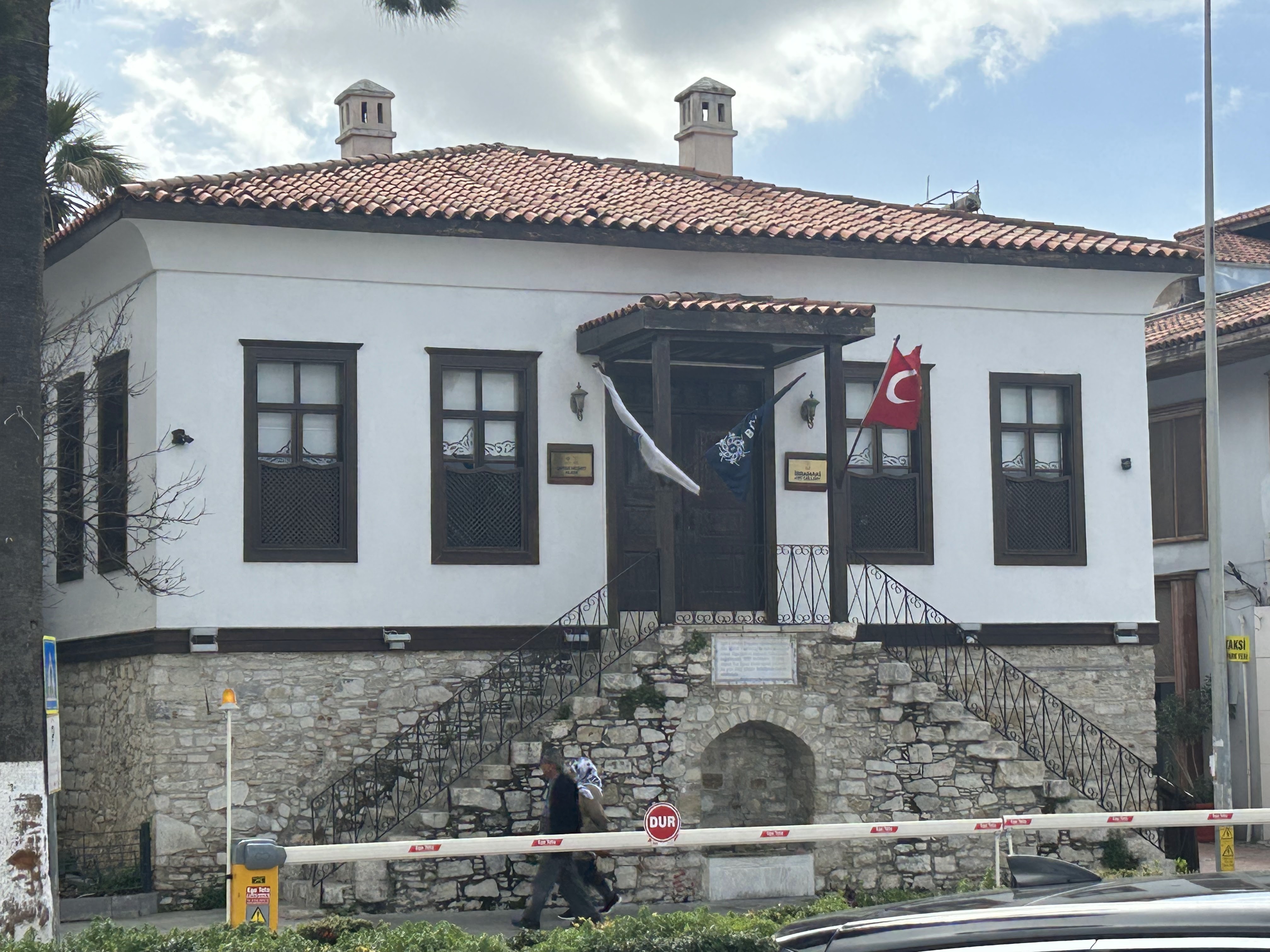
The Ibramaki Art Gallery originally opened as a hospital at the end of the 19th century.  In 2009, the local municipality restored the building and turned it into a gallery.

The old cemetery has graves from the 1700-1800's.


More than 400 homes of the Tepe neighbourhood are being revitalised under the city's "Let's Colour" programme with homes pained in various shades of pink, yellow, blue, orange, green and purple.

At the port, there are daily 1,5 hour ferries between Kuşadasi and the Greek island Samos.  We wanted to check it out but the ferries only run from April to October.


About 30 km (19 miles) south of the city is the Dilek Peninsula-Büyük Menderes Delta National Park.  There are dense forests, hiking trails, and beach, plus wild boars running around.


It was still just a wee bit too cold to lie out on the sand but it felt good to at least be at the beach.

Near the national park is the Cave of Zeus.  

There is a 10 metre (33 feet) deep pool that is off limits to swim in.  Legend has it that this is where Zeus would take refuge whenever his brother Poseidon would whip up a deadly storm.

Another story goes that Zeus would slip away here, from Mount Olympus and his wife Hera, to swim with local girls.


Yedi Uyurlar Mağarası is the Cave of the Seven Sleepers.  The story is that in 250 AD, the Roman Emperor ordered everyone to perform a sacrifice to dedicate themselves to the empire and to the Roman gods, or be executed.  Seven Christians refused and hid in the cave.  Romans found the young men asleep in the cave and sealed them in.  

One day a farmer opened the cave and found the men asleep.  When they awoke, they pooled their money to buy food but when they tried to pay they discovered their money was over 150 years old.  The cave, located outside of Ephesus was excited in the 1920s and found a number of Christian games from the 5th and 6th centuries.  

The Çamlik Railway Museum is home to one of the largest largest collection of steam locomotives, with more than 30, from 1891 to 1951.  The outdoor museum isn't well known but thanks to Atlas Obscura we went to have a look at it was well worth the visit.

We really enjoyed our week in Kuşadasi.  It's definitely worth a visit with lots of places to explore.  I wish the weather would have been just a little warmer but I'm quite glad that we managed to visit before all of the tourists rush in.

Here's a short Rick Steves video I found out on YouTube.

©Rick Steves

Saturday, March 18, 2023

İzmir, Türkiye

İzmir is home to almost 3 million people making it the 3rd largest city in Türkiye.  It's an old city with more than 3000 years of recorded history but the area had been settled since the Neolithic period over 8000 years ago.

It's almost 100 km from Kusadasi which takes a little over an hour by car.
Prior to 1930, the city was known by its Greek name Smyrna (Σμύρνη).


Konak Pier is a seaside pier that was converted to a modern shopping, dining, and cinema complex.

Konak Square, designed by Gustave Eiffel, the same architect that designed the Eiffel Tour in Paris, is home to a few of the city's landmarks.

Konak Mosque, also known as Yali Mosque, was built in 1755.  It's known for its distinctive octagonal shape.  It was last renovated in 1964.


The clock tower was built in 1901 to honour the 25th anniversary of Abdülhamid II, becoming Sultan of the Ottoman Empire.


The First Bullet Monument is dedicated to the 1919 memory of a journalist and martyrs.


The city's first government office was located in the square but was demolished in 1869-1872.  They burned down in 1970 and were rebuilt according to the original plans.


The Izmir Archaeology Museum was established in 1924 on the site of an abandoned church.  It opened to the public in 1927.


The Izmir Ethnography Museum is currently closed for renovation.  The stone building dates back to 1831 when it was originally built as part of a hospital.


The 19th-century Church St Polycarp is the city's oldest functioning Christian church.  I understand the the church walls are adorned with frescoes but unfortunately the church was closed so we missed out getting to see them.


The Asansör is a public level street elevator that was built in 1907.  Prior to the elevator, residents needed to walk a long way and climb 155 stairs to reach the upper part of the town.  There are cafés at the top with nice views of the coastline.


The Hisar Mosque is one of the biggest in the city centre.  Construction began in 1592 and opened in 1598.

Izmir had a sizeable Greek population until 1923 where there was a population exchange between Greece and Türkiye.

In 1923, following a seven-month conference, the Lausanne treaty was signed that recognised new Turkish state following the end of the Ottoman Empire after WWI.  The treaty provided for the protection of the Christian minority in Türkiye and the Muslim minority in Greece.  I had never heard of the forced population exchange before but here's a short video I found about it on YouTube.

©Choices Program

Friday, March 17, 2023

Best of Ephesus Tour, Türkiye

We had booked the Best of Ephesus Tour for Monday which was great.  We were the only two who had booked so we actually ended up on a private tour with our guide Mehmet.  

Our first stop was at a big statue of the Virgin Mary. 


After that we headed to Meryemana, the House of the Virgin Mary, which is about 6 km (3.7 miles) from Ephesus and 17 km (11 miles) from Şirince.  The house is surrounded by pine and olive trees.  It's a Catholic shrine and a UNESCO World Heritage Site.



A bedridden Augustinian nun in Germany, named Anne Catherine Emmerich, had visions, about the Virgin Mary.  One was a description of the house that the Apostle John had built for the Virgin Mary where she lived out the rest of her life.  An author spent five years transcribing the nun's visions, before she passed away, and a book was published in 1852.

Two expeditions completed in 1891, discovering the match between the location and the nun's visions.  While the Roman Catholic Church has never officially proclaimed the validity of the site, multiple popes have given blessings and visited the house.  Each year on 15 August, pilgrims come to celebrate Mary's Assumption.  In 2004, Pope John Paul II beatified Anne Catherine Emmerich.

On the way to the shrine, you pass a key hole-shaped baptismal pool.


Outside of the house is a "wishing wall" where people write their wishes on paper or fabric.

There is a spring under the house which pilgrims believe to have healing properties.  There are fountains that people can drink from. 


I had to make sure to light a candle for my grandmother.  She would have loved that I came here. 


It was then on to Ephesus which was a city in Ancient Greece located 3 km (2 miles) southwest of Selçuk, 8 km from Şirince, 20 km (12.5 miles) north of Kuşadasi, and 70 km (44 miles) south of Izmir.

Ephesus was built in the 10th century BC.  It was one of the 12-member cities of the Ionian League and became part of the Roman Republic in 129 BC.  It's believed that the Gospel of St. John may have been written here.  

The city was conquered by numerous empires over the centuries and it was completely abandoned by the 15th century.  Ephesus is home to one of the largest Roman archaeological sites in the Eastern Mediterranean and the ruins were designated a UNESCO World Heritage Site in 2015.

The most impressive ruin has to be the Library of Celsius.  It was built in around 125 AD in memory of Tiberius Julius Celsus Polemaeanus who served as governor of Roman Asia.  He paid for the library from his own money and he is buried in a sarcophagus beneath it.  The library was the third-largest in the Greco-Roman world and was home to 12.000 scrolls.  

The library was no longer in use after 400 AD.  The facade was damaged by an earthquake in the 10th or 11th century but archaeologists re-erected it from 1970 to 1978.


The Great Theatre could hold an estimated 25.000 spectators and dates back to the Hellenistic period (3rd-1st century BC) with extensive renovation during the Roman period.  It's believed to have been the the largest theatre in the in the ancient world.

As it was just the two of us, our guide Mehmet used the opportunity to show us everything in great detail.  It would never have been possible with a larger group.


Ephesus was famous for the Temple of Artemis which was nearby.  The temple was completed around 550 BC and it was one of the Seven Wonders of the Ancient World.  The temple was destroyed by 401 AD.  The only thing left of the temple is a single pillar.

The Basilica of St. John, or rather what's left of it, sits on the slope of Ayasluğ Hill, in Selçuk, about 3,5 km (2.2 miles) from Ephesus.  It was built in the 6th century but was damaged when Turks invaded in 1090.


Many believe that the basilica was built on the tomb of the apostle.  


There's a fortress on the hill above the cathedral but we didn't visit it.


From the basilica you can see the İsa Bey Mosque.  The mosque was built from 1374-1375.  Unfortunately it is currently closed for renovation so we only got to view it at a distance.

Temple, mosque, basilica, and fortress