İzmir is home to almost 3 million people making it the 3rd largest city in Türkiye. It's an old city with more than 3000 years of recorded history but the area had been settled since the Neolithic period over 8000 years ago.
It's almost 100 km from Kusadasi which takes a little over an hour by car. Prior to 1930, the city was known by its Greek name Smyrna (Σμύρνη).
Konak Pier is a seaside pier that was converted to a modern shopping, dining, and cinema complex.
Konak Square, designed by Gustave Eiffel, the same architect that designed the Eiffel Tour in Paris, is home to a few of the city's landmarks.
Konak Mosque, also known as Yali Mosque, was built in 1755. It's known for its distinctive octagonal shape. It was last renovated in 1964.
The clock tower was built in 1901 to honour the 25th anniversary of Abdülhamid II, becoming Sultan of the Ottoman Empire.
The First Bullet Monument is dedicated to the 1919 memory of a journalist and martyrs.
The city's first government office was located in the square but was demolished in 1869-1872. They burned down in 1970 and were rebuilt according to the original plans.
The Izmir Archaeology Museum was established in 1924 on the site of an abandoned church. It opened to the public in 1927.
The Izmir Ethnography Museum is currently closed for renovation. The stone building dates back to 1831 when it was originally built as part of a hospital.
The 19th-century Church St Polycarp is the city's oldest functioning Christian church. I understand the the church walls are adorned with frescoes but unfortunately the church was closed so we missed out getting to see them.
The Asansör is a public level street elevator that was built in 1907. Prior to the elevator, residents needed to walk a long way and climb 155 stairs to reach the upper part of the town. There are cafés at the top with nice views of the coastline.
The Hisar Mosque is one of the biggest in the city centre. Construction began in 1592 and opened in 1598.
Izmir had a sizeable Greek population until 1923 where there was a population exchange between Greece and Türkiye.
In 1923, following a seven-month conference, the Lausanne treaty was signed that recognised new Turkish state following the end of the Ottoman Empire after WWI. The treaty provided for the protection of the Christian minority in Türkiye and the Muslim minority in Greece. I had never heard of the forced population exchange before but here's a short video I found about it on YouTube.
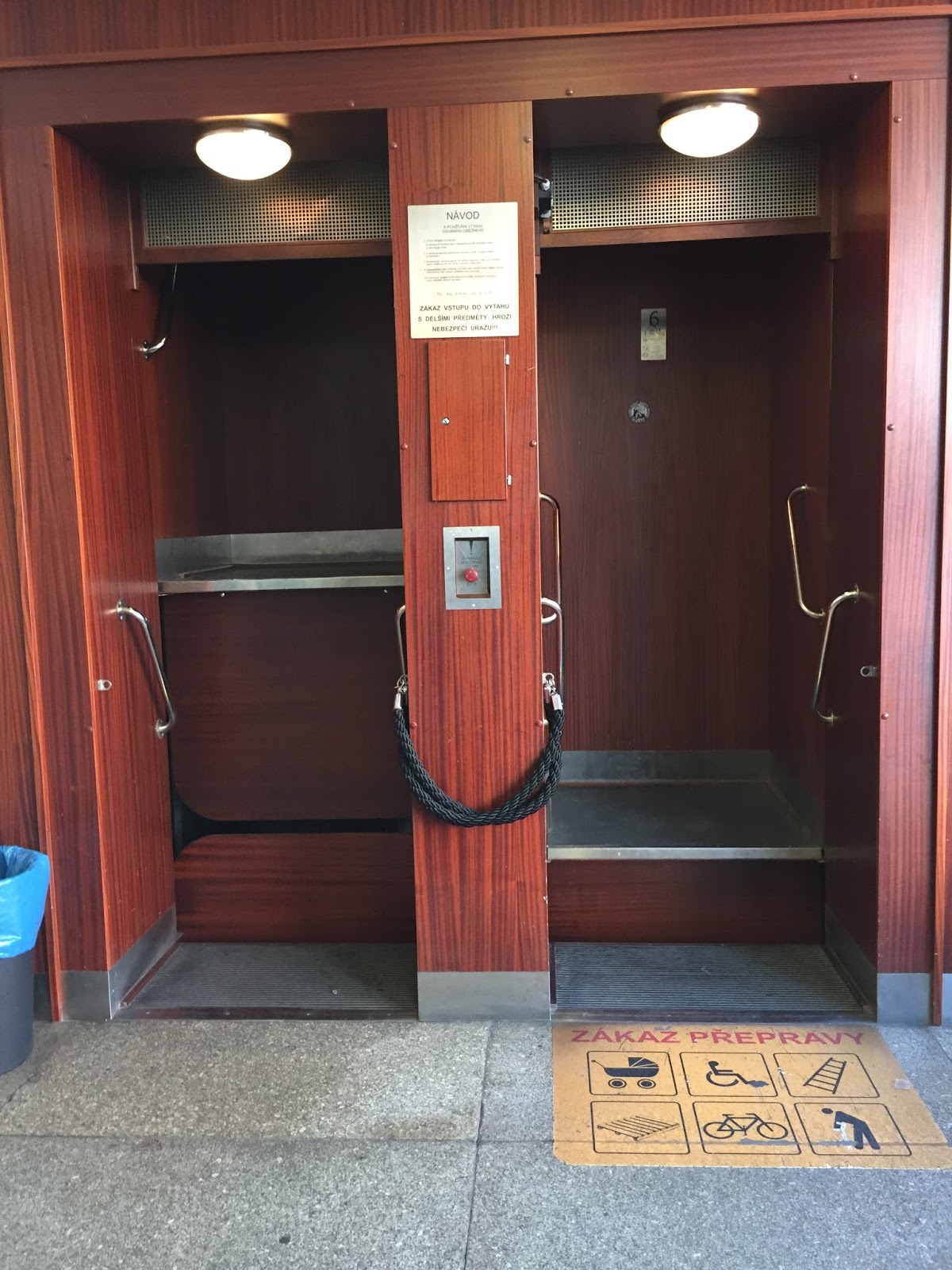
A few weeks ago Claudia and I went to the main Brno post office after picking Tünde up from kindergarten. This meant, of course, going for a ride on the paternoster lift (elevator). She thinks it's a fun ride.
It's really the niftiest thing. It's a chain of open compartments that move in a continuous loop between floors in a building. Each compartment holds up to two or three people.
There's no call button since the loop is always running. They don't break speed records or anything so that you can hop on and off.
Due to safety concerns, the production of new paternoster lifts ended in the 1970s. Those same concerns are why many have been shut down but you can find them still being used in Europe. There are around 230 of these still operational in Germany. Czechland has 68 still running and I know that there are at least a few in the UK. There are only two outside of Europe, one in Malaysia and one in Peru.
Lisboa is the capital city of Portugal. It is also the country's largest city. Lisbon proper has +547,000 residents but the metro area is home to more than 3 million people. It's the westernmost capital city in Europe and the only one on the Atlantic ocean.
Lisbon is one of the world's oldest cities. It's hundreds of years older than London, Paris or Rome.
The Patriarchal Cathedral of St. Mary Major is Lisbon's Roman Catholic Cathedral. Construction began in 1147 and it was consecrated in 1150.
Inspired by the Christ monument in Rio de Janeiro, Lisbon too has a similar landmark. The 28 meter (90 ft.) statue was built in 1959 as thanks for having spared Portugal from WWII. Portugal was one of only six European countries to remain neutral during the war.
The 25th of April Bridge crosses the Tejo river. It was opened in 1966 it was the 5th largest suspension bridge in the world. Today it ranks #25. The design was based on the San Francisco - Oakland Bay Bridge in California and was built by the same company.
The Santa Justa Lift is an elevator in the historic part of town. It was completed in 1902 and was built to connect the lower part of the town with the upper town. As the only remaining vertical lift it is now a tourist attraction offering views of the city.
Belém Tower was built between 1514 - 1520. It was dedicated to St. Vincent, Lisbon's patron saint and it was part of Lisbon's defense system at the mouth of the Tagus river. In 1983, it was became one of the city's two UNESCO World Heritage Sites. In 2007, it was listed as one of the Seven Wonders of Portugal.
The nearby Jerónimos Monastery is the other UNESCO World Heritage Site. The monastery was completed in 1601.
The Monument to the Discoveries was inaugurated in 1960 to mark the 500th anniversary of the death of Henry the Navigator. It celebrates the Portuguese Age of Discovery during the 15th and 16th centuries. The monument is 52 meters (171 feet) tall and the statues are carved out of limestone from Sintra.
At Bom Successo Fort there is a memorial to the Portuguese soldiers who died in the Colonial War in 1961–1975. This took place in the country's African colonies. There is an eternal flame and a changing of the guards every hour.
The São Jorge Castle is a Moorish citadel that dates back to medieval times. Until the early 16th it was the royal residence. Its position on a hilltop overlooking the city offers great views.
São Bento Palace began in 1598 as the first Benedictine monastery in Lisbon. In 1834 the monks were expelled and the building became the Assembly of the Republic which is now the Portuguese parliament.
The Lisbon Oceanarium opened in 1998. It is the largest indoor aquarium in Europe.
The Vasco da Gama Bridge was opened in 1998 to celebrate the 500th anniversary of da Gama's discovery of the sea route from Europe to India. The six lance bridge runs 17.2 km (10.7 miles) and is the longest bridge in Europe.
The Vasco da Gama Tower was completed in 1998 while the adjoining hotel opened in 2012. The tower is 145 meters (476 feet) tall. The lattice tower represents the sail of a caravel.
Palace Square is where the royal palace stood for more than two hundred years, until it was destroyed in 1755 by the Great Earthquake. It registered between 8.5 - 9 and it remains one of the deadliest earthquakes in history. The square is now a waterfront area with a triumphal arch and a statue of King Jose I.
View from Alfama
The Alfama is Lisbon's oldest district. It was the one area of Lisbon that best survived the Great Earthquake. It's a beautiful historic area and is home to many Fado bars.
Fado is typical melancholy Portuguese music that dates back to the 1820s. In 2011, Fado was added to the UNESCO Intangible Cultural Heritage List.
Here's a Rick Steves video I found on YouTube which talks about the Alfama and Fado.
When I left for work this morning I was preoccupied with thinking about all of the things I needed to get done at the office and how booked my calendar was with meetings. While in my building'slift (elevator) I felt a quick jolt and suddenly found myself stuck between the 4th and 3rd floors. Great. My mind immediately started racing. How long am I going to stuck in here by myself? My mobile phone was 1/2 charged but I had limited reception in the elevator. At what time do I call someone at the office to start shuffling my meetings around? Who has time to be stuck in an elevator?
I pushed the alarm button a few times but nothing happened. Of course all of the lift information is only in Czech but I figured out that I had to press and hold the alarm button for at least five seconds. Then a man's voice came across the speaker. I explained to him that I only speak a little Czech, that the elevator didn't work and where I lived. I guess explaining that I only speak a little Czech didn't register because he began to speak faster and use even bigger words and then hung up.
So I decided to call the service number that was posted. All I got was a recording that, I assume, said was that they were not open yet and to call back later. So then I called the "non stop" (24 hour) number. I swear that it was the same guy I spoke with before. I asked if he spoke English, German, French or Spanish. Of course not. So I explained again that I was a foreigner and could only speak a little Czech. Again, he started to speak even faster. So I asked him to slow down. This cycle of fun when on for a few minutes. He said he notified a woman about it. I finally got him to tell me that it would only be another five minutes.
A few minutes later I heard a woman's voice saying "hello". The head of my building's co-op went upstairs and basically rebooted the elevator so that it started moving again. When I got out of the elevator I walked upstairs one flight to say "thank you". There were two women there, one of whom is the concierge and she only speaks Czech. She asked me if I need to go upstairs. "No, I needed to head to work but I'm fine and thanks for letting me out". She then yelled up the stairs to the woman who fixed the elevator saying "Mrs Bartová! Everything is fine! It was just the American! Nice.
I only ended up stuck in the lift for 15 minutes. But it's a long 15 minutes when you're by yourself, in a foreign country, and with everything posted in a different language. I guess next week I'll ask my Czech teacher for the vocabulary for "Help! I'm trapped in this f*@#ing elevator! Please get me out!"
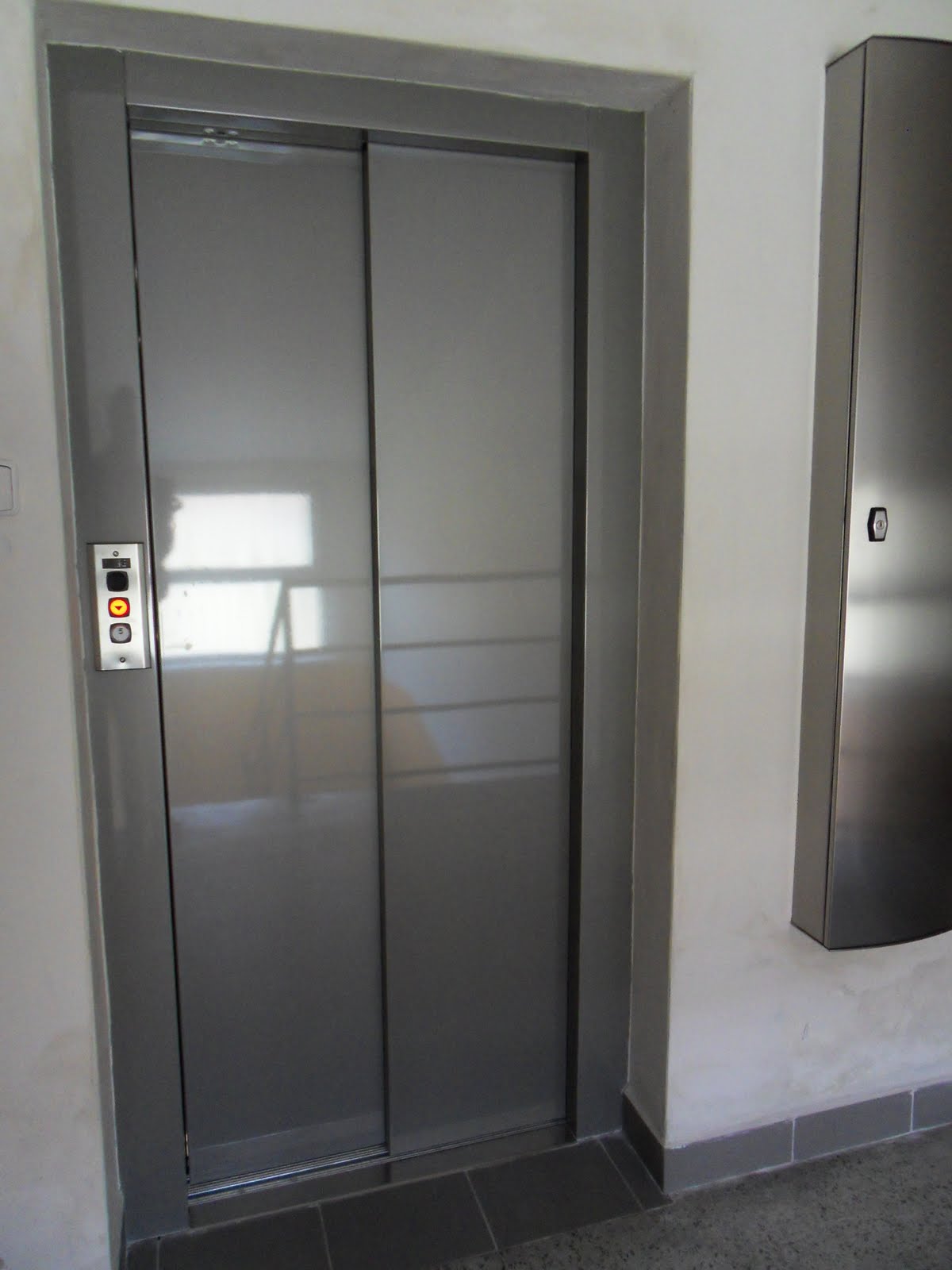
My building has finally got a new lift (elevator). When I moved in to my flat in August 2009, the landlady said that there would be a new lift within six months. Then in December she said there would be a new lift in six months. Still no new lift. And not that I'm complaining. I really didn't want a new lift.
My flat is on the 5th floor (a U.S. 6th floor). The lift only went to the 4th floor so then it was just up one flight of stairs. No big deal at all.
Well they started ripping out the old lift at the end of August and I was told it would take six weeks. What a pain in the ass this was. I thought I was going to die carrying groceries up 5 flights of stairs. They had to break through the wall right outside my door to make room for the new lift. All of the dust kept going underneath my door and right in to my flat. Yuck!! There was so much noise that I wasn't able to work from my home office. It took 8 weeks to finish but that's because the workers were there all day, Saturdays and Sundays too, for the final 3 weeks. But at least they finished.
The new lift is pretty jazzy. When you step in to it, the floor no longer sinks 2 inches. The door is no longer held closed with a magnet. You can now request multiple floors at the same time. Like many lifts in Europe, you could only select one floor, at a time. When you got to the first floor selected you could then select the next floor. This one has a button to open the doors but not one to close them. Kind of odd but no worries. There is an alarm button but no phone to call for help. But the old one didn't have a phone either. This one even has a mirror in it. Pretty snazzy.


 Konak Mosque, also known as Yali Mosque, was built in 1755. It's known for its distinctive octagonal shape. It was last renovated in 1964.




.jpg)

.jpg)
.jpg)

.jpg)


.jpg)









 Czech Koruna Exchange Rate



 Posts
Posts


