Showing posts with label Greece. Show all posts

Monday, March 20, 2023

Kuşadasi, Türkiye

Kuşadasi is a beach resort on the west coast of Türkiye, about 95 km (59 miles) south of Izmir.  With a population of almost 114.000 people it is the 117th biggest city in the country.  However, during the tourist season, which kicks off in about another week, the population reaches almost 2 million people.

Big cruises ships arrive daily with many tourists opting for a tour of Ephesus.  Others come to enjoy the 25 km (15,5 miles) miles of beach along the Aegean.

Kuşadasi is old and many of the locals refer to the town as Ada.  The earliest settlements in the area date back to around 3000 BC.  Over the centuries it has been part of the Persian Empire, the Roman Empire, and the Byzantine Empire.  In 1413, it became part of the Ottoman Empire.  After WWI, it was controlled by Greece until it became part of Türkiye in 1922.  In 1923, the local Greek population was exchanged for Turks as part of the population exchange under the Lausanne Treaty.


Güvercinada, "Pigeon Island" is an island connected to the city by a 350 metre (1.150 foot) causeway.


The island has a castle which was built back in the 1770s.  In 2020 the castle became a tentative UNESCO World Heritage Site


Near the harbour is the Öküz Mehmed Pasha Caravanserai that was built from 1615 - 1618.  It was a safe place for merchants to stay with their goods and later as a customshouse.  In 1968 it opened as a hotel and in 2022 the last hotel owner ceased operations.


Kale Kapisi, the Castel Gate, was part of the city walls built in the 17th century.  The upper floor was once used as a police station but there is now some kind of micro miniature art centre.


The Kaleiçi Mosque is the old town mosque, in the middle of the bazaar area that was built back in 1618.


The clock tower was built in 1996.


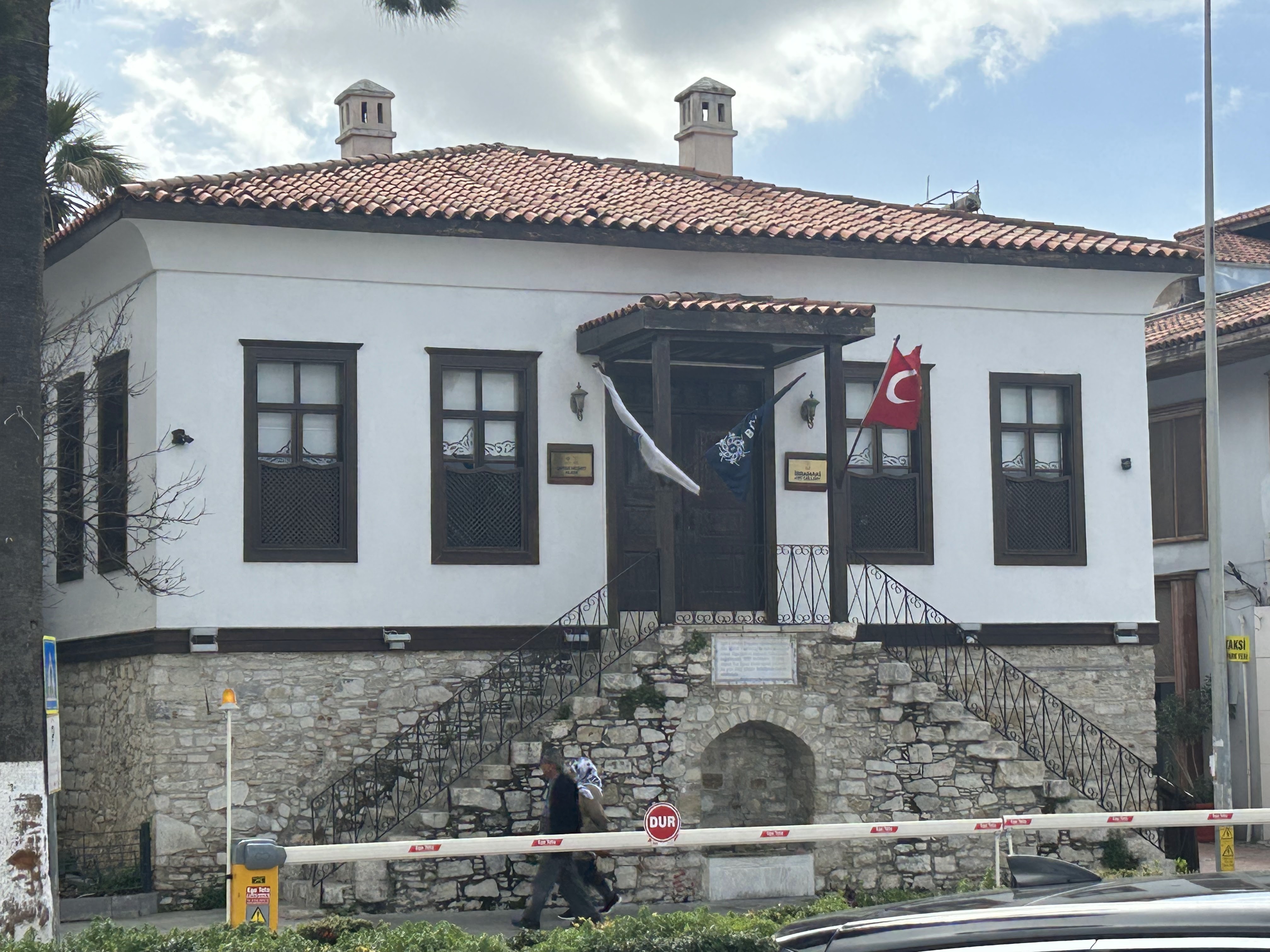
The Ibramaki Art Gallery originally opened as a hospital at the end of the 19th century.  In 2009, the local municipality restored the building and turned it into a gallery.

The old cemetery has graves from the 1700-1800's.


More than 400 homes of the Tepe neighbourhood are being revitalised under the city's "Let's Colour" programme with homes pained in various shades of pink, yellow, blue, orange, green and purple.

At the port, there are daily 1,5 hour ferries between Kuşadasi and the Greek island Samos.  We wanted to check it out but the ferries only run from April to October.


About 30 km (19 miles) south of the city is the Dilek Peninsula-Büyük Menderes Delta National Park.  There are dense forests, hiking trails, and beach, plus wild boars running around.


It was still just a wee bit too cold to lie out on the sand but it felt good to at least be at the beach.

Near the national park is the Cave of Zeus.  

There is a 10 metre (33 feet) deep pool that is off limits to swim in.  Legend has it that this is where Zeus would take refuge whenever his brother Poseidon would whip up a deadly storm.

Another story goes that Zeus would slip away here, from Mount Olympus and his wife Hera, to swim with local girls.


Yedi Uyurlar Mağarası is the Cave of the Seven Sleepers.  The story is that in 250 AD, the Roman Emperor ordered everyone to perform a sacrifice to dedicate themselves to the empire and to the Roman gods, or be executed.  Seven Christians refused and hid in the cave.  Romans found the young men asleep in the cave and sealed them in.  

One day a farmer opened the cave and found the men asleep.  When they awoke, they pooled their money to buy food but when they tried to pay they discovered their money was over 150 years old.  The cave, located outside of Ephesus was excited in the 1920s and found a number of Christian games from the 5th and 6th centuries.  

The Çamlik Railway Museum is home to one of the largest largest collection of steam locomotives, with more than 30, from 1891 to 1951.  The outdoor museum isn't well known but thanks to Atlas Obscura we went to have a look at it was well worth the visit.

We really enjoyed our week in Kuşadasi.  It's definitely worth a visit with lots of places to explore.  I wish the weather would have been just a little warmer but I'm quite glad that we managed to visit before all of the tourists rush in.

Here's a short Rick Steves video I found out on YouTube.

©Rick Steves

Saturday, March 18, 2023

İzmir, Türkiye

İzmir is home to almost 3 million people making it the 3rd largest city in Türkiye.  It's an old city with more than 3000 years of recorded history but the area had been settled since the Neolithic period over 8000 years ago.

It's almost 100 km from Kusadasi which takes a little over an hour by car.
Prior to 1930, the city was known by its Greek name Smyrna (Σμύρνη).


Konak Pier is a seaside pier that was converted to a modern shopping, dining, and cinema complex.

Konak Square, designed by Gustave Eiffel, the same architect that designed the Eiffel Tour in Paris, is home to a few of the city's landmarks.

Konak Mosque, also known as Yali Mosque, was built in 1755.  It's known for its distinctive octagonal shape.  It was last renovated in 1964.


The clock tower was built in 1901 to honour the 25th anniversary of Abdülhamid II, becoming Sultan of the Ottoman Empire.


The First Bullet Monument is dedicated to the 1919 memory of a journalist and martyrs.


The city's first government office was located in the square but was demolished in 1869-1872.  They burned down in 1970 and were rebuilt according to the original plans.


The Izmir Archaeology Museum was established in 1924 on the site of an abandoned church.  It opened to the public in 1927.


The Izmir Ethnography Museum is currently closed for renovation.  The stone building dates back to 1831 when it was originally built as part of a hospital.


The 19th-century Church St Polycarp is the city's oldest functioning Christian church.  I understand the the church walls are adorned with frescoes but unfortunately the church was closed so we missed out getting to see them.


The Asansör is a public level street elevator that was built in 1907.  Prior to the elevator, residents needed to walk a long way and climb 155 stairs to reach the upper part of the town.  There are cafés at the top with nice views of the coastline.


The Hisar Mosque is one of the biggest in the city centre.  Construction began in 1592 and opened in 1598.

Izmir had a sizeable Greek population until 1923 where there was a population exchange between Greece and Türkiye.

In 1923, following a seven-month conference, the Lausanne treaty was signed that recognised new Turkish state following the end of the Ottoman Empire after WWI.  The treaty provided for the protection of the Christian minority in Türkiye and the Muslim minority in Greece.  I had never heard of the forced population exchange before but here's a short video I found about it on YouTube.

©Choices Program

Wednesday, February 8, 2023

Seven Wonders of the World


There have been a few versions of the "seven wonders of the world."  The oldest list, known as the "classic" seven wonders were located around the Mediterranean and the Middle East.  Of the classic wonders, only one, the Great Pyramid of Giza, still exists.
1.  Great Pyramid of Giza in El Giza, Egypt.
2.  Colossus of Rhodes, was located in Rhodes, Greece.
3.  Hanging Gardens of Babylon, in Babylon, Iraq.
4.  Lighthouse of Alexandria, in Alexandria, Egypt.
5.  Mausoleum at Halicarnassus in present-day Turkey.
6.  Statue of Zeus in Olympia, Greece.
7.   Temple of Artemis in Ephesus, Turkey.   

Next month, we're off to Kuşadasi for a week and will visit Ephesus.  I'll get to see what's left of the Temple of Artemis and will be the only item on the classic list I'll have seen.

The Seven Wonders of the Middle Ages include:
1.  Catacombs of Kom el Shoqafa in Alexandria, Egypt.
2.  Colosseum in Rome, Italy.   
3.  Great Wall of China, in China.
4.  Hagia Sophia in Istanbul, Turkey.
5.  Leaning Tower of Pisa in Pisa, Italy.
6.  Porcelain Tower of Nanjing, in Nanjing, China.
7.  Stonehenge in Wiltshire, England, UK.

So far I've managed to see four of seven from this list.  I missed out on going to Nanjing during my Shanghai trip due to rain.

In 1994, the American Society of Civil Engineers paid tribute to the what they thought were the greatest civil engineering achievements of the 20th century by releasing their list of Seven Wonders to the Modern World.
1.  Channel Tunnel, between the UK and France.
2.  CN Tower in Toronto, Canada.
3.  Empire State Building in New York City, USA.
4.  Golden Gate Bridge in San Francisco, California, USA.
5.  Itaipú Dam between Brazil and Paraguay.
6.  Delta and Zuiderzee Works in the Netherlands.
7.  Panama Canal in Panama.

From this list I've been to the Empire State Building and the Golden Gate Bridge.  Toronto's been on my list of places to visit for years but who knows when I'll get a chance to visit Canada.

In 2001, a New Seven Wonders of the World was released.  The Great Pyramid of Giza didn't make the list but was added later as an honorary mention.
1.  Great Wall of China.
2.  Petra in Jordan.
3.  Christ the Redeemer in Rio de Janeiro, Brazil.
4.  Machu Picchu in Peru.
5.  Chichén Itzá in Mexico.
6.  Colosseum in Italy.
7.  Taj Mahal in India.  

From this list I've been to the Great Wall, Petra, Christ the Redeemer, and the Colosseum.  Back in 2007, Steven and I were getting our MBAs from Georgia State University.  We did a two-week study abroad programme in Argentina and Brazil.  One of my favourite memories is of us in a helicopter flying around Jesus's head in Rio.

Ephesus for sure will be the next place from all of these lists that I'll see.  Beyond that, who knows?  The Taj Mahal and the Great Pyramid are both on my bucket list.  Stonehenge would probably be the easiest to visit.

Sunday, January 22, 2023

Brno City Break in 2023

Last year, Time Out magazine published their list of the 16 best city breaks in Europe for 2022.  Brno came in second place.  

This year Brno made the list again but fell to seventh place.  A few spots lower but still in the top ten.

The write up for Brno was pretty much exactly the same as last year.  

Here are the top 18 places.  Several of these are still on my list of places to visit.

  1. Marseille, France
  2. Sheffield, UK
  3. Buhać, Bosnia and Herzegovina
  4. Milan, Italy
  5. Bilbao, Spain
  6. Arles, France
  7. Brno, Czech Republic
  8. Liverpool, UK
  9. Kaunas, Lithuania
  10. Oslo, Norway
  11. Hamburg, Germany
  12. Dublin, Ireland
  13. Inverness, UK
  14. Trikala, Greece
  15. Rotterdam, Netherlands
  16. Freiburg, Germany
  17. Turku, Finland
  18. Valencia, Spain


Monday, September 12, 2022

Eurocorps

My 2000th blog post.  I can't believe that I've been at this for over 13 years or that people still seem interested in my Czechland adventure.  Thank you to everyone who continues to follow along.

Eurocorps is a European army, of about 60.000 troops, that can be deployed on very short notice.  It was founded in 1992 by France and Germany and it went operational in 1995.  This month it celebrates its 30th anniversary.  Eurocorps' headquarters are in Strasbourg, France.
Eurocorps is at the service of the EU and NATO and in 2002, it was certified as one of NATO's nine High Readiness Land Headquarters.  Eurocorps considers requests for support from the UN and OSCE.  It can also be deployed at the request of the framework nations.

There are six framework nations - France, Germany, Belgium, Luxembourg, Spain, and Poland.  

Any EU country can join with the unanimous approval of the framework countries.  There are also five associated nations - Austria, Greece, Türkiye, Italy, and Romania

Finland was an associated member from 2002 - 2006 and Canada was from 2003 - 2007.  Czech Republic isn't a member but I believe that they have participated is some military exercises with Eurocorps in the past.  I'm not aware of Czechland having any plans to join. 

Eurocorps has participated in peacekeeping missions in the Balkans as part of SFOR in Bosnia and Herzegovina and KFOR in Kosovo.  It was deployed to Afghanistan as part of the UN's International Security Assistance Force (ISAF).  It's even been deployed to Africa as part of EU training missions in Mali and the Central African Republic.

Poland became the newest framework member this year in January.  From 2023-2025, a Polish general will take command of Eurocorps.  With all of the support Poland has given Ukraine during the Russian invasion, I'm sure that Russia isn't thrilled with Poland soon to lead Eurocorps.

What's interesting to me Austria and Türkiye being associate members.  Türkiye is a member of NATO but not the EU so until it actually becomes an EU member, if ever, then it can't be one of the framework nations.  Austria's constitution prohibits it form entering into military alliances.  So I guess that by being an associate member it can participate in Eurocorps without violating its constitution, in the same way that it is a member of NATO's Partnership for Peace programme without being a NATO member.

Here's a France24 video I found on YouTube from 2009 that talks about Eurocorps.

©France24

Thursday, December 16, 2021

Brno City Break in 2022

A couple of weeks ago, Time Out magazine published their list of "The 16 best city breaks in Europe for 2022."  Brno came in second place.  While it's great for Brno to get the recognition I kind of hope that it retains its status as a hidden gem.  They even mentioned my favourite cafe for breakfast.


Here's what the article said about Brno.

Although sandwiched between Prague and Vienna, self-confident Brno is no middle Child.  Once a powerhouse dubbed the "Moravian Manchester", the laidback Czech second city has repositioned itself as a post-industrial science and tech hub.  But you'll find plenty of clues to Brno's layered past at a clutch of offbeat underground attractions, including the mysterious brick cisterns at. Žlutý Kopec, communist-era nuclear bunker 10-Z, and the "Denis" bomb shelter under the cathedral.  The food and drink scene is reinventing itself to, from contemporary international at Element to Výčep na Stojáka, a modern take on a trad pub.

The perfect day:  After breakfast at Café Momenta, head up to Špilberk Castle and grab lunch at Cafe Placzek.  Explore the historical centre before dinner at Atelier Bar &Bistro and a nightcap at Rotor Bar.

Plan your trip:  The Industrial project celebrates Brno's manufacturing tradition, with several former industrial buildings opening to the public for the first time in 2022.  Káznice, a Habsburg-era prison, is also being redeveloped and will host events in the summer. --David Creighton

Here are the rankings.

  1. Arles, France
  2. Brno, Czech Republic
  3. Kaunas, Lithuania
  4. Odense, Denmark
  5. Bihać, Bosnia and Herzegovina
  6. Ljubljana, Slovenia
  7. Turku, Finland
  8. Inverness, Scotland
  9. Valencia, Spain
  10. Sheffield, England
  11. Trikala, Greece
  12. Oslo, Norway
  13. Rotterdam, Netherlands
  14. Liverpool, England
  15. Milan, Italy
  16. Freiburg, Germany

A few of these spots have already been on my list of places to visit.  Hopefully I'll get a chance to do a bit more travel in 2022.

Update: 2023 rankings.

Tuesday, November 23, 2021

Nutri-Score

When I first moved here I made a comment at work that I was going to get so fat here with this being the land of beer and potatoes.  A friend sniped back with, "but I thought that all Americans were already fat."  Well not quite right but not wrong either.

In 2016, the World Health Organisation put the USA's obesity rate at 33,8%.  Czech Republic was 24,2%.  Czechs have been getting bigger.

In 2019, the five EU countries with the highest percentage of obesity were Croatia, Malta, Czechland, Hungary, and Slovakia.  France has the lowest obesity levels in the EU, followed by the Netherlands, Italy, Belgium, and Sweden.  Czechs were had the 3rd highest levels of obscenity in the EU.

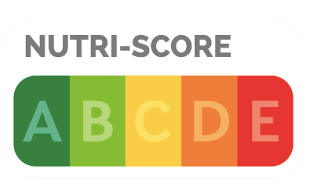
Here's where I think that Nutri-Score would be a good thing.  Nutri-Score is a "traffic light system" that ranks food products on a scale from A to E, where A is the best and E is the worst, and it is clearly visible of the front of the food's packaging.  

Food products get a lower rating if there is:

  • high energy density per 100 g or per 100 ml
  • high sugar content
  • high content of saturated fatty acids
  • high salt content.
There's a higher rating when:
  • contains fruits, vegetables, nuts and legumes
  • contains fiber
  • contains protein
  • contains rapeseed, walnut and olive oil
Nutri-Score was founded in France in 2013 and in 2017 the French Health Ministry officially recommended it.  Since then it has rolled out in Belgium, Spain, Germany, Switzerland, the Netherlands, and Luxembourg.  The system has been recommended by the European Commission and the World Health Organization.

So far it's not mandatory across the EU but I'm sure that it will be eventually.  Some companies such as Nestlé and Danone have announced that they will start using Nutri-Score in Portugal, Slovenia, and Austria even though it's not required in those countries.  

Not all countries are onboard with the system.  Poland, Czechland, Cyprus, Greece, Hungary, Latvia, and Romania all oppose it.  Italy believes that the system puts the traditional Mediterranean diet at a disadvantage.  

The Czech Ministry of Agriculture isn't in favour of the system but it will tolerate international labels with Nutri-Score.  The ministry is not in favour of a mandatory front-of-package label and believes that the Nutri-Score formula is too simplistic because it doesn't consider the size of a portion or how food is prepared. 

Nestlé will start using Nutri-Score in Czechland in 2023.  

Here's an interesting video I found out on YouTube where CNN talks about some of the differences between the US and Czech health care systems.  Not exactly Nutri-Score or Obesity related but still kind of fitting.  While the video is at least 12 years old already it's still pretty accurate.

©CNN

Update:  August 2022.  Here's a short TV commercial for Nestle that shows the Nutri-Score label.

©Nestlé Cereálie CZ

Monday, January 27, 2020

Back in Skopje, North Macedonia

I was back in the Balkans and spent this past weekend in Skopje.  While it was my second time in Skopje it was my first time in North Macedonia.  Greece and Macedonia finally came to an agreement on the name issue and in February 2019, Macedonia became North Macedonia.  I don't think that I get to count this as a new country.

With the name issue sorted, 27 years later, North Macedonia will now be able to move forward with joining NATO and the EU.  

When I was here in 2011 the government had just kicked off its Skopje 2014 project to give the capital a more classical look.  A lot of construction took place and it definitely felt like I was visiting a new city.  Although I think they went a bit overboard on the statues.  Sometimes less is more.

The "Alexander the Great" monument had been erected to celebrate the countries 20 years of independence from Yugoslavia.  Today, it is known as the "Warrior on a Horse".  It's still huge and cost €7,5 million.

There's now the Warrior monument and fountain.  Many believe that it is supposed to represent Philip II of Macedon.  The statue is 15 meters (49 feet) tall and it was unveiled in 2012.  It cost about €2 million.

The Museum of Archaeology also houses the Constitutional Court and the National Archives.  Construction cost over €7 million.  The bridge leading to the museum, with its 28 sculptures cost another €2,5 million.

The new Saints Cyril and Methodius statue was only €540.000.

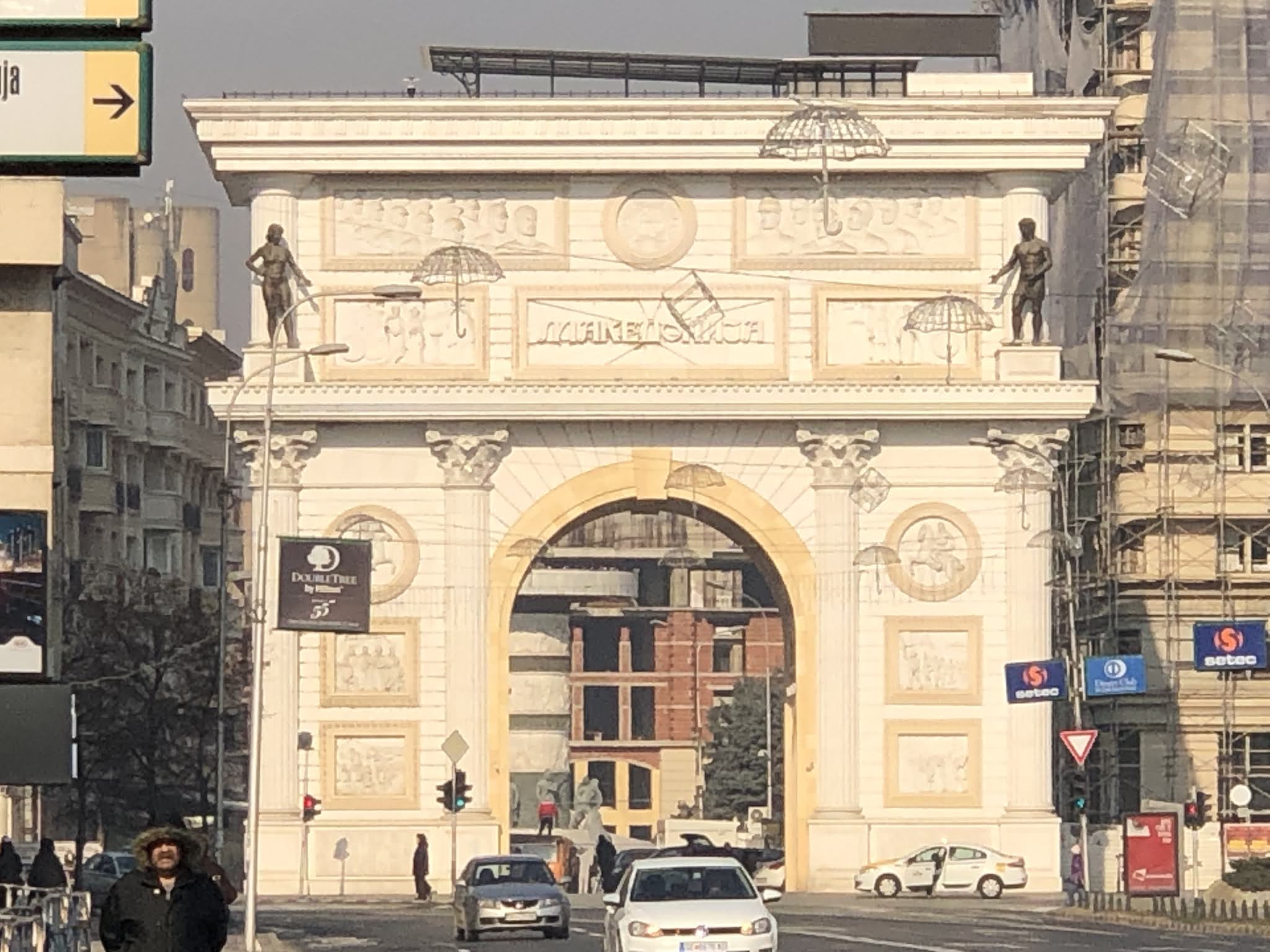
There's now a triumphal arch called the Porta Macedonia that commemorates the long struggle for Macedonian independence.  It was opened to the public in 2012 and cost an estimated €4,5 million.

A statue went up in front of the parliament building that cost €715.000.

Across from the parliament is Žena Borec Park which got several monuments.  The Defenders of Macedonia cost around €300.000

The monument for the Anti-Fascist Assembly for the National Liberation of Macedonia (ASNOM) was €1,9 million.

The statue of the Founders of the Internal Macedonian Revolutionary Organization cost €1,2 million.

The Fallen Heroes of Macedonia memorial is home to an eternal flame.  This one cost €2,3 million.

The statue of Pitu Guli was a bargain because it was just €118.000.

The Museum of the Macedonian Struggle for Statehood and Independence opened in 2011.  The cost of the museum was around €10 million.

The statue of Karposh, the rebellion leader cost €540.000.

The Macedonian National Theatre replaced the former one which was destroyed in the 1963 earthquake that levelled the city.  Reconstruction of the theatre actually began in 2007.  The cost of reconstruction has been estimated to have been between €6 million and €30 million.

The Boatmen of Thessaloniki, also known as the Assassins of Salonica, cost €970.000.


The marble monument of Justinian I was unveiled in 2011.  It cost over €1 million.


Four boats have been permanently built into the riverbed of the Vardar River.  The boats are used for restaurants and cafes.


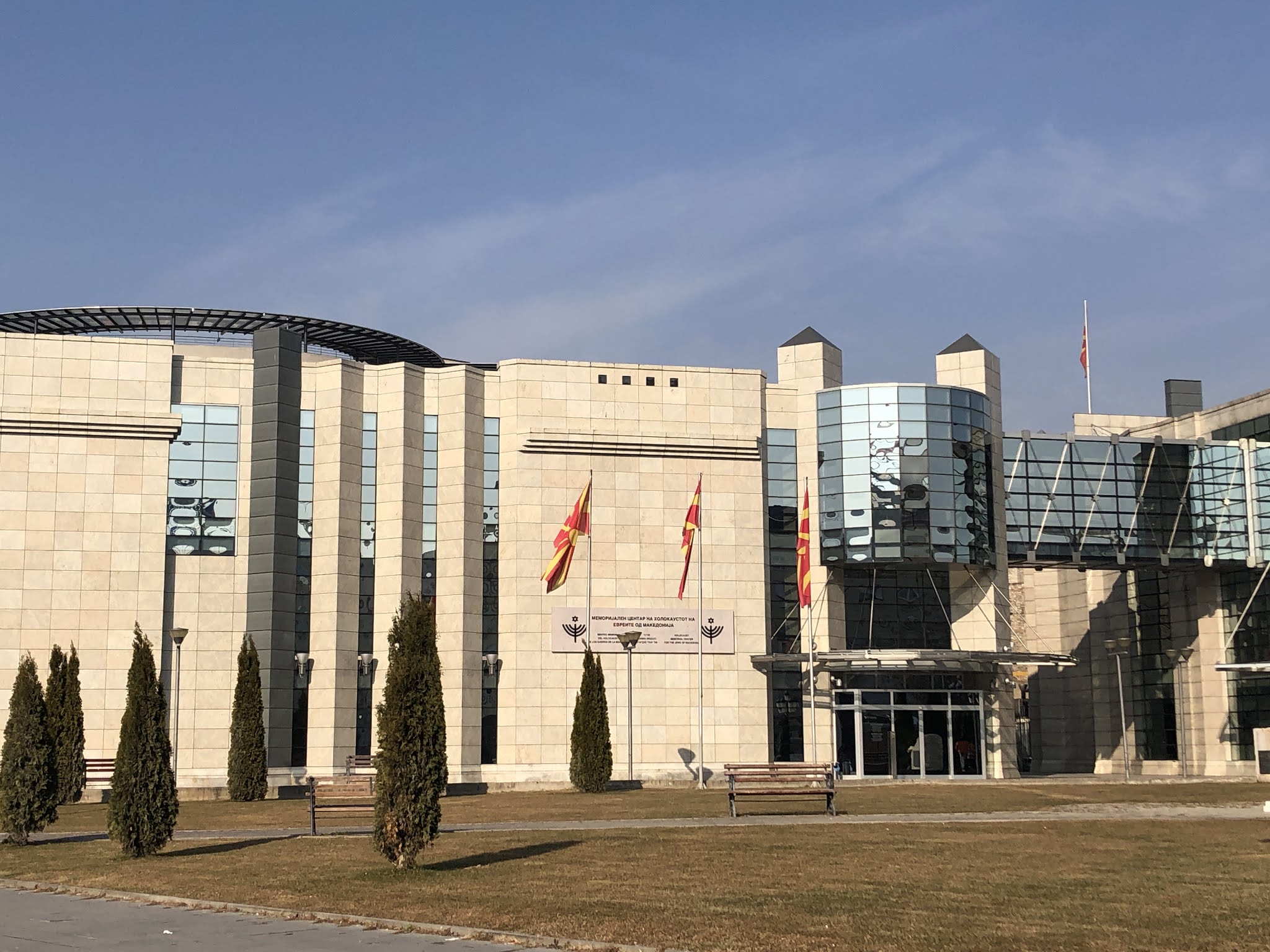
The Holocaust Memorial Centre for the Jews of Macedonia is a memorial for the 7.148 Macedonian Jews who perished in WWII.


The city purchased 202 double-decker buses for its transportation system.  Who knows what that must have cost?

It's not like the city didn't have any monuments before.  I did come across an old statue of Tito.

This whole Skopje 2014 project was massive.  Something like 136 structures were built at a cost well over €800 million.  It's amazing to me that the country spent so much on this.  It's not like this isn't the 6th poorest country in Europe.

Update:  Here's a video I found out on YouTube that talks about the money spent on Skopje 2014.

©Journeyman Pictures