Showing posts with label Macedonia. Show all posts

Tuesday, August 30, 2022

2028 European Capital of Culture Nominations

In 2028, Czechland and France will each host a European Capital of Culture.  A third city will come from outside of the EU, either an EEA country or from an EU-candidate country.  

Czech cities have to submit applications by 1.9.2022.  

The winning cities will be announced in December 2023.

Yesterday, a group of three cyclists left Brno to ride 230 km (143 miles) to deliver Brno's application to the Ministry of Culture in Prague.  They should arrive tomorrow afternoon.  There's a a lot on the line.  Being selected as a European Capital of Culture comes with a €1,5 million prize.

The four Czech cities in the running are Brno, Broumov, České Budějovice, and Liberec.

The Frech cities in contention are Nice, Clermont-Ferrand, Reims, Rouen, Bourges, Saint-Denis, Amiens, and Bastia.

The non-EU cities up for consideration are Budva, Montenegro and Skopje, North Macedonia.

Good luck Brno!  Fingers crossed!

Update October 2022:  Well that didn't take long.  Brno is out of contention.  There was a 12-member panel of experts that narrowed the Czech application list down to Broumov and České Budějovice.  

The Frech cities now on the short list are Rouen, Bourges, Clermont-Ferrand, and Montpellier.

Wednesday, June 22, 2022

Turkey is now Türkiye

In Turkish, the Republic of Turkey is Türkiye Cumhuriyeti and it took the name when it declared itself a republic on 29 October 1923.  The country's short name in English has been "Turkey" for almost 100 years.  In German it's been "Turkei" and in French it's been "Turquie". 

Well Turkish President Recep Tayyip Erdoğan wants to change the country's image and disassociate it from the bird.

The country's short name is now Türkiye.  

It can take a while for a country's name change to take root.  In 1935, Persia changed its name to Iran with "Iran" being the Farsi word for Persia.

In 2019, Macedonia changed its name to North Macedonia to resolve its name dispute with Greece which was holding up the country's accession to NATO.

In 2016, Czech Republic changed its official short name to Czechia.  That's still taking a while to catch on.

Here's a five-minute video I found on YouTube that talks about Türkiye's name change.

©DW News

Sunday, April 24, 2022

Organization for Security and Co-operation in Europe (OSCE)

The Organisation for Security and Co-operation in Europe (OSCE) is the world's largest regional security-oriented intergovernmental organisation.  It even has observer status as the United Nations.  It began in 1973 as a forum between the west and the east during the Cold War.  The OSCE focuses on arms control, promotion of human rights, freedom of the press, and free and fair elections.  

Its headquarters are in Vienna and today the OSCE consists of 57 participating countries plus 11 observer/partner countries.  The six official languages are English, French, German, Italian, Spanish, and Russian. 

It's basically every country in Europe plus the USA and Canada.  The 11 partner countries are Afghanistan, Australia, Algeria, Egypt, Israel, Japan, Jordan, Morocco, South Korea, Thailand, and Tunisia. 

Each year a different country assumes the chairmanship for a calendar year and that country's minister of foreign affairs is the Chairperson-in-Office.  Czechoslovakia held the chairmanship in 1992.  An independent Czechland hasn't held the chairmanship yet but Slovakia held it in 2019.  

The chairmanship is with Poland this year.  North Macedonia has it next year followed by Estonia in 2024 and Finland in 2025.

Here's a short video I found out on YouTube about the OSCE.

©The Organisation for Security and Co-operation in Europe

Sunday, April 4, 2021

Erasmus

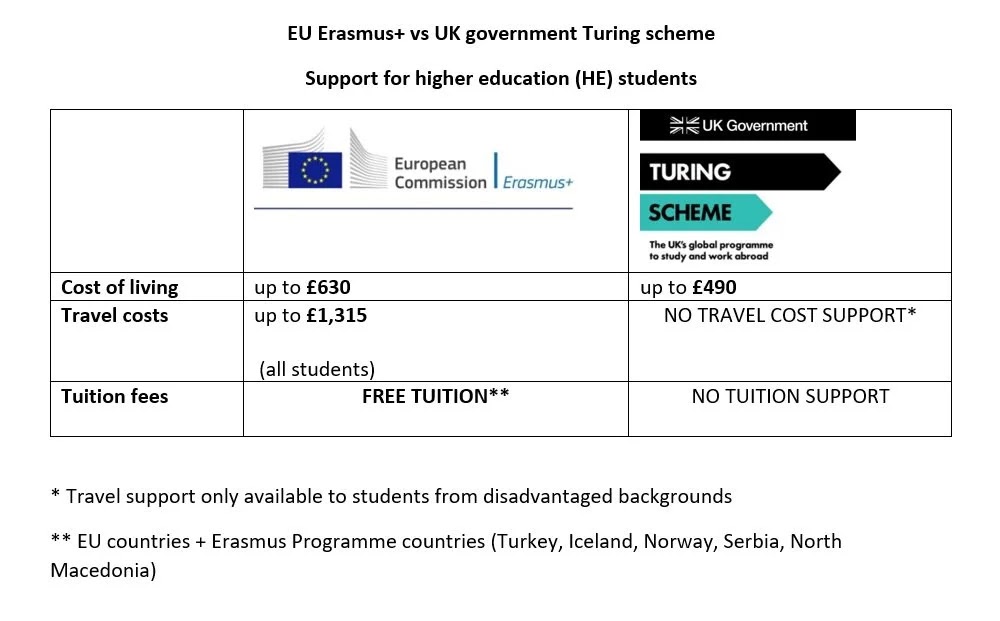
Brno is a student city and, under more normal times, there are many foreign students here under the Erasmus Programme.  Erasmus is the EU student exchange programme that was established in 1987.  It provides educational exchanges across the EU.  Some non-EU countries like Turkey, Iceland, Serbia, Norway, and Macedonia pay to participate in the programme as well.  Erasmus is the acronym for the EuRopean Community Action Scheme for the Mobility of University Students.  

In 2014, all of the EU's programmes for education, training, youth and sport were combined under Erasmus Plus.

Under Erasmus Plus students don't pay any more tuition than what they pay at their home institution.  Students receive grants to help cover living expenses to study abroad and for work placements/internships.  Teachers and educational staff are also able to attend training courses across Europe.  

Every year around 300.000 students participate in the programme at over 4.000 institutions in 37 countries.  Spain sends the most participants followed by France, Germany, and Italy.  The most popular receiving countries are Spain, Germany, Italy, and France.

I don't know how true it is but I've heard that some 25% of Erasmus participants meet their future spouse/partner while on the programme.

After Brexit the United Kingdom decided to no longer participate in Erasmus.  So UK students can no longer study in the EU and EU students aren't able to study at UK institutions.  The UK has rolled out the Turing Scheme, named after Alan Turing, as its replacement for Erasmus.  It will allow up to 35.000 UK students to study and work worldwide.   

Erasmus provides more money to students than Turing to subsidise their foreign placements.  

Ireland has announced that it will fund students from Northern Ireland to continue to participate in Erasmus even though the UK pulled out of the programme.

Monday, January 27, 2020

Back in Skopje, North Macedonia

I was back in the Balkans and spent this past weekend in Skopje.  While it was my second time in Skopje it was my first time in North Macedonia.  Greece and Macedonia finally came to an agreement on the name issue and in February 2019, Macedonia became North Macedonia.  I don't think that I get to count this as a new country.

With the name issue sorted, 27 years later, North Macedonia will now be able to move forward with joining NATO and the EU.  

When I was here in 2011 the government had just kicked off its Skopje 2014 project to give the capital a more classical look.  A lot of construction took place and it definitely felt like I was visiting a new city.  Although I think they went a bit overboard on the statues.  Sometimes less is more.

The "Alexander the Great" monument had been erected to celebrate the countries 20 years of independence from Yugoslavia.  Today, it is known as the "Warrior on a Horse".  It's still huge and cost €7,5 million.

There's now the Warrior monument and fountain.  Many believe that it is supposed to represent Philip II of Macedon.  The statue is 15 meters (49 feet) tall and it was unveiled in 2012.  It cost about €2 million.

The Museum of Archaeology also houses the Constitutional Court and the National Archives.  Construction cost over €7 million.  The bridge leading to the museum, with its 28 sculptures cost another €2,5 million.

The new Saints Cyril and Methodius statue was only €540.000.

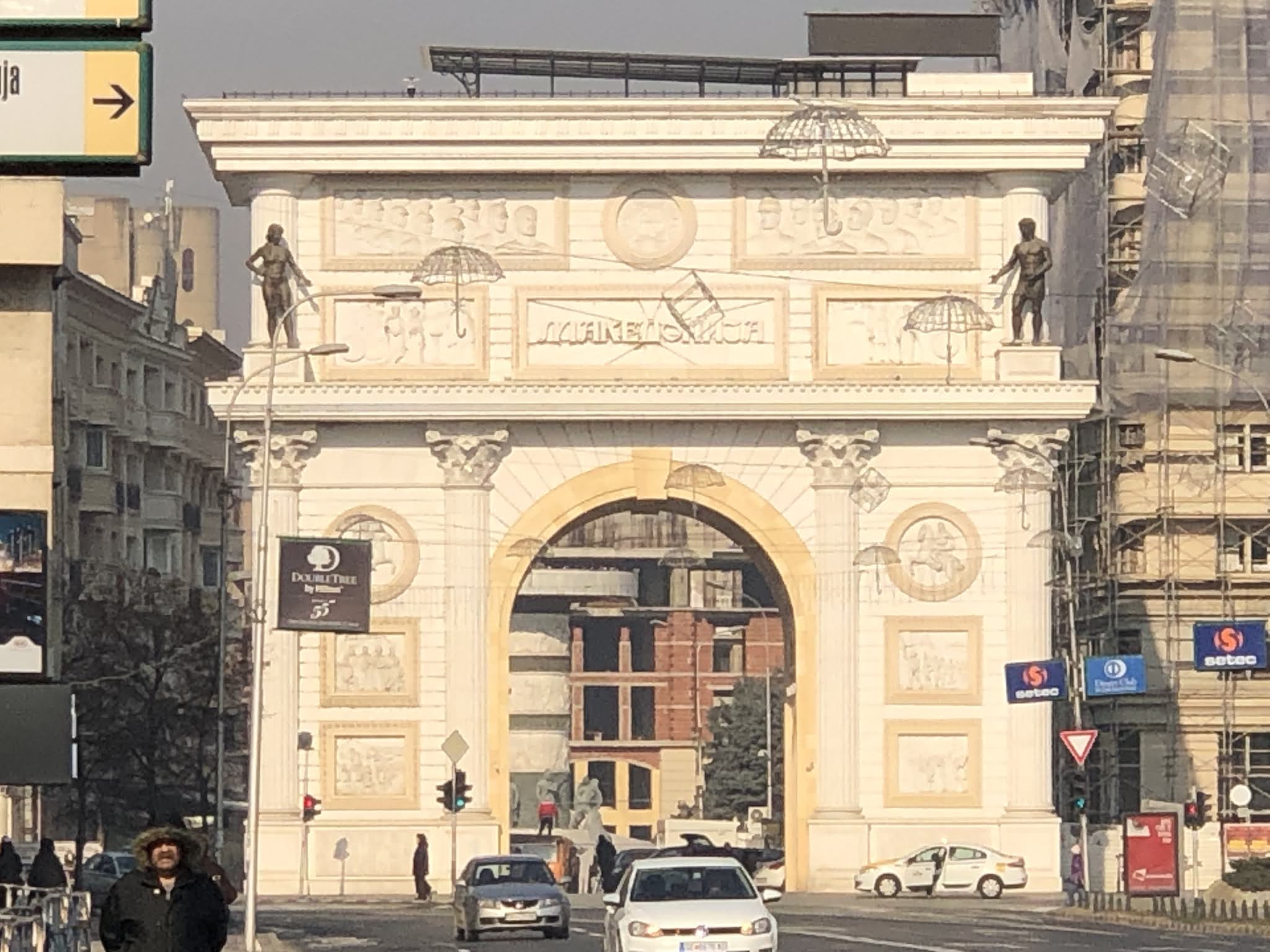
There's now a triumphal arch called the Porta Macedonia that commemorates the long struggle for Macedonian independence.  It was opened to the public in 2012 and cost an estimated €4,5 million.

A statue went up in front of the parliament building that cost €715.000.
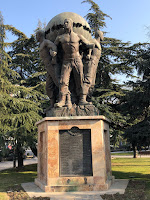
Across from the parliament is Žena Borec Park which got several monuments.  The Defenders of Macedonia cost around €300.000

The monument for the Anti-Fascist Assembly for the National Liberation of Macedonia (ASNOM) was €1,9 million.

The statue of the Founders of the Internal Macedonian Revolutionary Organization cost €1,2 million.

The Fallen Heroes of Macedonia memorial is home to an eternal flame.  This one cost €2,3 million.

The statue of Pitu Guli was a bargain because it was just €118.000.

The Museum of the Macedonian Struggle for Statehood and Independence opened in 2011.  The cost of the museum was around €10 million.

The statue of Karposh, the rebellion leader cost €540.000.

The Macedonian National Theatre replaced the former one which was destroyed in the 1963 earthquake that levelled the city.  Reconstruction of the theatre actually began in 2007.  The cost of reconstruction has been estimated to have been between €6 million and €30 million.

The Boatmen of Thessaloniki, also known as the Assassins of Salonica, cost €970.000.


The marble monument of Justinian I was unveiled in 2011.  It cost over €1 million.
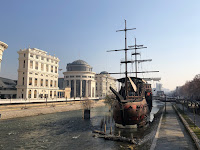

Four boats have been permanently built into the riverbed of the Vardar River.  The boats are used for restaurants and cafes.


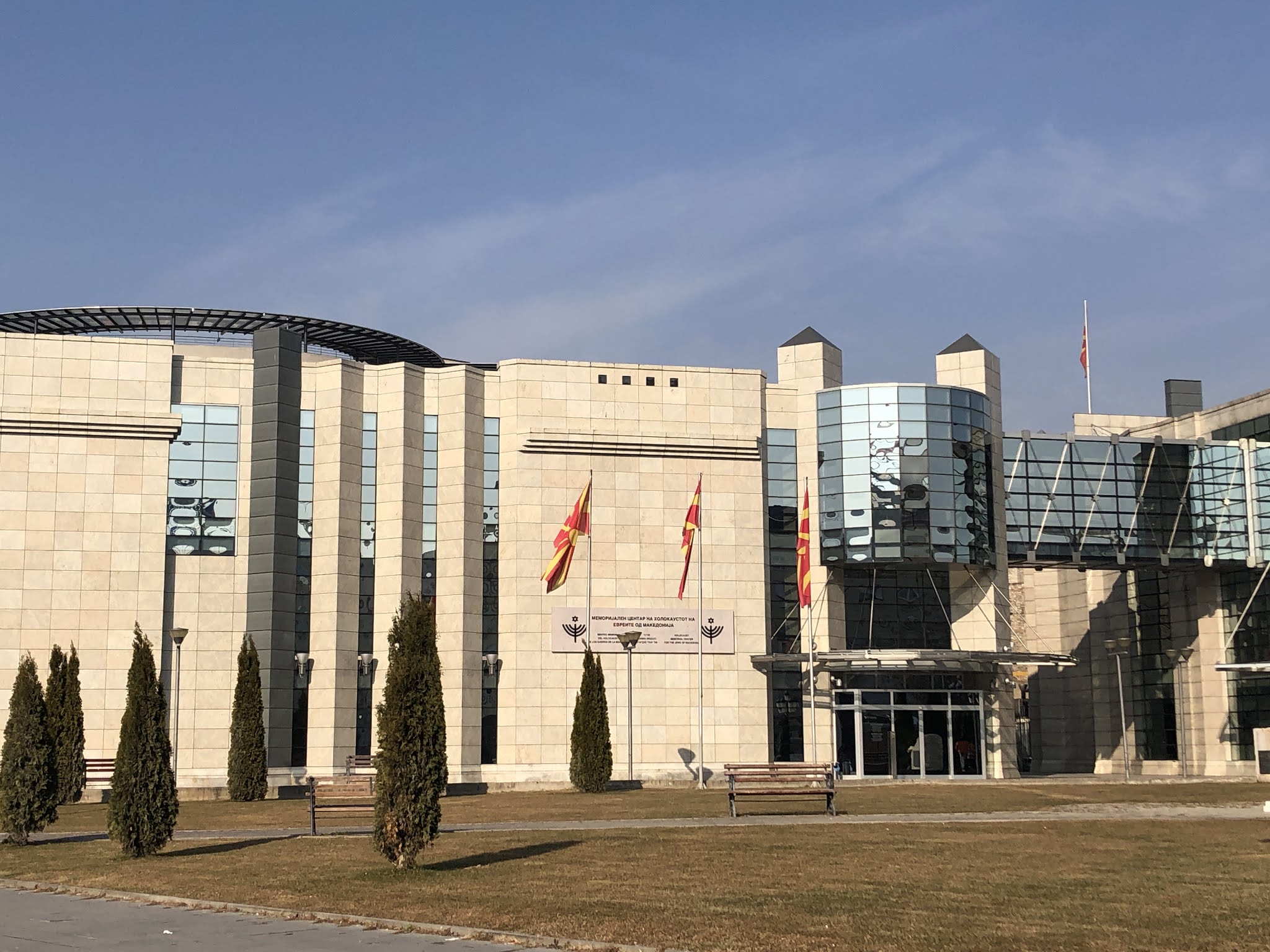
The Holocaust Memorial Centre for the Jews of Macedonia is a memorial for the 7.148 Macedonian Jews who perished in WWII.


The city purchased 202 double-decker buses for its transportation system.  Who knows what that must have cost?
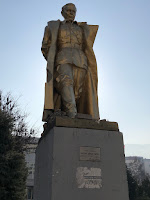
It's not like the city didn't have any monuments before.  I did come across an old statue of Tito.

This whole Skopje 2014 project was massive.  Something like 136 structures were built at a cost well over €800 million.  It's amazing to me that the country spent so much on this.  It's not like this isn't the 6th poorest country in Europe.

Update:  Here's a video I found out on YouTube that talks about the money spent on Skopje 2014.
©Journeyman Pictures

Sunday, January 5, 2020

First Trip of 2020

Slovakia's Presidential Palace
Today was my first trip of the new year.  Well not a big trip though.  

I just went to Bratislava to meet a friend for lunch.  After a walk around the city, and a coffee to warm up with, it was back to the train station to get home.

My next "real" trip is in a couple of weeks when I go visit Skopje again.  The last time I was there was in 2011 when it was the capital of Macedonia.  Now it's the capital of North Macedonia and I'm looking forward to see how the city has changed in 9 years.

Friday, August 16, 2019

CEFTA

The Central European Free Trade Agreement, or CEFTA, was formed in 1992 by the Visegrád countries - Czechoslovakia, Poland, and Hungary.  After the Velvet Divorce both Czech Republic and Slovakia became independent members.  The purpose was to work together towards integrating political, economic, security, and legal systems with western free-market economies.
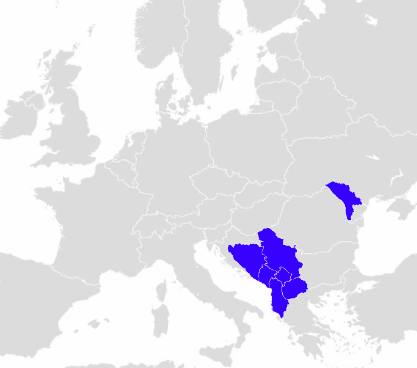
Over the years, other countries have joined CEFTA.  However, once a country joins the European Union it must leave CEFTA.  Former members include Bulgaria, Croatia, Romania, and Slovenia.  Basically being a CEFTA member servers as good preparation for eventually joining the EU.

Current CEFTA members
CEFTA seems less "Central Europe" and more "Balkans" to me.  The seven current members are Albania, Bosnia and Herzegovina, Kosovo, Moldova, Montenegro, Macedonia, and Serbia.  Combined the CEFTA countries have a combined population of about 21,5 million people and a GDP over $290 billion.

Friday, April 12, 2019

70 Years of NATO

Last month Czech Republic celebrated 20 years in NATO but last week NATO turned 70.

I'm sure that Russia isn't exactly happy that NATO is still going strong.  It's ironic that not only former Warsaw Pact countries like Czechland & Slovakia, Hungary, and Poland are NATO members, but so are the Baltic countries which used to be part of the Soviet Union.

It looks like North Macedonia will probably be the next country to join.  Bosnia and Herzegovina, Georgia, and Ukraine are all potential members as well.

Here are a couple of short videos I found out on YouTube about NATO and the 70th anniversary.

©Radio Free Europe

The second video has comments from Tomáš Petříček, the Czech Minister of Foreign Affairs.

©Newsy

Here's a 2015 video about how powerful NATO is.  It's even more powerful now.

©Test Tube News

Update: North Macedonia joined in 2020 becoming the 30th NATO member.

Sunday, January 10, 2016

Czechs and Salt

According to the World Health Organization Czechs consume more than twice the recommended daily salt intake.  While the WHO recommends less than 5 grams (one teaspoon), Czechs average around 13 grams per person.

This doesn't surprise me a bit.  I've never understand it when my friends immediately salt their food without even tasting it first.  To be fair, I do the same thing but with pepper.  Of course, the difference is that I already know that Czech food doesn't ever have enough pepper for me.  I never need to add salt over here.

When it comes to salt consumption, Czechs rank #3 in Europe.  Only Hungary and Macedonia consume more salt per person than in Czechland. 

Monday, August 4, 2014

Emergency Numbers

In the USA, if you need to make an emergency call for the police, fire department or an ambulance you dial 911.  In Europe, each country has their own emergency numbers.  For example, in Czechland you call:

150 for fires, natural disasters, accidents and emergencies
155 for health problems, injuries or accidents requiring medical attention
156 for the municipal police
158 for disturbances of public order and safety, traffic accidents or to report a crime

And that's just for Czechland.  To get an ambulance in Spain you dial 061, in Austria it is 144, in Italy it is 118, in Croatia it is 94, in Hungary the number is 104, while both the UK and Ireland use 999.  The list of numbers goes on and on. 

It can be a real problem if you don't know the emergency number in the country you're visiting.  So the European Union came up with the 112 number.  Aside from the local numbers, anyone in any EU country can dial 112 for any emergency - police, fire, ambulance.  112 even works in some non-EU countries such as Andorra, San Marino, Liechtenstein, Monaco, Vatican City, Iceland, Macedonia, and Serbia.

112 is a free call from either land line or mobile phones and can be used even without a SIM card.  The 112 number is awesome because the operators are prepared to dispatch calls in foreign languages.  So no need to speak Czech if you need the police.

Here's short video I found out on YouTube about the 112 emergency number.
 

Thursday, May 1, 2014

10 Years in the EU

Today is 1 May and it's a public holiday.  Today is also the 10th anniversary of Czech Republic joining the European Union.

In 1952, six countries (Belgium, Italy, Luxembourg, France, Netherlands, and West Germany) formed the European Coal and Steel Community.  In 1953, Denmark, Ireland and the UK also joined.  This eventually developed in to a European common market.

Greece joined in 1981 and Portugal and Spain both joined in 1986.  After German reunification in 1990, the EU picked up what used to be East GermanySweden, Finland, and Austria all joined in 1995.

2004 was a big year for the EU.  The single largest EU expansion (number of countries, territory, and population) occurred in 2004.  The EU welcomed Cyprus, Czech Republic, Estonia, Hungary, Latvia, Lithuania, Malta, Poland, Slovakia, and Slovenia.

In 2007, Bulgaria and Romania joined.  Last year, Croatia became the newest member.  Today, the EU contains 28 countries and more than 500 million people.

Still, not every country in Europe is an EU member.  Norway, Andorra, Monaco, San Marino, Vatican City, Liechtenstein, and Switzerland are not members.  Iceland, Macedonia, Montenegro, Serbia, and Turkey are all candidates to join the EU.  Albania, Bosnia and Herzegovina, Kosovo, and Ukraine are not yet even candidates to join. 

Czechs have gained economically from joining the EU.  Plus it's a heck of a lot easier for Czechs to travel now.  However, many Czech people consider EU legislation as a negative and only around 20% or so of the people want to give up the Crown for the Euro.

Update:  Here's a video I found out on YouTube about the European Union.
©CGP Grey

Update:  15 years in the EU.
Update:  The UK officially left the EU on 31 January 2020.

Update:  Here's a short 5½-minute video on how the EU works.
©CNBC International

Update 2025:  Here's a short video about the EU.

©EU Made Simple

Wednesday, March 12, 2014

15 Years in NATO

Today was the 15th anniversary since Czech Republic joined NATO. 


NATO is the North Atlantic Treaty Organization.  The organization came about after WWII.  It is a military alliance where all members agree to mutual defense.  An attack on one NATO member is considered an attack on all members.

The alliance is headquartered in Brussels.  

Back in 1949, the alliance began with 12 members - Belgium, Canada, Denmark, France, Iceland, Italy, Luxembourg, Netherlands, Norway, Portugal, the United Kingdom and the USA.  

Greece, Turkey and West Germany joined in the 1950s and Spain joined in 1982.

Czech Republic, Hungary and Poland joined in 1999 becoming the first former Warsaw Pact members to join the alliance.

Seven new members joined in 2004 - Bulgaria, Estonia, Latvia, Lithuania, Romania, Slovakia and SloveniaAlbania and Croatia both joined in 2009.

Today there are 28 members.  Bosnia and Herzegovina, Montenegro and Macedonia are all in the process of joining as well.  Georgia is another aspiring member.  Given the problems in Crimea, I'm sure that Ukraine wishes it was currently a member.

Macedonia fulfilled the requirements to join at the same time as Albania and Croatia, but its membership was blocked by Greece over the country name of Macedonia.    

Here's a NATO video timeline I found out on YouTube.
©NATO
 
I also found a video from 2011 showing Czech NATO troops training police recruits in Afghanistan.

©NATO 

Update: Montenegro joined in 2017.
Update: 2019 is the 20th anniversary of joining NATO.

Update: 2019 - Here's the Czechia is NATO - We Are NATO video.

©NATO 

Update: North Macedonia joined in 2020 becoming the 30th NATO member.

Update:  September 2022 - Here's a short video I found on YouTube about how a country joins NATO.

©NATO

Update: 4 April 2023 - Finland became the 31st member of NATO.

Monday, January 7, 2013

Merry Orthodox Christmas

Most people celebrate Christmas on December 25 as based on the Gregorian calendar which Pope Gregory XIII replaced the Julian calendar with in 1582.

However, Christians in many Eastern Orthodox countries still observe Christmas using the Julian calendar which puts it on January 7th.

The Orthodox Church is the second largest Christian church, after the Roman Catholic Church, in the world.  There are an estimated 225-300 million followers.  Most of whom are in Eastern and Southeastern Europe, as well as, in the Middle East.

Orthodoxy is by far the largest faith in Russia, Belarus, Ukraine, Moldova, Georgia, Romania, Serbia, Montenegro, Macedonia, Bulgaria, Greece and Cyprus.  There are also large populations in Lebanon, Jordan and Syria.

Orthodox Churches in Greece, Bulgaria, and Romania celebrate Christmas on December 25th.  But today is Christmas for all of my friends and colleagues from Russia, Ukraine, Serbia, Macedonia and Moldova.  So Merry Christmas!!

Wednesday, October 24, 2012

Greece

Nat and I decided on a weekend trip to Athens in a few weeks.  She's never been there before and it's been 20 years since I was in Athens so this should be a good little adventure.  This will also be country #33 that I've visited since I moved here in July 2009.  My last assignment in the military was in Heraklion, Crete, which seems like a lifetime ago.  I'm still planning a return trip to Crete in the future.  It should be interesting to see how things have changed in Greece since I left.

Officially the Hellenic Republic (Ελληνική Δημοκρατία), Greece (Ελλάδα) is in southeast Europe.  Greece borders Albania, Macedonia, Bulgaria and Turkey.  It lies on the Aegean Sea, the Ionian Sea and the Mediterranean Sea.  The country has around 1,400 islands but only 227 of them are inhabited.  Crete is the largest island.  The entire country is a bit smaller than Alabama and has a population around 11 million.  Athens is the capital and its largest city.

The first advanced civilizations in Europe began here around 3200 BC.  Ancient Greece was the cradle of Western civilization.  It gave us democracy, western philosophy, and the Olympic Games.  There is a lot of history to explore here.  Greece is home to 17 UNESCO World Heritage Sites - the 7th most in Europe (13th in the world).

Following the Greek War of Independence, from the Ottoman Empire, Greece was established in 1830.  During WWII, Greece was invaded by Italy in 1940 and then occupied by Nazi Germany from 1941 to 1944.  Then there was a civil war between nationalists and communists that lasted until 1949.  Many Greeks ended up in Czechoslovakia but more on that one later.

Greece joined NATO in 1952.  A military dictatorship took control of the country in 1967 and it wasn't until 1974 that democratic elections took place which created a parliamentary republic.  In 1981, Greece joined what later became the EU and adopted the euro in 2001.  Greece is a member of the Schengen area but may be kicked out.

Greece has several issues to deal with.  Traditionally, these have been with neighboring countries.  There is a big rivalry between Greeks and Turks.  There are always territorial disputes in the Aegean Sea between the two countries.  There is a section of Greece called Macedonia so it rejects the Republic of Macedonia from using the name.  The migration of unemployed people from Albania has helped to put a strain on the Greek government.  And these are just some of the traditional issues the country deals with.  The more recent problems are the ones that require the most attention.

Greece's economy is a wreck.  The country falsified records in order to join the Eurozone when in fact it never met the basic requirements for membership.  Greece was spending more than it was earning before it joined the euro and public spending went crazy after it joined.  To make matters worse, high levels of tax evasion have caused the budget deficit to spiral out of control.  When the global financial crisis hit, Greece was no longer able to repay its debt and the country was forced to ask for massive loans.

In 2010, the EU and the International Monetary fund gave €110 billion ($140 billion) and in 2012 another €130 billion bailout package was approved.  Most of the country's private creditors agreed to write off over half of their Greek debt and to provide lower interest rates for existing loans.  Currently Greece owes $38B to French banks, $8.2 to UK banks, $5.5 to German banks and $3.2B to US banks.

However, in exchange for all of this assistance, Greece has had to undertake major austerity measures to cut spending, raise taxes and undergo pension and labor market reforms.  Without the ability to devalue its currency, Greece has a long hard road ahead.  Over 25% of the country is currently unemployed.  For young people, the rate is more than 54%.  This prevents the country from collecting revenue in order to pay off its debt which forces further public spending cuts.  This is also causing a "brain drain" as educated Greeks are leaving the country in order to find jobs overseas.  What a mess!  At some point, there will have to be a "GrExit" from the Eurozone which will set a dangerous precedent with regards to the troubled economies in Spain, Italy, Portugal and Ireland.

Here's a video from 2011 I found on YouTube that gives more information.

©Deutsche Welle