 Banja Luka, or Бања Лука in Serbian, is the second largest city in Bosnia and Herzegovia. It is the largest city and the administrative capital of Republika Srpska.
 The city is in the northwest part of Bosnia, on the Verbs river, just over 3 hours by car, 139 km (86 miles), from Sarajevo.
Banja Luka is home to just around 140,000 while the greater area totals around 185,000 people.
 There's evidence that the Romans were here back in the first centuries.
Banja Luka was first mentioned in writing in 1494. In 1527 it fell to the Ottoman Empire before eventually becoming part of the Austro-Hungarian Empire.

At the end of WWI it became part of the the Kingdom of Yugoslavia. During WWII, it became part of the Independent State of Croatia which was a Nazi puppet regime. Yugoslav partisans liberated the city on 22 April 1945 and it rejoined
Yugoslavia.
During the war in the 1990s, almost all of the city's Bosniaks and Croats were expelled. All 16 of the city's mosques were rigged with explosives and destroyed as part of the ethnic cleansing that was going on.
 The Ferhat Pasha Mosque was built in 1579 but it was demolished in 1993. The mosque was rebuilt and opened in 2016.

The Catholic Church of St. Anthony and Franciscan monastery was also destroyed in 1993 by the Bosnian Serb Army. Reconstruction began in 2003 after Pope John Paul II visited the site.
 The Cathedral of Christ the Saviour, is part of the Serbian Orthodox Church, was consecrated in 1939. It was demolished during WW2 and following the war the Yugoslav communists didn't permit the church to be rebuilt. During the Bosnian war, in 1993, permission was give to rebuilt the church.
 There are four Roman Catholic cathedrals in Bosnia and Herzegovina one of them is in Banja Luka. The Cathedral of St. Bonaventure was built in the 1970s. It too was damaged during the Bosnian War but it reopened in 2001 following repairs. The 42m (138 ft.) tall bell tower is kind of funky.
 There's even a Ukrainian church that was built on the site where a Ukrainian Greek church was destroyed during WWII. Restoration began in 1998. The exterior is done but the interior is still a work in progress.

The National Theatre of the Republic of Srpska was founded in 1930.

At Memorial Park, there is a memorial to the Yugoslav partisans that died fighting in WWII.

Banski Dvor opened in 1932. Until 2008 it was the seat of the President of the Republika Srbska. Today, it is home to the city administration and it is a cultural centre.
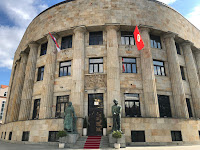 The Palace of the Republic is the official residence of the President of Republika Srpska. It was built as a bank in 1936. After WWII, the communists used the building as the People's Bank. During the Bosnian War the building became a place for youth meetings. After the war it was the home of the National Bank of Republika Srpska and the Ministry of Finance of Republika Srpska. In 2008 is when the official residence of the President of Republika Srpska moved here from Banski Dvor.
 The Office of the Prime Minister of Republika Srpska is a modern building. I was surprised that the armed guards allowed me to take photos of it.

Gospodska is
Gentleman's Street, and it is full of shops with cafes and bars tucked in side streets.

The Museum of Modern Art of Republika Srpska was established in 1971.
 In 1930 the Museum of Verbs Banovina opened. In 1982 the location was moved to the Worker's Solidarity House, next to the national library. In 1982 it became the Museum of Republika Srpska. There's some interesting displays inside but there's this odd taxidermy collection that I didn't really understand how it fit in with the displays.
 Next door to the museum is a library. I assume it's the national library but I could be wrong.

The Arie Livne Jewish Cultural Centre was inaugurated in 2014. It is the only such facility built in the Balkans since WWII. It contains one of only two synagogues in Republika Srpska. Before the Holocaust there were a few hundred Jewish families in Banja Luka but today the number of families is in the tens.

Tržnica is the central market where you can find pretty much everything. There are plenty of fruits and vegetables plus lots of clothing shops.

The Kastel Fortress is on the left bank of the Vrbas river. It's medieval but it sits on the site of previous Roman fortifications. It is one of the city's main sights.

The Vrbas river runs through the town. The river runs for 250 km (155 miles) and it is a tributary of the Sava river.

At Banj Brno is the monument to fallen Krajina soldiers in the National Liberation War (1941-1945). It opened in 1961. It's a good hike up to the the top of the hill. Thanks to Covid, I'm still
not allowed any strenuous exercise for another couple of months so I took my time on the way up the hill. But on my first post-Covid hike, I'm glad that the 18 km (11,25 miles) didn't do me in.

There are Republika Srpska flags all throughout the city. On the other hand I think I only saw maybe two Bosnia flags out.

There are also lots of murals for the Vultures which is the local football team.

I saw a few murals across the city of Ratio Mladić, who led the Bosnian Serbs during the war. In 2017 he was convicted of committing war crimes, crimes against humanity and genocide.
The Serbian text translates to "Unification has started and it can't be stopped." I assume this has to do with the desire to merge with Serbia.
 What I didn't care for was all of the open support for Putin and Russia in the invasion of Ukraine. I saw more than one Z in the city.

There were even Z t-shirts for sale. It wasn't a souvenir that I wanted.
Я за Україну. Я за Україною. Слава Україні Stojím za Ukrajinou! I stand with Ukraine. 
 The European Union Force Bosnia and Herzegovina (EUFOR) is a military deployment to help keep the peace in Bosnia and Herzegovina (BiH). At least it used to be called EUFOR. Now it is Operation ALTHEA.
 After the one year, IFOR was replaced by the Stabilisation Force in Bosnia and Herzegovina (SFOR). SFOR was another NATO-led peacekeeping force, with several non-NATO countries contributing troops. IFOR was replaced by EUFOR in December 2004.








 Czech Koruna Exchange Rate



 Posts
Posts


