We had booked the Best of Ephesus Tour for Monday which was great. We were the only two who had booked so we actually ended up on a private tour with our guide Mehmet.
 Our first stop was at a big statue of the Virgin Mary.

 After that we headed to Meryemana, the House of the Virgin Mary, which is about 6 km (3.7 miles) from Ephesus and 17 km (11 miles) from Şirince. The house is surrounded by pine and olive trees. It's a Catholic shrine and a UNESCO World Heritage Site.

A bedridden Augustinian nun in Germany, named Anne Catherine Emmerich, had visions, about the Virgin Mary. One was a description of the house that the Apostle John had built for the Virgin Mary where she lived out the rest of her life. An author spent five years transcribing the nun's visions, before she passed away, and a book was published in 1852.
 Two expeditions completed in 1891, discovering the match between the location and the nun's visions. While the Roman Catholic Church has never officially proclaimed the validity of the site, multiple popes have given blessings and visited the house. Each year on 15 August, pilgrims come to celebrate Mary's Assumption. In 2004, Pope John Paul II beatified Anne Catherine Emmerich.
 On the way to the shrine, you pass a key hole-shaped baptismal pool.
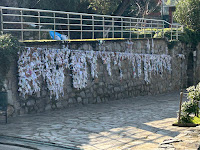
Outside of the house is a "wishing wall" where people write their wishes on paper or fabric.
 There is a spring under the house which pilgrims believe to have healing properties. There are fountains that people can drink from.

I had to make sure to light a candle for
my grandmother. She would have loved that I came here.

It was then on to Ephesus which was a city in Ancient Greece located 3 km (2 miles) southwest of Selçuk, 8 km from Şirince, 20 km (12.5 miles) north of
Kuşadasi, and 70 km (44 miles) south of
Izmir.
 Ephesus was built in the 10th century BC. It was one of the 12-member cities of the Ionian League and became part of the Roman Republic in 129 BC. It's believed that the Gospel of St. John may have been written here.
 The city was conquered by numerous empires over the centuries and it was completely abandoned by the 15th century. Ephesus is home to one of the largest Roman archaeological sites in the Eastern Mediterranean and the ruins were designated a UNESCO World Heritage Site in 2015.

 The most impressive ruin has to be the Library of Celsius. It was built in around 125 AD in memory of Tiberius Julius Celsus Polemaeanus who served as governor of Roman Asia. He paid for the library from his own money and he is buried in a sarcophagus beneath it. The library was the third-largest in the Greco-Roman world and was home to 12.000 scrolls.
 The library was no longer in use after 400 AD. The facade was damaged by an earthquake in the 10th or 11th century but archaeologists re-erected it from 1970 to 1978.

The Great Theatre could hold an estimated 25.000 spectators and dates back to the Hellenistic period (3rd-1st century BC) with extensive renovation during the Roman period. It's believed to have been the the largest theatre in the in the ancient world.
 As it was just the two of us, our guide Mehmet used the opportunity to show us everything in great detail. It would never have been possible with a larger group.

Ephesus was famous for the Temple of Artemis which was nearby. The temple was completed around 550 BC and it was one of the
Seven Wonders of the Ancient World. The temple was destroyed by 401 AD. The only thing left of the temple is a single pillar.

The Basilica of St. John, or rather what's left of it, sits on the slope of Ayasluğ Hill, in Selçuk, about 3,5 km (2.2 miles) from Ephesus. It was built in the 6th century but was damaged when Turks invaded in 1090.

Many believe that the basilica was built on the tomb of the apostle.

There's a fortress on the hill above the cathedral but we didn't visit it.

From the basilica you can see the İsa Bey Mosque. The mosque was built from 1374-1375. Unfortunately it is currently closed for renovation so we only got to view it at a distance.
 |
| Temple, mosque, basilica, and fortress |
 Last weekend we did the Gregor Johann Mendel in Brno self-paced walking tour published by the Tourist Information Centre.









 Czech Koruna Exchange Rate



 Posts
Posts


