Showing posts with label Yugoslavia. Show all posts

Wednesday, April 20, 2022

Banja Luka, Bosnia and Hezegovina

Banja Luka, or Бања Лука in Serbian, is the second largest city in Bosnia and Herzegovia.  It is the largest city and the administrative capital of Republika Srpska.  

The city is in the northwest part of Bosnia, on the Verbs river, just over 3 hours by car, 139 km (86 miles), from Sarajevo.  

Banja Luka is home to just around 140,000 while the greater area totals around 185,000 people.

There's evidence that the Romans were here back in the first centuries.  

Banja Luka was first mentioned in writing in 1494.  In 1527 it fell to the Ottoman Empire before eventually becoming part of the Austro-Hungarian Empire.  


At the end of WWI it became part of the the Kingdom of Yugoslavia.  During WWII, it became part of the Independent State of Croatia which was a Nazi puppet regime.  Yugoslav partisans liberated the city on 22 April 1945 and it rejoined Yugoslavia.

During the war in the 1990s, almost all of the city's Bosniaks and Croats were expelled.  All 16 of the city's mosques were rigged with explosives and destroyed as part of the ethnic cleansing that was going on.

The Ferhat Pasha Mosque was built in 1579 but it was demolished in 1993.  The mosque was rebuilt and opened in 2016.


The Catholic Church of St. Anthony and Franciscan monastery was also destroyed in 1993 by the Bosnian Serb Army.  Reconstruction began in 2003 after Pope John Paul II visited the site.

The Cathedral of Christ the Saviour, is part of the Serbian Orthodox Church, was consecrated in 1939.  It was demolished during WW2 and following the war the Yugoslav communists didn't permit the church to be rebuilt.  During the Bosnian war, in 1993, permission was give to rebuilt the church.

There are four Roman Catholic cathedrals in Bosnia and Herzegovina one of them is in Banja Luka.  The Cathedral of St. Bonaventure was built in the 1970s.  It too was damaged during the Bosnian War but it reopened in 2001 following repairs.  The 42m (138 ft.) tall bell tower is kind of funky.

There's even a Ukrainian church that was built on the site where a Ukrainian Greek church was destroyed during WWII.  Restoration began in 1998.  The exterior is done but the interior is still a work in progress.


The National Theatre of the Republic of Srpska was founded in 1930.


At Memorial Park, there is a memorial to the Yugoslav partisans that died fighting in WWII.


Banski Dvor opened in 1932.  Until 2008 it was the seat of the President of the Republika Srbska.  Today, it is home to the city administration and it is a cultural centre.

The Palace of the Republic is the official residence of the President of Republika Srpska.  It was built as a bank in 1936.  After WWII, the communists used the building as the People's Bank.  During the Bosnian War the building became a place for youth meetings.  After the war it was the home of the National Bank of Republika Srpska and the Ministry of Finance of Republika Srpska.  In 2008 is when the official residence of the President of Republika Srpska moved here from Banski Dvor.

The Office of the Prime Minister of Republika Srpska is a modern building.  I was surprised that the armed guards allowed me to take photos of it.


Gospodska is Gentleman's Street, and it is full of shops with cafes and bars tucked in side streets.  


The Museum of Modern Art of Republika Srpska was established in 1971.

In 1930 the Museum of Verbs Banovina opened.  In 1982 the location was moved to the Worker's Solidarity House, next to the national library.  In 1982 it became the Museum of Republika Srpska.  There's some interesting displays inside but there's this odd taxidermy collection that I didn't really understand how it fit in with the displays.

Next door to the museum is a library.  I assume it's the national library but I could be wrong.


The Arie Livne Jewish Cultural Centre was inaugurated in 2014.  It is the only such facility built in the Balkans since WWII.  It contains one of only two synagogues in Republika Srpska.  Before the Holocaust there were a few hundred Jewish families in Banja Luka but today the number of families is in the tens.


Tržnica is the central market where you can find pretty much everything.  There are plenty of fruits and vegetables plus lots of clothing shops.


The Kastel Fortress is on the left bank of the Vrbas river.  It's medieval but it sits on the site of previous Roman fortifications.  It is one of the city's main sights.


The Vrbas river runs through the town.  The river runs for 250 km (155 miles) and it is a tributary of the Sava river.


At Banj Brno is the monument to fallen Krajina soldiers in the National Liberation War (1941-1945).  It opened in 1961.  It's a good hike up to the the top of the hill.  Thanks to Covid, I'm still not allowed any strenuous exercise for another couple of months so I took my time on the way up the hill.  But on my first post-Covid hike, I'm glad that the 18 km (11,25 miles) didn't do me in.


There are Republika Srpska flags all throughout the city.  On the other hand I think I only saw maybe two Bosnia flags out.


There are also lots of murals for the Vultures which is the local football team.  


I saw a few murals across the city of Ratio Mladić, who led the Bosnian Serbs during the war.  In 2017 he was convicted of committing war crimes, crimes against humanity and genocide.

The Serbian text translates to "Unification has started and it can't be stopped."  I assume this has to do with the desire to merge with Serbia

What I didn't care for was all of the open support for Putin and Russia in the invasion of Ukraine.  I saw more than one Z in the city.  


There were even Z t-shirts for sale.  It wasn't a souvenir that I wanted. 

Я за Україну. Я за Україною. Слава Україні  Stojím za Ukrajinou!  I stand with Ukraine. 🇺🇦

Saturday, May 29, 2021

Radio Free Europe

Radio Free Europe (RFE) was established in 1949 and Radio Liberty (RL) was established in 1951.  In 1976 the two organisations merged together.  These radio stations were run by the United States and they broadcast American propaganda in Eastern Europe during the Cold War.  The goal was to inspire independence movements within the Warsaw Pact countries and to counter Soviet propaganda within these countries.

During the Cold War, Radio Liberty targeted the Soviet Union while Radio Free Europe broadcast to Czechoslovakia, East Germany, Hungary, Poland, Romania, Bulgaria, and the three Soviet Baltic states.  The communist governments weren't keen on American propaganda and they routinely tried to jam the transmissions.  In 1959, an StB agent attempted, but failed, to poison the salt shakers in RFE's cafeteria.  

RFE was headquartered in Munich, West Germany until 1995.  In 1995, the headquarters were moved to Prague.

Here's an old 1960's or 1970's public service announcement about RFE broadcasting to Hungary that I found out on YouTube.

Following the end of the Cold War, operations in Europe were decreased.  RFE stopped broadcasting to Czechoslovakia in 1992 but Czech programming lasted until 2002 and Slovak programming ended in 2004.

Broadcasts to Hungary ended in 1993 while broadcasts to Poland ended in 1997.  Broadcasts began in 1994 in Bosnian, Croatian, and Serbian to the former countries of Yugoslavia.  In 1999, Albanian broadcasts began in Kosovo.  In 2000 broadcasts began in Montenegrin and Macedonian broadcasts began in 2001.  In 2004, broadcasts ended in Estonia, Latvia, Lithuania, Slovakia, Croatia, Montenegro, Bulgaria, and Romania.  In 2019, programming resumed in Bulgaria and Romania.  In 2020, programming resumed in Hungary.

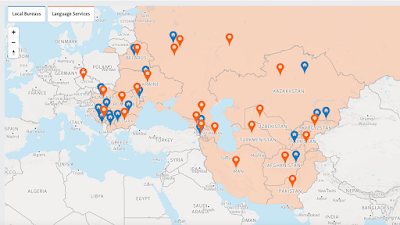
Today, RFE/RL broadcast to 23 countries in 27 languages.  Its headquarters remain in Prague even though no content is produced in Czech.  Here's where they currently produce material for.

Thursday, September 13, 2018

Turning 100

This 11 November will commemorate 100 years since the end of WWI.  In the United Kingdom, and most Commonwealth countries it is known as Armistice Day.  The USA changed Armistice Day to Veterans Day, in 1954, to honour all U.S. veterans.

In Europe, the end of WWI changed the landscape as long-standing empires fell and newly independent countries emerged.  So this year, several countries will celebrate their centenary.

On 28 October, Czechland will celebrate the 100 years of the founding of Czechoslovakia.  Specifically the First Republic, which was the twenty years between WWI and WWII.  Even though Czechoslovakia hasn't existed for 25 years, the Czechs still celebrate independence from the Austro-Hungarian Empire.

The three Baltic countries of Estonia, Latvia, and Lithuania are also celebrating 100 years of independence.  Even though they haven't been independent nations the whole time.  Each declared independence at the end of WWI.

However, their independence was brief because they were occupied by the Soviet Union, then the Germans, and eventually were annexed as Soviet republics.  They eventually gained independence in 1991 as the Soviet Union broke apart.

Lithuania already celebrated its 100th, known as #LT100 on 16 February.  Estonia celebrated on 24 February.

Latvia celebrates on 11 November.

Poland had been an independent country but following partitions and 123 years of serfdom the country ceased to exist until 1918.  On 11 November, the Second Polish Republic declared independence from the German, Austrian, and Russian Empires.  This is when Poland, as a country, got back on the map.

On 11 November 1918, Emperor Charles I renounced the throne of the Austro-Hungarian Empire.  The next day, Austria declared itself a republic.  Like many countries, Austria's independence was interrupted during WWII as it had been annexed by the Third Reich.

Like Austria, Hungary became independent but they aren't so happy.  On 1 December 1918, Hungary lost Transylvania to Romania.  So while Hungary isn't celebrating anything, in Romania they are celebrating the "Great Unification".

On 1 December 1918, Iceland became a free and sovereign state after it signed the Act of Union with Denmark which kept the Danish King as head of state.  Iceland actually became an independent country in 1944, but this year they are celebrating 100 years as a sovereign state.

Following WWI, the Kingdom of Serbs, Croats, and Slovenes was established which became Yugoslavia.  I'm not aware of anyone celebrating 100 years of Yugoslavia as it only lasted 75 years and has been gone for a generation.

Finland celebrated its 100th last year on 6 December.


In 1922, 26 counties formalised the independence of the  Irish Free State.  While it became Ireland in 1937 and declared itself a republic in 1949, I bet there will still be a 100th party of some kind in 2022.

Sunday, July 7, 2013

Dubrovnik, Croatia

Dubrovník is one of the most popular Mediterranean destinations.  It is known as the "Pearl of the Adriatic".  While not the largest city in Croatia (#13), it is home to around 43,000 people.

After WWI, and the fall of the Austro-Hungarian Empire in 1918, Dubrovnik became part of the Kingdom of Serbs, Croats and Slovenes.  After WWII, it became part of Yugoslavia.

In 1979, it became a UNESCO World Heritage Site.  During the early 1970s the Old Town demilitarized so that it would never become a casualty of war.  That didn't go as planned.  When Croatia declared independence from Yugoslavia, in 1991, Serbia and Montenegro demanded that the city be handed over.

Once the war broke out many Croats went to Durbrovnik's Old Town thinking it would be safe.  Who in the world would bomb a UNESCO World Heritage Site?  Serb and Montenegrin forces laid siege on Dubrovnik for seven months.  More than half of the city was damaged and hundreds of people were killed.

The city is surrounded by a series of defensive stone walls.  The limestone walls were mainly built during the 12th to 17th centuries.  The walls run about 1,940 meters (6,360 feet) long and reach up to 25 meters (82 feet) high. 


Onofrio's Fountain was built upon completion of the city's water supply in 1438.  It is a popular meeting point in the city.


The St. Savior Church is a Catholic church in old town.  It was built in 1528.


Construction of St. Blaise's church was completed in 1715.  The Baroque church is dedicated to St. Blaise, the city's patron saint.

The Old Synagogue was established in 1352 and gained legal status in the city in 1408.  It is the second oldest synagogue in Europe and the oldest Sefardic synagogue still used in the world today.  It is primarily a museum but the main floor is still used for worship on hold days and special occasions.  It is located on a tiny side street so it's difficult to get a decent photo of it.

The Assumption Cathedral was built in the 12th century and today is the seat of the Catholic Diocese of Dubrovnik.  The story goes that it was financed by Richard the Lion-Heart.  On his return from the Third Crusade he was shipwrecked off a local island and saved by the people of Dubrovnik.  To show his gratitude he gave a substantial amount of money to build the church.  Unfortunately it was destroyed by an earthquake in 1667 but completely rebuilt in 1713.

Outside of the city walls is Fort Lovrijenac which sits on a 37 meter (121 foot) high sea cliff.  It was built in order to protect the city's western sea access.  While construction began in 1018 it wasn't completed until the 16th century.

View from Mt. Srđ
The best view of the city is from the top of nearby Mount Srđ.  A cable car ride to the top only takes a few minutes.

On top of Mount Srđ is Fort Imperial which was built, from 1806 to 1816, during the Napoleonic Wars.  There is the Homeland War Museum which shows how the city was affected during the 90s siege.   I've been to Croatia many times but prior to visiting Dubrovnik I had never heard of the fighting in Croatia referred to as the "Homeland War".

Here's a Rick Steves video on Dubrovnik that I found out on YouTube.

 
©Rick Steves