
David, Slavek, Martin, and I were there for three days of customer meetings. Fun, fun, fun.
 Germany launched its new Deutschlandticket, or D-Ticket, as the successor to its €9 ticket.
The new €49 ticket began on 1 May, and it's a monthly subscription fee for travel, all across the country. It is good for all:
Travel is valid for second class but you may purchase first-class upgrades. Children under 6 can travel for free. Separate tickets are required for pets and bicycles.
The ticket can't be used for ICE, IC, or EU trains, or long-distance buses.
The D-Ticket seems like it would be a good deal if, I lived in Germany as a monthly subscription, or if I was going to be travelling around Germany for a couple of weeks. I loved the €9 ticket but I don't see me buying the €49 ticket.
I still have my Czech In-Karta, which costs 990 Kč ($50) every three years and gives me 25% of train tickets and 50% off seat reservations. The only difference now is that I don't have a physical card; it's just an app on my phone.
Here are a couple of short YouTube videos I found about the new ticket.
 While in Berlin last week, for the Johannes Oerding concert, we wanted to visit Museuminsel, the Museum Island. It's a complex of five museums, sitting on 8,6 hectors (21 acres) in the historic part of the city, on Spree Island, located near the Berlin Cathedral and Humboldt Forum.
 The five original museums, originally built from 1830 to 1930, are the Altes Museum, the Neues Museum, the Alte Nationalgalerie, the Bode-Museum, and the Pergamon Museum.
 In 1999, Museuminsel was designated a UNESCO World Heritage Site.
 In 2019, the James Simon Gallery opened which is an art gallery and visitor centre.


The Bode-Museum opened in 1904 and is home to late Antique and Byzantine art.
 The Pergamon Museum was completed in 1930. It contains the Greek Pergamon Altar and Ishtar Gate of Babylon.
Here's a short DW video I found out on YouTube about Museum Island.
We wanted to check out the some of the museums because the area is about to go under significant renovation but everything was sold out. I believe that everything is supposed to be completed by 2025 to 2026.
Update December 2025: Here's a short YouTube video about the Pergamon Museum renovations.
 Back in 2020, for Christmas, I gave concert tickets to Tünde, for the three of us to see Johannes Oerding at the Mercedes-Benz Arena in February 2021.
However, due to Covid restrictions, the concert kept getting pushed back.


The opening act was ELIF, who's real name is Elif Demirezer, a local Turkish-German singer. She also later performed a duet with him.
Here's a YouTube video I found of her singing Alles Brennt with him.
He also had another Turkish performer join him on stage. Zeynep Avci, also a Berlin local, competed on season 11 of The Voice of Germany, where Johannes Oerding was a judge.
Here's them singing Stärker.
A fun weekend but to Berlin and back for a concert was a bit much. Still worth it and Tünde finally got her 2020 Christmas present. I guess I lucked out that after 2,5 years, he's still one of her favourite singers.
 Tchibo, pronounced CHEE BO, is one of Germany's largest retail chains. The stores are interesting. It's a café where you can get a good cup of coffee and something sweet. Of course, you can also purchase coffee beans and accessories.

Then there is everything else that you can buy there such as clothing, household items, electronics, appliances, and sometimes even furniture. You never know just quite what they will have when you go there because the non-coffee products change weekly. In Germany, the company's slogan is Jede Woche eine neue Welt, "Every week a new world". In Czecland, it's každý týden nový svět.
 Today is the 70th anniversary of the Tchibo Coffee Company. It was founded in 19149 in Hamburg where it still maintains its headquarters. The company founders were Max Herz and Carl Tchilinghiryan and the name Tchibo came from the abbreviation of Tchilinghiryan and Bohnen (coffee beans), The company started off as a mail-order service for roasted coffee beans.
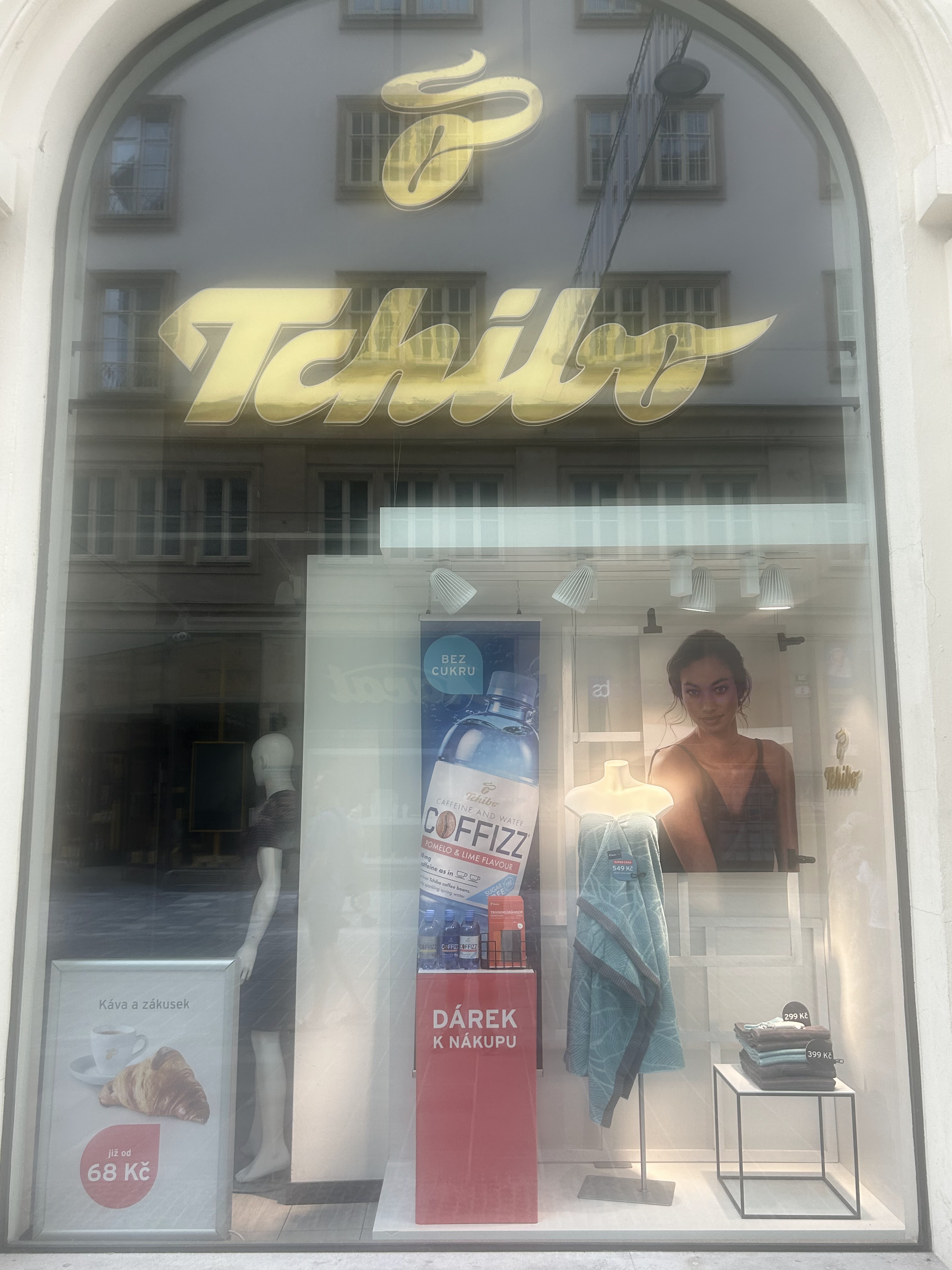 In the early 1990's the company started to expand outside of Germany. There are about 550 stores in Germany and over 300 stores in Austria, Czechia, Hungary, Poland, Slovakia, Switzerland, and Türkiye.

 Tchibo Praha, spol. s.r.o., was established in 1991 and today there are 38 stores in Czechland. In 2021, the company expanded its distribution facility in Cheb, near the German border. The new facility is over 102.000 sq.m. (+1 million square feet) and services seven European countries.
Here are a couple of Czech television commercials from about five years ago that I found out on YouTube.
Here's also a short, three-minute video I found that talks about the history of the company. It's only in German but it's still pretty easy to follow the story.
 Last year, Time Out magazine published their list of the 16 best city breaks in Europe for 2022. Brno came in second place.
This year Brno made the list again but fell to seventh place. A few spots lower but still in the top ten.
The write up for Brno was pretty much exactly the same as last year.
Here are the top 18 places. Several of these are still on my list of places to visit.
 This evening we met up with a few people for dinner at our favourite sushi place on Bölscherstraße. Afterwards it was on the beach at Müggelsee, where we went ice skating before, for a a Christmas sing-a-long.

 Some of the songs I knew but there were several German songs that I'd never heard before. Fortunately the programmes contained the lyrics to all of the songs.

I still can't believe that Christmas is tomorrow.
 Germany reunified more than 30 years ago but there are still differences, cultural and economic differences, between between what used to be East Germany and West Germany. The same goes for Berlin. I can feel the difference between West Berlin and East Berlin.
Personally I prefer East Berlin. And not just because East Berlin has trams and Ampelmännchen.


 In Friedrichshagen, the main posh street is Bölscherstraße which is nicknamed Ku'damm des Ostens which means "Ku'damm of the east".

 There's quite a bit on this street including my favourite Döner Kebab place, the spaghetti ice cream shop, and even the Union theatre where I had to watch the movie about a girl and a horse.
 A few years ago, Nat introduced me to Atlas Obscura. It's an American website that was founded in 2009. It doesn't list the usual sightseeing destinations. Just unusual and obscure travel must-sees that would only be known to locals. Heck, some of these, even the locals might not know about. Anytime I travel someplace, I always looks to see what the local Atlas Obscura sights are.
One of the things on Tünde's list this time was to visit the Deutsches Currrywurst Museum. The museum opened in 2009 on the 60th anniversary of Currywurst being created. Currywurst and a wacky museum? Sounded great. What we didn't know was that the museum closed permanently back in December 2018.
Here's a two-minute YouTube video I found that at least shows what the museum was like. I bet that the gift shop would have been fun.
 So instead, we went to the David Hasselhoff Museum. Yes, Berlin has a David Hasselhoff museum. The museum is very small. It's basically a downstairs hallway that's located at a hostel. The museum is free and it's open 24/7.

 Following Russia's invasion of Ukraine, Czech Republic was the first EU country to stop issuing visas to Russian citizens except for humanitarian cases. Czechland is now stepping things up and as of 25 October, that even with a valid Schengen visa, Russian citizens will not be allowed in the country for tourism, sport or culture. It's not clear if Russian citizens, with a valid visa, will be granted entry for business purposes.
Citizens of Russian that have a valid Czech residency visa will still be granted entry.
Vladimir Putin's announcement of partial mobilisation has caused many people to try to leave Russia before they are drafted to fight in Ukraine. People fighting the Russian government or human rights activists are among the exceptional cases that qualify for a humanitarian visa. The Czech Foreign Minister, Jan Lipavský, has said that Russians who fear mobilisation don't fulfil the conditions for a humanitarian visa in Czechland.

The European Commission says that it is up to each EU country to decide if they will accept Russian citizens in to their country. Finland, Poland, and the Baltic countries
- Estonia, Latvia, and Lithuania, like Czechland, don't grant asylum to people fleeing Russian military mobilisation. However, Germany will allow Russians fleeing military conscription.
Here's a short video that I found on YouTube about Estonia not issuing visas to Russians.

My 2000th blog post. I can't believe that I've been at this for over 13 years or that people still seem interested in my Czechland adventure. Thank you to everyone who continues to follow along.
 Eurocorps is a European army, of about 60.000 troops, that can be deployed on very short notice. It was founded in 1992 by France and Germany and it went operational in 1995. This month it celebrates its 30th anniversary. Eurocorps' headquarters are in Strasbourg, France.
There are six framework nations - France, Germany, Belgium, Luxembourg, Spain, and Poland.
Any EU country can join with the unanimous approval of the framework countries. There are also five associated nations - Austria, Greece, Türkiye, Italy, and Romania.
Finland was an associated member from 2002 - 2006 and Canada was from 2003 - 2007. Czech Republic isn't a member but I believe that they have participated is some military exercises with Eurocorps in the past. I'm not aware of Czechland having any plans to join.
Eurocorps has participated in peacekeeping missions in the Balkans as part of SFOR in Bosnia and Herzegovina and KFOR in Kosovo. It was deployed to Afghanistan as part of the UN's International Security Assistance Force (ISAF). It's even been deployed to Africa as part of EU training missions in Mali and the Central African Republic.
Poland became the newest framework member this year in January. From 2023-2025, a Polish general will take command of Eurocorps. With all of the support Poland has given Ukraine during the Russian invasion, I'm sure that Russia isn't thrilled with Poland soon to lead Eurocorps.
What's interesting to me Austria and Türkiye being associate members. Türkiye is a member of NATO but not the EU so until it actually becomes an EU member, if ever, then it can't be one of the framework nations. Austria's constitution prohibits it form entering into military alliances. So I guess that by being an associate member it can participate in Eurocorps without violating its constitution, in the same way that it is a member of NATO's Partnership for Peace programme without being a NATO member.
Here's a France24 video I found on YouTube from 2009 that talks about Eurocorps.
 The Protectorate of Bohemia and Moravia, Protektorát Čechy a Morava, was established on 16 March 1939 and lasted until the surrender of Nazi Germany on 8 May 1945.
From 1933, Czechoslovakia was Central Europe's only functioning democracy. The First Republic ended following the 1938 Munich Agreement, where the UK and France sold out the country in hopes of preserving peace in Europe, which enabled Nazi Germany to occupy the Sudetenland.
 What was left of Czechoslovakia become the Second Czechoslovak Republic. This lasted from 30 September 1938 to 15 March 1939. On 14 March 1939, Slovakia broke off as an "independent" Nazi puppet state. What was left became the Protectorate of Bohemia and Moravia.
 There were about 7,38 million people and 3,3% of them were ethnic Germans who were given German citizenship.
 |
| Emil Hácha |
There was a dual system of government with Prague as the capital. German law applied to ethnic Germans. Everyone else was a Protectorate subject governed by a Czech puppet administration, led by Státní Prezident Emil Hácha, who had been the President of the Second Czechoslovak Republic since November 1938.
.svg.png) |
| The Protectorate of Bohemia and Moravia within the Third Reich |
 The common languages were Germany and Czech. The Czechoslovak crown was replaced by the Protectorate crown at a rate of 1 German Reichsmark to 10 crowns.
The workforce was well-trained so people living in the protectorate were used as labour for the German war effort. Czechs were drafted to work in coal mines, in the iron and steel industries, and to produce armaments. It became a major production hub for manufacturing aircraft, tanks, and artillery. This was good for the Nazis because the Protectorate was just beyond the reach of Allied bombers.
 Perhaps because of the need to keep the population nourished enough to carry out the vital arms production work in the factories, but the Nazis had a plan to Germanise the area. It was believed that about 50% of the population was capable of being Aryanisation. The other 50% were too Slavic, too intellectual, or too Jewish.

 On 29 September 1941, Reinhard Heydrich took over as acting Reichsprotektor. In 1942, the Czechoslovak government-in-exile, led by Edvard Beneš, from the UK, initiated Operation Anthropoid - the assassination of Reinhard Heydrich. One Czech, Jan Kubiš, and one Slovak, Jozef Gabčík, went to Prague to carry out the assassination. On 27 May 1942, Heydrich was wounded in the attack and he later died of his wounds on 4 June 1942. Operation Anthropoid was the only verified government-sponsored assassination of a senior Nazi leader during WWII.
Here's the movie trailer for the 2016 film Anthropoid.
Following his death, Hitler was so enraged that he ordered his troops to "wade through blood" to find the killers. What proceeded was martial law, mass arrests, and the exceptions and obliterations of the the villages of Lidice and Ležáky.
Here's an eight-minute video I found on YouTube about the execution of Reinhard Heydrich - "the Butcher of Prague."
Next to the Reich Protector, was the State Minister who was in charge of most of the internal security. From 1939 to 1945, it was Karl Hermann Frank who ran the Gestapo, security service and the police for the Protectorate. He was involved in the massacres at Lidice and Ležáky and after the war he was executed.
It's estimated that of the 92,199 Jews living in the Protectorate in 1939, 85% were murdered.
Here's a short, interesting YouTube video on how Czechoslovakia went from an independent, functioning democracy to being carved up during WW2.








 Posts
All Comments
Posts
All Comments


 Czech Koruna Exchange Rate


