Showing posts with label History Matters. Show all posts

Wednesday, June 21, 2023

United States of America

In ten days Kája and I are going to the USA for three weeks.  I haven't been back since 2017.  I was supposed to go in 2020 but Covid prevented that one.  Kája hasn't been there before and he'll get to use his ESTA.  The plan is to fly to Atlanta to visit Steven and Michael for a week before flying to Arizona for another week.  Then it's a 7-ish hour drive with my parents to visit my sister in California.  So here's a bit about the USA.

The United States of America is a federal republic of 50 states, plus the capital, Washing, D.C., which is the federal capital district.  In North America, there are 48 contiguous states, bordering Canada and Mexico, plus Alaska and Hawaii.  After Russia and Canada, the U.S. is the 3rd largest country by size, and with more than 340 million people it is also the 3rd largest by population after China and India.  

The USA is huge!!  Over 9 million km² (+3.5 million sq mi) kind of huge.  A direct flight from the east coast to the west coast is six hours.  A flight from Los Angeles to Hawaii, in the Pacific Ocean, is almost another six hours.  In comparison, a six hour flight from Portugal, on one side of Europe, would put you all the way over in the Caucasus.

About 12.000 years ago Paleo-Indians migrated from North Asia to North America and became the first inhabitants.  There were up to 1000 different native civilisations, in the area that would become the USA, before the Europeans arrive.  

The Spanish established a colony in South Florida in 1513, and the British established a the first of the 13 Colonies in Virginia in 1607.  The economy of the American Colonies was built on slave labour from Africa.  The Declaration of Independence was signed on 4 July 1776, and the American Revolution lasted from 1775 to 1783 which led to international recognition.  France was the first country to recognise an U.S. independence in 1778.  

Following a westward expansion, and the genocide of native peoples, more states joined the union.  

The North and South fought the American Civil War, from 1861 - 1865, over slavery when the Confederate States tried to secede from the Union.

The USA was a major world power by 1900.  During WWII, it became the world's first nuclear power and was one of two superpowers during the Cold War.  The U.S., with 42% of the world's nuclear weapons, has the 2nd largest stockpile after Russia.  A very short, abbreviated summary of U.S. history.  

The United States has the 3rd largest military and is made of of 5 branches of service - the Army, Navy, Air Force, Marine Corps, and Coast Guard.    


The military has about 800 bases and facilities overseas, in roughly 85 different countries.  

The USA is a founding member of NATO, and holds a permanent seat on the U.N. Security Council.


The USA is a presidential constitutional federal republic made up of three branches of government - legislative, executive and judicial.  The legislature is made of the House of Representatives, based on population, and the Senate, with 2 members per state.


I think the big problem with the two-party system is that no one, Republicans or Democrats, is willing to compromise on anything.  When there are only two parties, you're either a winner or a loser.  At least with parliamentary democracies, it is easier for multiple parties to find middle ground.

©One Minute Economics

The USA is a major economic power.  Of the 500 largest revenue companies, 136 have their headquarters in the U.S.  The U.S. dollar is the most used currency in international transactions and the world's largest reserve currency.

It is the world's largest importer and second-largest exporter.  It's also the world's largest exporter of services.  The largest trading partners are the European Union, Mexico, Canada, China, Japan, South Korea, the UK, Vietnam, India, and Taiwan.

California is the country's economic powerhouse.  If California was independent it alone would be the 4th largest economy in the world.  California ends up subsidising other states because it pays more in to the U.S. federal system than it receives back.  As a Californian, it was always funny to listen to other states complain about California but while at the same time taking its money.

What's amazing to me is that the USA is the only advanced economy in the world that doesn't provide for paid vacation.  Also no federally mandated paid maternity or paternity leave.  l

California is the most populous state but New York City, in New York, is the biggest city.  

The metric system isn't used.  Except for in healthcare and you can buy 1 and 2 litre bottles of soda.  That's it.

©History Matters

The USA still has five territories.  In the Caribbean, there is Puerto Rico and the U.S. Virgin Islands.  In the North Pacific Ocean, there is Guam and the Northern Mariana Islands, and American Samoa in the South Pacific Ocean.  Plus several uninhabited islands in Oceania and the Caribbean.

People from Puerto Rico, the U.S. Virgin Islands, Guam, and the Northern Mariana Islands get U.S. citizenship at birth.  People born in American Samoa have U.S. nationality but not U.S. citizenship.  Each of these are self-governing territories.  They only get to elect a non-voting member to House of Representatives.  The can propose legislation but can't vote on it.

English is the de facto official language but some individual states have English as an official language.  There are many regional accents.  Here's a short video highlighting how each state's accent sounds.  Plus the usual greeting in each state.

©Condé Nast Traveler

©Condé Nast Traveler

I'm looking forward to introducing Kája to my family and showing him the USA.  I'm not sure who will experience more culture shock, him or me.  But we'll see.  There are a lot of good things about the USA but there are still many problems and most Americans are so filled with blind patriotism about being the "greatest country on earth" that they end up being pretty obnoxious.  Here's a clip from The Newsroom that hits home.

©HBO

Sunday, March 5, 2023

The Russian Empire

The Russian Empire was founded in 1721 by Czar Peter I, also known as Peter the Great.  It lasted until 1917, almost two hundred years, and stretched from Central/Eastern Europe to Siberia, Central Asia and even Alaska.  It was the third largest empire in history, only behind the the Mongol Empire and British Empire.

Peter the Great, a member of the Romanov dynasty, wanted to transform Russia into a modern European state.  Here's a ten minute video I found on YouTube on Peter the Great and the Russian Empire with a bit of background on Russia prior to the Russian Empire.

©History Matters

Following Peter the Great's death, there came a number of Romanov czars and czarinas but the next great ruler wasn't until 1762, with Catherine II, known as Catherine the Great became empress.  

Following defeats of the the Ottoman Empire and the Polish-Lithuanian Commonwealth in a number of wars, the Russian Empire's borders expanded into Crimea, Belarus, Central Ukraine, and Lithuania.  Catherine the Great ensured the empire's status as one of the great European powers.

Catherine the Great ruled from 1762 to 1796.  Here's a short video about her.

©Biography

Alexander II was czar from 1855 to 1881.  Almost half of the people living in the empire were serfs, peasant labourers tied to particular parcels of land they worked or to the Russian nobleman who owned it.  In 1861 he emancipated all 23 million serfs.  The newly freed serfs received 2/3rds of the land they had worked but in return had to pay annual compensation to the state.  
In 1867, he sold Alaska and the Aleutian Islands to the United States for $7.2 million.

Nicholas II took the throne in 1894 and was the last Romanov czar.  In 1917 the Russian Revolution took place which overthrew the czarist government and the Bolsheviks under Vladimir Lenin took control in the October Revolution. 
During the 19th century, the empire was multilingual and multireligious with only about half of the population native Russian speakers and Russian Orthodox.  Russia had fought on the side of the allies in WWI.  In 1918 they exited WWI and gave up Finland, Poland, Latvia, Estonia, and Ukraine.  Later that same year, Nicholas II and his family were executed by the Bolsheviks and the Russian civil war broke out.  

Here's a short video about why Nicholas II wasn't able to flee Russia after his abdication and his eventual execution.

©History Matters

The civil war ended in 1922 and the Soviet Union was established which was one of the world's superpowers almost until the end of the twentieth century.  

Russian President Vladimir Putin has lamented that the breakup of the Soviet Union was the "greatest geopolitical catastrophe of the 20th century".  Putin has compared the invasion of Ukraine to the conquests of Peter the Great.  I think that it is safe to say that things have not gone to plan.

Putin expected to take over Ukraine in a few days.  He got that one way wrong.  But this also has an impact on his goal of either creating a new Russian Empire or just returning to the days of the Soviet Union as more former Soviet republics distance themselves from Russia.
  • Russia has lost tens of thousands of troops in Ukraine.  The blow to the prestige of the Russian military can not be underestimated.
  • Russia has been a peacekeeper between Armenia and Azerbaijan by maintaining a large military presence in Armenia.  Due to the war in Ukraine, Russia isn't able to maintain the peace and Armenia is reconsidering its relations with Russia.
  • Since the invasion, Kazakhstan is strengthening its ties with China, Turkey, the EU and the USA.  The country is also questioning its membership in the CSTO.
Я за Україну. Я за Україною. Слава Україні  Stojím za Ukrajinou!  I stand with Ukraine. 🇺🇦

Update 2025: Here's a short, interesting video I found that's worth a look at.

©History Matters

Thursday, February 9, 2023

The Ottoman Empire

In a few weeks we're headed to Kuşadasi, Turkey.  Or rather, I should get used to saying Türkiye.  Either way I am so ready for a week away.

I know that modern Türkiye came about after the end of WWI and the fall of the Ottoman Empire.  What I didn't know was just how vast the Ottoman Empire was.


The Ottoman Empire was actually one of the world's most powerful states during the 15th and 16th centuries.  It was an Islamic superpower founded by Osman I around 1299 and it lasted more than 600 years, only coming to an end back in 1922.  


Covering about 2 million square miles with 15 million people, it was huge!  At its height, the Ottoman Empire stretched all the way to the gates of Vienna.  Today, it would be made up of Türkiye, Greece, Cyprus, Bulgaria, Egypt, Hungary, North Macedonia, MontenegroBosnia and Herzegovina, AlbaniaSerbia, KosovoRomaniaMoldova Jordan, Israel, Palestine, Lebanon, Syria, Qatar, plus parts of Saudi Arabia, Libya, Algeria, Armenia, Azerbaijan, Ukraine, and Russia.  

Here's a short YouTube video about the rise of the Ottoman Empire.

©Seeker


The Ottoman Empire is known for its achievements in art, architecture, science, and medicine.  

But nothing lasts forever.  Here's another short video but this one is about the decline of the empire.

©Seeker

The darkest legacy of the Ottoman Empire is the Armenian genocide where up to approximately 1,5 million Armenian Christians living in the empire were killed from spring 1915 through autumn 1916 .  It is often called the first genocide of the 20th century and I still remember visiting the Armenian Genocide memorial in Yerevan.

Türkiye still denies that genocide occurred.  However, the Catholic Church, the United Nations, the European Parliament, and the Council of Europe have all recognised it as genocide.

In 2017, the Czech Parliament approved a resolution condemning the Armenian genocide and in 2020 the Czech Senate unanimously adopted a resolution recognising the Armenian genocide.

In 2019, the U.S. Congress affirmed the Armenian genocide and the Senate unanimously recognised the genocide.  Of course then-President Trump did not support the resolution but in 2021 President Biden officially recognised the Armenian genocide.

The Ottoman Empire made the fatal decision to side with the Central Powers in WWI.  Here's a short four-minute video about why they chose to fight alongside Germany.

©History Matters

Following the end of the war, Mustafa Kemal Atatürk became the first president of the Republic of Turkey.  Here's a bit about how the empire was carved up.

©History Matters

Considering that the Ottoman Empire contained parts of the Middle East, North Africa, the Caucasus and the Balkans, it's not a big surprise that there have been multiple conflicts between countries there since the breakup of the empire.  This map shows the borders of the Ottoman Empire in 1801in green.  The red lines show wars that have been fought between countries.  

Fortunately, I'm not expecting any drama whilst on holiday in Kuşadasi.  Fingers crossed.

Monday, November 7, 2022

The Channel Islands

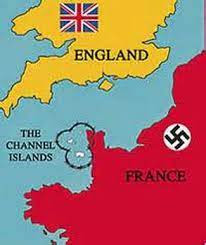
The Channel Islands consist of the Bailiwick of Guernsey and the Bailiwick of Jersey.  They are two of the three Crown Dependencies and they are located in the English Channel, off the coast of France

Each of the two bailiwicks have their own money, legal and healthcare systems, as well as, their own individual immigration policies.  Since 1290, they have been Crown Dependencies which means that they are not part of the United Kingdom, but the UK is responsible to represent them internationally and to provide for their defence.  Together the two bailiwicks have a population of almost 172.000 people.

The Bailiwick of Jersey consists of the island of Jersey plus the uninhabited islets Écréhous and Minquiers, with Jersey being a single jurisdiction.  Jersey the is largest and southernmost island with 118 km² (46 square miles).  It is 23 km (14 miles) from the coast of Normandy and 160 km (100 miles) south of England.  There are almost 108.000 people living in Jersey.  About a third of the population lives in the capital Saint Helier.

People have been living on Jersey since at least 12.000 BC.  The island has Bronze and Iron Age settlements and the islands have controlled by the Romans, Vikings, and Normans.

The official languages are English, French, and Jèrriais which is a Norman French dialect.

The Bailiwick of Guernsey consists of the islands of Alderney, Brecqhou, Guernsey, Herm, Jethou, Lihou, and Sark.  Guernsey is the second-largest and westernmost island with 78 km² (30 square miles).  It is roughly 48 km (30 miles) off the coast of Normandy.  Guernsey is home to about 64.000 people with roughly 20.000 living in the capital St. Peter Port.

There are actually three different jurisdictions.  Guernsey, Alderney and Sark, each have their own parliaments but they do work closely together.

History on Guernsey goes back to at least 6000 BC.  There's evidence that Neolithic farmers lived here, plus the Romans, Vikings, and Normans.

Flag of Guernsey.svgGuernsey has jurisdiction over the islands of Herm, Jethou, Limo, and a few other small uninhabited islands.

Flag of Alderney.svgAlderney is a small island that is only 7,7 km² (3 square miles) and home to over 2000 people.  It is the northernmost Channel Island and the closest to France which is only 13 km (8 miles) west of La Hague.  Saint Anne is the capital.  English is the only official language.  Auregnais was a Norman French language spoken here but it is now extinct.

Flag of Sark.svgSark is an even smaller island that is just 5,4 km² (2,1 square miles) and home to about 500 people.  It is about 32 km (20 miles) from France.  Sark also has jurisdiction over the island Breqhou which is almost uninhabited, plus some other smaller uninhabited islands.  There's no official capital city but the de facto capital is La Seigneurie.  English is the only official language but a few people still speak Sercquiais which is another Norman French dialect.

Sark became a democracy in 2008 and until then it was Europe's last feudal political entity.

The official currency in the Channel Islands is the pound sterling.  However, both Jersey and Guernsey issue their own pounds which are pegged one-to-one to the UK pound.  British £ are valid in the Channel Islands but the Jersey and Guernsey pounds aren't accepted in the UK.

Guernsey £ on top and Jersey £ below

The Channel Islands were occupied by Nazi Germany during WWII.  The only part of the British Islands to be occupied by Germany.

Here's a short video I found on YouTube that talks about how the Channel Islands came to be.

©History HQ

And here's another short video specifically about the German occupation during the war.

©Smithsonian Channel

There was a 2017 film, takes place in Jersey during the occupation that was based on a true story.  Here's the movie trailer for Another Mother's Son

©Vertigo Releasing

On Netflix I saw the 2018 film, The Guernsey Literary and Potato Peel Pie Society that also takes place during the occupation. 

©Netflix

Update 2025:  Here's a short YouTube video about why France doesn't have the Channel Islands.

©History Matters

Friday, October 14, 2022

Czechs Annex Královec

I had a trip planned to visit Kaliningrad, the Russian exclave between Poland and Lithuania, as part of my "20 countries in 2020" but the trip was cancelled due to Covid-19 shutting down the world.

It used to be called Königsberg.  The city was founded in 1255 and it was named in honour of King Ottokar II of Bohemia.  Königsberg was a part of Germany but after WWII it was taken by the Soviet Union, renamed Kaliningrad, and today is home to Russia's Baltic fleet. 

Here's a short 4-minute video of how Kaliningrad an exclave of Russia.

©History Matters

On 30 September, Russia declared that following a referendum that it annexed four Ukrainian oblasts - Donetsk, Luhansk, Kherson, and Zaporizhzhia.  Aside from North Korea and Syria, no other country in the world recognises the illegal annexation of about 15% of Ukraine.  This is now the largest of land in Europe since WWII.

Well aside from the 4 billion Kč ($186.5 million) of military arms and equipment that the Czech government has given Ukraine, the Czechs have unleashed one of its more powerful weapons - the Czech sense of humour.

There's now a whole satirical campaign on social media that Czechland has now annexed Kaliningrad and renamed it Královec.  There are all kinds of memes out now about "Královec is Czechia" and "Make Královec Czech Again".

There's a satrical tourist website for visiting Královec and there's a twitter account

A few days ago some 200 people staged a mock referendum in front of the Russian Embassy in Prague.  This is even better now that thanks to Prague's mayor, Zdeněk Hřib, the square in front of the embassy is now Boris Nemcov Square which commemorates the outspoken Putin critic that was assassinated in 2015.

You've just got to love the Czech sense of humour.  One of my favourite memes shows the critical infrastructure work going on as Czechland supplies beer to Královec via "Beer Stream 1".

#Kralovec #KralovecIsCzechia #MakeKaliningradKralovecAgain

If only Czechland would take over Královec.  Then at least the country would no longer be landlocked.  Sitting on the Baltic Sea, there would now be water and beaches and the Czech military could now even have a navy.   

Я за Україну. Я за Україною. Слава Україні  Stojím za Ukrajinou!  I stand with Ukraine. 🇺🇦

Saturday, September 3, 2022

Protectorate of Bohemia and Moravia

The Protectorate of Bohemia and Moravia, Protektorát Čechy a Morava, was established on 16 March 1939 and lasted until the surrender of Nazi Germany on 8 May 1945.

From 1933, Czechoslovakia was Central Europe's only functioning democracy.  The First Republic ended following the 1938 Munich Agreement, where the UK and France sold out the country in hopes of preserving peace in Europe, which enabled Nazi Germany to occupy the Sudetenland.

What was left of Czechoslovakia become the Second Czechoslovak Republic.  This lasted from 30 September 1938 to 15 March 1939.  On 14 March 1939, Slovakia broke off as an "independent" Nazi puppet state.  What was left became the Protectorate of Bohemia and Moravia.

There were about 7,38 million people and 3,3% of them were ethnic Germans who were given German citizenship.  

Emil Hácha


There was a dual system of government with Prague as the capital.  German law applied to ethnic Germans.  Everyone else was a Protectorate subject governed by a Czech puppet administration, led by Státní Prezident Emil Hácha, who had been the President of the Second Czechoslovak Republic since November 1938.

The Protectorate of Bohemia and Moravia within the Third Reich

The common languages were Germany and Czech.  The Czechoslovak crown was replaced by the Protectorate crown at a rate of 1 German Reichsmark to 10 crowns.  

The workforce was well-trained so people living in the protectorate were used as labour for the German war effort.  Czechs were drafted to work in coal mines, in the iron and steel industries, and to produce armaments.  It became a major production hub for manufacturing aircraft, tanks, and artillery.  This was good for the Nazis because the Protectorate was just beyond the reach of Allied bombers. 

Perhaps because of the need to keep the population nourished enough to carry out the vital arms production work in the factories, but the Nazis had a plan to Germanise the area.  It was believed that about 50% of the population was capable of being Aryanisation.  The other 50% were too Slavic, too intellectual, or too Jewish.  


While there was a Czech President, the ultimate authority was the Reich Protector who was the senior Nazi administrator who represented the interests of the German state. 

On 29 September 1941, Reinhard Heydrich took over as acting Reichsprotektor.  In 1942, the Czechoslovak government-in-exile, led by Edvard Beneš, from the UK, initiated Operation Anthropoid - the assassination of Reinhard Heydrich.  One Czech, Jan Kubiš, and one Slovak, Jozef Gabčík, went to Prague to carry out the assassination.  On 27 May 1942, Heydrich was wounded in the attack and he later died of his wounds on 4 June 1942.  Operation Anthropoid was the only verified government-sponsored assassination of a senior Nazi leader during WWII.

Here's the movie trailer for the 2016 film Anthropoid.

Following his death, Hitler was so enraged that he ordered his troops to "wade through blood" to find the killers.  What proceeded was martial law, mass arrests, and the exceptions and obliterations of the the villages of Lidice and Ležáky.

Here's an eight-minute video I found on YouTube about the execution of Reinhard Heydrich - "the Butcher of Prague."

©World History

Next to the Reich Protector, was the State Minister who was in charge of most of the internal security.  From 1939 to 1945, it was Karl Hermann Frank who ran the Gestapo, security service and the police for the Protectorate.  He was involved in the massacres at Lidice and Ležáky and after the war he was executed.

©World History

It's estimated that of the 92,199 Jews living in the Protectorate in 1939, 85% were murdered.

Here's a short, interesting YouTube video on how Czechoslovakia went from an independent, functioning democracy to being carved up during WW2.  

©History Matters

Most Czechs sympathise with Ukraine because they see Hitler's annexation of the Sudetenland as the same as Russia's annexation of Crimea.  

Я за Україну. Я за Україною. Слава Україні  Stojím za Ukrajinou!  I stand with Ukraine. 🇺🇦