Showing posts with label Malta. Show all posts

Saturday, November 5, 2022

Commonwealth of Nations

Today is the 5th of November which is Guy Fawkes night.  So Happy Bonfire night to all of my Commonwealth peeps.  

Here's a bit about the Commonwealth of Nations.

The Commonwealth of Nations is a political association of 56 countries, most of which, 52 of them, were once part of the British Empire either as colonies or dependencies.

With the passing of Queen Elizabeth II's passing, Charles III immediately succeeded his mother as monarch of the Commonwealth realm even though he has not yet be crowned king.

Once Charles III will be king, he will be both monarch and head of state, of the 15 countries of the Commonwealth realm.

These 15 countries are the United Kingdom, Antigua and Barbuda, Australia, the Bahamas, Belize, Canada, Grenada, Jamaica, New Zealand, Papua New Guinea, Saint Kitts and Nevis, Saint Lucia, Saint Vincent and the Grenadines, the Solomon Islands, and Tuvalu.

There are five countries that have other monarchs but are still a part of the Commonwealth.  These five are Brunei, Eswatini, Lesotho, Malaysia, and Tonga.

The remaining 36 members of the Commonwealth are all republics.  They include Bangladesh, Barbados,  Botswana, Cameroon, Cyprus, Dominica, Fiji, Gabon, The Gambia, Ghana, Guyana, India, Kenya, Kiribati, Malawi, Maldives, Malta, Mauritius, Mozambique, Namibia, Nauru, Nigeria, Pakistan, Rwanda, Samoa, Seychelles, Sierra Leone, Singapore, South Africa, Sri Lanka, Tanzania, Togo, Trinidad and Tobago, Uganda, Vanuatu, and Zambia.

The Commonwealth consists of 31,5 million km² (12.2 million square miles) which is about 21% of the world's total land area.  The Commonwealth countries are home to 2,4 billion people which is about ⅓ of the world's population with 94% living in Asia and Africa.

There's no requirement that a member has to have been a British colony.  Mozambique, Rwanda, and Gabon never were.  The Commonwealth Charter states that members have shared values of democracy, human rights and the rule of law.

The human rights thing is a bit funny to me.  The UK left a legacy of anti-homosexuality laws, particularly during the 19th century, at the height of the British Empire.  Being gay is still a criminal offence in more than 30 Commonwealth countries.  There's a direct link between anti-gay law and increased rates of HIV.  While the Commonwealth accounts for about a ⅓ of the world's population it has more than 60% of the world's HIV cases.    

Membership in the Commonwealth isn't forever.  Ireland was the first country to leave.  It left when the country became a republic.  Prior to India becoming a republic the rules were changed so that India could remain a member.  Zimbabwe left in 2003 but it is now trying to rejoin.  Other potential members currently include Somaliland, South Sudan, Suriname, and Burundi.

The three Crown dependencies of Jersey, Guernsey, and the Isle of Man aren't happy with only being represented by the UK.  All three want to have direct representation with the Commonwealth.

The Commonwealth Games are held every four years.  They began in 1930 as the Empire Games.  They contain the usual Summer Olympic events plus "British" sports like bowls, netball and rugby sevens.  The next games take place in 2026 in Victoria, Australia.

Update August 2023:  Looks like it's getting too expensive for cities to host the Commonwealth Games.  Two cities have withdrawn their bids for upcoming games.  Here's a BBC report about it.

©BBC News

Monday, April 25, 2022

Partnership for Peace

NATO has something something called Partnership for Peace (PfP).  It's a bilateral cooperation programme between NATO and Euro-Atlantic partner countries that lets partners build up an individual relationship with NATO.  PfP started in 1994 as a way to build security relationships between NATO and non-NATO countries.  Participating countries choose their own priorities for cooperation and the both the level and pace of progress.

The programme allowed NATO to reach out to former Warsaw Pact and Soviet Republics following the end of the Cold War.  The programme allows countries to build closer relationships with NATO without actually becoming a NATO member.  It's important to remember that the PfP programme has nothing to do with NATO's article 5 which says that an attack on one NATO country is an attack on all.  So while Ukraine is a PfP member it is not a member of NATO.  

Here's the list of when countries joined the PfP programme.  Many went on to officially join NATO later on.  

Romania - 26.01.1994
Lithuania - 27.01.1994
Poland - 02.02.1994
Estonia - 03.02.1994
Hungary - 08.02.1994
Ukraine - 08.02.1994
Slovakia - 09.02.1994
Bulgaria - 14.02.1994
Latvia - 14.02.1994
Albania - 23.02.1994
Czechia - 10.03.1994
Moldova - 16.03.1994
Georgia - 23.03.1994
Slovenia - 30.03.1994
Finland - 09.05.1994
Sweden - 09.05.1994
Azerbaijan - 04.05.1994
Turkmenistan - 10.05.1994
Kazakhstan - 27.05.1994
Russia - 22.06.1994
Armenia  05.10.1994
Uzbekistan - 13.07.1994

Belarus - 11.01.1995
Austria - 10.02.1995
Malta - 26.04.1995
Macedonia - 15.11.1995

Switzerland - 11.12.1996

Ireland - 01.12.1999

Croatia - 25.05.2000

Tajikistan - 20.02.2002

Montenegro - 14.12.2006
Serbia - 14.12.2006

In 1999, Czechland, Hungary, and Poland became the first three PfP countries to join NATO.

In 2004, NATO saw its largest expansion when seven PfP countries joined - Bulgaria, Estonia, Latvia, Lithuania, Romania, Slovakia, and Slovenia.

Malta joined the programme in 1995 but left in 1996 and rejoined in 2008.

In 2009 - Albania and Croatia joined NATO.  Montenegro joined NATO in 2017 and North Macedonia joined in 2020 as the 30th NATO member.

In 2014, when Russia first invaded Ukraine, NATO suspended practical cooperation with Russia.  It's hard to picture Russia as a Partnership for Peace member considering it invaded Ukraine to keep it from joining NATO in the future.  But by doing do, I don't think it will be long until Finland and Sweden decide to join NATO.

Traditionally neutral countries such as Austria, Finland, Sweden, and Switzerland are all PfP members.  For Austria, the programme allows for cooperation with NATO without joining because under the country's constitution, Austria is prohibited from entering into military alliances and no foreign military bases may be on Austrian territory.  

Andorra, Liechtenstein, Monaco, San Marino, and Vatican City are all neutral micro states that are surrounded by NATO members.  They are all a part of the OSCE but they do not participate the PfP programme.

Cyprus is the only EU member that isn't a member of either NATO or the PfP programme. Kyrgyzstan is the only former Soviet republic that didn't join the PfP programme.  It did join the CSTA with Armenia, Belarus, Kazakhstan, Russia, and Tajikistan.

Update: 4 April 2023 - Finland became the 31st member of NATO.

Tuesday, November 23, 2021

Nutri-Score

When I first moved here I made a comment at work that I was going to get so fat here with this being the land of beer and potatoes.  A friend sniped back with, "but I thought that all Americans were already fat."  Well not quite right but not wrong either.

In 2016, the World Health Organisation put the USA's obesity rate at 33,8%.  Czech Republic was 24,2%.  Czechs have been getting bigger.

In 2019, the five EU countries with the highest percentage of obesity were Croatia, Malta, Czechland, Hungary, and Slovakia.  France has the lowest obesity levels in the EU, followed by the Netherlands, Italy, Belgium, and Sweden.  Czechs were had the 3rd highest levels of obscenity in the EU.

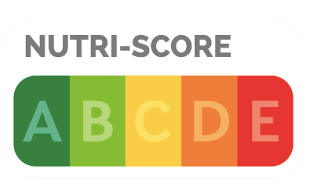
Here's where I think that Nutri-Score would be a good thing.  Nutri-Score is a "traffic light system" that ranks food products on a scale from A to E, where A is the best and E is the worst, and it is clearly visible of the front of the food's packaging.  

Food products get a lower rating if there is:

  • high energy density per 100 g or per 100 ml
  • high sugar content
  • high content of saturated fatty acids
  • high salt content.
There's a higher rating when:
  • contains fruits, vegetables, nuts and legumes
  • contains fiber
  • contains protein
  • contains rapeseed, walnut and olive oil
Nutri-Score was founded in France in 2013 and in 2017 the French Health Ministry officially recommended it.  Since then it has rolled out in Belgium, Spain, Germany, Switzerland, the Netherlands, and Luxembourg.  The system has been recommended by the European Commission and the World Health Organization.

So far it's not mandatory across the EU but I'm sure that it will be eventually.  Some companies such as Nestlé and Danone have announced that they will start using Nutri-Score in Portugal, Slovenia, and Austria even though it's not required in those countries.  

Not all countries are onboard with the system.  Poland, Czechland, Cyprus, Greece, Hungary, Latvia, and Romania all oppose it.  Italy believes that the system puts the traditional Mediterranean diet at a disadvantage.  

The Czech Ministry of Agriculture isn't in favour of the system but it will tolerate international labels with Nutri-Score.  The ministry is not in favour of a mandatory front-of-package label and believes that the Nutri-Score formula is too simplistic because it doesn't consider the size of a portion or how food is prepared. 

Nestlé will start using Nutri-Score in Czechland in 2023.  

Here's an interesting video I found out on YouTube where CNN talks about some of the differences between the US and Czech health care systems.  Not exactly Nutri-Score or Obesity related but still kind of fitting.  While the video is at least 12 years old already it's still pretty accurate.

©CNN

Update:  August 2022.  Here's a short TV commercial for Nestle that shows the Nutri-Score label.

©Nestlé Cereálie CZ

Wednesday, October 12, 2016

Low Unemployment in Czechland

Unemployment is low in Czechland.  It has been falling since January and as of September is is 5,2%.

The last several quarters have seen steady growth.  Exporters see a solid demand for Czech goods and there's a growing services demand.  There's also been an increase in self employment and entrepreneurship.

This is all good news.  On the flip side, it's getting more and more difficult for employers to find workers.  Even for low qualified positions.  It's creating wage pressure as well.  Difficulty finding people and at higher wages will become a major obstacle for continued economic growth.

Czechland currently has the lowest unemployment rate in the EU.  Followed by Germany, Hungary, Malta and the UK.

At around 23%, Greece has the highest unemployment rate in the EU.  Ahead of Spain, Cyprus, Italy and Croatia.

Update:  New record-low unemployment in Czechland.

Tuesday, May 12, 2015

Same-Sex Marriage

On 22 May, Irish voters decide on a constitutional amendment that will allow for same-sex marriage.  If it passes then Ireland will be the first country in the world to legalize same-sex marriage via the ballot box.


There are posters up all through out Dublin right now.  Both for and against; mostly for.

The amendment is supported by the government as well as by every major political party.  Hopefully the measure will pass.


The referendum is only for Ireland.  It does not include Northern Ireland which is the only part of the United Kingdom where same-sex marriage is not recognized.  Here's a great TV commercial I found on YouTube about the upcoming vote.


In 2001 the Netherlands became the first country in the world to legalize same-sex marriage.  Belgium followed in 2003 and in 2005 so did Spain and Canada.  South Africa passed legislation in 2006.  In 2009 it became legal in Norway and Sweden.  Gay marriage became legal in 2010 in Portugal, Iceland, and Argentina.  In 2012 it became legal in Denmark.  Brazil, France, Uruguay, and New Zealand all passed legislation in 2013.  Same-sex marriage became legal in 2014 in England, Wales, and Scotland.  So far in 2015 only Luxembourg has legalized same-sex marriage.  It becomes legal in Finland in 2017.

These are just the countries that permit same-sex marriage.  Other countries such as Germany allow for civil unions/domestic partnerships that allow for many of the same benefits as marriage but not equal protection.  Let's see what happens this year in Ireland and the USA.

While Czechland does not recognise same-sex marriage it has allowed for registrované partnerství (registered partnerships) since 2006.  While not perfect, Czech registered partnerships grant equal status when it comes to inheritance, alimony, and hospital privileges but it does not allow for joint adoption, widow's pensions or joint property rights.  That's still way more benefits than many parts of the USA allow for. 

Since 1999 gays are allowed to serve openly in the Czech military.  In 2009, a law was passed that prohibits discrimination on the basis of sexual orientation in employment, education, housing, and access to goods and services.  Again, way more than what most American states have.

While more and more countries are recognizing gay marriage there are still many more that want to limit equal rights.  In February there was a motion in Slovakia to restrict marriage to only between a man and a woman.  Fortunately it failed but most likely only because not enough Slovaks went to the polls.

Update:  Another reason for me to like my favorite island even more! Ireland became the first country in the world to legalize same-sex marriage by popular vote on Saturday.  In politics it was a landslide with 62,07% of Irish voters choosing "Yes/Tá" for equality.

Update:  Gay marriage actually became legal in the USA.
Update:  In July 2017, gay marriage became legal in Malta.

Update:  Here's the current 2019 status.  Gay marriage is now legal in Columbia, Greenland, Australia, Germany, Austria, Ecuador, and Taiwan.  

Update:  Northern Ireland passed it in October 2019 and it becomes effective in January 2020.  In 2020, it became law in Costa Rica.

Update:  Switzerland had a referendum in 2021 that passed with 64% of the vote.  So equal marriage in Switzerland becomes legal on 1 July 2022.

Thursday, May 1, 2014

10 Years in the EU

Today is 1 May and it's a public holiday.  Today is also the 10th anniversary of Czech Republic joining the European Union.

In 1952, six countries (Belgium, Italy, Luxembourg, France, Netherlands, and West Germany) formed the European Coal and Steel Community.  In 1953, Denmark, Ireland and the UK also joined.  This eventually developed in to a European common market.

Greece joined in 1981 and Portugal and Spain both joined in 1986.  After German reunification in 1990, the EU picked up what used to be East GermanySweden, Finland, and Austria all joined in 1995.

2004 was a big year for the EU.  The single largest EU expansion (number of countries, territory, and population) occurred in 2004.  The EU welcomed Cyprus, Czech Republic, Estonia, Hungary, Latvia, Lithuania, Malta, Poland, Slovakia, and Slovenia.

In 2007, Bulgaria and Romania joined.  Last year, Croatia became the newest member.  Today, the EU contains 28 countries and more than 500 million people.

Still, not every country in Europe is an EU member.  Norway, Andorra, Monaco, San Marino, Vatican City, Liechtenstein, and Switzerland are not members.  Iceland, Macedonia, Montenegro, Serbia, and Turkey are all candidates to join the EU.  Albania, Bosnia and Herzegovina, Kosovo, and Ukraine are not yet even candidates to join. 

Czechs have gained economically from joining the EU.  Plus it's a heck of a lot easier for Czechs to travel now.  However, many Czech people consider EU legislation as a negative and only around 20% or so of the people want to give up the Crown for the Euro.

Update:  Here's a video I found out on YouTube about the European Union.
©CGP Grey

Update:  15 years in the EU.
Update:  The UK officially left the EU on 31 January 2020.

Update:  Here's a short 5½-minute video on how the EU works.
©CNBC International

Update 2025:  Here's a short video about the EU.

©EU Made Simple

Sunday, March 4, 2012

Plugs and Outlets

American plugs and outlets
In the USA, household electric voltage is 110 at a frequency of 60 Hz.  Throughout Europe, it is 220 volts and a frequency of 50 Hz.

Experienced travelers know that you need a converter to adjust the voltage so that electrical products from one continent will work in another area.  When I moved over here I didn't even bother to bring any big electronics, such as a TV, because I knew it would be better to just buy something over here.

Aside from the converter you also need to have the right kind of plug so that your power cord will fit in to the outlet.  So even though the voltage is uniform throughout Europe, the plugs and the outlets can be different.


In the United Kingdom, Ireland, Malta and Cyprus they use the British 3-prong plugs.


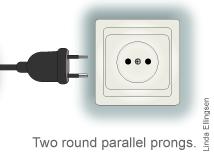
The 4 mm plug is the most versatile plug in Europe.  It is used everywhere except for where the British 3-prong outlet is used.  It can use the 4 mm or 5 mm outlets.  Most of my small appliances (iPhone charger, electric shaver, camera charger) have a 4 mm plug.

The 4 mm outlet is not grounded so it is being phased out in most of Europe.  Just the outlet; not the plug.

Through most of Europe the 5 mm outlet is used.  Again, you can use a 4 mm plug in a 5 mm outlet.  My flat has 5 mm outlets.


Italy has its own plug and outlet.  The plug looks like the 4 mm plug except that it has a grounding pin.  The good thing is that a 4 mm plug adapter will work in an Italian 3 pin outlet.

Finally there is a plug and outlet that is used in Switzerland and Liechtenstein.  It looks like the Italian version except that the grounding pin in the center is not parallel with the other pins.  A 4 mm plug adapter will work in a Swiss outlet.

None of this really causes me any trouble when I travel.  My small appliances with a 4 mm plug work everywhere except with that funky British outlet so then I just take along a UK plug adapter.  And when I'm in Italy I just make sure to bring along my 4 mm adapter so that I can plug in my laptop.

Update:  The UAE uses the UK plugs too.

Update:  SingaporeHong Kong and Macau each use the UK plugs as well.

South Africa plug
Update:  South Africa has a 3-prong plug similar to the UK plug but the prongs are all round.  The outlet also has the UK on/off toggle.

India plug


Update:  India uses a plug similar to South Africa but the prong size is a bit different.

Tuesday, January 3, 2012

Comino, Malta

Comino is the smallest of the three inhabited Maltese islands, located about half-way between Malta and Gozo.

The Mediterranean island is only 3.5 square km (1.35 sq miles) in area. Today, the island is a bird sanctuary and popular with tourists in the summer.

The island population is four. Yes, four! There's a priest and a policeman that commute regularly from Gozo.

Here's a video I found out on YouTube about Salvu Vella. We actually saw him out and about on the island.

©DW English

St. Mary's Tower was built in 1618. The fortification was used as an early warning system and to improve communication between Malta and Gozo.


The main attraction is the Blue Lagoon. The water is absolutely beautiful and there is even a small sand beach. On the other side of the Blue Lagoon, only 100 meters (300 feet) from Comino, is the fifth Maltese island – Cominetto.

Monday, January 2, 2012

Driving in Malta

Part of our Malta adventure has been just touring around in our Daihatsu Sirion rental car. At times, it has bit a bit stressful. The roads aren’t exactly the best. And Maltese drivers have, shall we say, have their own style of driving. Turn signals aren’t used, speed limits seem to be optional and stop signs appear to only be a suggestion. All of this I can handle. But what really has done me in is that in Malta, like in the UK, Ireland and Cyprus, everyone drives on the left-hand side of the road.
I’ve been driving on the right-hand side of the road for around 25 years. So to me this seems “normal”. I have driven in Aruba and Japan before, where everyone drives on the left-hand side, but I was still in left-handed vehicles. So it wasn’t really that different. In Malta, I am forced to drive a right-handed vehicle on the left-hand side of the road. Yikes!
You really have to remember that the nearest edge of the road has to be on the left. It sounds simple enough. Mentally, I keep thinking, drive on the left…drive on the left…drive on the left. It freaks me out though when you drive down all of the one-way streets because Maltese drivers park their cars facing both directions so as you go down a street you approach cars on both sides. Wicked confusing at first.
At first it was odd to shift with my left hand. The gearbox is laid out in the same pattern but downshifting is just counter-intuitive. It takes a few hours before you get used to making big right hand turns and taking tight left hand turns. Eventually you figure out just how close you are to the curb.
The most difficult part has been the left-handed roundabouts. And Malta seems to have way more roundabouts than the Czech Republic. It is just very, very odd driving the “wrong way” around them.
Miran has done a bit of the driving but it’s mainly been me behind the wheel. Go figure that the first time I drive a car in Europe, after getting my Czech license, is in a country that drives on the opposite side of the road. Probably not the best idea ever but it really has been worth it. We’ve really been able to get out and explore Malta and Gozo. We can go where we wanted, when we want and stay for as long as we want.
Who knows? Maybe after this I'll be ready to tackle driving in Ireland.

Sunday, January 1, 2012

New Year's in Malta

New Year's Eve has never been my favorite holiday. Sure it was a lot of fun when I was younger and I've had my adventures. But as I get older I just find it to be a lot more tedious. Everything costs way more than it should. People drink way more than they should. There is more traffic, delays due to extra security, etc.

So I really prefer a more laid back NYE. I'm lucky that Miran feels the same way. So yesterday we went to the local market and picked up a few supplies and had a nice little picnic in our hotel room. Later we walked down to the Sliema promenade and found a spot with a great view of Valletta, across the water. We cracked open a bottle of champagne and watched the fireworks over the capital city. It was a really nice time. And since we're not hung over, (we didn't even finish the bottle of bubbly), we are ready to go out and do some more exploring today.

Saturday, December 31, 2011

Gozo, Malta

Gozo is Malta's second largest island, about 1/3rd the size of the big island, and home to 31,000 people. It's about a 30-minute ferry ride from Malta to the Gozo port city of Mġarr. Gozo is a great place to drive around and check out all of the sites.

The Ġgantija Temples are considered to be the oldest free-standing structures in the world. They are more than 5,500 years old and are designated as a UNESCO World Heritage Site. I liked the temples on Malta better. Here it just looks like a big pile of rocks.

Calypso Cave is where, according to legend, the nymph Calypso held the Greek hero Ulysses as her prisoner of love for seven years.


You can't enter the cave but from here there's a nice view of the beach at Ramla Bay.


We drove to Xagħra to visit the Ta' Kola windmill. It was built in 1725 and is the only one of the 12 windmills built by the Maltese Knights that is still in good working condition. Or at least what's what we thought but it's currently under renovation.

Victoria, with around 6,400 people, is the largest town on Gozo. The British renamed the town in 1897 in honor of Queen Victoria's Diamond Jubilee. However, the locals still refer to it by its original name - Rabat.

In the center of Victoria is the Citadel. The Knights built the defensive stone walls between 1599 and 1603. It is one of the highest points on the island so there are some great views.

There's a 17th century Baroque cathedral. The ceiling is painted to look like the interior of a dome. I guess it's way cheaper than actually building a dome.


Three kilometers away is the village of Għarb.


Nearby is the National Shrine of the Blessed Virgin of Ta' Pinu. It's a Neo-romantic Roman Catholic church and a minor basilica. It was consecrated in August 1932.


The Ta' Ċenċ Cliffs are quite lovely. And well worth the crazy left-sided driving required to get there.


Dwejra Bay was my favorite part of Gozo because of the Azure Window, the Inland Sea and the Fungus Rock.

The Azure Window is a 50 m (150 ft) high rock arch where the sea has worn a hole through the rock forming the window. The window is disintegrating because large pieces of rock keep falling from the arch and within a few years the Azure Window will become known as the Azure Pinnacle.

The Inland Sea is a small sea lake connected to the Mediterranean Sea by a narrow tunnel through the cliffs. Around the small lake are a few boat houses.


Fungus Rock
is known locally as the General's Rock. It is a massive chunk of limestone off the coast of Gozo. The Maltese Knights used the plant growing on top of the rock to dress wounds and as a cure for dysentery. Today Fungus Rock s a nature reserve.