Showing posts with label Albania. Show all posts

Friday, August 16, 2019

CEFTA

The Central European Free Trade Agreement, or CEFTA, was formed in 1992 by the Visegrád countries - Czechoslovakia, Poland, and Hungary.  After the Velvet Divorce both Czech Republic and Slovakia became independent members.  The purpose was to work together towards integrating political, economic, security, and legal systems with western free-market economies.

Over the years, other countries have joined CEFTA.  However, once a country joins the European Union it must leave CEFTA.  Former members include Bulgaria, Croatia, Romania, and Slovenia.  Basically being a CEFTA member servers as good preparation for eventually joining the EU.

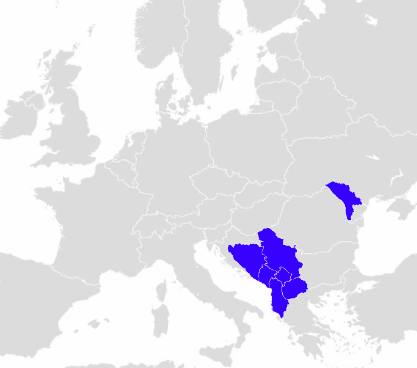
Current CEFTA members
CEFTA seems less "Central Europe" and more "Balkans" to me.  The seven current members are Albania, Bosnia and Herzegovina, Kosovo, Moldova, Montenegro, Macedonia, and Serbia.  Combined the CEFTA countries have a combined population of about 21,5 million people and a GDP over $290 billion.

Wednesday, June 26, 2019

The Warsaw Pact

The Warsaw Pact was the communist version of NATO.
Officially it was the Treaty of Friendship, Cooperation, and Mutual Assistance.

In 1955, West Germany joined NATO so a military alliance was established to counter it.


Like NATO, one of the main principles was that an attack on one country was an attack on all members of the alliance.  The Warsaw Pact countries were the Soviet Union, Poland, East Germany, Hungary, Romania, Bulgaria, Albania, and Czechoslovakia.

When I grew up the Cold War was NATO vs the Warsaw Pact.

Ironically, its largest military engagement wasn't against NATO but "Operation Danube" which was the invasion of Czechoslovakia that put down the Prague Spring.
Romania and Albania didn't participate in the invasion.  Shortly afterwards, Albania left the alliance.

At the last minute it was decided that East Germany would not invade because it was the 30th anniversary of Germany annexing the Sudetenland.  

Here's a video I found out on YouTube called "March of the Warsaw Pact".  The lyrics are in Russian but there are English subtitles.  It's basically the alliance's anthem but I find it interesting that the East Germans aren't mentioned.

©YugoslavianHeros 1943

The Warsaw Pact became less relevant following the fall of communism in 1989 and the breakup of the Soviet Union in 1991.  Except that there were still Soviet troops stationed across Eastern Europe.  East Germany left the pact in 1990 following the reunification of Germany.

It's fitting that the Warsaw Pact was formally ended, in Prague, on 1 July 1991 by Czechoslovak President Václav Havel

Over the next 20+ years former Warsaw Pact countries ended up joining NATO.  Czech Republic, Hungary, and Poland joined in 1999.  Slovakia, Bulgaria, and Romania joined in 2004, along with the former Soviet Baltic states Estonia, Latvia, and Lithuania.  Albania joined in 2009.  

NATO just celebrated its 70th anniversary and continues to expand.

Update 2025: Here's a short video I found that explains, prior to the Warsaw Pact, the USSR actually tried to join NATO.  Who know?

©History Matters

Wednesday, March 12, 2014

15 Years in NATO

Today was the 15th anniversary since Czech Republic joined NATO. 


NATO is the North Atlantic Treaty Organization.  The organization came about after WWII.  It is a military alliance where all members agree to mutual defense.  An attack on one NATO member is considered an attack on all members.

The alliance is headquartered in Brussels.  

Back in 1949, the alliance began with 12 members - Belgium, Canada, Denmark, France, Iceland, Italy, Luxembourg, Netherlands, Norway, Portugal, the United Kingdom and the USA.  

Greece, Turkey and West Germany joined in the 1950s and Spain joined in 1982.

Czech Republic, Hungary and Poland joined in 1999 becoming the first former Warsaw Pact members to join the alliance.

Seven new members joined in 2004 - Bulgaria, Estonia, Latvia, Lithuania, Romania, Slovakia and SloveniaAlbania and Croatia both joined in 2009.

Today there are 28 members.  Bosnia and Herzegovina, Montenegro and Macedonia are all in the process of joining as well.  Georgia is another aspiring member.  Given the problems in Crimea, I'm sure that Ukraine wishes it was currently a member.

Macedonia fulfilled the requirements to join at the same time as Albania and Croatia, but its membership was blocked by Greece over the country name of Macedonia.    

Here's a NATO video timeline I found out on YouTube.
©NATO
 
I also found a video from 2011 showing Czech NATO troops training police recruits in Afghanistan.

©NATO 

Update: Montenegro joined in 2017.
Update: 2019 is the 20th anniversary of joining NATO.

Update: 2019 - Here's the Czechia is NATO - We Are NATO video.

©NATO 

Update: North Macedonia joined in 2020 becoming the 30th NATO member.

Update:  September 2022 - Here's a short video I found on YouTube about how a country joins NATO.

©NATO

Update: 4 April 2023 - Finland became the 31st member of NATO.

Wednesday, October 24, 2012

Greece

Nat and I decided on a weekend trip to Athens in a few weeks.  She's never been there before and it's been 20 years since I was in Athens so this should be a good little adventure.  This will also be country #33 that I've visited since I moved here in July 2009.  My last assignment in the military was in Heraklion, Crete, which seems like a lifetime ago.  I'm still planning a return trip to Crete in the future.  It should be interesting to see how things have changed in Greece since I left.

Officially the Hellenic Republic (Ελληνική Δημοκρατία), Greece (Ελλάδα) is in southeast Europe.  Greece borders Albania, Macedonia, Bulgaria and Turkey.  It lies on the Aegean Sea, the Ionian Sea and the Mediterranean Sea.  The country has around 1,400 islands but only 227 of them are inhabited.  Crete is the largest island.  The entire country is a bit smaller than Alabama and has a population around 11 million.  Athens is the capital and its largest city.

The first advanced civilizations in Europe began here around 3200 BC.  Ancient Greece was the cradle of Western civilization.  It gave us democracy, western philosophy, and the Olympic Games.  There is a lot of history to explore here.  Greece is home to 17 UNESCO World Heritage Sites - the 7th most in Europe (13th in the world).

Following the Greek War of Independence, from the Ottoman Empire, Greece was established in 1830.  During WWII, Greece was invaded by Italy in 1940 and then occupied by Nazi Germany from 1941 to 1944.  Then there was a civil war between nationalists and communists that lasted until 1949.  Many Greeks ended up in Czechoslovakia but more on that one later.

Greece joined NATO in 1952.  A military dictatorship took control of the country in 1967 and it wasn't until 1974 that democratic elections took place which created a parliamentary republic.  In 1981, Greece joined what later became the EU and adopted the euro in 2001.  Greece is a member of the Schengen area but may be kicked out.

Greece has several issues to deal with.  Traditionally, these have been with neighboring countries.  There is a big rivalry between Greeks and Turks.  There are always territorial disputes in the Aegean Sea between the two countries.  There is a section of Greece called Macedonia so it rejects the Republic of Macedonia from using the name.  The migration of unemployed people from Albania has helped to put a strain on the Greek government.  And these are just some of the traditional issues the country deals with.  The more recent problems are the ones that require the most attention.

Greece's economy is a wreck.  The country falsified records in order to join the Eurozone when in fact it never met the basic requirements for membership.  Greece was spending more than it was earning before it joined the euro and public spending went crazy after it joined.  To make matters worse, high levels of tax evasion have caused the budget deficit to spiral out of control.  When the global financial crisis hit, Greece was no longer able to repay its debt and the country was forced to ask for massive loans.

In 2010, the EU and the International Monetary fund gave €110 billion ($140 billion) and in 2012 another €130 billion bailout package was approved.  Most of the country's private creditors agreed to write off over half of their Greek debt and to provide lower interest rates for existing loans.  Currently Greece owes $38B to French banks, $8.2 to UK banks, $5.5 to German banks and $3.2B to US banks.

However, in exchange for all of this assistance, Greece has had to undertake major austerity measures to cut spending, raise taxes and undergo pension and labor market reforms.  Without the ability to devalue its currency, Greece has a long hard road ahead.  Over 25% of the country is currently unemployed.  For young people, the rate is more than 54%.  This prevents the country from collecting revenue in order to pay off its debt which forces further public spending cuts.  This is also causing a "brain drain" as educated Greeks are leaving the country in order to find jobs overseas.  What a mess!  At some point, there will have to be a "GrExit" from the Eurozone which will set a dangerous precedent with regards to the troubled economies in Spain, Italy, Portugal and Ireland.

Here's a video from 2011 I found on YouTube that gives more information.

©Deutsche Welle

Monday, December 12, 2011

Postcards

I always send six postcards back to the USA when I travel. Part of my routine is that I find a nice little cafe somewhere, have a latté, and write out my postcards. It helps me focus my thoughts for possible blog posts later. With every card I actually try to write something of substance as opposed to "Greetings from where ever" and "Bye".

At times, the biggest challenge is just getting stamps. Every country is a little different. Sometimes you can buy stamps from a postcard kiosk on the street. Sometimes you buy stamps at a tobacco shop or a newsstand. Sometimes you can purchase stamps in hotel lobbies. And other times you have to go to the post office. When I arrive at a new destination, one of the first things I find out about is the post situation. Especially if I arrive someplace on a Saturday morning because you never know at what time the post office will close.

In Kosovo, the only place you can buy stamps is at the post office which, of course, is closed on Sundays. In Prishtina, I even went to the Grand Hotel to see if they possibly had stamps I could purchase. They did sell stamps. Great. However, on Sundays, the stamps are locked away upstairs and no one on duty had the key. Not so great. So my Kosovo postcards were all mailed from Albania.

I always ask for a postcard stamp to North America. Some countries charge different prices depending on where the postcard is going. For example, in Germany an international postcard stamp costs €0,75 regardless if it goes next door to Austria or all the way to Australia.

France charges €0,75 for the European Union and Switzerland but €0,89 for the rest of Europe or the USA.

Italy is expensive. There it's €0,75 for Europe, €1,60 for the USA and €2 for Australia.

In the Czech Republic, it's 20 Kč for Europe and 21 Kč (~$1.10) for the USA. I just budget in $20 for stamps and postcards on every trip I take and I'm covered.

There are normally mail boxes at airports and train stations. Most hotels will also mail things off for you, if you don't have time to find a box or the actual post office. In Albania, there are no mail boxes. The only mail boxes in the entire capital are in front of the post office so you have to go to the post office to mail anything.

My niece has a map of the world on her bedroom wall and she tacks up all of the post cards I send her. Someone else has a special album filled with the cards I've sent. My mom had the most creative idea. She pastes recipes on the back side of any postcard she receives and then puts them in an actual post card rack. Pretty clever.

Update:  2014 - Czech Post raised the price of a postcard to the USA to 30 Kč ($1.50).

Sunday, October 23, 2011

2011 Balkan Trip Summary

I made it back from my latest Balkan adventure. I traveled well over 1,200 km (745 miles) and I managed to do it all by bus.

Sofia was my starting and ending point. Bulgaria was fine except for that confusing head nod thing that they do. The next time I fly to Sofia it will be to visit Plovdiv, about 150 km (~93 miles) away. On the east side of the country, on the Black Sea, I still want to see Bourgas and Varna.

Macedonia was fine and Skopje made a good one-day visit. I'll wait and see what the capital looks like after all of the construction is completed.

I wasn't that impressed with Kosovo. Prishtina wasn't what I expected. I can see going back to Kosovo to visit Prizren. But that would be the only reason why.

Albania was interesting because I really didn't know too much about it before. Tirana was fine, except for having to dodge cars. I'll go back one day to visit Shkodër, Krujë and Berat. And of course, to see the completed museum exhibition. But, if Durrës is any indication then I can guarantee I won't be planning any beach holidays in Albania.

For me, the best part of the whole week was the brief time I spent at Lake Ohrid. For some reason it took me a while to get the name right. I kept saying Orhid or Orchid. But it is pronounced "Oxh-rid". You can bet that now that I've got the name down, I'll be back there for sure.

Overall, this was a good little adventure. Four new countries (again, all by bus), four currencies, and three languages (none of which I know). It was worth it. But it felt so good to sleep in my own bed last night. At least I'll be able to do that for a few more days. Then I'm headed back to Slovenia for a couple of days and then a road trip to Italy and San Marino.

Friday, October 21, 2011

Burek

One of the good things about traveling in the Balkans is the burek. Burek is popular for breakfast, but it also makes a great snack or midday meal.


It originated in Turkey but is popular in all of the countries of the former Yugoslavia.

The pastry consists of layers of thin, flaky phyllo dough that is filled with various ingredients and then baked or fried. Normally it has a type of feta cheese or ground meat & onions. While not as popular as the meat or cheese variety, my favorite is the spinach burek. In Ljubljana you can even find apple burek. I never tried the apple because to me that sounds less like burek and more like strudel.

You can find burek at most bakeries. You can even find dedicated burek stands. Burek and a cup of plain yogurt makes for a great, cheap breakfast.

Thursday, October 20, 2011

Lake Ohrid, Macedonia

From Tirana it is a 5.5 hour bus ride to Struga, Macedonia, and then a €5 ($6.75) cab ride to Ohrid. Lake Ohrid is one of the oldest and deepest lakes in Europe. The lake itself is over 3 million years old. One-third of the lake belongs to Albania and two-thirds belong to Macedonia.


With a maximum depth of 288 meters (940 feet) it is the deepest lake in the Balkans.


Old Town used to be surrounded by walls. The Upper Gate is the only one of the three remaining gates to the city and dates back from the 3rd century BC.


The King Samuel Fortress is one of the largest preserved fortifications in Macedonia. It sits on a hill above the town. There are a few towers but not much else to see at the fortress. The best thing about the fortress is the views of the town and the lake.

Below the fortress is the open theater. The amphitheater is just over 2,000 years old. It is the only Greek theater in Macedonia; the other three are Roman amphitheaters. It was buried for centuries and fully uncovered by the 1990s. During the summer it is used for outdoor concerts.

Near the bazaar and the town fountain is a large tree. It's a local landmark and somewhere between 800 and 1,000 years old.

Ohrid used to be the city of 365 churches, one for each day of the year. There are no longer that many churches here now but there are a few interesting ones.

The 13th century St. Jovan Kaneo church sits on a cliff overlooking the lake. The view is great. The church is known for its frescoes and Armenian-influenced architecture. Below the cliff is a great place to catch a short water taxi ride around the lake for nice views of the town.

St. Sophia Church is an 11th century cathedral. It was built in 1035 and is the oldest church in Ohrid. It is one of the largest medieval churches in the area and home to the world's largest composition of preserved 11th century frescoes.

St. Bogorodica Perivlepta is a 13th century church that was dedicated to the Virgin Mary. The church was built in 1295.

The monastery church of Sts. Kliment and Pantelejmon sits on a hill overlooking Lake Ohrid. This is the place where the Cyrillic alphabet was created. Opened in the 10th century, this was the first and oldest discontinued university in Europe.

On the south-east side of the lake, near the Albanian border, is the St. Naum Monastery. I really wanted to visit it but unfortunately, I just didn't have enough time. This time that is. I'm for sure coming back to Ohrid.

In 1979, Lake Ohrid was declared a UNESCO World Heritage site. In 2010, NASA named one of the lakes on Titan (one of Saturn's moons) after Lake Ohrid.

Wednesday, October 19, 2011

Durrës, Albania

Durrës is Albania's second largest city. It's home to around 202,000 residents.

It is also one of the oldest cities in the country. The area has been continuously inhabited for 2,700 years.

Durrës is only 33 km (21 miles) away from Tirana and a one-way ride in a furgon costs 100 lekë ($0.95).


The city was founded by ancient Greeks and today it is the country's main port. There are several ferries that run between Durrës and Italy. Brindisi is 200 km/124 miles away and Bari is 300 km/186 miles away.


To be honest there is not a lot to see here. The main attraction is the Roman amphitheater that was discovered in 1966. It was built between 117 - 78 BC. Up to 20,000 people used to watch gladiators do battle here. Up to 25% of the archeological site is still buried beneath houses. This is the largest Roman amphitheater in the Balkans. Currently it is under consideration to become a UNESCO World Heritage site.


Near the port is the ancient Byzantine city wall.


The Venetian Tower was built in the city center during the 16th century.


The primary reason that people come to Durrës is because it is home to the largest and most popular beach in Albania. Around 600,000 tourists visit annually and many people from Tirana spend their summer vacations here.

I don't get it. There's no way on earth that I would use the beach here. The "beach" wasn't sand or pebble or even rock. It looked like garden mulch!! Looking at it made my skin itch. I saw some kids going out in to the water and they looked like they were having fun. Good for them.

I found this clip out on YouTube. It's not about Durrës per se. However, I found it interesting, and sad, and I'm glad that I didn't hit the beach.


©Reuters

Tuesday, October 18, 2011

Furgons

Furgons are a popular means of getting around in Albania. They had them in Istanbul too but I never tried it there. A furgon is a privately owned minivan that is basically a group taxi for 8-15 people. First, you figure out where you want to go to and then you ask around for where the furgons are that are headed to your desired destination.

Once you find the appropriate furgon you ask "how much?" and get in. Schedules are very fluid because the furgon doesn't leave until there's a full load. If it does depart with a couple of empty seats then it's not uncommon to trawl through the streets along the way looking for additional passengers. You don't pay until you get out.

Most furgons depart either early in the morning or in the early afternoon. After that, you're pretty much stuck wherever you're at.

Today was going to be my first furgon experience on my way to Durrës. But it turned out that Durrës is such a main destination that my furgon was actually just a normal long-distance bus. It's funny to me that, given train service here isn't what it is in Western/Central Europe, buses are so important but Tirana doesn't even have a bus station. You find the buses right alongside the furgons. The big difference is that with the bus you don't pay when you get off. After the bus departs, someone will come along later and collect the fare. So I guess I missed out on my furgon adventure today but I'm OK with that. The bus was at least a bit roomier.

Tirana, Albania

Tirana is the capital of Albania and has over 750,000 residents. Tirana is located almost right in the center of the country. It's a six hour (€20/$27) bus ride from Prishtina.


The Tirana area has been inhabited since Paleolithic times but the city wasn't founded until 1614 and it didn't become the capital city until 1925.


Skanderbeg Square is the city's main square. It was completed in 1929 to commemorate the 500th anniversary of the death of Albania's national hero. Skanderbeg managed to create an independent Albanian princedom for 25 years. Albanians consider him to the father of the country and the one who saved all of Europe from the Ottoman Empire. There was also a Skanderbeg monument in Prishtina. At the main square is the opera, the national history museum, the Et'hem Bey Mosque and some government buildings. Right now the square is a full on construction zone. The entire square is being renovated with funds from Kuwait. No one seems to know when the project will be finished.

The Et'hem Bey Mosque was built in 1789. Not only did it survive WWII but it managed to escape the communist crack down on all things religious. The frescoes on the outside depict trees, waterfalls and bridges which I'm told is rare in Islamic art because still life isn't the usual subject matter. The inside is small but well worth a visit.

Behind the mosque is the 35 meter (~115 ft) clock tower. It was built in 1830. For a long time it was the tallest structure in town. The USA provided the funds to restore it. Albania is a poor country but apparently has lots of friends. America paid for the clock tower, Kuwait is taking care of the square, I was some university building renovations under way compliments of Italy and few historic sites are currently funded by the EU.

Not far from the main square is an area called the bllock (block). An entire block of the capital was off-limits to the general public until 1991. During communism this is where the party leaders lived and there were armed guards to keep average people out. Today the area is filled with cafes, shops and pubs and is home to the nightlife scene.

In 2007, George W. Bush became the first U.S. President to visit Albania. He even has a street named after him. At least Prishtina has a boulevard name President Clinton. Anyway, on George W. Bush Street is the Statue of the Unknown Partisan. It was built to honor all of the people who died fighting the fascists in WWI. Today, this is where day laborers hang out waiting for work.


The National Art Gallery was looted in 1997. The current collection covers 13th century icons to modern art. There is a large section containing socialist art from the 1940s to the 1990s when the government dictated the subject matter. Behind the museum are the last statues of Lenin and Stalin.


Enver Hoxha was the country's ruler for almost 40 years. When he died, his daughter and son-in-law designed a museum called the Pyramid which opened in 1988. The marble and glass building was allegedly the most expensive building in Albania. After the regime changed the building became a conference center and then a disco called "The Mummy".  NATO used it during the Kosovo crisis. In front of the Pyramid is the Bell of Peace as a memorial to the country's struggle. Schoolchildren collected bullet cases, in the 1990s, from which the bell was forged. The government was to demolish it and use the space for more parliament buildings. It's a real eyesore.

The National Museum of History has a huge mosaic illustrating the country's history from the Illyrians to the partisans of WWII. The first part of the museum's exhibits are labeled in Albanian and some also have French translations, but no English. In the second part of the museum the French is replaced by the occasional English caption. I had heard that this was the best place to get more information on the totalitarian years. So this was the whole reason that I went to the museum. It sure wasn't to see the usual collection of Balkan prehistoric arrowheads. I made it up to the middle of WWII and the museum ended. The whole final third of the museum is closed for renovation. Nice that there was no mention that 1/3rd of the museum is closed when you purchase a ticket. I mentioned that the entire reason I came to the museum was to see the section that was closed. A staff member asked me where I was from. After I said the USA, she told me not to worry because it would re-open one day. I still don't really get the connection but whatever. At least the admission price was only 200 lekë (~$1.92).

The Martyrs' Cemetery is up on a hill that overlooks the city. This is where 900 partisans who died in WWII are buried. It is also home to a 12 meter tall statue of Mother Albania. Enver Hoxha was buried here in 1985 but his remains were moved to another cemetery in 1992.

Albanians are the worst drivers in Europe. Never again can I complain about how bad Czech drivers are. Until 1991, only communist party officials were allowed to drive or own cars. There were only 600 cars in the whole country. My Albanian colleague at work says that they went from donkeys to Mercedes overnight. All of a sudden there was a flood of second-hand cars but there were no traffic rules, no driver's licenses, no traffic lights and zero enforcement. I have never been so scared in my whole life of just crossing the street. The drivers that do slow down or stop aren't really worried about pedestrians. They are simply worried about denting their cars. I found that the safest thing to do was wait until other people crossed the street and simply use them as human shields.