Showing posts with label Art. Show all posts

Monday, September 25, 2023

Gliwice, Poland

Gliwice is located in southern Poland, about 25 km (16 miles) west of Katowice.  The city was founded in 1250 and it's home to just over 180.000 people.  Gliwice is one of the oldest cities in Upper Silesia, is an important industrial centre and a university town.  On Friday evening, we hopped on a train for a weekend away.

Gliwice where is WWII began.  Prior to the war, the city was called Gleiwitz and it was a part of Germany.  On 31 August 1939, German SS officers, wearing Polish military uniforms, commode a false-flag attack on the radio station.  Nazi Germany used this as an excuse to invade Poland the next day which was the start of WWII.

The Gliwice Radio Tower is the world's last wooden radio tower.  It is 118 metres (387 feet) tall and it is part of a local museum and a registered historic monument.


The Market Square dates back to the late 13th century making it one of the oldest medieval squares in Upper Silesia.


In the centre of the square is the neoclassic town hall and a fountain.  Around the square are a number of restaurants and cafes.


Saint Bartholomew's Church dates back to the late 1200s.  It was rebuilt in the 15th century and expanded in the 16th and 17th centuries.


The Christ the King Church is a Catholic Church that was consecrated in 1935.


The All Saints Church was built in the late 15th to early 16th century.  The exterior is Gothic and the interior is Baroque.  The tower is about 63 metres (207 feet) tall.


The Church of the Holy Cross is a Baroque era parish church that was built in 1623.  It is part of a monastery complex and is a registered cultural heritage monument.


The Church of the Assumption of the Blessed Virgin Mary is a wooden church that was built in 1493.  It was moved to its current location in 1925, near an old German cemetery. 


At Starokozielski Park is the Memorial Sarcophagus of French Soldiers.  It is a war memorial for 71 French soldiers who died while serving in Upper Silesia in 1920-1922 following WWI.


The Jews House of Remembrance is a branch of the Gliwice Museum focused on the history of the Jews in Upper Silesia.  The building was completed in 1903 and located next to an old Jewish cemetery.

There are over 600 tombstones in the cemetery.

Back in 1929 there were approximately 2.200 Jews in Gliwice.  Only 25 survived WWII with all of them being in mixed marriages with gentiles.


The Red Army Cemetery was established in 1951.  

There are about 2500 Soviet soldiers buried here.


The Weichmann Textile House was built in 1922.  It was built as a textile and department store.  In 1988it was designated as a historic monument.


The 19th century Chopin Park is home to the municipal Palm House, one of the country's largest.  


The brick water tower was built in 1918.


Vila Caro was built in 1885 for a local industrialist.  Today it is a museum.


Piast Castle was built in the mid-1300s.  Today it is part of the city museum.


The Cathedral of Sts. Peter and Paul was completed in 1900.  The church became a cathedral in 1992.


Gliwice has a street art scene and we found an industrial area that was full of various murals.


We enjoyed our little Polish city break weekend.  Well worth the trip.

Wednesday, April 12, 2023

The Slav Epic

The Slav Epic, Slovanská epopej), was painted by the famous Art Nouveau Alphonse Mucha between 1910 and 1928, and is a cycle of 20 large canvases.  The cycle shows the mythology and history of the Slavic people.


The paintings are on display in Moravský Krumlov, about 51 km (31 miles) from Brno.


Mucha worked on these paintings for 18 years and the cycle is considered his biggest success.  After finishing the cycle in 1928, it first went on display in Prague and Mucha bestowed it to Prague, on the condition that the city build a special pavilion to display it.

Mucha died in July 1939.  He was interrogated by the Gestapo because he was culturally important in Czechoslovakia.  During WWII, the paintings were hidden away to prevent the Nazis from seizing them.


After the 1948 Communist Coup, the communist government wasn't keen on Mucha who they considered a bourgeois artist and whose art wasn't in line with socialist realism.  So building a special pavilion to display Mucha's work wasn't a priority for the communist government so they were put on display in Moravský Krumlov in 1963.

The Slav Epic was on display in Moravský Krumlov for almost 50 years.  Prague waged a decade-long legal battle to move the paintings to the city which intensified in early 2010.  The city of Prague felt the paintings would be seen by more people...tourists...if they were located in Prague but none of the city's galleries had space for the pieces.  They are huge; up to 6 metres tall and 8 metres wide (19.8 feet tall by 26.25 wide).

In 2012 the paintings were moved to the National Gallery and stayed there until the end of 2016.  In 2017 they were taken on a two-year tour of Asia before returning to Prague in 2019.  The Asian tour was controversial and Mucha's grandson unsuccessfully sued Prague to stop the tour.

The paintings returned to Moravský Krumlov in July 2021 where they are to remain for up to five years.  In 2022, Prague signed an agreement to renovate Savarin Palace, in Prague, which is to be the painting's new home.  In my humble opinion, Prague being the capital and all, the city has more than enough things to see and do.  There weren't any problems with having the paintings in Moravský Krumlov and having the paintings outside of Prague brought tourists to South Moravia.  

Seeing The Slav Epic has been on my list of things to do for a long time.  Claudia and Nat went and saw it about 12 or so years ago but on a weekend when I was out of town somewhere.  It was worth the wait. 

Here's a Rick Steves video I found out on YouTube about Alphonse Mucha and The Slav Epic.

©Rick Steves

Tuesday, November 1, 2022

Vizcaya Bridge, Urdaibai, San Juan de Gaztelugatxe, Bermeo And Gernika Tour, Spain

On Saturday we did a half-day tour to see Vizcaya Bridge, San Juan De Gaztelugatxe, Bermeo and Gernika.  We got to see several Basque Country sights.  It was a long trip but well worth it.  

Our first stop was in Getxo for a 20-minute stop to take a look at the UNESCO transporter bridge.  Twenty minutes didn't leave people with enough time take a ride across the river and back but we were fine since we already did the bridge thing the day before when we went to Portugalete.

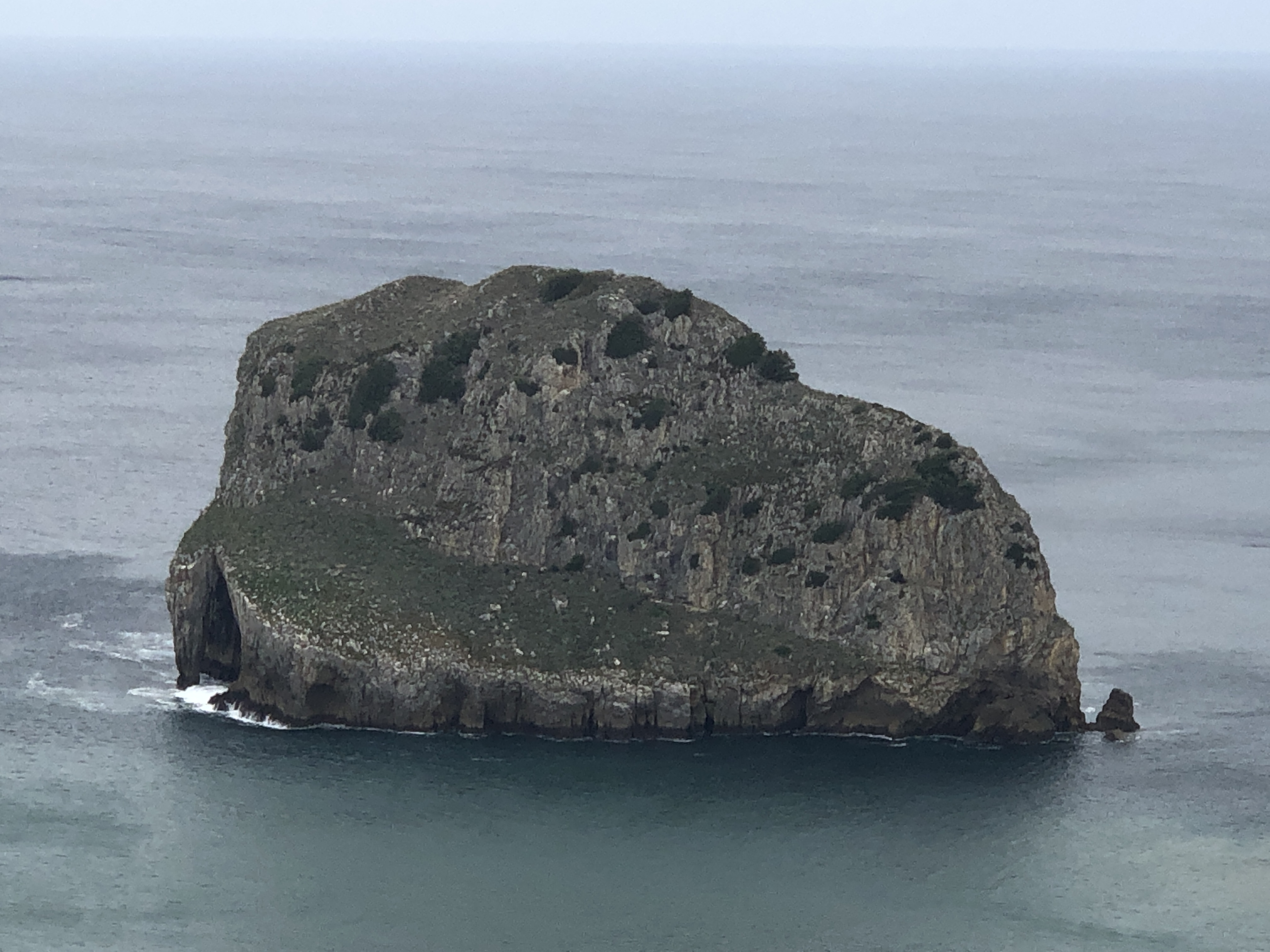
San Juan de Gaztelugatxe is an islet off the coast of the Bay of Biscay, about 35 km (22 miles) east of Bilbao.  There is a man-made stone bridge to the island with a 10th century hermitage on top dating back to 1051.

Many people take two hours to hike to the hermitage and ring a bell there three times to make a wish.  We only stopped at an overlook for 20 minutes to take some photos.


Akatz Island is a neighbouring island that is home to nesting birds.

San Juan de Gaztelugatxe has become even more popular when HBO digitally created a castle on top of the islet and created Dragonstone for the seventh season of Game of Thrones.

The Urdaibai Biosphere Reserve was declared a UNESCO Biosphere Reserve in 1984.  

It covers an area of 220 km² (85 square miles) on the Bay of Biscay coast.  It is home to about 45.000 people and 80% of them around towns of Bermeo and Gernika.

Our next stop was the small fishing town of Bermeo about 11 km (7 miles) away.  Bermeo was founded in 1236 and is home to almost 17.000 people.

Bermeo was the provincial capital from 1476 to 1602.  However, once Bilbao was founded in 1300, Bermeo's importance started declining.  


We stayed here for about 40 minutes and even got to sample a local fish pintxo which is the Basque version of Spanish tapas.

Then it was on to Gernika, the Basque name for Guernica, about 40 km (25 miles) east of Bilbao, where we stayed for about an hour.

Guernica was founded in 1366 and is home to 17.000 people.  It is a small market town but it is very important to Basque culture and identity.

Our first stop here was at the Assembly House which is the Basque House of Parliament.  

The hall was built from 1826 - 1833.  The Assembly House is also part museum because there's the Hall of Stained Glass, the Library and the former office of the President.

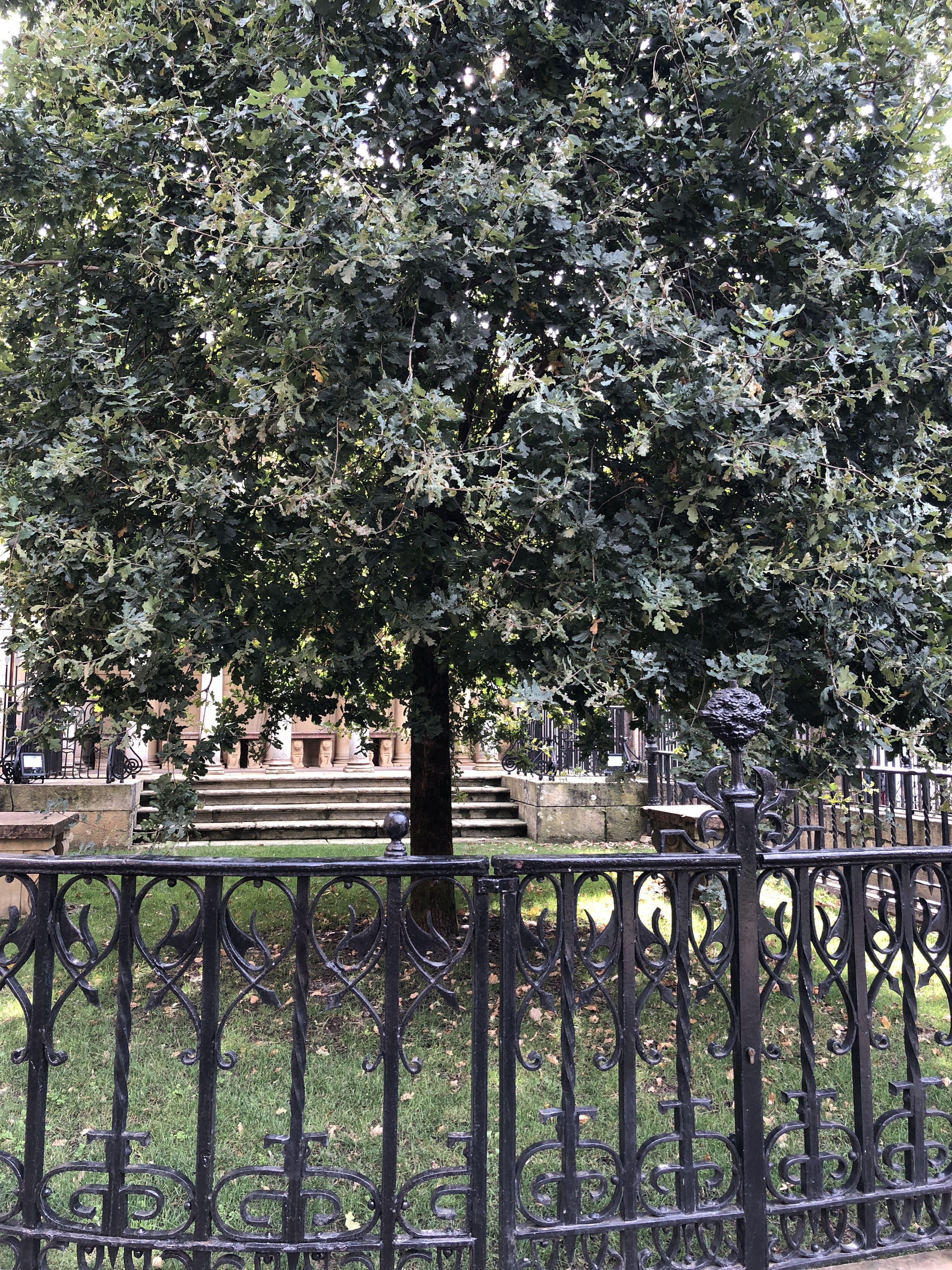
The Tree of Gernika is a symbol of Basque independence and democratic ideals from The current oak tree was planted in 2015 and it replaced the tree that had been planted in 2004.  It was descended from the "Old Tree" (1792-1860) and from the "Father Tree" which died in 1792.

The Church of Santa Maria is the oldest building in the town dating back to the 15th century.

Guernica is most know for being bombed on 26 April 1937.  During the Spanish Civil War, General Francisco Franco requested the Germans and Italians to help him overthrow the Basque Government and the Spanish Republic government.  The German Luftwaffe used it as an opportunity to experiment with its blitzkrieg tactics which it later unleashed on Europe in WWII.

The city was bombed for three hours and more than 1500 people were killed.

It's what inspired Picasso's Guernica which is on display at Madrid's Reina Sofía Museum.  A life-size reproduction of the piece was installed in 1997 to commemorate the 60th anniversary of the bombing.

Here's a short video I found on YouTube that helps interpret Picasso's masterpiece.

©BBC News

Thursday, October 7, 2021

Recyclable Art

I swear there is almost always something going on at náměstí Svobody.  I went to DM today to pick up a few things and saw this big "number one" filled with plastic recyclables.  


I didn't see a sign or anything that gave any details about it so I guess it either (a) isn't finished yet or (b) it's up to the individual to figure it out.  I wonder how long it will be up for?

Update:  It was gone sometime the next week.

Saturday, January 11, 2020

Czech Citizenship Exam: Art From the Middle Ages to the Present

Here are the 10 study questions for the Czech Citizenship exam from section 30: Art from the Middle Ages to the Present.

1.  Which important Prague Jewish monument is in the picture?

Old-New Synagogue.

2.  In which picture are Prague Castle with the Gothic St. Vitus Cathedral - symbols of Czech statehood?

3.  In which picture is the National Theatre in Prague?

4.  In which picture is Karlštejn Castle, founded by Charles IV?

5.  In which picture is the Petřín lookout tower in Prague?

6.  In which picture is the Gothic church of St. Barbara in Kutná Hora?

7.  Who does this statue represent in Vítkov, Prague?


Jan Žižka.

8.  Which Prague museum is in this picture?


The National Museum. 

9.  The astronomical clock is a medieval clock on the tower.  In which picture is the Prague Astronomical Clock? 


10.  The picture shows the famous Prague building in the Art Nouveau style.  What is this building for?

It's a train station.