Former members include Azerbaijan, Georgia, and Uzbekistan.
Here's a short video I found out on YouTube about the CSTO.
©Test Tube News
Former members include Azerbaijan, Georgia, and Uzbekistan.
Here's a short video I found out on YouTube about the CSTO.

Today the CIS consists of Armenia, Azerbaijan, Belarus, Kazakhstan, Kyrgyzstan, Moldova, Russia, Tajikistan, and Uzbekistan. In 2005, Turkmenistan became an observer member. In 2008, Afghanistan and Mongolia became observer members.
Georgia withdrew its membership in 2008 following the five-day war when Russia invaded and took control of South Ossetia.
The three Baltic states, Estonia, Latvia, and Lithuania, chose not to participate because they viewed their being in the Soviet Union was an illegal occupation.
Headquarters for the CIS are in Minsk, Belarus.
The goal of the CIS is to coordinate policies regarding its members' economies, foreign relations, defence, immigration policies, environmental protection, and law enforcement.
The CIS spawned three organisations.
The Collective Security Treaty Organization is a military alliance. Kind of like the new Warsaw Pact but made up of former Soviet republics.
The Eurasian Economic Union is basically the Eurasian version of the EU but only consisting of Armenia, Belarus, Kazakhstan, Kyrgyzstan, and Russia.
The Union State is the union of Belarus and Russia with the goal of common government, flag, currency, etc.
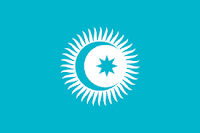
In 2019, Uzbekistan joined the council.
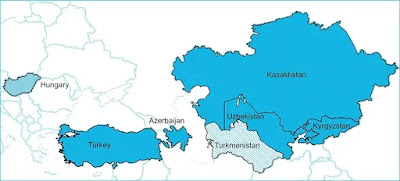
In 2021, Turkmenistan also joined as an observer member so now, except for Tajikistan, four of the five of the "Stans" are members of the council.
Earlier this year, the Islamic Republic of Afghanistan applied for observer status but no decision has been made public yet.
While not an official language, English is a working language of the council.
 Well my Uzbekistan adventure came to a close. I can't believe that I finally made it there. It's the item that's been on my bucket list the longest but after 32 years I did it.
I also had my first Aeroflot flight and made it to Moscow. Only as far as my "capsule" hotel in transit hall at Sheremetyevo Airport.
 I started off in Tashkent. It reminded me of other former Soviet cities with the way things were laid out. There was plenty to see but it didn't have the rich history of the other cities I visited.
 I'm glad that I took the half-day trip out to the mountains and Lake Charvak.
 One thing worth checking out is the Tashkent metro. Many of the stations are simply stunning.
 One of my friends knows a guy who works at one of the embassies in Tashkent, who he put me in touch with. On my last night in Tashkent he invited me over to have some wine and to meet his boyfriend. It was a lovely evening. I would post a photo and use names but I can't because being gay is illegal and can be punished by a three to five year prison sentence. It was still one of the highlights of my trip.
 I then caught the train to Samarkand. My Russian failed me a bit here because instead of getting on the high-speed train I ended up on the normal Uzbek railway. Overall not bad and I got some extra time to relax with my book.
 Samarkand was small but so much to see. In one day I walked 20 km (12,5 mile) walk where I visited mosques, museums, a souq, an ancient observatory, a necropolis, Jewish, Christian, and Muslim cemeteries, and the tomb of St. Daniel.
This photo of Registan is for sure going up on Facebook.

 For anyone going to Uzbekistan I can't stress this enough. Bring either U.S. Dollars or Euros with you to exchange. Very few places take cards so you need to have cash on you. Most of the ATMs across the country don't work with foreign cards. Some machines only work with Visa while some only work with MasterCard. And it was very common for ATMs simply to be out of cash.
 Use the ATM at the airport when you land and take out more money than you normally would. When I first landed I only took out 1,5 million Uzbek Som (€145 or $159). I should have taken out enough money for the entire trip because trying to get more cash later was a bit of an adventure.


After a week my Russian was pretty functional again. An Uzbek woman said that I spoke pretty decent Russian for a Czech. Not sure how I felt about this because the joke goes that when a drunk Czech speaks Russian what you end up with is Slovak.


If I had a few more days in Uzbekistan then I would have made it up ti Khiva. Since I didn't make it this time I guess a return visit is in order. Hopefully it won't take 32 years to make it back again.
 From Tashkent I had my first flight with S7 (Siberian Airlines) which is part of Oneworld Alliance. Unfortunately there was some mechanical problems with the connecting flight in Moscow so I was delayed a couple of hours getting back to Vienna on Sunday night.

 Bukhara, or Buxoro in Uzbek, was founded around the 6th century BC and is one of the oldest continuously inhabited places in Central Asia. It's 240 km (149 miles) from Samarkand. With a population of 272.000 people it is the 5th largest city in Uzbekistan.
The city is located along the Silk Road and it was once a major intellectual centre in the Islamic world. Bukhara is filled with architectural sights and the historic centre is a UNESCO World Heritage Site.
 I never knew that there once was a Bukhara People's Soviet Republic. It only existed from 1920 - 1925 and it then became part of the Uzbek Soviet Socialist Republic.
 The Ark is the massive fortress. The true age isn't known but the military structure was in use around the 5th Century AD. It remained in use as a fortress until it fell Imperial Russia in 1920. Today it holds a few museums, a mosque, and stables.

 The Kalyan Minaret was built in 1127. It is made of bricks at is 45,6 meters (150 feet) tall and 9 meters (30 feet) wide at the base. As a minaret it is used to call people to prayer. During war times it was used as a watchtower. It was also known as the Tower of Death because criminals were executed by being thrown from the top. Apparently Genghis Khan was so impressed by the tower that it was spared when his men destroyed the city.
 The Mir-i-Arab Madrassah was completed in 1535-1536. It is still a functioning madrassah where future imams and religious leaders train. At night it looks like something from "Alladin."
 |
| Mir-i-Arab Madrassah at night. |


 The Memorial Complex of Imam Al Bukhari is a small museum that opened in 2001. It is shaped as a partially opened book.
 The Chashma-Ayub mausoleum is on top of the the spot where it is believed that the prophet Job struck the ground with a stick and fresh water came forth.
 The Sarrafon Bathhouse was built in the 16th century. I'm not sure if it is still a functioning Hammam.
 The Magoni-Attori Mosque was rebuilt in the 12th century.
 The Bukhara Synagogue is one of only two remaining synagogues in the city. Back in the 1920s, over 10% of the city's population was Jewish and there were 13 synagogues.
 The Lyab-i Hauz complex sits around one of the city's last remaining ponds as they were all filled in during the Soviet era. It's a great place to grab a tea and write postcards.
  The statue of Nasruddin Hodja is the central character of many Central Asian children's folk stories.
 The Kukeldash Madrasah was completed in 1569 and it is the largest in the city.
 The Samanid Mausoleum was built in the 10th century.
 The Museum of Fine Art building was built in 1912. The museum has been here since 1982.
 Zindan is the 18th century dungeon.
 The prison's 4th cell was the most notorious and it was known as the "bug pit" which was reserved for the least favourite prisoners.
 The trading domes are filled with souvenir shops.
  The observation tower was originally a water tower built in 1920. The observation deck on top provides views of the entire city.

 Chor Minor, also known as the Madrassah of Khalif Niyaz, was completed in 1807. It was a gatehouse for a madrasa that has long since been destroyed.
 The Emir's Palace was completed in 1898. During Soviet times it was used as the Palace of Culture of the Railway Workers. It is not used today and is in desperate need of renovation.






 Posts
All Comments
Posts
All Comments


 Czech Koruna Exchange Rate


