Showing posts with label Palestine. Show all posts

Tuesday, January 15, 2019

Malaysia


Malaysia is a country in South East Asia.  

It is made up of two parts, Peninsular Malaysia and East Malaysia.  Peninsular Malaysia borders Thailand while East Malaysia, on the island of Borneo, borders Indonesia and Brunei.

Malaysia is a little larger than New Mexico and it is home to almost 32 million people.

The country is a federal parliamentary constitutional monarchy.  Most of the country's 13 states are ruled by hereditary sultans or governors appointed by the government.  Every five years one of the sultans is elected king and is the head of state.  However, the prime minister is the head of the government.  Malaysia is the only country in SE Asia that is official federalist.  Kuala Lumpur is the capital and the largest city while Putrajaya is the federal government administrative centre.

The UK established colonies during the late 18th century.  In 1957, the country gained independence from Britain.  Singapore had been a part of the country but it became an independent country.

It is a part of ASEAN and the Commonwealth of Nations.

Malaysia is a diverse country.  Roughly half of the population is Malay with large Chinese and Indian minorities.  The official language is Malay but English is widely spoken.  Chinese and Tamil are commonly spoken by the respective minority communities.  However, in total there are 134 languages spoken within the country.

1 Ringget 
The Ringget is the national currency and it is made up of 100 sen.

Islam is recognised as the state's religion and about 61% of the population is Muslim.  The Malaysian constitution grants freedom of region and about 20% of the country is Buddhist and 9% is Christian.

As a predominately Muslim country, it's not a good place to be gay.  Homosexuality is illegal and punishable by up to 20 years in prison.

Malaysia has no diplomatic ties and has never recognised Israel.  It will only recognise Israel once a peace agreement has been reached with Palestine.

There are diplomatic relations with Czechland.  Primary exports from here to Malaysia are engineering products, machine tools and electric motors.  While Czechland primarily receives machinery, rubber, cocoa, and other electrical equipment.  

Here's a video I found out on YouTube about how powerful the country is.
©Test Tube News

Malaysia has been on my list of places to visit since 1999 when I saw the movie Entrapment.  I also had several colleagues who had been to Kuala Lumpur for work and everyone had such good things to say about KL.  It's hard to believe that after 20 years I'm finally going to tick this off of my bucket list.

Wednesday, March 7, 2018

Eilat Trip Summary

We had a great time on our Middle East adventure last week.  Eilat was the perfect place for some quiet beach time.  Especially last week when a cold blast of snow and freezing wind set record low temperatures across Europe.

Thanks to the Sibiřská zima, Siberian cold, Brno was -14℃ (7℉).  I definitely felt friends freezing back home while it was 28℃ (82℉) on the beach.


On Monday we went to Egypt and visited Saint Catherine's Monastery.

Egypt has long been a popular beach holiday destination for Czechs.  The number of tourists declined after the revolution in 2011 but have steadily increased the last couple of years.

On Wednesday we took our long day trip to Jerusalem and the Dead Sea.

I can definitely see going back to spend some more time at the Dead Sea.  Quite the experience.

Then we went in to Palestine to visit the Church of the Nativity in Bethlehem.

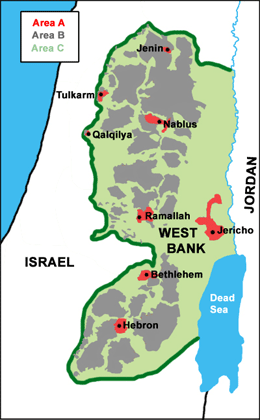
Something I didn't understand was that the Oslo II Accord actually divided up the West Bank into three different areas.  Area A is where the Palestinian Authority has administrative control, Area B is co-administered with Israel, and Area C contains settlements only controlled by Israel.

Israelis are not allowed to enter Area A.  This sign warns that it is both dangerous and against the law for Israeli citizens to enter Area A.


On Friday we took our tour to Petra.  It was even better than I thought it would be.  The carvings were so cool.  I wish we had more time to really explore Petra but we hit the major highlights.  I'm glad that we didn't stay over though because Jordan is ridiculously expensive.

Since 2013, Israel no longer stamps your passport.  Instead you receive a paper ticket every time you enter or exit the country which you hold on to.  There are several counties which won't let you enter if there's any evidence in your passport that you've been to Israel.

Taba visa stamps
The thing is that Egypt and Jordan do stamp your passport.  So there's now evidence in my passport that I used the Taba border crossing in Egypt, and since the only country that one can get to from here is Israel, which means it's pretty easy to figure out where I've been.

Israeli border crossing to Jordan
It's the same story with the Jordanian border crossing.  My passport now won't let me enter Iran, Iraq, Kuwait, Lebanon, Libya, Pakistan, Saudi Arabia, Sudan, Syria, or Yemen.

Aqaba, Jordan, across the Red Sea
While not immediate travel destinations I would like to eventually go to Iran and Lebanon.  I'll either have to get a second U.S. passport, which will only be valid for two years, but won't show evidence of having been in Israel.  Or I wait until I eventually get a Czech passport.


The rest of the time we just relaxed on the beach and enjoyed our time in Eilat.

Mall security


Mall security is no joke in Israel.  According to the law, you can enter only a shopping centre after clearing security.  Your bags will be searched and you go through a metal detector.  It's quick and easy and you don't have to remove your shoes like at an airport.

The biggest surprise actually came when we left.  Ryanair says to be at the airport at least two hours before your flight.  However, Israeli airport regulations state that passengers should arrive at least three hours prior to your flight in order to clear security.  It took us about 2,5 hours to make it to the gate.

First you get in line to talk to a security who asks a few questions and looks through your passport.  I think there's a bit of racial profiling that goes on as well.  We were then split up and asked the same questions again separately.  It didn't seem to be a problem that we had gone to Egypt or Jordan but security had lots of questions about out visit to Morocco a year ago.  Why did I go to Morocco?  Do I know anyone there? What did I do?  Did I meet anyone there?  It took a while to explain that it was just a day trip and again, a year ago.

"2" is low risk but "6" is the highest risk
After about five minutes they put a yellow sticker on my passport and I could then get in the queue for baggage inspection.  All of your bags go through a screening machine.  Some people were told to remove iPads but I wasn't so I left it in the bag.  Depending on the number on the yellow passport sticker, some people had to then go to another bag check where they had open their bags and watch an official inspect every item.  I'm glad that this didn't happen to me.  Then you go to the airline counter and check in your bag.  After this you then go through "normal airport security" where you remove your liquids from your carry-on, take off your shoes and pass through metal detectors.  Then you go to passport control and then finally you are cleared to go to the gate.  Super thorough but you can definitely feel safe at an Israeli airport.

Thursday, March 1, 2018

Church of the Nativity Tour, Palestine

Bethlehemبيت لحم, is located in the West Bank, Palestine.  It's about 10 km (6,2 miles) south of Jerusalem.  The city was founded around 1400 BC and today is home to about 25,000 people.  The city is famous as the birthplace of Jesus Christ.


After our main tour, a smaller group was taken by bus in to Palestine to visit the Church of the Nativity.


The Church of the Nativity is a basilica that was completed in 339 AD.  The church was built over the cave where Jesus was born.

It was destroyed by fire in the 6th century.  A new basilica was built in 565 AD.

The church is managed by the Greek Orthodox, Armenian Apostolic, Roman Catholic, and Syriac Orthodox churches.  In 2012, it was listed as a UNESCO World Heritage site.


Major renovations began in September 2013.  I don't know how long it is expected to last but the completion date looks quite far off.


Beneath the church is the Grotto of the Nativity and an alter marks the spot where the Virgin Mary gave birth to Jesus.  The precise spot has a 14-point silver star on the floor.

After visiting the church we made our way back in to Israel where we met up with the rest of the tour group and headed back to Eilat.  It was a very long day but well worth it.

Thursday, January 11, 2018

The Middle East

There are no hard rules about where exactly the Middle East is.  Some consider it to be a geographical term and others consider it a political one.  The term "Middle East" began as a Eurocentric term for the area separating Europe from the Far East.  Most agree that the area consists of the transcontinental region from Turkey to Central Asia, plus the Gulf Area.  Many also include Egypt due to its territory in the Sinai Peninsula.  Others consider North Africa to be part of the Middle East as well.

Definite Middle East countries include: Bahrain, Cyprus, Egypt, Iran, Iraq, Israel, Jordan, Kuwait, Lebanon, Oman, Palestine, Qatar, Saudi Arabia, Syria, Turkey, United Arab Emirates, and Yemen.

North African countries that often get lumped in are Libya, Tunisia, Algeria, Morocco, Mauritania, and Sudan.

Middle East history goes all the way back to ancient times.  It is the birthplace of Judaism, Christianity, and Islam.  Many other ancient belief systems such as Zoroastrianism were also established here.

Islam is the largest religion in the area.  Almost every country, except Cyprus and Israel, have Muslim majorities.  Iran, Iraq, and Bahrain are mostly Shia while most of the other countries are predominately Sunni.  Islam plays a huge role here as the legal systems in most of these countries are influenced by Islamic law.

©Test Tube News

It's a scary place for gays.  Being gay is illegal and punishable by imprisonment in Egypt, Kuwait, Oman, Qatar, and the U.A.E.  In Iran, Iraq, Saudi Arabia, Syria, and Yemen, it is punishable by death.   Most of these places aren't high on my travel bucket list anyway.

Arabs are the largest ethnic group in the Middle East.  The five most spoken languages are Arabic, Farsi, Turkish, Kurdish, and Hebrew.

With such a large region there are of course many problems.  One of the biggest problems is the Israeli-Palestinian conflict.  One of the biggest mistakes lately was President Trump, going against years of U.S. prescient and recognising Jerusalem as the Israeli capital.  Almost every other country in the world recognises Israeli occupation of East Jerusalem as illegal which is why all of the foreign embassies are in Tel Aviv.  Here's an NBC video I found out on YouTube showing some of the reaction to the U.S. action.

©NBC

There's currently a big regional power struggle in the Middle East between Iran and Saudi Arabia.  Each wants to be calling the shots in the region.

©Test Tube News

Update 2025:  Here's a short YouTube video about why didn't the Arab world unite.

©History Matters

Monday, January 8, 2018

State of Palestine

The State of Palestine, دولة فلسطينis the de jure sovereign state consisting of the West Bank and Gaza Strip.  All of the Palestinian territory combined is a bit smaller than Delaware and it is all located in Israel.  The West Bank borders Jordan and the Gaza Strip borders Egypt.


Along with the Vatican, Palestine is recognised by the United Nations as a non-member observer state.

Palestine is home to over 4,5 million people.  It's administrative centre is in Ramallah but its capital is East Jerusalem which was annexed by Israel in 1980.  East Jerusalem has 456,000 people of which about 60% are Palestinian and 40% are Israeli.

Arabic is the official language.  As it doesn't have a currency of its own, people rely on the Israeli shekel, Jordanian dinar and Egyptian pound.

There has never been a country called Palestine.  The area was ruled for centuries by the Ottoman Empire and after WWI, the League of Nations placed the area under British mandate.

In 1947, the United Nations recommended the British Mandate for Palestine be divided to create two countries - Israel and Palestine.  The Jews accepted the recommendation but the Arabs didn't.  On 14 May 1948, the Israeli State was proclaimed and the very next day the armies of Egypt, Jordan, Syria, Lebanon, and Iraq all invaded.  Israel won and ended up claiming more land.

I'm planning on another trip to Israel in February.  Hopefully, there won't be any rocket attacks coming out of the Gaza Strip like last time.  On one of the days I hope to enter the West Bank and visit Bethlehem.

Here are a couple of short videos I found out on YouTube that gives a bit more background.

©Test Tube News
©Test Tube News

Friday, March 27, 2015

UNESCO

UNESCO is the United Nations Educational, Scientific and Cultural Organization.  It is a specialized agency of the United Nations whose purpose is to promote international collaboration to further fundamental freedom.

A UNESCO World Heritage Site is a place recognized for special cultural or physical significance.  "Place" can be a building, a city, complex, desert, forest, island, lake, monument or mountain.  The selection process is a difficult one.  Being listed as a World Heritage Site is a big deal as some funding is provided plus it brings lots of tourists.

There are currently 1,031 UNESCO World Heritage Sites.  Italy has the most with 51 sites.  Followed by China (48), Spain (44), France (41), Germany (40), Mexico (33) and India (32).  Only twice have sites been removed for failing to maintain strict standards.  Oman's Arabian Oryx Sanctuary was removed in 2007 and Germany's Dresden Elbe Valley was removed in 2009.
UNESCO Sites in Czechland

Czech Republic is fortunate to have 12 UNESCO World Heritage Sites.

- Historic Centre of Český Krumlov
- Historic Centre of Prague
- Historic Centre of Telč
- Pilgrimage Church of St. John of Nepomuk at Zelená Hora
- Kutná Hora: Historical Town Centre with the Church of St. Barbara and the Cathedral of Our Lady at Sedlec
- Lednice-Valtice Cultural Landscape
- Gardens and Castle at Kroměříž
- Holašovice Historic Village
- Litomyšl Castle
- Holy Trinity Column in Olomouc
- Tugendhat Villa in Brno
- Jewish Quarter and St. Procopius' Basilica in Třebíč

In the 1990s, the United States Congress enacted laws that require an automatic funding cutoff for any United Nations agency that accepts Palestine as a member.  Well Palestine joined UNESCO and in 2011 the USA (and Israel) began withholding financial support.  By withholding dues for two years, both the USA and Israel lost its votes in the UNESCO General Assembly back in 2013.

The lack of U.S. support has had a huge impact on UNESCO's ability to promote freedom of expression, press freedom, gender equality, clean water, and education programs for girls throughout the world.  These are key things that the USA should want to have a voice in and now don't.  The Obama administration has tried to change the laws to allow for UNESCO funding but it hasn't been successful in Congress.  These laws need to be changed before Palestine joins other U.N. agencies such as the World Health Organization.

Update:  July 2019, two new Czech locations were designated World Heritage Sites.
In 1945, UNESCO was created in order to respond to the firm belief of nations, forged by two world wars in less than a generation, that political and economic agreements are not enough to build a lasting peace. Peace must be established on the basis of humanity’s moral and intellectual solidarity.
UNESCO strives to build networks among nations that enable this kind of solidarity, by:
  • Mobilizing for education: so that every child, boy or girl, has access to quality education as a fundamental human right and as a prerequisite for human development.
  • Building intercultural understanding: through protection of heritage and support for cultural diversity. UNESCO created the idea of World Heritage to protect sites of outstanding universal value.
  • Pursuing scientific cooperation: such as early warning systems for tsunamis or trans-boundary water management agreements, to strengthen ties between nations and societies.
  • Protecting freedom of expression: an essential condition for democracy, development and human dignity.
- See more at: http://en.unesco.org/about-us/introducing-unesco#sthash.ui7bwnpJ.dpuf

Monday, July 28, 2014

Israel Trip Summary

The weekend trip to Israel was great.  Aside from the two rocket attacks everything in Tel Aviv was fine.  I ♥ the Iron Dome!!   And the beach was awesome!!  Except for the beach, I enjoyed Jaffa more as it had much more history to it.

Jerusalem was a good day trip.  Just enough to get the feel of things but many more days are needed in order to do it right.  Especially since we couldn't visit Temple Mount due to security issues on the day we went.

Israel isn't exactly the cheapest place to visit.  Prices are way better in Czechland.  But the €7 frozen mint lemonade on a hot day is so so worth it.

There were lots of differences between Tel Aviv and Jerusalem.  This weekend made me realize that I need another 10 to 14 days to go back to Jerusalem and see the rest of Israel and Palestine.

The list of places for future visits include Haifa, Nazareth, Beersheba, Eilat, Galilee, Bethlehem, Hebron, Jericho, Ramallah and the Dead Sea.

One of the cool things is that Israel no longer stamps passports.  Instead you receive a ticket that is used instead of the stamp.  It's a free souvenir and prevents future travel hassles.  An Israeli passport stamp would prevent entry to Iran, Iraq, Kuwait, Algeria, Libya, Lebanon, Saudi Arabia, Indonesia, and the U.A.E.  All of which are on the list of places to visit sooner or later.

Overall it was a super visit and Yad Vashem was outstanding.  Things looked way worse on the news then what we experienced.  I made sure to post daily Facebook updates so that everyone knew we were safe.  We made it back to Prague on Monday, all safe and sound, prior to the Tel Aviv airport being closed.