Wednesday, February 5, 2020

2020 Czech Eurovision Entry

Eurovision 2020 is coming up in a few months and this year it will be in The Netherlands.   Last year, Lake Malawi came in 11th place which is the country's second best finish.  Mikolas Josef finished in 6th place in 2018 which is Czechland's best finish to date.

2020 will be Czechia's ninth shot at the Eurovision title.  Česká televize had received 152 submissions to be the country's official entry.  Interestingly, of the 152 entries, only 72 were from Czech musicians.  Somehow the 152 was whittled down to seven.  The selection process was made up of combination of an international jury panel of ten former Eurovision entrants and a public vote made on the official Eurovision Song Contest app.

Here are the results...

In 7th place is Pam Rabbit with "Get Up".  Pam Rabbit was born in Armenia and came in 4th place during last year's selection process.  In 2018 she was a backup vocalist for Mikolas Josef during the Eurovision finals.

©PamRabbit Official

In 6th place was Olga Lounová with "Dark Water".  She started acting in TV and movies in 1998 and she released her first album in 2011.

©Olga Lounova

In 5th place was Karelll with "At Least We've Tried".  Karelll isn't well known on the Czech music scene. However he was the first Czech to take part in the Los Angeles MUSEXPO.

©Karelll

In 4th place was We All Poop and their song "All the Blood (Positive Song Actually)".  The group formed specifically to compete in this year's competition.

©WeAllPoop

In 3rd place was Barbora Mochowa with "White & Black Holes".  She also came in 3rd place during last year's selection.

©Barbora Mochowa

In 2nd place was Elis Mraz & Čis T with "Wanna Be Like".  Eliška Mrázová reached the 2014 semifinals of Nova Hlas Česko Slovenska (The Czech-Slovak version of The Voice).  Čis T is a hip-hop artist from Bratislava who's released 13 studio albums.

©Elis Mraz

And 1st place went to Benny Cristo with his song "Kemama".  Benny Cristo is a Czech of Angolan descent and since 2013 he's had 11 top ten hits here in Czechia.  He's also a professional jiu-jitsu competitor and in 2009 he made the finals of SuperStar (the Czech-Slovak version of Pop Idol).

Here's the official Eurovision bio about him that I found out on YouTube.
©Eurovision

Here's Czech Republic's official entry for the 2020 song contest.  "Kemama" is short of "Ok mama" and the song is entirely in English.

©Ben Cristovao

Benny will perform in the second semi-final round on 14 May.  Fingers crossed! 🤞

Update:  Eurovision was cancelled this year due to COVID-19.

Monday, February 3, 2020

Svůj

I'm still working on my Czech.  Sometimes I feel like things are starting to come together and other times I feel like I'm going mad.

One of the peculiarities of Slavic languages is the use of "svůj".  It's a reflexive personal pronoun that basically means "one's own".  You use svůj in a sentence when the possessor is also the subject.  Clear as mud, right?

Řídím moje auto. = I drive my car.  

People will understand you but this is incorrect.


Řídím svoje auto.  = I drive my (own) car.  

This is the correct way to say this.  It's because the thing being possessed "car" is possessed by the subject "I" so you need to use svůj.


Using svůj can remove some of the ambiguity we sometimes have in English.  For example:

On vidí svého otce.  = He sees his father.  Meaning his own father.
On vidí jeho otce.    = He sees his father.  Meaning not his own father but the father of someone else.

So I concede that using svůj makes sense.  If only it was just svůj.  This is where Czech grammar gets fun.  First you need to know if the word 'being possessed' is masculine, feminine, or neuter because there are three genders in Czech.  Well actually 3,5 because if a word is masculine, you need to know if it is animate or inanimate.  You also need to know if you're talking about something in the singular or plural.

Then come the grammatical cases.  All seven of them in the singular and all seven of them in the plural.  So depending on how svůj fits in to the sentence grammatically it could actually be svůj, svá, svoje, své, svého, svoji, svojí, svému, svou, svém, svým, sví, svých, or svými.

Sunday, February 2, 2020

02/02/2020

Today's date is written the same forwards and backwards, for everyone in the world.  The last time that this happened was 909 years ago.

In the USA, the date is written Month/Day/Year.  In most of the rest of the world the date is written Day.Month.Year.

In China, Japan, Korea, and Iran the date is written as Year-Month-Day.

Today's palindrome date of 02 02 2020 works for the USA, Asia, and the rest of the world.  The last time this happened was 909 years ago on 11/11/1111.  

This won't happen again for another 909 years on 03/03/3030 and then another 1.010 years later on 04/04/4040.

Saturday, February 1, 2020

The UK Left the EU

Well Brexit finally happened.  Yesterday, after 47 years, the United Kingdom officially left the European Union

Now starts the transition period which will last until 31 December 2020. Everything should stay the same for the rest of the year.  

27 EU members minus the UK
The UK has to continue following EU laws and continue putting money in to the EU coffer.  The big difference is that the UK no longer gets to vote in the EU Parliament.

EU citizens are still allowed to live and work in the UK.  UK citizens can still live and work in the EU.  At least until the end of the year.  Then there need to be agreements on the rights of EU and UK citizens residing in each other's territory.  For example, what happens to all of the British who have bought homes and retired in Spain?

The UK and the EU will have to agree on a new trade deal.  Plus individual trade deals with the rest of the world.


The biggest sticking point is going to be the Irish border.  The Good Friday Agreement opened the border and put an end to the Troubles.  


During the Troubles there were only 20 border crossings between the Republic of Ireland and Northern Ireland.  Today there are 208 border crossings.

It's quite the mess.  The UK wanted to close its borders with the EU.  Now Northern Ireland is the new physical border between the UK and EU.  No one wants the Irish border closed or a return of the Troubles. 

Pre-Brexit vs My Future UK Prediction

Who knows what the end result will end up looking like?  Personally I think Brexit will result in the eventual breakup of the UK.  Eventually, the two Irelands are going to end up as a united Ireland.  Scotland voted to remain in the EU during the last referendum but they voted overwhelmingly to remain in the EU so it's just a matter of time before Scotland eventually leaves the UK.  The future UK will probably just be the United Kingdom of England and Wales.  This is just my personal opinion.  I don't have a crystal ball but this is what I'd bet on.

Thursday, January 30, 2020

Dogs in Czechland

Czechs are big time dog lovers.  Something like 25%-30% of Czechs own a dog.  The most popular dogs across the country are German shepherds, dachshunds, Labradors and golden retrievers.

Dogs are welcomed more places than they are in the USA.  It's not uncommon to see dogs sitting under the table at cafes, pubs, and restaurants.  And I'm not talking about service animals.  People take their dogs almost everywhere.

If dogs aren't allowed then there's usually a sign on the door indicating that dogs aren't allowed.  Large grocery stores, museums, castles, churches, and some restaurants are places that usually restrict entry except for service animals.

If you take a dog to a pub or restaurant, the waiter will normally bring the dog a bowl of water without even being asked.  

Dogs here tend to be better socialised than in the USA.  Dogs are well trained and because they are used to being out in public without any problems they continue to be become even better behaved.  

Now this is Czechland so there are rules and bureaucracy to deal with.


The law states that dogs either have to be on a leash (a lead) or wear a muzzle.  In cases where the dog bites someone then the owner or walker of the dog is liable.

You have to purchase a ticket for the dog to ride public transportation.  When on public transport the dog must wear a muzzle.  Or if it's a small dog then no muzzle is required if the dog is in an enclosed pet carrier.  

People here are pretty good about picking up after their dogs.  I expect that there's a huge fine if you don't but I don't know how much it is.

All dogs must be registered with the city authorities.  Registration fees are paid for each dog older than three months.  The owner is required to register the dog within 15 days of getting the dog.  If you take a dog from a shelter then you are exempt from registration fees for the first year.  The fees can vary depending if you live in a flat or a family house.  The fees are also lower if you are a pensioner.

I'm told that Brno has the most complicated fees in the entire country because each of the city's 29 districts have their own rules.  Here are the fees if you live in the city centre.

If you live in a flat then the basic registration fee for a single dog is 1500 Kč ($67).  For additional dogs it is 2250 Kč ($101).  If you live in a family house then it is 600 Kč ($27) for the first and 900 Kč ($40) for the additional dogs.  If you are a pensioner then the fees are only 200 Kč ($9) and 300 Kč ($13).  

If you don't pay your registration fees on time then the fine is three times the original cost.  If your dog passes away then your are required to inform the authorities.

The Veterinary Act was amended so that as of 1 January 2020, all dogs older than six months must be chipped.  The fee to chip your dog is normally 400-450 Kč ($18-$20).  I though chips had been mandatory before but maybe there were exceptions allowed.  The fine for not chipping your dog was increased from 10.000 Kč ($450) to 20.000 Kč ($900).

Monday, January 27, 2020

Back in Skopje, North Macedonia

I was back in the Balkans and spent this past weekend in Skopje.  While it was my second time in Skopje it was my first time in North Macedonia.  Greece and Macedonia finally came to an agreement on the name issue and in February 2019, Macedonia became North Macedonia.  I don't think that I get to count this as a new country.

With the name issue sorted, 27 years later, North Macedonia will now be able to move forward with joining NATO and the EU.  

When I was here in 2011 the government had just kicked off its Skopje 2014 project to give the capital a more classical look.  A lot of construction took place and it definitely felt like I was visiting a new city.  Although I think they went a bit overboard on the statues.  Sometimes less is more.

The "Alexander the Great" monument had been erected to celebrate the countries 20 years of independence from Yugoslavia.  Today, it is known as the "Warrior on a Horse".  It's still huge and cost €7,5 million.

There's now the Warrior monument and fountain.  Many believe that it is supposed to represent Philip II of Macedon.  The statue is 15 meters (49 feet) tall and it was unveiled in 2012.  It cost about €2 million.

The Museum of Archaeology also houses the Constitutional Court and the National Archives.  Construction cost over €7 million.  The bridge leading to the museum, with its 28 sculptures cost another €2,5 million.

The new Saints Cyril and Methodius statue was only €540.000.

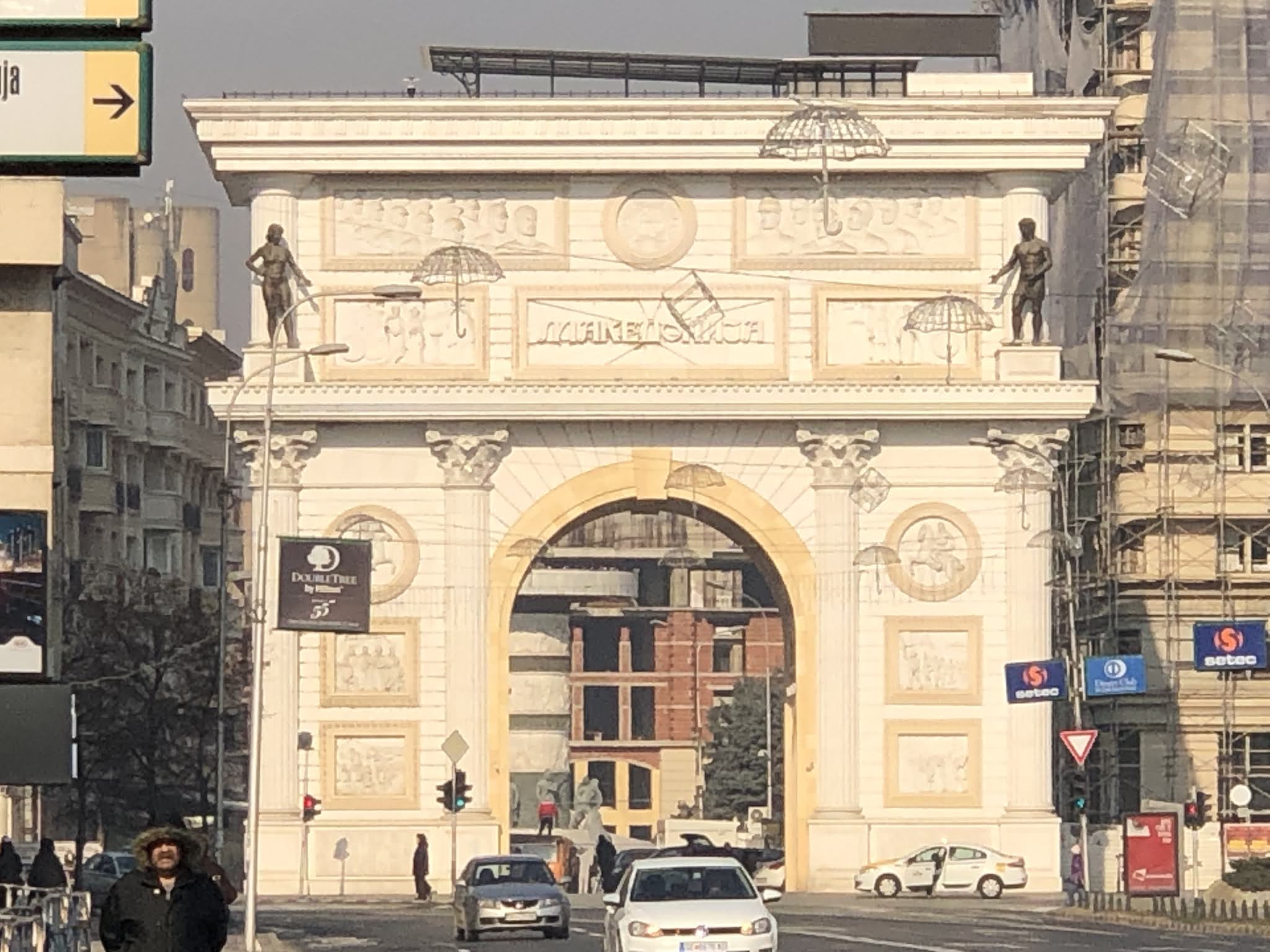
There's now a triumphal arch called the Porta Macedonia that commemorates the long struggle for Macedonian independence.  It was opened to the public in 2012 and cost an estimated €4,5 million.

A statue went up in front of the parliament building that cost €715.000.
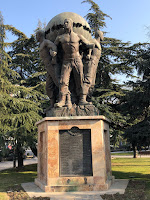
Across from the parliament is Žena Borec Park which got several monuments.  The Defenders of Macedonia cost around €300.000

The monument for the Anti-Fascist Assembly for the National Liberation of Macedonia (ASNOM) was €1,9 million.

The statue of the Founders of the Internal Macedonian Revolutionary Organization cost €1,2 million.

The Fallen Heroes of Macedonia memorial is home to an eternal flame.  This one cost €2,3 million.

The statue of Pitu Guli was a bargain because it was just €118.000.

The Museum of the Macedonian Struggle for Statehood and Independence opened in 2011.  The cost of the museum was around €10 million.

The statue of Karposh, the rebellion leader cost €540.000.

The Macedonian National Theatre replaced the former one which was destroyed in the 1963 earthquake that levelled the city.  Reconstruction of the theatre actually began in 2007.  The cost of reconstruction has been estimated to have been between €6 million and €30 million.

The Boatmen of Thessaloniki, also known as the Assassins of Salonica, cost €970.000.


The marble monument of Justinian I was unveiled in 2011.  It cost over €1 million.
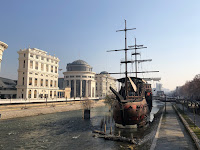

Four boats have been permanently built into the riverbed of the Vardar River.  The boats are used for restaurants and cafes.


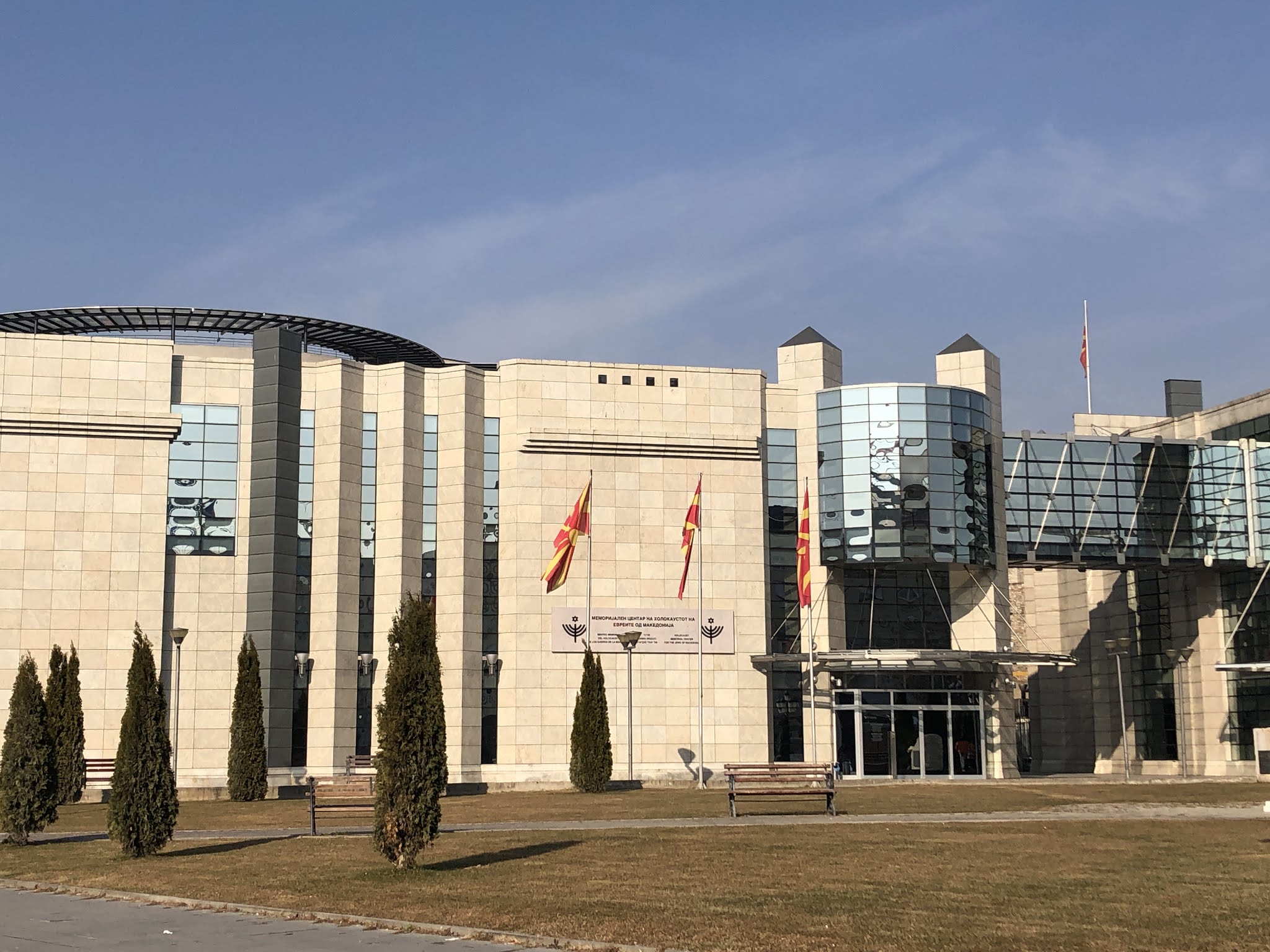
The Holocaust Memorial Centre for the Jews of Macedonia is a memorial for the 7.148 Macedonian Jews who perished in WWII.


The city purchased 202 double-decker buses for its transportation system.  Who knows what that must have cost?
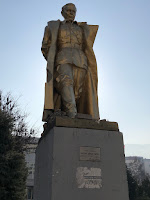
It's not like the city didn't have any monuments before.  I did come across an old statue of Tito.

This whole Skopje 2014 project was massive.  Something like 136 structures were built at a cost well over €800 million.  It's amazing to me that the country spent so much on this.  It's not like this isn't the 6th poorest country in Europe.

Update:  Here's a video I found out on YouTube that talks about the money spent on Skopje 2014.

©Journeyman Pictures

Wednesday, January 22, 2020

Increased Parental Benefits

Last year the government passed an amendment to the parental leave law and as of January parental benefits have increased.  The biggest change is that the total amount of money parents are eligible for has been increased.

For a single child under four years of age the amount increases from 220.000 Kč to 300.000 Kč ($9852 to $13,435).

For multiple children (twins, triplets, etc.) under the age of four then the amount increases from 330.000 Kč to 450.000 Kč ($14,778 to $20,152).

This new larger total amount is still paid out over two, three, or four years.

The government has increased the maximum amount of time that children younger than two years of age can be in kindergarten/preschool while the family receives parental benefits from the state.  

The logic was that if the state is paying for a parent to be at home with the kid then the parent should be at home with the kid.  So there was a limit was 46 hours per month.  The new limit is 92 hours per month.

Monday, January 20, 2020

Gymnázium

A friend's daughter is applying for gymnázium which is a comprehensive school that prepares students to go on to university study.  Basically it's a Czech high school but there are several different flavours so here's a bit about secondary education here in Czechland.

First comes základní škola, basic school, which is compulsory.  Students enter the 1st grade at the age of six.  Basic school has two levels.  The first level is grades 1-5 and the second level is grades 6-9.  Students then have a few different options.  For students wanting to study music, dance, drama, or art then they have the option to study at a conservatory.

There are vocational and trade schools, which often include apprenticeships, and students graduate with certifications allowing them to enter the work force.  Typical fields include electrician, carpentry, plumbing, mechanics, hotel management, and culinary arts.  These graduates will not be able to later on apply for university.  

Some students will attend a lyceum which is a kind of professional high school.  It is similar to a vocational school where students learn skills to a specific profession but it includes general academic subjects like history, geography, foreign languages, etc.  There are lyceum for business, health care, IT, technical engineering, and education.  Students graduate with a maturita (a high school diploma) that qualifies them to be able to find a job in their field.  Students are also qualified to pursue advanced studies if they want to but they don't qualify to enter university.

Then there's the gymnázium.  This is a comprehensive school with the sole focus of preparing students to enter university.  The curriculum is tough but when students graduate with a maturita they aren't qualified for any kind of work.  They are just ready to enter a university and begin a degree programme.  A bachelor's degree is 3 years, law is 3 or 4 years, and medicine is 5 years.

Traditionally, after the 9th grade, students would enter gymnázium for four years.  Remember that the Czech education system goes to the 13th grade.

The competition for university has increased and now students have the option of starting gymnázium after the 7th grade for a six-year programme or after the 5th grade for an eight-year programme.

Here's where it gets tricky.  First, you need to find the gymázium that you want to attend.  Although all students take every subject, some schools have more of an emphasis on mathematics and science while others concentrate more on humanities and languages.  Then there's the challenge that most gymnasiums only open up one or two classes (up to 30 students each) per year.  Potential students and parents are able to attend open days in November, December and January, to get a feel for which school is the best fit.  

Students' marks received in their previous two semesters of school are reviewed and they have to pass entrance exams. The entrance exams have three parts.  One section is on Czech language and grammar.  The second section covers mathematics and the third section covers Czech literature, history, social sciences and logic.  There is a state-wide two-day exam period every April.  

Some may also have an additional language requirement because I have friends who attended bilingual schools Brno where half of their subjects were taught in either French, Spanish, or German.  While English is a popular foreign language I don't know if there are any bilingual Czech-English schools here in Brno.  

Applications to gymnáziums have to be submitted by mid-March.  Students can only apply to a maximum of two schools.  I believe that there is an application fee but I don't know how much it costs.  If a student doesn't get in then there is a second round of selections.  There is serious pressure on getting accepted to the best gymázium, both for the students and the parents.

Sunday, January 12, 2020

Ewa Farna

In preparation for my language exam I'm listening to more Czech music.  One of the Czech artists I have on my iPhone is Ewa Farna.

Ewa Farna is a Polish-Czech pop singer.  The first tip is that her first name is spelled in Polish.  The Czech spelling would be "Eva".

Ewa was born in 1993 in Vendryně, to a Polish family, near the Polish border.  She has dual-citizenship with Czechland and Poland.  In 2004 and 2005, she started winning local talent competitions in Czechia and Poland.

In 2006, at just 13, she released her first studio album called "Měls mě vůbec rád" (Did You Even Like Me).  The song hit #3 here, the album went platinum, she won a Český slavík for best new artist and became the the youngest commercially successful singer in Czechland.

She's released four studio albums in Czech and five in Polish.  Her albums have gone gold and platinum in both countries.  In 2013 she was a judge on Czech & Slovak SuperStar.  She's also been a judge on Poland's versions of X Factor and Idol.

One of my favourite songs is Na ostří nože (On the Edge of the Knife).  Here's the music video for it that I found out on YouTube.

©Universal Music Group

Saturday, January 11, 2020

Czech Citizenship Exam: Art From the Middle Ages to the Present

Here are the 10 study questions for the Czech Citizenship exam from section 30: Art from the Middle Ages to the Present.

1.  Which important Prague Jewish monument is in the picture?

Old-New Synagogue.

2.  In which picture are Prague Castle with the Gothic St. Vitus Cathedral - symbols of Czech statehood?

3.  In which picture is the National Theatre in Prague?

4.  In which picture is Karlštejn Castle, founded by Charles IV?

5.  In which picture is the Petřín lookout tower in Prague?

6.  In which picture is the Gothic church of St. Barbara in Kutná Hora?

7.  Who does this statue represent in Vítkov, Prague?


Jan Žižka.

8.  Which Prague museum is in this picture?


The National Museum. 

9.  The astronomical clock is a medieval clock on the tower.  In which picture is the Prague Astronomical Clock? 


10.  The picture shows the famous Prague building in the Art Nouveau style.  What is this building for?

It's a train station.