Showing posts with label Czech TV. Show all posts

Monday, June 26, 2023

78th International Folklore Festival

We spent the weekend in Strážnice with Kája's family.  Every year, Strážnice hosts the International Folklore Festival, the largest and oldest folklore festival in Europe.  

Czech TV even broadcasts it across the country.  This year was the 78th edition. 


The festival is organised by the National Institute of Folk Culture which is part of the Ministry of Culture. 


The festival includes dancing, music, and various competitions for both children and adults.  This year there were over 31.000 visitors who came to see 3.150 performers from across the country.


There were another 230 performers that came from Slovakia, Hungary, the Netherlands, South Korea, and the USA.


The first festival was in 1946 and it was only for ensembles from across Czechoslovakia.  In 1957, the first foreign folklore ensembles participated.  The festival is for both amateur and professional groups.

On Saturday, there was a parade that proceeded to the open-air museum and stadium.

It was pretty interesting.  It's interesting to see how each region and village's traditional costumes vary.

Saturday, February 25, 2023

2023 Czech Eurovision Entry

Česká televize recently decided on this year's entry for Eurovision.  From 2 November to 8 December 2022, artists could submit their entry for 2023.  There were 170 entries received and the field was narrowed down to five which were announced in January.

The rules were that solo artists had to have Czech citizenship.  For group entires, the maximum number of members was six and at least one of the lead vocalists had to have Czech citizenship.  This citizenship requirement was a Czech thing because there's no Eurovision rule that says a contestant must be a citizen of the country being represented.  For example, Céline Dion won in 1988 competing form Switzerland even though she is Canadian.

This is the first year that the country will compete at Eurovision as Czechia instead of as Czech Republic.  This is also the first time that Czech TV organised a live broadcast to determine who would be selected by audience vote.  The vote was weighted as 70% for international voting and 30% by local Czech voting.  

Here are the five entries that battled it out on TV.


Up first was Maella with her song Flood.  The daughter of a jazz musician, she grew up in Prague but has been living in London for several years where she studied songwriting.

©Česká televize


Up next was Pam Rabbit with her song Ghosting.  She is Czech with Armenian roots and she competed at the 2018 Eurovision contest as a backup singer for Mikolas Josef.

©Česká televize

Up third was Markéta Irglová with her song Happy.  She's from Valašské Meziříčí and has lived in Ireland, the USA, and now in Iceland.  She won an Academy Award in 2008 for Best Original Song, Falling Slowly, for the film Once.

©Česká televize

Vesna performed fourth with their song My Sister's Crown.  Three of the six members of the group are Czech, with a Bulgarian, a Slovak, and a Russian.  Their song is about empowerment and pan-Slavic sisterhood with the lyrics in English, Czech, Ukrainian, and Bulgarian.   

©Česká televize

The final performer was Rodan with his song Introvert Party Club.  In 2021 he was nominated for Discovery of the Year 2021 and the music magazine Headliner included him amongst the 50 hopefuls of Czech music.

©Česká televize

A few weeks ago the results were in and Vesna won by a landslide.  Here are the results:
  1. Vesna - 10.584 points
  2. Pam Rabbit - 4.217 points
  3. Rodan - 1.995 points
  4. Markéta Irglová - 1.009 points
  5. Maella - 599 points
Czechland will compete in the first semi-final on 9 May.  Vesna will perform in the second half of the show.  Good luck Vesna!

Update May 2023: Vesna placed 10th at the finals.

Friday, January 6, 2023

Česko Slovensko má talent

Česko Slovensko má talent (ČSMT) is the Czech-Slovak version of the "Got Talent" franchise that is in some +60 countries. 

ČSMT first aired on 29 August 2010 and the tenth season finished airing a couple of months ago.

One of the moderators is Czech and the other is Slovak.  Both Czech and Slovak are spoken by the moderators, judges, and contestants.  

From what I understand, back in the days of Czechoslovakia, the evening news used to always be broadcast in both languages.  The first half was in Czech and the second half was in Slovak.  This was one of the ways that pretty much helped everyone to understand each other.  While Czech and Slovak are pretty close, the younger generations today, in both Czechland and Slovakia, have a harder time understanding the other language.  I wonder how many other shows there are out there that are broadcast in both languages.  

Here's a short clip from season 8 that I found out on YouTube.  The contestant plays clips from songs in several languages and holds up cards with similar sounding but incorrect lyrics.  I think it's pretty funny.

©TV Prima

Nikola Kusendová is a 15-year old from Slovakia who just won season 10.  Here's her winning performance.  

©TV Prima

Sunday, February 28, 2021

TV Licence Fee

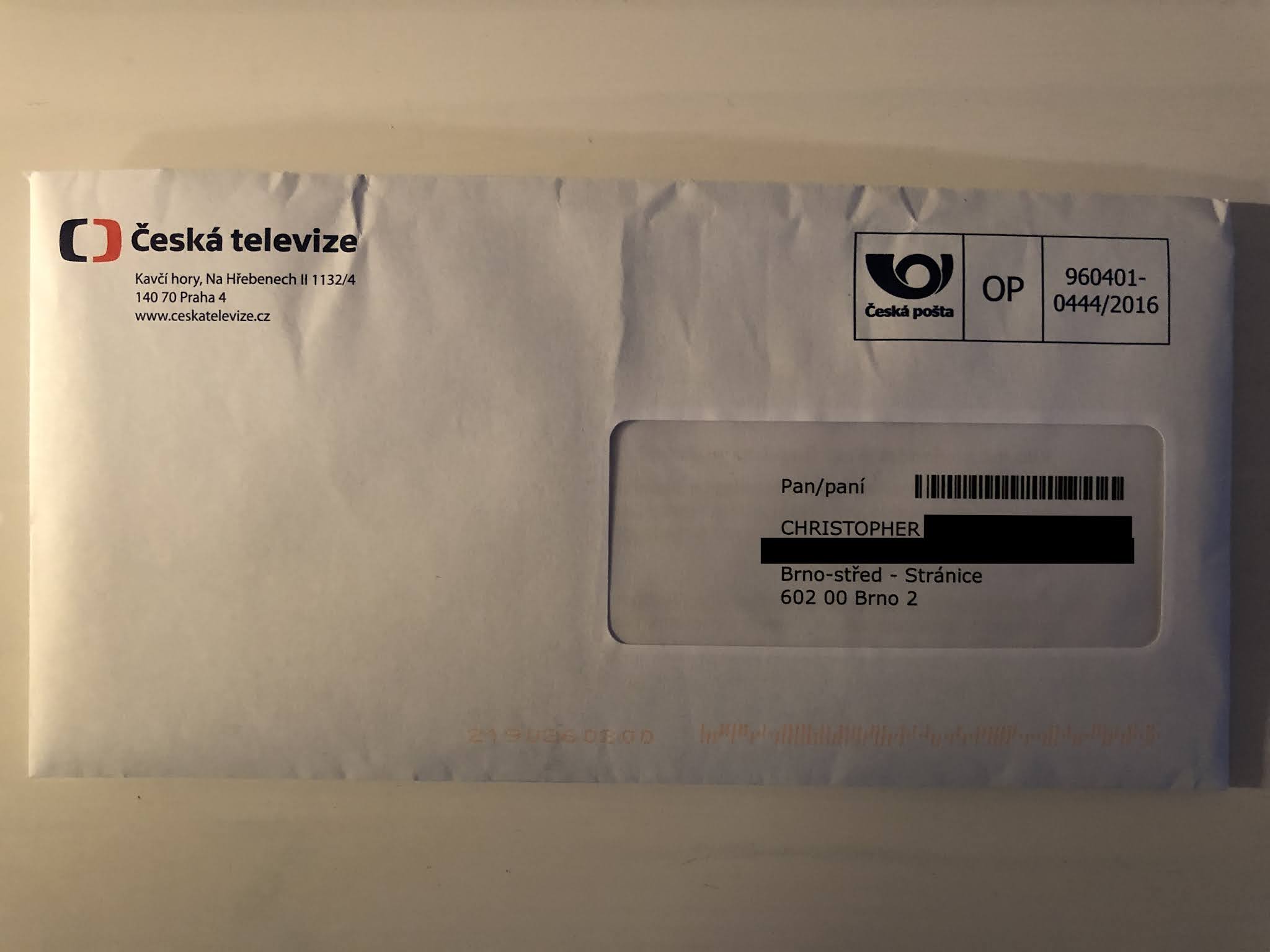
Last week I received a letter from Czech Television letting me know that I need to pay a TV licence fee.  I do own a television but I use it to watch Netflix, YouTube or AppleTV.  I don't watch Czech TV, I don't have cable or satellite service so what gives?  

Apparently every household that owns a television, whether you use it or not, is required to pay 135 Kč ($6 or €5) a month.  You have the option of paying monthly, quarterly or annually.

The money goes toward funding Czech Television (Česká televize) and Czech Radio (Český rozhlas).  Neither receives any government funding so the money received from licensing helps keep public broadcasting independent from political influence.

Every household is required to pay regardless of how many televisions or radios they own.  Business and the self-employed have to pay a licence fee for each television and radio owned.

Apparently they got my info from my electric provider.  A friend of mine in Prague received the same notification last week so I guess there's a push right now to collect.  TV licensing fees aren't a thing in the USA but they are normal in Europe with each country doing its own thing.  In Germany for example the monthly fee is €17,50 while there's no fee in Spain.

The letter I received did provide for the option of declaring that I don't own a television.  I really don't want to get in trouble for not paying my TV fee when I'm trying to apply for citizenship.  I just went online, paid the yearly fee and now I'm covered.

Friday, February 5, 2021

Vyprávěj

The Wonder Years premiered 33 years ago and depicted events from 20 years earlier.  A similar show today would be set way back in 2001.  I feel old. 

This American TV show ran on ABC for six seasons from 1988 to 1993. It is considered by many to the one of the top 20 best shows of the 1980s.

©ABC

The Czech equivalent is Vyprávěj, which translates to "Tell" and it aired on ČT1 from 2009 to 2013.  I'm told that it is one of the most successful shows on Czech television.  I'm currently watching series 1 online.

The show takes place in Czechoslovakia, and latter on in Czech Republic, and centres on the Dvořák family.  In each episode there are actual excerpts of the news and film from the time. 
©ČT1

The show ran for five series and there are 106 episodes.  Series one starts off in 1964 and series five ends in 2005.  The box set has 34 DVDs and is around 99 hours of content.  Let's see how far I get through series one considering there are no subtitles.
Side note:  In the USA, a TV show is referred to as a "series" but in Euroland it is a "serial" while an American "season" is called a "series."  So "season 1" in the USA is called "series 1" over here.  This took me a little bit of time to get used to.

Wednesday, February 5, 2020

2020 Czech Eurovision Entry

Eurovision 2020 is coming up in a few months and this year it will be in The Netherlands.   Last year, Lake Malawi came in 11th place which is the country's second best finish.  Mikolas Josef finished in 6th place in 2018 which is Czechland's best finish to date.

2020 will be Czechia's ninth shot at the Eurovision title.  Česká televize had received 152 submissions to be the country's official entry.  Interestingly, of the 152 entries, only 72 were from Czech musicians.  Somehow the 152 was whittled down to seven.  The selection process was made up of combination of an international jury panel of ten former Eurovision entrants and a public vote made on the official Eurovision Song Contest app.

Here are the results...

In 7th place is Pam Rabbit with "Get Up".  Pam Rabbit was born in Armenia and came in 4th place during last year's selection process.  In 2018 she was a backup vocalist for Mikolas Josef during the Eurovision finals.

©PamRabbit Official

In 6th place was Olga Lounová with "Dark Water".  She started acting in TV and movies in 1998 and she released her first album in 2011.

©Olga Lounova

In 5th place was Karelll with "At Least We've Tried".  Karelll isn't well known on the Czech music scene. However he was the first Czech to take part in the Los Angeles MUSEXPO.

©Karelll

In 4th place was We All Poop and their song "All the Blood (Positive Song Actually)".  The group formed specifically to compete in this year's competition.

©WeAllPoop

In 3rd place was Barbora Mochowa with "White & Black Holes".  She also came in 3rd place during last year's selection.

©Barbora Mochowa

In 2nd place was Elis Mraz & Čis T with "Wanna Be Like".  Eliška Mrázová reached the 2014 semifinals of Nova Hlas Česko Slovenska (The Czech-Slovak version of The Voice).  Čis T is a hip-hop artist from Bratislava who's released 13 studio albums.

©Elis Mraz

And 1st place went to Benny Cristo with his song "Kemama".  Benny Cristo is a Czech of Angolan descent and since 2013 he's had 11 top ten hits here in Czechia.  He's also a professional jiu-jitsu competitor and in 2009 he made the finals of SuperStar (the Czech-Slovak version of Pop Idol).

Here's the official Eurovision bio about him that I found out on YouTube.
©Eurovision

Here's Czech Republic's official entry for the 2020 song contest.  "Kemama" is short of "Ok mama" and the song is entirely in English.

©Ben Cristovao

Benny will perform in the second semi-final round on 14 May.  Fingers crossed! 🤞

Update:  Eurovision was cancelled this year due to COVID-19.

Thursday, December 5, 2019

CSFD.cz

CSFD.cz is the Česko-Slovenská filmová database - the Czech-Slovak film database.  It's basically the IMDb for Czech and Slovak speakers. 

ČSFD is an Internet database of films and television shows.  There is a social network aspect to it where fans contribute ratings and reviews.  There are more than 845.000 films in the database.

While there is more content on IMDb, I'm starting to use ČSFD a bit more.  Or at least I start off with ČSFD and use IMDb if I couldn't find what I was originally looking for.  There are some films on ČSFD that are not on IMDb and vice verse.  

ČSFD obviously has way more info on Czech and Slovak films and series.  It gives me the chance to see the Czech language movie trailers.  If it a trailer isn't in Czech then it's usually in English with Czech, or Slovak, subtitles.  

While IMDb went online in 1993, ČSFD began in 2002.

Sometimes the hardest bit is simply finding the name of a movie in another language because titles aren't always a direct translation.  Titles can differ due to specific cultural references or on how something may get marketed.

Taken in Czech is called 96 Hodin which translates to "96 hours".


The movie Bad Santa over here in Czechland is Santa je úchyl! which translates to "Santa is a pervert!"

Coming from Atlanta, where Margaret Mitchell wrote Gone With the Wind, I was surprised to find out that here it is known as Jih proti Severu which is "The South Against the North."

Sometimes the titles make more sense over here.  For example, the 2014 film about Alan Turing was called The Imitation Game in the USA.  Over here it was Kód Enigmy, "The Enigma Code" which to me made way more sense as the movie title. 

The translations aren't just a Czech thing.  I remember this one time that Claudia was telling me something about a movie in German called Schokolade zum Frühstück, "Chocolate for Breakfast."  

I had no idea what the hell movie she was talking about.  That's because in English it is known as Bridget Jones's Diary.

At least in Czech it is Deník Bridget Jonesové.

Sunday, May 26, 2019

Ondřej Brzobohatý

Ondřej Brzobohatý is a Czech singer, actor, composer, and TV personality.  I enjoy his music so, like Kryštof, I have several of his tunes on my iPod to help me improve my listening comprehension skills.

He is from Prague and is the son of Czech actor Radoslav Brzobohatý and Slovak actress Hana Gregorová.  In 2016, he changed his last name from "Brzobohatý" to "Brzobohatý Gregor" because he worked as a composer of music overseas.

In 2004 he was the moderator for Česko hledá SuperStar, the Czech version of the Idol series.  In 2012 he hosted the Český slavík, in 2013 he danced on StarDance...když hvězdy tanči, the Czech version of Strictly Come Dancing.  He 2014 he was a judge on X Factor.

As a composer he has written and produced songs for Karel Gott, Helena Vondráčková, Dara Rolins, Hana Zagorová, and Ilong Csáková.

In 2016 he married Taťána Kucharová who was the 2006 Miss World.

Here are a couple of his music videos from YouTube.  The first is And the Oscar Goes To.

©Ondřej G. Brzobohatý

Máme rádi jazz is a duet with Vojtěch Dyk, another popular singer here in Czechland.

©Ondřej G. Brzobohatý

Saturday, March 10, 2018

Český lev

Tonight is the 25th annual Český lev, Czech Lion, film awards.  The award is given by the Czech Film and Television Academy (ČFTA) and it is the local equivalent of the Oscar or a BAFTA award.  The first awards were in 1993.

A new version of the award was created to celebrate the 25th anniversary.  Each glass statue took about three days to create.

The award categories are:  Best Film, Best Documentary Feature, Best Director, Best Actress in a Leading Role, Best Actor in a Leading Role, Best Actress in a Supporting Role, Best Actor in a Supporting Role, Best Screenplay, Best Cinematography, Best Film Editing, Best Sound, Best Music, Best Stage Design, Best Costume Design, and Best Makeup and Hairstyling.

There are two television awards presented for Best Television Film or Miniseries and Best Television Drama Series.

There are also non-statutory awards for Best Film Poster, Award of Film Fans, and the Magnesia Award for the Best Student Film.

This year the films with the most nominations are Bába z ledu (Ice Mother) with 15 nominations, Po strništi bos (Barefoot) with 13 nominations, and Milada with 10 nominations.

Very much like the Academy Awards, I haven't seen any of the films that are nominated for awards.

Sunday, September 10, 2017

Spejbl and Hurvínek

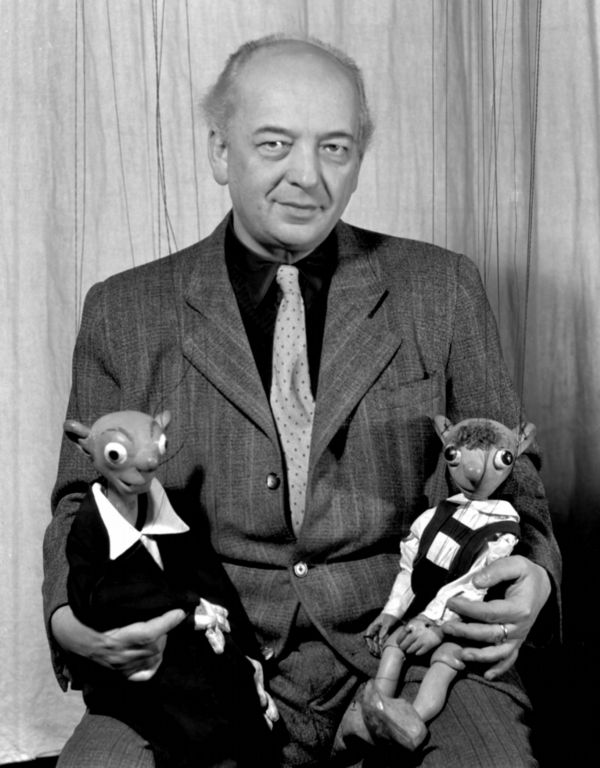
Josef Skupa, Spejbl and Hurvínek
Josef Skupa (1892 - 1957) was a Czech puppeteer whose characters have been entertaining children for over 100 years.  In 1930 he founded a travelling theatre in Plzeň which was the first professional puppet theatre in Czechoslovakia.

In 1943, the Gestapo closed the theatre and he was arrested for anti-fascist resistance.  In 1945, his Nazi prison in Dresden burned down and he escaped.  Following the war in 1945 he opened the Spejbl and Hurvínek Theatre in Prague which is still open to this day.

Skupa's most famous characters are Spejbl and Hurvínek which were created in 1920 and 1926 respectively.  Spejbl is the foolish father and Hurvínek is his mischievous son.  They also have a dog, Žeryk, who is able to bark out words.  Other characters include Hurvínek's friend Mánička and her granny Mrs. Kateřina Hovorková.

Spejbl and Hurvínek have travelled to over 30 countries.  Albums, television shows and movies have been released.  Despite being over a century years old, the show still does a great job of showing the generation gap between parents and children.

Here's an episode I found on YouTube called Únor bílý, pole sílí (White February, Fields Grow).  Spejbl, Hurvínek, and Mánička compete for the best snowman and first prize is a cake.


In August 2017, a 3-D animated film called Hurvínek a kouzelné muzeum (Hurvínek and the Magic Museum) was released.  Of course Tünde wanted to go see it.

Too bad kid's movies aren't subtitled.  Here's the movie trailer.


©Total Film 

Tuesday, May 10, 2016

Gabriela Gunčíková

Eurovision starts tonight and the Czechs are going for it again.  Gabriela Gunčíková will represent Czechland this week.


She is also known as Gabriela Gun.  2011 was a busy year for her as she came in second in Česko Slovensko SuperStar.  Then she placed seventh on Let's Dance which is the Slovak version of Dancing with the Stars.  (Strictly Come Dancing for all of my UK folks.)  She capped off 2011 by winning Best New Artist at Český slavík which are the Czech Grammys.

Last year the Czech Eurovision entry did not make it to the finals.  Let's hope for a place in the finals this year.  Her song for this year's competition is called I Stand and it is in English.  Here's the song which I found out on YouTube.

©Eurovision Song Contest

Update:  The Czechs finally make it to the finals!  Gabriela placed 9th in the first semi-finals with 161 points.  This Saturday she will compete in the grand final.

Update:  With 41 points, she placed 25th out of the 26 finalists.  At least Czechland finally made it to the grand final for the first time ever.  Let's see if they can make it again next year.

Thursday, September 3, 2015

Honey Ball?

So at lunch today someone asked me if I've seen the TV show "Honey Ball".  Honey Ball?  Nope.

No, she said.  "Honey Bell".  Honey Bell?  Nope.  I wondered if she was talking about "Honey Boo Boo" which believe it or not is shown on Czech TV. 

Well it turns out she was asking about "Hannibal".  She just said it with a thick Slovak accent. 

I've heard of the show but never seen it.  Just a little linguistic misunderstanding but it sure made for a fun lunch discussion.

Tuesday, August 18, 2015

Die Biene Maja

One of Tünde's favorite things is Die Biene Maja.

Maya the Bee debuted in a book in 1912 in Germany.  There have been comic books, an animated TV series and a movie was released in 2014.

Maja is obviously the main character and she goes on random adventures with her friends Willy the bee and Flip the grasshopper.

I had never heard of Maja before but apparently she is popular across the world.

In Czechland the show is Včelka Mája.  The original theme was sung by Karel Gott who released German, Czech, and Slovak versions.

Here's the Czech version that I found on YouTube.

Thursday, June 11, 2015

Bob and Bobek

Bob and Bobek are two rabbits that live in a magician's hat.  They are the main characters from a popular cartoon series that first appeared on Czechoslovak television in 1979.

There have been eight series and the episodes have appeared on večerníček (night time children's TV program).

Bob is the bigger rabbit and often takes the parental role.  Bobek (bobby) is the smaller rabbit and takes the child role.  They are clever and often get in and out of trouble.

Vladimír Jiránek is a well-known artist and illustrator who authored the series.

Bob and Bobek were even the mascots of the 2015 World Hockey Championships.

Here's a video of their adventure Na Koncertě that I found out on YouTube.

Wednesday, April 22, 2015

Ladislav Pešek

Ladislav Pešek was a famous Czechoslovak film actor.  He was born in Brno in 1906.  Back when Brno was still part of the Austro-Hungarian Empire.  He passed away in 1986 at the age of 79.

His real name was Ladislav Pech.  Although his parents were actors, and that he took to the stage at four years of age, his parents wanted him to pursue a solid profession.  He graduated from a two year commercial school but he still ended up at the Brno Conservatory.  He performed on stage with his parents so he took his mother's maiden name so that he would not be confused with his father.

When he was 23 he received an offer to join the National Theatre in Prague where he performed for nearly 50 years.  Between 1931 and 1984 he performed in more than 90 films and television shows.  His memoirs were published in 1977.

He was born on my street in Brno.  The house that he was born at has a plaque commemorating him.

Friday, November 15, 2013

Večerníček

Večerníček
Večerníček is a children's television program that has been on the air for 40 years.

Večerníček is shown every evening at 6:45 pm, when children are supposed to go to bed.  Each episode lasts five to seven minutes and there are usually 10 to 20 episodes per show.

Sandmännchen
It is also shown in Slovakia.  Prior to 1993, both Czech and Slovak versions were shown in Czechoslovakia.

In East Germany, the children watched Sandmännchen (the Sandman).  He too is still popular in Germany.

The Večerníček website has lots of videos online that you can watch.  Here's a sample video, from 1983, that I found out on YouTube.


©ČT

Thursday, December 23, 2010

Popelka

It's Christmas time in the ČR which means that there are lots of Czech fairy tales on TV. One of the favorite stories shown during Christmas is the 1973 film Tří Oříšky pro Popelku, Three Hazelnuts for Cinderella. Popelka is the Czech Cinderella.

I never knew that there were different versions of the Cinderella classic. In this version by Božena Němcová, there is no fairy godmother and there is only one wicked step-sister. Popelka finds some magic hazelnuts and receives three wishes. This Cinderella is a little more independent and does not simply fall in to the the prince's arms. Here, he has to actively pursue her.

The interesting thing about this film is that it was made as a joint venture between Czechoslovakia and East Germany. Czech and German actors spoke in their own language and the content was dubbed into either all Czech or all German for distribution.

The story is cute and I found a copy on DVD for 50 Kč (~$2.50) that has both English and Czech subtitles so I can use it to practice my Czech. Here is a clip of the film that I found on YouTube.

Update:  In East Germany the movie is called Drei Hasselnüsse für Aschenbrödel.  So in the east, Cinderella is "Aschenbrödel" but in the west she is called "Aschenputtel."

Monday, February 15, 2010

Czech Television

It's Olympic time and I'm not able to watch like I normally would. First of all, there's the 9 hour time difference between Vancouver, Canada and the Czech Republic. And because of international copyright laws, etc., I can't watch U.S. coverage on NBC.com from Europe.

There's also the fact that everything on TV here is in Czech. I still haven't got the full low-down on Czech TV but here's a couple of things. Most of the shows are shown with very few, if any, commercials. It looks like the commercials are shown between shows.

The start times are just odd to me. Granted the times are all listed in military time but that's not the odd part. It's the air times. In the U.S., shows all start on the hour or the 1/2 hour. But not here. It's not uncommon for shows to begin at five or ten minutes past or even twenty minutes till.

I don't quite get the 18:49 start time. Why does a show start at 6:49 PM?

My Czech teacher wants me to start watching more Czech TV to improve my listening skills. Maybe it will also help me understand why some programs have such unusual air times.