Showing posts with label Traditions. Show all posts

Monday, June 26, 2023

78th International Folklore Festival

We spent the weekend in Strážnice with Kája's family.  Every year, Strážnice hosts the International Folklore Festival, the largest and oldest folklore festival in Europe.  

Czech TV even broadcasts it across the country.  This year was the 78th edition. 


The festival is organised by the National Institute of Folk Culture which is part of the Ministry of Culture. 


The festival includes dancing, music, and various competitions for both children and adults.  This year there were over 31.000 visitors who came to see 3.150 performers from across the country.


There were another 230 performers that came from Slovakia, Hungary, the Netherlands, South Korea, and the USA.


The first festival was in 1946 and it was only for ensembles from across Czechoslovakia.  In 1957, the first foreign folklore ensembles participated.  The festival is for both amateur and professional groups.

On Saturday, there was a parade that proceeded to the open-air museum and stadium.

It was pretty interesting.  It's interesting to see how each region and village's traditional costumes vary.

Wednesday, March 8, 2023

2023 International Women's Day

International Women's Day isn't a public holiday here in Czechland but it is a significant day.


This year's campaign theme is #EmbraceEquity and the goal is to get the world talking about Why equal opportunities aren't enough because people start from different places, so true inclusion and belonging requires equitable action.


It's traditional here in Czechland to give flowers on IWD.  Thanks to some of the ladies that help keep me on track every day.

Thursday, January 6, 2022

Feast of the Three Kings

The Feast of the Three Kings, or the Epiphany, is on 6 January and it officially marks the end of the Christmas holidays.  Even though the last Christmas public holiday is 26 December for St. Stephen's Day

If you haven't taken down your Christmas tree yet then today's the day to do it.

The day commemorates the adoration of baby Jesus by the three kings Balthazar, Caspar, and Melchior, who brought gifts of gold, frankincense, and myrrh.  

The tradition is to write on a door frame, in white chalk, the initials "K + M + B", the initials of the three wise men.  In Czech it's Kaspar since the "K".  And the little "plus" isn't a plus sign, it's a Christian cross.

Out on YouTube I found the traditional Czech Christmas song My tři králové jdeme k vám (We Three Kings are Coming to You).

Friday, December 31, 2021

Dinner For One

Dinner for One, or Der 90. Gerburtstag (The 90th Birthday), is a black-and-white television comedy sketch that was released in 1963.  It was adapted from a British stage skit that was performed by Freddie Frinton and May Warden.

It enjoys cult status in Germany and is shown every year for New Year's.  Since 1995, it is the most frequently repeated television programme in Germany ever.  It is also very popular in Austria and Switzerland, plus in Scandinavia - Denmark, Sweden, Norway, and Finland.  Despite coming from the UK, it wasn't broadcast there until 2018.  

What's remarkable about the show is that despite it being broadcast in English, and without subtitles, it is still tremendously popular.  Even Germans who can't speak English will still usually be able to quote lines from the comedy in English. 

The basic premise is that Miss Sophie is celebrating her 90th birthday and, as in every other year, invited her four closest friends.  Unfortunately, she has outlived everyone so her butler, Mr. Winterbottom, gives a toast by proxy.  He gets tipsy and there's a bit of physical comedy.  All in good fun.

Here's a short Meet the Germans video that talks about this cult classic.

©DW Euromaxx

Here's the show which is out on YouTube.

Retro TV

Saturday, December 25, 2021

Czechs vs Santa Claus

Again, 24 December in Central Europe is Christmas.  In the USA, and the UK, the 24th is Christmas Eve and the 25th is Christmas Day.  In the UK, the 26th is Boxing Day which isn't a thing in the U.S.

In Czechland, and Germany, the 24th, the 25th and the 26th of December are public holidays.  Like all public holidays you hope that they don't fall on the weekend because then you lose the free day off.

In Germany, the 25th and 26th are Erster Weihnachtstag and Zweiter Weihnachtstag, respectively the First and Second Christmas Day.  The 26th is also Stephanstag (St. Stephen's Day).

In Czechland, the 24th is Štědrý den.  The 25th is první vánoční svátek and the 26th is druhý vánoční svátek, the First and Second Christmas Day with the 25th also called Boží hod vánoční (the Christmas Feast) and the 26th also being Svátek svatého Štěpána (St. Stephen's Day).

Today we started out with Oma's typical German breakfast.  This is coffee with fresh bread rolls, meats, cheeses, butter, home made jams, and hard-boiled eggs.

We went for a walk around town for a couple of hours and then just relaxed for the rest of the day.  There are always fairly tales on German TV and of course we had to watch Drei Haselnüsse für Aschenbrödel which is the German version of Popelka.  It's always on TV in what used to be East Germany.  It's not as popular in Western Germans.  Also for some reason, in the east, Cinderella is "Aschenbrödel" but in the west they say "Aschenputtel".

This afternoon Oma put out another Christmas feast.  

We had duck and goose, with potatoes and gravy, dumplings, red and green cabbage.  It was delicious!  

Dinner was way better with everyone here in Berlin than it was during last year's Covid Christmas where I joined them for dinner on Skype.

While we were celebrating Christmas last night with the Weihachtsmann it seems that the Czechs were fighting with Santa Claus.


On 24 December, NORAD (the North American Aerospace Defence Command) tracks Santa Claus' trip around the globe.  They've been doing this since 1955.

Řízení letového provozu ČŘ, Air Traffic Control of the Czech Republic, is responsible for the airspace above Czech territory.  They put out a video on Twitter that Supersonic Ježíček submitted his flight plan and was doing Mach 9 (11.113 km/hr or 6905 mph) through Czech airspace.

©ŘLP ČŘ

Remember that Santa doesn't bring the presents.  Ježíček does.  In the following video I found out on YouTube, the Czech military shoots Santa out of the sky and then tanks surround him.  At the end of the video there is a disclaimer that neither Santa or any reindeer were injured in the making of this video.  You'e got to love the dark Czech sense of humour.

©tvarmycz

The Czech police went even darker.  They put out a public service video to illustrate the dangers of driving while SMSing (texting).  In the video, Santa gets distracted while driving and has an accident.  The Czech police come to the rescue by taking over his delivery route.

©Policie ČR

Thursday, December 23, 2021

Getting Ready for Christmas

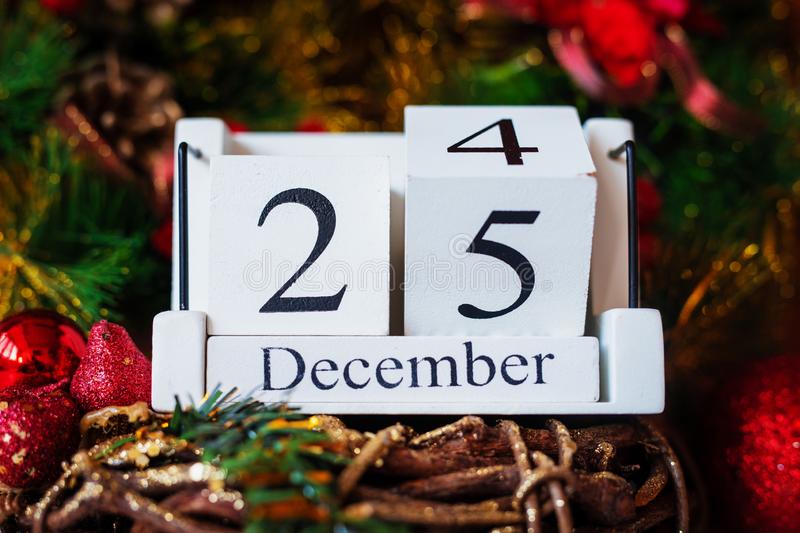
Tomorrow is Christmas over here in Euroland.  Sometimes people forget that this isn't my first Christmas in Euroland.  Tomorrow will be my 13th.  Maybe people assume that I fly back to the U.S. every year or something but without fail, someone will always point out to me that Americans celebrate Christmas on the 25th.  Which is true but not always.  

In the U.S., it's Christmas Eve which is still basically Christmas because in the USA we usually celebrate both.  As a kid, I remember going to one part of the family for Christmas Eve, the 24th, for a big dinner, presents, and usually midnight mass.  Then on Christmas Morning, the 25th, it was presents with the immediate family, and then lunch and presents with the other part of the family.  Nowadays, with so many people getting divorced and re-married it's not that uncommon for some kids to have two sets of parents and four sets of grandparents.  

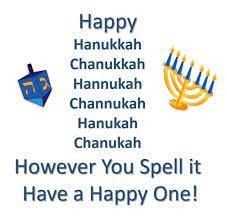
Let's not forget that not everyone celebrates Christmas.  I know many people who celebrate Hanukkah and some celebrate both which is Christmakkah or Hanumas.

There are a few more differences.  Americans put up the Christmas tree usually right after Thanksgiving and it stays up for over a month.  Some take it down around the 26th, or just after the New Year's.  Usually no later than the first weekend after New Year's.  Anything after that is tacky.  The same goes for outside Christmas decorations.  

Czechs, and Germans, normally decorate the Christmas tree during the day on the 24th.  Sometimes the day before.  Claudia's mom finished decorating the tree this morning.  The tree will say up until 6 January for the Feast of the Three Kings which ends the Christmas holidays.

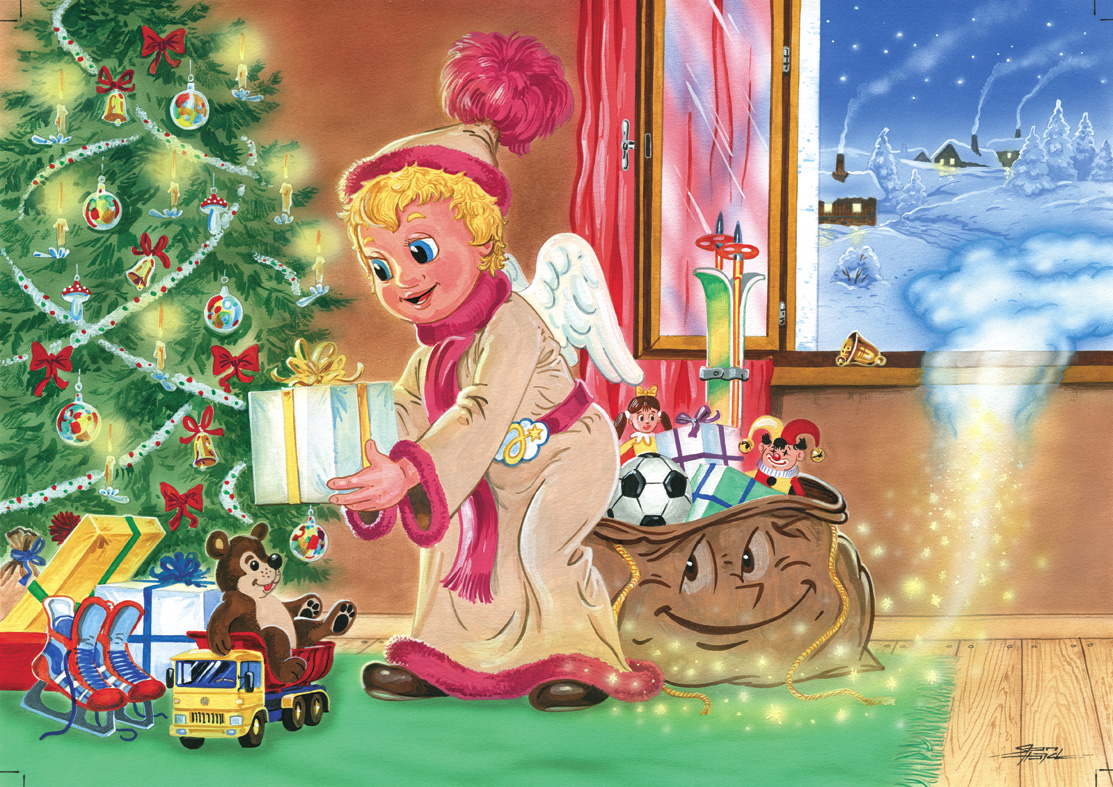
In Czechland it's Jezíšek, and in Slovakia it's Ježiško, Little Baby Jesus, that brings the gifts.  It's the same in parts of Germany (and Austria) where it's the Christkindl who brings the gifts.  In other parts of Germany, we wait for the Weihnachtsmann, Father Christmas.  Tünde is excited about der Weihnachtsmann coming tomorrow.  She's planning on singing four or five songs for him.

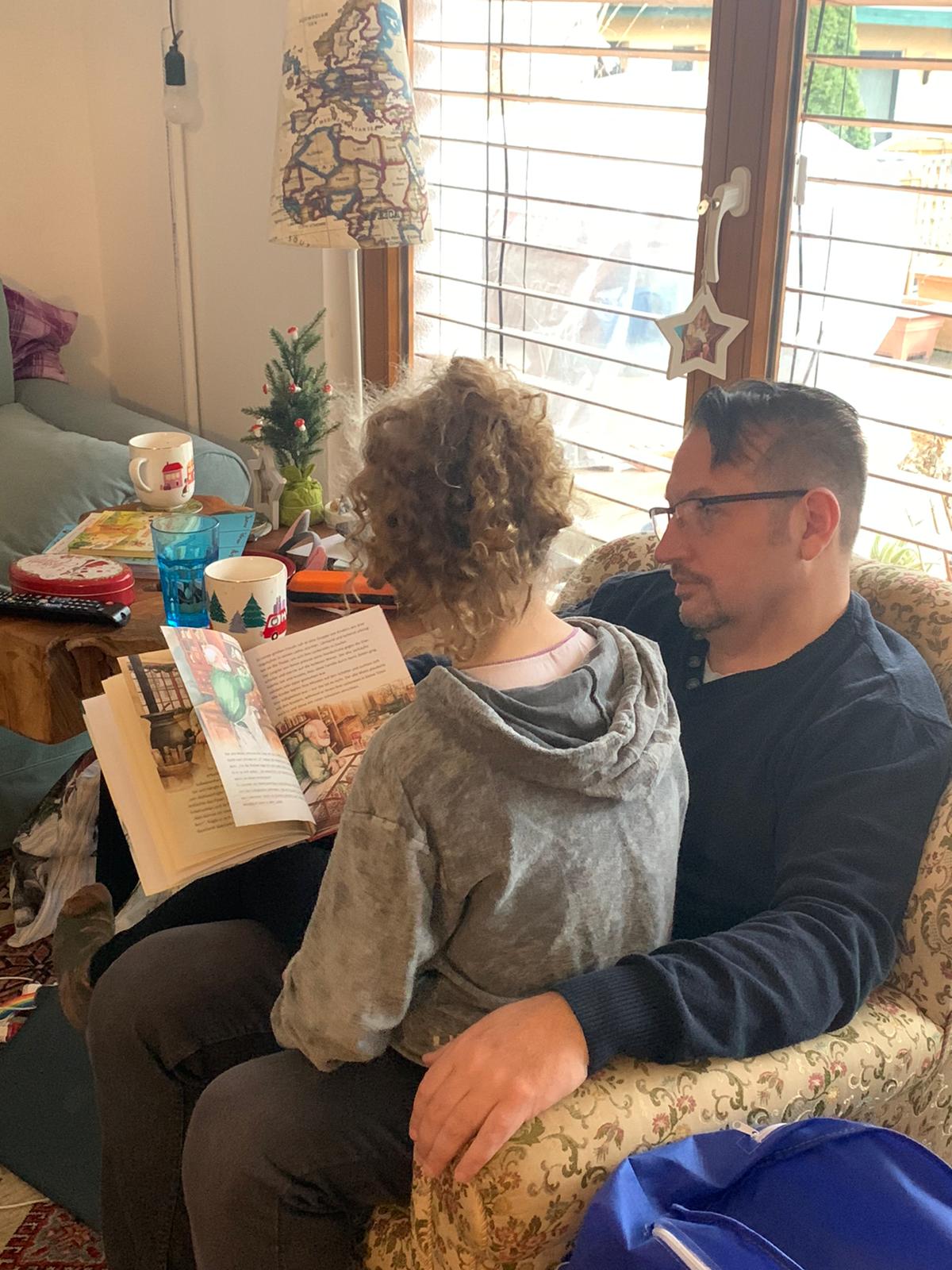
Today Tünde read me a Christmas story called Das Geheimnis der Zuckerstrange.  It's the German version of The Candymaker's Gift which tells the story of how the candy cane was created.  I'd never heard it before but it's a cute story.

Somehow it was decided that I was making the Buletten for dinner tomorrow.  Buletten are traditional German meatballs made out of ground beef, ground pork, onion, breadcrumbs, salt, and pepper.  They are panfried but can then be eaten either hot or cold with good mustard.  I think that they turned out fine but we won't know until tomorrow.  Hopefully they will be better than the frozen Ikea meatballs I had last year.

Later we went to check out Dark Matter.  Maybe this was my reward for the Buletten.

Sunday, November 28, 2021

First Day of Advent & Hanukkah

Today is both the first day of Advent and the first day of Hanukkah.  Czechland is often described as one of the world's most atheistic countries.  I'm not hundred percent sure on the numbers but it's something like 75-80% of Czechs don't declare a religious faith in surveys or the census.  As far as atheism goes, Czechs are third in the world at 30%, behind China and Japan.  

Religion just isn't a big part of daily life here.  It's definitely not like in Poland where some 88% of the country identifies as Roman Catholic and the church is very much a part of the national identity.

Advent marks the countdown to Christmas.  It begins four Sundays before 25 December.  In most of Central Europe, Christmas is 24 December followed by the second day of Christmas and St. Stephen's Day.

Two different ways of counting down to Christmas are Advent wreaths and Advent calendars.  For the wreath, you light a new candle each of the four Sundays prior to Christmas.  This is what I'm doing this year because I won't put up a Christmas tree since I'll spend Christmas in Berlin again this year.


For kids, and many adults, Advent calendars are more fun.  Every day of December you eat a piece of chocolate.  I still send Advent calendars to my niece and nephew in California each year.

Claudia does her own version of an Advent calendar with Tünde.  Each day in December, Tünde unwraps a book.  Some are new books and some are Christmas themed books that are reused each year.

Hanukkah, or the Festival of Lights, is a Jewish holiday that celebrates the recovery of Jerusalem and the rededication of the Second Temple.  Hanukkah is observed for eight nights and days and candles are lit on a menorah.

It's not that uncommon in California for there to be mixed families where some member are Christian and some are Jewish so both holidays are celebrated.  Sometimes it's called Christmakkah or Hanumas.  This year Hanukkah began today at sundown.  

Happy Hanukkah and Happy First Advent Sunday!

Friday, July 9, 2021

No More Mandatory -ová

I've written before that Czech names can be a complex thing.  One of the key differences is that surnames don't always match up.  Due to some patriarchal rules for names, and the lovely Czech grammar that treats surnames like adjectives, a husband will have a different last name than the wife.  A mother will not have the same last name as her son while a father and daughter will also have different names.  

Mr. Novotný and his sons will be called Novotný while his wife and daughters will be called Novotná.  That's because Novotný is the grammatically masculine version and Novotná is the grammatically feminine version. 

Most of the time, the feminine suffix is -ová.  So Mr. Novák and Mrs. Nováková.  The -ová is so common that the Czech press adds -ová to women's names automatically.  For example, German Chancellor Angela Merkel is written as Angela Merkelová.

Personally, I still see it as odd that a parent and child don't have the same last name.  Czechs aren't the only ones to do this.  It's the same in all of the Slavic countries, and I believe the Baltic countries, too.

Until 2004, every woman in Czechland was required to adopt the feminine version of her husband's last name.  There were few exceptions allowed in order to avoid the whole -ová thing.  Foreign women marrying foreign men in Czechland were exempt.  Czech women who married a foreigner whose name ended in a vowel were also off the hook.  Czech citizens with permanent residence abroad or women who had plans to live abroad could also request not to get the -ová.  I don't know how much but there was a fee for this.

A proposed amendment to the Registry Act made it past the Chamber of Deputies, 91-to-33, that would give women the right to utilise the masculine version of her husband's name.  The Senate had 30 days to debate the topic and if passed it would go to the President to be signed in to law.  Well, it passed.  So most likely in January 2022, women can choose to take her husband's masculine-form surname.  So both spouses will have the same last name.

Grammatically the -ová indicates ownership.  So a woman either belongs to her husband or a daughter belongs to her father.  Some view this as kind of sexist and archaic.  Others just view it is tradition and important for Czech grammar.

In Czech every noun is either masculine, feminine or neutral.  So a last name needs to be either masculine or feminine.  The argument is that if you can't decline a last name correctly then this could lead to miscommunication.  

I have a Czech colleague who took her Czech husband's (masculine) last name a couple of years ago.  I need to ask her how she did it.  I do believe that their daughter has the -ová form.  She's said that it really hasn't been a problem other than a few times on the telephone when people stumble a bit thinking the last name is an -ová when it isn't.

A few things that I found out...

  • The mandatory -ová thing is relatively new.  It only became mandatory in 1945.
  • Slovakia allowed women to decide on the -ová suffix several years ago.  The vast majority of women still go with the feminine form.
  • Poland also gave women the right to decide on the -ová suffix a few years.  It wasn't that disruptive.
  • Men can take their wive's name but they only get the masculine version.  There's no -ová for men.
  • If someone wants to change a surname then there is a 1000 Kč (~$47) fee.  The fee is waived following a divorce or a sex change.
  • A person can change their first name if the name is "derogatory, eccentric, ridiculous, distorted, or foreign".  The fee is 100 Kč (~$5).

I get how this all applies to women when they marry.  I don't know if the -ová thing will still apply when a child is born.  Can the parents now decide if their newborn daughter will take the -ová form or not?

Tuesday, December 22, 2020

Carp Time

It's carp buying time.  

Pandemic or no pandemic, nothing is going to get in the way of Czechs getting carp for Christmas dinner.  Going on 12 years here and I still can't get behind fried carp and potato salad for Christmas.

I still haven't decided what I'm going to have for dinner.  Something easy for sure since it will just be me.  Like the virtual Thanksgiving, this is going to be a virtual Christmas dinner.  

Tuesday, December 10, 2019

Czech Citizenship Exam: Customs & Traditions

Here are 10 possible questions and answers I need to study for the Czech Citizenship exam.  This is from section 1: Customs and Traditions.

These are the questions in English however the exam will only be in Czech.  

1.  What day is the start of the Czech calendar?  

The 1st of January.

2.  What is the name of the pre-Christmas holiday season?

Advent

3.  An Easter egg is an egg that is dyed and decorated.  When do women and girls give Easter eggs to men?

At Easter - Velikonoce.

4.  Which national holiday is celebrated in the Czech Republic in autumn?

The Struggle for Freedom and Democracy Day.

5.  Good Friday is a holiday that commemorates the death of Jesus Christ.  Which holiday season does Good Friday belong to?

Easter

6.  The memory of the deceased is popularly called Dušičky in the Czech Republic.  It is a day when, according to Czech tradition, graves are decorated with flowers, candles are lit and the dead are remembered.  What time of year is this holiday celebrated?

In the autumn.

7.  What food is usually eaten in the Czech Republic for Christmas Eve dinner?

Fried carp.

8.  On what day do Czechs usually give Christmas presents?

24th December.

9.  According to tradition, who brings presents for Christmas in the Czech Republic?

Ježíšek - Baby Jesus.


10.  Which holiday ends the Christmas season?

The Three Kings.

Sunday, December 16, 2018

Louskáček 2018

This is my 1500th blog post!  I still don't seem to be running out of material.

Yesterday was our annual Christmas tradition to go see Louskáček.  We missed it last year because the Janáček Theatre was still closed for renovations and the performance was washed out in Berlin.


The Janáček Theatre is the biggest theatre in Czechland.  It was built in 1965 and was the largest and best-equipped theatre in Czechoslovakia.  It then cost almost 100 million Czechoslovak Crowns but I have no idea how much that translates to today.


It is primarily used for ballet and opera and besides Louskáček, I've seen a few over the years.  The theatre has been closed for over a year for renovations that cost more than 750 million Kč (~ €29 million / $34 million).

The performing arts in Brno really are top drawer.  Every time there's a performance at Janáčkovo you'll see Austrian tour buses lined up because so many people from Vienna come up for shows that are way less expensive than in Austria.

The renovations look great.  I believe that there is still some ongoing projects behind the scenes which should complete by April 2020.

After the show it was time to stop by the Christmas Market to see the tree.  This was a brief stop because the market was so packed with people and because it was just so dang cold.

Wednesday, December 5, 2018

Mikuláš 2018

It's Mikuláš time again.  So we made sure to pass out candy at work today.

How is already Mikuláš time again?  This year has gone by so quickly.  It's true what they say, as you get older time goes by faster.

Friday, December 23, 2016

Merry Christmas!

Today's the last day to buy the traditional carp for Christmas dinner.

This is also the last working day before the three Christmas holidays so I'd like to wish my very international team a very Merry Christmas.


Merry Christmas!  Veselé Vánoce!  Veselé Vianoce!  Selamat Hari Natal!  Boldog Karácsonyt!  Wesołych Świąnt!  Geseënde Kersfees!  Crăciun fericit!  Gëzuar Krishtlindjet!  Весела Коледа!  圣诞节快乐!  Nollaig Shona!  Buon Natale!  क्रिसमस की बधाई!  Feliz Natal!  Maligayang Pasko!  عيد ميلاد سعيد!  Priecīgus Ziemassvētkus!  Linksmų Kalėdų!  С Рождеством!  ¡Feliz Navidad!  Chúc Giáng Sinh Vui Vẻ!  З Різдвом Христовим!  மெர்ரி கிறிஸ்துமஸ்!

Monday, December 5, 2016

Mikuláš 2016

The Christmas season has begun which means it's time for Mikuláš to show up.  Every year a few of us go around the office giving out candy.

I've been the angel but I think it's more believable for me to be the devil.  Sooner or later, I may actually have to be Mikuláš. 

Wednesday, March 23, 2016

Sokol

Sokol is a Czech sports community that was founded in Prague in 1862.  Sokol is the Czech word for "falcon".  The Sokol movement is based on the principle of a "strong mind in a sound body".  Not only physical education, but moral training was also provided.  The courses were originally opened to men and later were opened to women as well.  Sokol is kind of a version of scouting.

Sokol Brno I
The Sokol movement became popular and spread to Poland, Slovenia, Serbia, Bulgaria, Ukraine, Belarus, Croatia and the Russian Empire.  In 1865 Czechoslovak-Americans started the American Sokol Organisation in St. Louis, Missouri.

Sokol was banned during WWI as being seen as fostering nationalism.  It was banned again prior to WWII when the Nazis occupied Czech lands.  The communists banned them again after 1948.  Sokol was revived again in 1990.  Today more than 190,000 people actively participate.

In Brno they offer floor hockey, rock climbing, fencing, table tennis, athletics, volleyball and gymnastics.  Every year Brno hosts an international Grand Prix competition.  Here's a video about Brno's Sokol out on YouTube.
©Brno Sokol I

Tuesday, February 2, 2016

Circumcision

OK, so here's a random topic.  Circumcision.  I'm not going to get in to the whole cut vs. uncut debate.  There are pros and cons to both.

What I will say is that male circumcision is way more common in the USA than it is here in Czechland.

©Wikipedia
According to the World Health Organisation (WHO), circumcision in the U.S., is between 20-80%.  It does vary by geographic region, religion and ethnicity.  If someone asked me I would say that at least +70% of guys in the USA are cut.  In Europe, most men are uncircumcised; probably around 80%.

This is also my biggest Czech language faux pas.  So many years ago someone at work used the phrase dělát opičky which translates to "making monkeys".  So if you are goofing off, or monkeying around, in Czech you are "making monkeys".  Later that evening I was telling my Czech teacher what I had learned.  I said it and I got a blank response.  So I said it again.  I tried to explain and said it again but the whole time she just had this confused look on her face.

Then all of a sudden she got it.  Dělat opičky.  Apparently I had really butchered the phrase.  When I asked her what I was saying she began to blush and explain that it was something for little Jewish boys.  Go figure!  I was saying Dělat obřizky...to perform a circumcision.  I never made that linguistic blunder again.

I told my mates at work what happened and they all fell out laughing.  This got us on the topic of "German war helmets" and "turtleneck sweaters" and it was rather interesting trying to explain that I am cut but not Jewish.  Who knew that over here I would be exotic?