Saturday, May 15, 2010

Hahn Airport, Germany

Ryanair is an Irish low-cost carrier that typically uses remote airports, as part of its business model, to keep down costs. When I went to Stockholm last year, Ryanair flew in to Skavsta Airport, near Nyköping, about 100 km (62.5 miles) south of the city. When we went to Milan, our plane flew to Bergamo which is about an hour away.

To get to Frankfurt am Main, Ryanair makes use of the Frankfurt-Hahn Airport. Despite its name, the airport is over 120 km (~75 miles) west of Frankfurt.

What's funny is that the last time I was here, I was in the U.S. Air Force and it was called Hahn Air Base. During the Cold War, Hahn was home to the 50th Fighter Wing as part of the U.S. Air Forces in Europe (USAFE).

In 1993, the base was turned over to the German government and they turned it in to a regional airport. Now the flightline has Boeing 737s instead of F-16 fighters. And who would have thought all of those years ago that a former NATO base would now be used for commercial flights to Prague?

At least for now...Ryanair announced last week that they are going to pull out of Prague this Fall.

Friday, May 14, 2010

Holy Week

Today is the end of Svatý týden – Holy Week. It’s also called Svaťák.

High school seniors need to pass the maturitní zkouška exam in order to graduate and move on to university. The written section is taken in April and the oral portion is taken in May. Seniors get the entire week off from school in order to prepare for the exams.

As part of Svaťák, students dress up in the craziest costumes they can find and go out begging for money to fund their graduation party. I’ve seen plenty of students, dressed up and out ringing bells. Unfortunately, I never had my camera with me when I came across them. I’ll have to post pictures next year.

My guess is that there are more students at home studying this week than there are out collecting money. But you never know.

Thursday, May 13, 2010

Flower Day

March 12th was Český den proti rakovině - Czech Day Against Cancer. Otherwise known as Květinový den (Flower Day). Volunteers, in yellow shirts, go around selling marigold pins for 20 Kč ($1). Each year the color of the ribbon changes and this year it's red.

This was the 20th year that Flower Day has been held. The emphasis this year is on prostate cancer since this has recently overtaken lung cancer here. The money raised goes towards prevention campaigns, supporting education, research and improving the quality of life of oncology patients.

According to the organization's statistics, every third Czech citizen becomes an oncology patient and of those, 75% die. These numbers seem really high to me.

Wednesday, May 12, 2010

Danube River

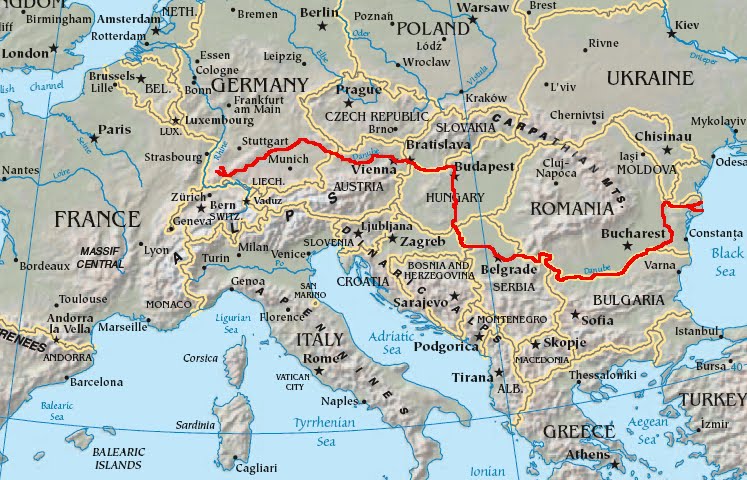
The Danube is Europe’s second longest river after the Volga. It starts in Germany’s Black Forest where the Brigach and Breg rivers join up at Donaueschingen. The river then flows eastward for about 2,850 km (~1,771 miles) before it empties into the Black Sea. There are around 300 tributaries.

The river flows through, or is part of the border, of 10 different countries: Germany, Austria, Slovakia, Hungary, Croatia, Serbia, Romania, Bulgaria, Moldova, and Ukraine. However, the river is not known as the Danube in any of these countries.

English uses the French word “Danube”. In Germany and Austria is the Donau, in Slovakia it is the Dunaj, in Hungary it is the Duna, in Croatia, Serbia and Bulgaria it's called the Dunav, in Romania and Moldova it called Dunărea and in Ukraine it is the Dunai. I still just call it the Danube.

The upper Danube is an important source of hydroelectricity and the lower Danube is a major avenue for freight transport. In 1992, a canal was completed on the Main River, linking to the Danube, allowing traffic to flow between the North Sea and the Black Sea.

The river is also an important water supply for irrigation and fishing. It contains 7 different species of fish that are not found anywhere else on Earth. It provides drinking water for over 10 million people, especially in Germany. However, the water is highly polluted in Austria and in Hungary; it becomes drinkable again in parts of Romania.


This summer I want to do one of the day cruises between Budapest & Bratislava or between Bratislava and Vienna. Here's a picture of the river in Budapest.
Most people are at least somewhat familiar with Johan Strauss' famous 1867 An der schönen, blauen Donau - The Blue Danube waltz which became one of the symbols of imperial Vienna.

Sunday, May 9, 2010

Budapest Liberation Monument

Szabadság Szobor, the Liberty Statue, is a prominent feature of Budapest’s cityscape.


The bronze statue is a woman, holding an olive branch, the symbol of peace, in her hands. The statue is 14 meters (46 feet) tall on top of a 26 meter (85 feet) pedestal. On both sides are statues. The one of the young man defeating the dragon represents the victory over fascism.

The stature was built in 1947 in remembrance of Hungary’s liberation from Nazi Germany by the Soviet Red Army. The memorial’s original inscription read “Erected by the grateful Hungarian Nation in memory of the liberating Russian heroes."


Of course, when the monument was first built it was considered liberation; not an occupation. But then the last Soviet troops didn’t leave until 1991.
After the 1989 transition to a democratic government the inscription was changed to “To the memory of all of those who sacrificed their lives for the independence, freedom, and success of Hungary."

Friday, May 7, 2010

House of Terror

The House of Terror is a museum on Andrássy út, about the fascist and communist regimes that ruled Hungary for over 40 years. It is also a memorial to the victims of the regimes.

After WWI, the Austro-Hungarian Empire was carved up and Hungary's territory was reduced by 2/3 rds. Hungary became central Europe's smallest and weakest state. In the 1930s, the country was caught between Germany and the Soviet Union. Hungary allied itself with Nazi Germany and 200,000 troops fought on the Eastern Front against Russia.

After heavy losses, Hungary tried to negotiate a cease fire with the Soviet Red Army. So the Germans took over and put in a puppet government run by the fascist Hungarian Nazi Arrow Cross party.

The Arrow Cross Party used the house as its headquarters. It was referred to as the "House of Loyalty". Political opponents were tortured and killed in the basement.

After the war, the brutal Arrow Cross government was replaced by two generations of Communist rule. From 1945 - 1956, the same building was used as headquarters for the Communist government's secret police - the ÁVO (later named the ÁVH).

In 1956 it became a clubhouse of sorts for the local Communist youth club. The last Soviet troops didn't leave Hungary until June 19, 1991.


In the museum's atrium is a Soviet tank and a huge wall covered with portraits of victims. There is also another wall with pictures of the victimizers. This museum is very well done and so much better than the Stasi museum in East Berlin.

Here's a Rick Steves video I found on YouTube about the museum.


©Rick Steves

Thursday, May 6, 2010

Hungarian Parliament

Országház, the parliament building, is the seat of Hungary's National Assembly and one of the oldest legislative buildings in Europe. The main façade faces the Danube River on the Pest side, but the main entrance is from Lajos Kossuth Square in front of the building.

After the Austro-Hungarian Compromise in 1867, a dual monarchy was created, Hungary began planning its parliament building. It was built between 1885 - 1902 in Gothic Revival style.

This thing is huge! It has 691 rooms, 10 courtyards, 27 gates, 29 staircases and over 12.5 miles of corridors. It is the second largest Parliament in Europe (3rd largest in the world). I didn't have time to take the inside tour but I definitly will next time.
The building is in the middle of a huge renovation project. They can't just pressure wash it because it destroys the stone. The back side of the building, facing the river, has been completed which is why the building looks white. The front side has not been completed yet which is why the stone is so much darker.

Wednesday, May 5, 2010

Budapest Chain Bridge

One of the iconic landmarks in Hungary is Széchenyi lánchíd (the Széchenyi Chain Bridge). It was the first permanent bridge across the Danube in Budapest. It opened in 1849 and is named after Count István Széchenyi.

The story goes that due to storms, the count was not able to cross the river to be with his dying father. He had to wait 8 days before he could cross and during this time, not only did his father die, but he also missed the funeral. He vowed to create a bridge linking Buda and Pest. It took almost 50 years, but when it was completed, the suspension bridge had the second-largest span in the world.

The pairs of lions at each end were added in 1852. It is an urban legend that the lions do not have tongues. They do, but they can only be seen from above and everyone looks at them from below.

At the end of World War II, the retreating German troops blew up all of the city's bridges, including the Chain Bridge on January 18, 1945, in order to slow down the Russian offensive. Only its pillars remained intact. In 1947 the decision was made to rebuild the bridge and it was completed on November 20, 1949 - exactly 100 years after its initial inauguration.

I saw a movie in 1989 that had featured the lánchíd and thought it would be so cool to see it one day. Well, it took me 21 years but I finally did it. The bridge seemed bigger in the movie but it was worth the wait.

Tuesday, May 4, 2010

Budapest, Hungary

A round-trip ticket, for the four hour train ride, from Brno to Budapest costs 1259 Kč (~$66). It is so worth it. Budapest is the capital of Hungary and is one of the most beautiful cities in Europe. With almost 2 million residents, about 20% of the entire country lives there.

In 1873, the cities of Óbuda (Ancient Buda) and Buda (both on the west side of the Danube), and Pest (on the east side of the Danube) were united and became Budapest. The city used to be the second capital of the Austro-Hungarian Empire until 1918.

There is a lot to see and do here. Way more than you can do in 1.5 days. I, for sure, have to go back soon. Here are some of the highlights of my weekend trip.
Buda Castle, completed in 1265, was home to Hungarian kings. Inside the castle is Hungary’s biggest library, the National Gallery and the Budapest History Museum. During communism, the government considered buildings like the castle to be symbols of the former regime. During the 1950s, the castle was gutted and the interiors were destroyed. Such a shame.

Near the castle is the lánchíd (Chain Bridge) which joins Buda and Pest. It was the first permanent bridge in Budapest that crossed the Danube River.


Hősök tere (Hero’s Square) is the major square. In the center of the square is the Millennium Memorial with statues of the leaders of the seven tribes that founded Hungary in the 9th century, plus other outstanding figures in Hungarian history. Construction on the memorial began in 1896 on the 1,000th anniversary of Hungarians coming to the area. It is surrounded by the Museum of Fine Arts and the Palace of Art. The square is at the top of Andrássy Avenue.

Andrássy út dates back to 1872. The wide boulevard is lined with Neo-renaissance mansions, the State Opera House, expensive boutiques, restaurants and theaters. It was recognized as a World Heritage Site in 2002.

Magyar Állami Operaház, the Hungarian State Opera House is a neo-Renaissance building, in central Pest, Andrássy út.

The House of Terror, located on Andrássy út, is a museum and memorial containing exhibits about Hungary’s fascist and communist governments.

Dohány Street Synagogue, is located in Erzsébetváros, in the city’s 7th district. It is the second largest synagogue in the world, after the Temple Emanu-El in New York City. The original synagogue was bombed by the pro-Nazi Arrow Cross party in 1939. The Germans used it as a radio base and as a stable during WWII. It suffered lots of damage from aerial raids during the war.

The Memorial of the Hungarian Jewish Martyrs resembles a weeping willow. The leaves are inscribed with the names of the 400,000 Hungarian Jews murdered by the Nazis.

The Hungarian Parliament is the 3rd largest in the world. It is the seat of the National Assembly. It is at Lajos Kossuth Square, on the bank of the Danube.


On the Pest side of the Danube, between Parliament and the Hungarian Academy of Sciences is a memorial to Jewish victims, who had to remove their shoes and were shot directly in to the Danube by, the fascist Arrow Cross militiamen.

Monument of the 1956 Hungarian Revolution. In 1956, there was a spontaneous nationwide revolt against the communist government from October 23 – November 10. On November 4th, Soviet troops invaded and over 3,000 people were killed while 200,000 people fled as refugees.


St. Stephen's Basilica is a Roman Catholic basilica and the neoclassical building is the city’s largest church. It is named for Hungary’s first king. Stephen’s mummified fist can still be seen there.

The Liberation Monument was erected in 1947 in remembrance of the country’s liberation from the Nazis by the Soviet Red Army during WWII. It is located on Gellért Hill, with an awesome view of the city.

Monday, May 3, 2010

Hungarian Language & Money

I went to Budapest this past weekend and this was my first visit to Hungary. The city was incredible!! I loved it and I know that I'll be back soon.

But I've got to tell you...the two things that made it a challenge were the language and the money.

Czechs here tend to find it very cool that I'm learning their language. But most other foreigners here wonder why I'm wasting my time with it because it won't do me any good outside of the ČR (or Slovakia). I just feel that since I live here, it's my responsibility to learn the language. I don't know if I would feel the same in Hungary.

Hungarian is unlike anything I've ever come across. Magyar is unrelated to most other languages in Europe. It's spoken in Hungary and by minorities in 7 neighboring countries. The alphabet has 44 letters. It's the only language that has both Ő and Ű, with double acute accent marks.

A, Á, B, C, Cs, D, Dz, Dzs, E, É, F, G, Gy, H, I, Í, J, K, L, Ly, M, N, Ny, O, Ó, Ö, Ő, P, Q, R, S, Sz, T, Ty, U, Ú, Ü, Ű, V, W, X, Y, Z, Zs

I'm pretty good with languages and can usually, at least, muddle my way through. Not here. I couldn't figure anything out. Look at just how different the days of the week are.

Monday = hétfő
Tuesday = kedd
Wednesday = szerda
Thursday = csütörtök
Friday = péntek
Saturday = szombat
Sunday = vasárnap

Hungarian is a highly inflected language in which nouns can have up to 238 possible forms. Fortunately, everyone in Budapest speaks English and/or German, really well.

The Hungarian currency is called the Forint. As a member of the EU, the long-term goal is to replace the Forint with the Euro. Depending on the economic situation, it looks like Hungary will convert sometime around 2014.

The Forint used to be divided into 100 fillér. However, due to inflation, fillér coins haven't been in circulation since 1996.

1 Ft = $0.004927
$1 = 200.39 Ft
1 Kč = 10.45 Ft

It was kind of a pain always having to figure out what everything cost in Dollars and Crowns. The coins come in denominations of 5, 10, 20, 50, 100 and 200 Ft. The notes come in 500, 1000, 2000, 5000, 10000 and 20000 Ft. It was like playing with Monopoly money.