Showing posts with label Czech/US Differences. Show all posts

Friday, July 21, 2023

Some Major California Sightseeing

We did quite a bit of sightseeing yesterday.  With mom, my sister Angela, and brother-in-law manual we showed Kája more of the LA/Hollywood touristy experience.  

The first stop was Union Station which is in the northeastern corner of downtown Los Angeles.  Union Station opened in 1939 was known as the "Last of the Great Railway Stations."  

The station is beautiful, combining Art Deco, Mission Revival, and modern styles.  In 1980, it was added to the National Register of Historic Places.


Union Station is the largest and busiest passenger rail terminal in the Western United States.  It is the 13th busiest train station in North America.  This also shows that train travel isn't really a thing in the USA.  Just the city of Los Angeles has about 4 million people but the station only serves about 110,000 passengers a day.  Brno has about 400,000 people and more than 65,000 passengers use hlavní nádraží every day.

Me & my sister


Across the street is Olvera Street.  It's a historic pedestrian street in the historic centre of the city.  There are plenty of street vendors and restaurants to check out.


Olvera Street is home to Ávila Adobe, built in 1818, which is the oldest standing residence in Los Angeles.


Olvera Street gets about two million visitors per year.  Some people don't care for it because it can seem touristy.  I like it because of the history; it was the historical city centre in both the Spanish and Mexican times prior to California being taken by the U.S.

Then it was on to the Warner Bros. Studio Tour.  Warner Brothers (WB) was founded in 1923.  It is one of the major American film, animation and television studios.


It's fun but expensive.  An adult ticket is $76 and the tour lasts about three hours.  You get to visit a soundstage and the backlot, which is where we got to sit on the Friends couch.


Some of the most popular sets we got to visit were from Friends and The Big Bang Theory, plus big exhibits for Harry Potter, Game of Thrones, and The Justice League.  


Barbie gets released this week so there was lots of promotion for the film.  I had to get a photo of the Kája Barbie doll, plus some video of him dancing around like Dobby the house elf.  

Saturday, June 10, 2023

2023 Global Peace Index

The 17th edition of the Global Peace Index was released.  The Institute for Economics and Peace (IEP) uses 23 qualitative and quantitative indicators across three different domains: Societal Safety and Security, Ongoing Domestic and International Conflict, and Militarisation.

For the 17th year in a row, Iceland maintains the top spot.  Here are the top 15 countries and the variance from last year's results.

  1. Iceland
  2. Denmark +1
  3. Ireland -1
  4. New Zealand +2
  5. Austria -1
  6. Singapore +4
  7. Portugal +1
  8. Slovenia -4
  9. Japan
  10. Switzerland +1
  11. Candada +2
  12. Czechia -5
  13. Finland +3
  14. Croatia +1
  15. Germany +2
Europe continues to be the most peaceful region, with 7 of top 10 countries.  Although Europe did go down in all three domains over the past year.  Mainly due to the Russian invasion of Ukraine, Europe is now less peaceful than it was 15 years ago.

I'm not sure what happened here in Czechland, with the five spot drop and falling out of the top 10.  But even in 12th place I feel much safer living in Euroland than anywhere else.

The USA remains at 131st place.  Behind Haiti and South Africa, but ahead of Brazil, Eritrea, and Palestine.

The USA recorded the 4th largest overall increase in its homicide rate, which is more than 6 per 100.000 people.  This is more than six times higher than most Western European countries.

The Middle East and North Africa is the world's least peaceful region.  

Ukraine dropped 14 places to 157, just ahead of Russia at 158.  Followed by the five least peaceful countries, with no change from last year.

159. Democratic Republic of the Congo
160. South Sudan
161. Syria
162. Yemen
163. Afghanistan

Я за Україну. Я за Україною. Слава Україні  Stojím za Ukrajinou!  I stand with Ukraine. 🇺🇦

Saturday, March 25, 2023

2023 World Happiness Report

This year's World Happiness Report is in and just like last year Europe continues to be the happiest place to be with Israel and New Zealand being the only non-European countries to crack the top 10.

Finland came in first place for the sixth year in row.  This year's top ten countries are the same as last year.

The five Nordic / Scandinavian countries all placed in the top seven with Finland #1, Denmark #2, Iceland #3, Sweden #6, and Norway #7.

The BeNeLux countries did well again too.  The Netherlands came in at #5, Luxembourg was #9, and Belgium was #17.

Czechland again was the highest ranked of the Visegrád countries.  Half of Central Europe placed in the top 20.

Switzerland #8, Austria #11, Germany #16, Czechland #18, Slovenia #22, Slovakia #29, Poland #39, and Hungary #51.


Czechland kept its #18 place from last year.  The USA moved up to #15 from #16.
This year Lithuania #20 cracked the top 20; bumping France from #20 to #21.
Here's a short CBS News video I found out on YouTube.

©CBS News

Given Russia's invasion of Ukraine, it's no wonder that neither country ranks as happy.  Russia came in at #70 and Ukraine ranked #92.

Я за Україну. Я за Україною. Слава Україні  Stojím za Ukrajinou!  I stand with Ukraine. 🇺🇦

Tuesday, November 29, 2022

2022 World Happiness Report

This year is the 10th anniversary of the World Happiness Report. by the Sustainable Development Solutions Network of the United Nations.  The report factors in things like gross domestic product per capita, healthy life expectancy, freedom to make choices, perceived corruption and social support from friends and family. 


For the fifth year in a row, Finland came in first place.

Scandinavia did well as usual with the five countries all placing in the top eight places.  Finland #1, Denmark #2, Iceland #3, Sweden #7 and Norway #8.

Switzerland placed #4.

The BeNeLux countries did well too with the Netherlands #5, Luxembourg #6, and Belgium #19.

Europe is the happiest region with the eight of the top ten spots.  The only non-European countries to crack the top ten are Israel #9 and New Zealand #10.

The USA placed #16 and Czechland placed #18.

Czechland continues to be the happiest of the Visegrád Four with Slovakia #35, Poland #48, and Hungary #51.

Last place goes to Afghanistan, behind Botswana, Rwanda, Zimbabwe, and Lebanon.

Thursday, November 3, 2022

Two Slovaks Murdered

Juraj Vankulič and Matúš Horváth

A couple of weeks ago, two Slovaks, Juraj Vankulič, age 26, and Matúš Horváth, age 23, were shot at the entrance of Tepláreň, a gay bar in downtown Bratislava on 12 October.  A third person, a woman was injured but she survived.

The shooting took place just after 19:00 and the local police initiated a manhunt.  The perpetrator was later identified as Juraj Krajčík, the 19 year old son of a far-right politician.  Prior to the shooting he posted anti-LGBTQ+ and anti-Semitic posts on Twitter.  He was found dead at around 7 am the next day.  He apparently committed suicide by shooting himself in the head.

The police began investigating the murder as a hate crime but deemed it an act of terror after it appeared that the killer was planning to target other people including the prime minister.

Slovak President Zuzana Čaputová and Prime Minister Eduard Heger posted messages of support on Twitter in both Slovak and English.

Rallies were held in Bratislava and also in Prague.

Slovakia offers less protection for gays and lesbians than Czechland does.  While sexual orientation and gender identity are covered with comprehensive anti-discrimination laws, it doesn't permit same-sex marriage or even civil partnerships.  Since 2014, Slovak law defines marriage as a union between a man and a woman.  However, due to the EU, the country does have to recognise same-sex marriages established abroad.

Here's a one-minute video I found on YouTube of the Slovak President addressing a memorial rally in Bratislava.

©news.com.au

Here's a 3,5 minute video about following the aftermath.  The video is only in Slovak but you get the idea.

©Refresher SK

Aside from the sheer horror of people being murdered for being gay, the other thing that stands out is that it involved a gun.  Over here a gun murder is big news because it just doesn't happen.  In the USA, this would be just another shooting.

The gun homicide rate in the the USA is way, way higher than in other high-income countries.  What I still don't understand is that if guns made people safer, then America should be the safest place in the world.

Sunday, September 11, 2022

WhatsApp

When I was in hospital I would give a daily update to my parents in Arizona, my sister in California, Claudia in Berlin, Natalie in Wellington, and Kája.  I couldn't use iMessage because Nat and Kája are Android users and everyone is on Apple.  I couldn't use WhatsApp because my parents and sister don't use it.  So I had to go old school and use SMS (text message). 

SMS is Short Message Service but in the USA we call it a "text message" and we use "to text" as the verb.

The USA is one of the few big countries where SMS remains the usual way to chat.  SMS/Text message travel over telephone lines rather than over the Internet.

If you use an iPhone then and you want to message someone else who also has an iPhone then you send them an iMessage.  The message goes over the internet.  If you want to message someone who uses an Android phone then you send them an SMS.

The benefit of SMS is that it works with any phone.  However, there are security flaws, you don't get notifications when the recipient has read your message and you can't start a video call from a text message.  SMS messages are up to 160 characters.

WhatsApp is a free instant messaging and voice-over-IP (VoIP) service that was purchased by Facebook in 2014 for $19.3 billion.  It's the most popular way to message people in most of Europe, Africa, Latin America and most of India.

It's heavily used across Europe.  Mainly because it's free.  In the USA, SMS is usually priced at a flat rate and most carriers include text messaging as part of your mobile package.  In Czechland, a single SMS is usually around 1 Kč (5¢) which over a month can add up to a good chunk of change.  On the other hand, most U.S. mobile providers charge a heavy fee for international text messaging.

To use WhatsApp you just need an internet connection.  With WhatsApp you're not limited to 160 characters per message, you can send images, videos, audio files and documents, there are read notifications when the recipient has seen the message, you can use it to video call, group chats and calls are no problem and it uses end-to-end encryption which means that only the sender and the recipient of the message can see its contents.  Plus, it's free.

Spain uses it the most.  Something like 90% of mobile users use WhatsApp.  In the USA, only about 1/3rd of users have downloaded the app.  I bet that a good chuck of the users have it to communicate with family and friends in parts of the world where SMS is expensive.

In China, WeChat is the go-to messaging tool while in Japan, Line is number one, and Telegram is popular in Russia.  WhatsApp is banned in China, North Korea, Syria, Qatar, and the UAE.

Here's a short video I found on YouTube that talk about why Americans don't use WhatsApp.

©Digital Trends

Saturday, September 10, 2022

Inflation in Czechland

The average gross monthly wage here in Czechland is 40.086 Kč ($1,860) which in the USA would be $22,320 per year.  By comparison the average monthly salary in the USA is $6,228 (134.248 Kč).

The 40.086 Kč is 4,4% higher that it was a year ago but once you factor in inflation, Czech wages have decreased in real terms by 9,8%.  Basically, people in Czechland are able to buy one-tenth less with the same wages that we earned a year ago.

Thursday, September 1, 2022

2022-2023 Academic Calendar

The annual school calendar in Czechland is determined by the Ministry of Education, Youth, and Sports.  

The dates are the same for all schools throughout the country except for the spring holidays which depend on the county, municipality or city district.

School principles have the ability to declare extra days off due to "serious organisational or technical reasons."  They usually do this to bridge public holidays with the weekend.

Teachers start the last week in August.  This is a preparation week for the teachers and school administrators.  Parents can make appointments to speak with teachers.  During this week, any students who failed any compulsory subjects are re-examined to determine their advancement in the upcoming school year.

Today, 1 September, is the start of the school year.  The first day of school pretty much lasts an hour.  

First grade students and their parents are officially welcomed and there is a meet-the-teacher ceremony.  Students in other grades have a 45-minute with their teacher and they have registration forms to fill out.  In the USA, the first day of school is a full day.

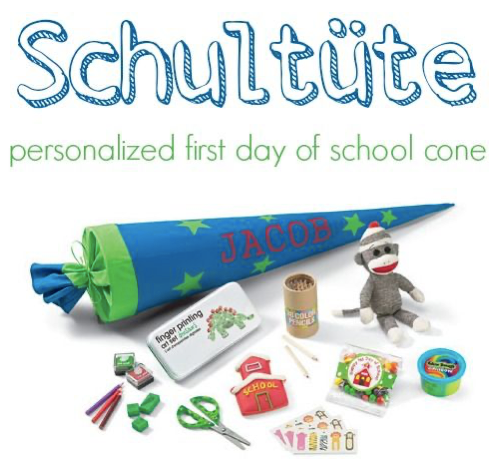
In Germany, all first-graders get a Schultüte, a personalised cone filled with school supplies.  I remember Claudia spending so much time putting Tünde's cone together.  I think that they do it in Austria too but I'm pretty sure that the tradition doesn't exist here in Czechland.


During the first two weeks of school, there is a meeting for parents and the classroom teacher.  The teacher explains how the school year is organised.  These meetings usually take place after school once the parents are off from work.  For the first six weeks, from September to mid-October, students are able to join after-school activities and clubs.  Many of the clubs are sponsored by organisations outside the school.

28 September is a public holiday for St. Wenceslas Day and Statehood Day.

This year, 26-27 October is the Autumn break for all public schools.  This break with the 28 October holiday for Independent Czechoslovak State Day, and the weekend, gives students a 5 day break.

Schools have open-door days from November to January.  These are for students, and their parents, to help decide which gymnázium, conservatories, or vocational school they will apply to.

17 November is the public holiday for Freedom and Democracy Day.

30 November is the deadline for students to submit their applications to schools that that specialise in art, drama, dance, music, language, or sports.

23 December - 2 January is the Winter/Christmas holiday.  Students return to school on 3 January.

By 1 January, schools have to list the criteria for secondary school applications on their websites.  

31 January marks the end of the first semester.  Students receive report cards.

3 February is a one-day school holiday to mark completion of the first semester.

1 March is the final day for students to submit applications to gymnáziums, specialised high schools, or vocational schools.  

Spring break is determined by region so not every student is off the same week across the country.  In Brno, Spring break will be 13-19 March.

6 - 10 April is the Easter holiday.  Students get Thursday off, plus Good Friday and Easter Monday.

In April, parents have to register their children for 1st grade and preschool (kindergarten).

1 May and 8 May are public holidays.

1 June is Children's Day.  It isn't a public holiday but many schools celebrate the day with cultural activities or field trips.

30 June is the last day of school and students receive their report cards.

Summer holiday runs from 1 July to 3 September.  The first day of school for the 2023-2024 year will be 4 September.

Sunday, March 13, 2022

Three Week Update

I am over Covid and I'm cleared to return to work tomorrow.  The doctor wants me to take it easy still.  I'm not allowed any strenuous exercise or sport for at least three months because, as she put it, "at your age we want to be careful".  I swear that I didn't feel old when I turned 50, but I'm starting to with all of these "at your age" comments.

I had my first two Covid vaccinations in May and June and then I had my booster in December.  Covid kicked my butt for almost a month.  I don't want to imagine how bad it could have been if I hadn't received my vaccines and booster.  

I'm also very grateful that I didn't have to worry about the cost of being sick.  The Czech healthcare and social insurance system meant that I could focus on getting better without the fear of financial ruin.  In the USA, the vast majority of Americans are one major disease away from bankruptcy.  

I've had a goatee for years but I've never tried growing a beard before.  While I was stuck at home I didn't bother shaving.  I was starting to look like a mountain man so now I'm going to give a beard a try.  What do think?

Before and after

I've also managed to keep the -27 kg for a week.  

Let's see if I can keep it up.  I'll be happy just to keep the -25,4 kg off for an entire month.  

Wednesday, January 19, 2022

2022 Passport Power

The Henley Passport Index is out and once again, Japan has the world's most powerful passport.  Since 2018, it has held the #1 spot.  Having a Japanese passport allows one to travel to 193 countries either visa-free or visa on arrival.  Only 34 destinations require a visa or an e-visa.  Last year, a Japanese passport "only" got you to 191 countries and 35 countries required a visa.  

There's no such thing as an EU passport.  There are just passports issued by EU member countries and they tend to dominate the rankings.  22 EU countries rank amongst the 11 most powerful passports.  

  1. Japan (193)
  2. Singapore, South Korea (192)
  3. Germany, Spain (190)
  4. Finland, Italy, Luxembourg (189)
  5. Austria, Denmark, NetherlandsSweden (188)
  6. France, Ireland, Portugal, UK (187)
  7. Belgium, New Zealand, Norway, Switzerland, USA (186)
  8. Australia, Canada, Czechia, Greece, Malta (185)
  9. Hungary (183)
  10. Lithuania, Poland, Slovakia (182)
  11. Estonia, Latvia, Slovenia (181)

The three weakest EU member passports belong to the three most recent joiners.  Romania ranks at #16 with 174 countries while Bulgaria and Croatia both come in at #17 with 173 countries.

My American passport is still ranked in 7th place with only 41 countries requiring a visa to visit.  In 2006 and 2014, the U.S. passport was ranked #1.

A U.S. passport gets you in to Australia, Central African Republic, Equatorial Guinea, Guyana, Mongolia, and Pakistan.  Czechs need a visa to visit these countries.  Americans are still eligible for a 3-year visa for Russia which isn't available to Czechs.

A Czech passport will still ranked in 8th place with only 42 countries requiring a visa to visit.  In 2006, a Czech passport was ranked #21.  In 2014, it cracked the top 10 and has stayed there since.  Czechs are able to visit Belarus, Iran, Turkey, Myanmar, and Venezuela while Americans need a visa to visit them.

I need to get on the ball and submit my paperwork for Czech citizenship so that I can get my Czech passport.

Update:  Here's a 10½ minute video from Faultline that I found out on YouTube that talks about passports, visas, and travel.

©Faultline

Update: 2023 passport power rankings.

Thursday, December 23, 2021

Getting Ready for Christmas

Tomorrow is Christmas over here in Euroland.  Sometimes people forget that this isn't my first Christmas in Euroland.  Tomorrow will be my 13th.  Maybe people assume that I fly back to the U.S. every year or something but without fail, someone will always point out to me that Americans celebrate Christmas on the 25th.  Which is true but not always.  

In the U.S., it's Christmas Eve which is still basically Christmas because in the USA we usually celebrate both.  As a kid, I remember going to one part of the family for Christmas Eve, the 24th, for a big dinner, presents, and usually midnight mass.  Then on Christmas Morning, the 25th, it was presents with the immediate family, and then lunch and presents with the other part of the family.  Nowadays, with so many people getting divorced and re-married it's not that uncommon for some kids to have two sets of parents and four sets of grandparents.  

Let's not forget that not everyone celebrates Christmas.  I know many people who celebrate Hanukkah and some celebrate both which is Christmakkah or Hanumas.

There are a few more differences.  Americans put up the Christmas tree usually right after Thanksgiving and it stays up for over a month.  Some take it down around the 26th, or just after the New Year's.  Usually no later than the first weekend after New Year's.  Anything after that is tacky.  The same goes for outside Christmas decorations.  

Czechs, and Germans, normally decorate the Christmas tree during the day on the 24th.  Sometimes the day before.  Claudia's mom finished decorating the tree this morning.  The tree will say up until 6 January for the Feast of the Three Kings which ends the Christmas holidays.

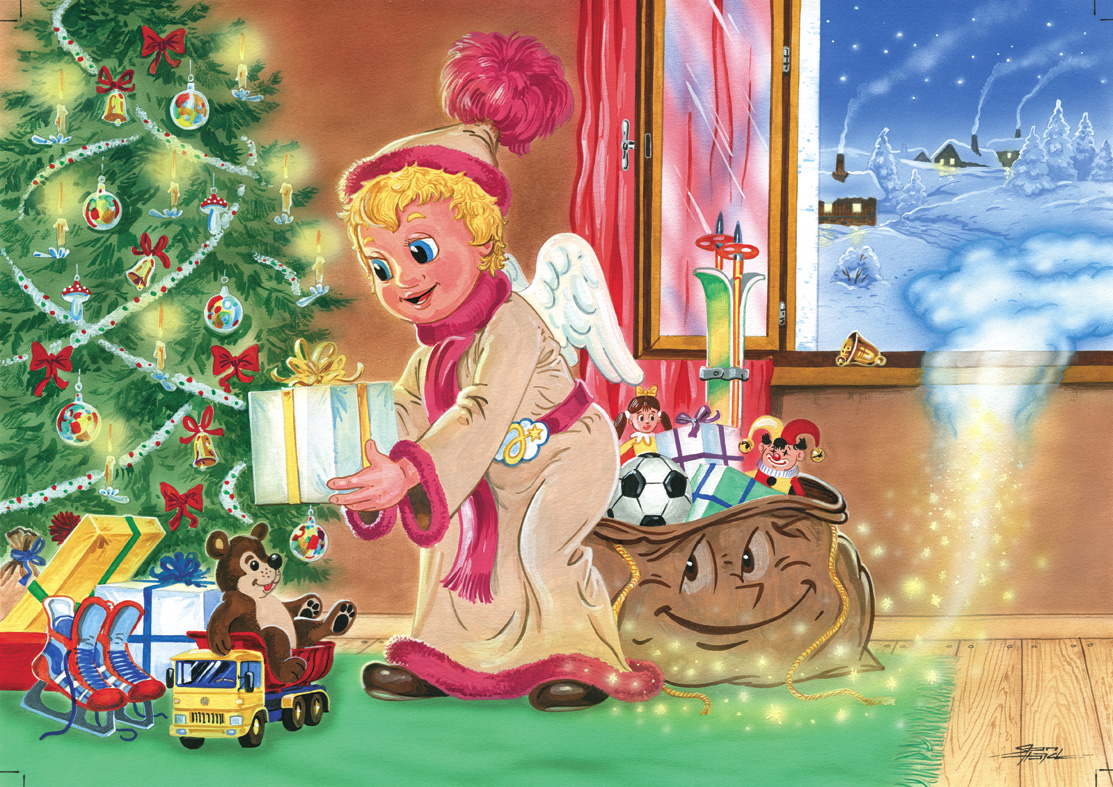
In Czechland it's Jezíšek, and in Slovakia it's Ježiško, Little Baby Jesus, that brings the gifts.  It's the same in parts of Germany (and Austria) where it's the Christkindl who brings the gifts.  In other parts of Germany, we wait for the Weihnachtsmann, Father Christmas.  Tünde is excited about der Weihnachtsmann coming tomorrow.  She's planning on singing four or five songs for him.

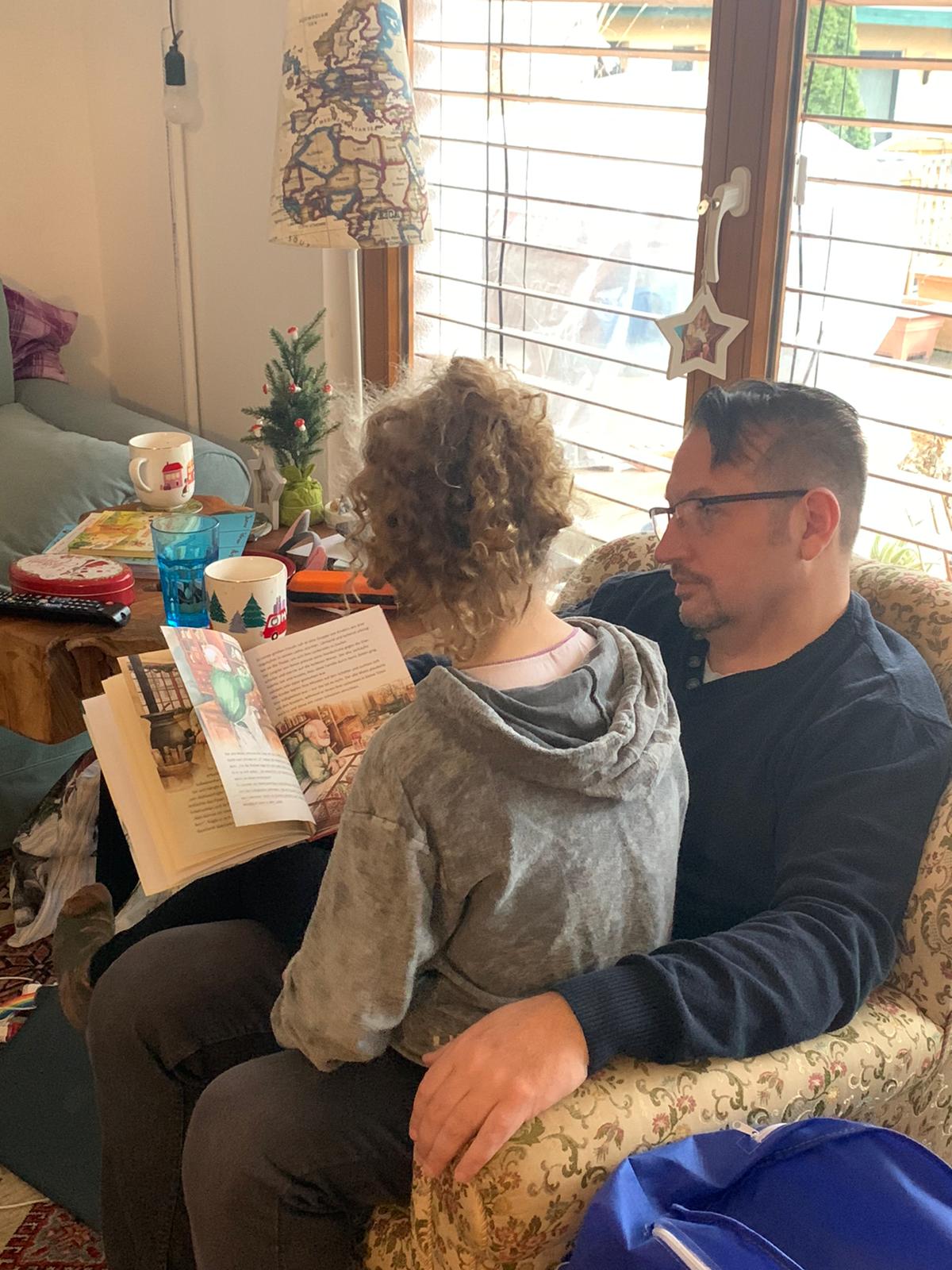
Today Tünde read me a Christmas story called Das Geheimnis der Zuckerstrange.  It's the German version of The Candymaker's Gift which tells the story of how the candy cane was created.  I'd never heard it before but it's a cute story.

Somehow it was decided that I was making the Buletten for dinner tomorrow.  Buletten are traditional German meatballs made out of ground beef, ground pork, onion, breadcrumbs, salt, and pepper.  They are panfried but can then be eaten either hot or cold with good mustard.  I think that they turned out fine but we won't know until tomorrow.  Hopefully they will be better than the frozen Ikea meatballs I had last year.

Later we went to check out Dark Matter.  Maybe this was my reward for the Buletten.