Showing posts with label Bulgaria. Show all posts

Tuesday, January 3, 2023

Croatia Joins Eurozone & Schengen

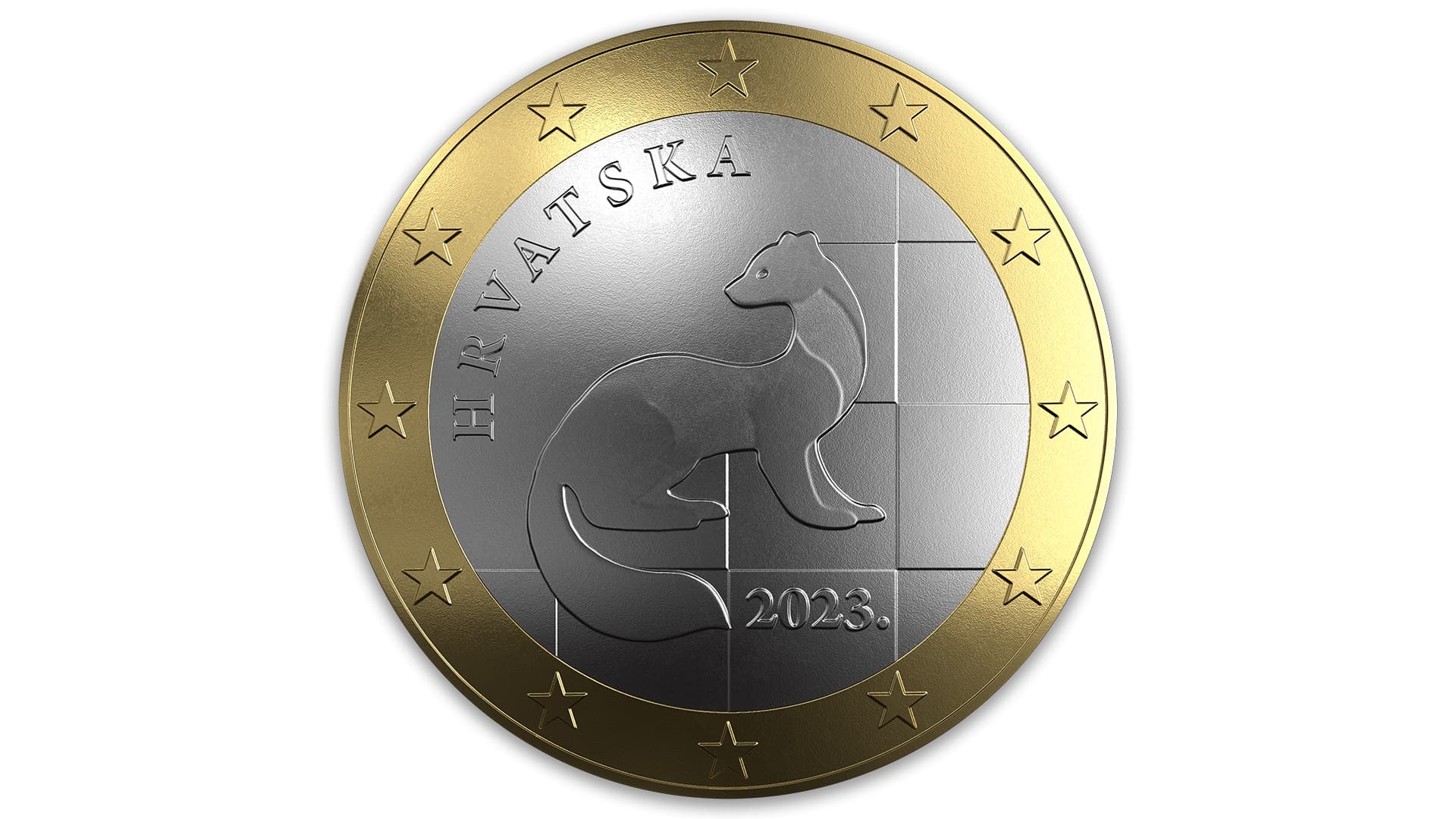
New Year's Day was a big day for Croatia.  It officially joined both the Eurozone and Schengen.

When the country joined the EU back in 2013, it had to commit to eventually replacing its currency, the kuna, with the Euro.  But then again, Czechland joined the EU in 2004 and still hasn't switched.

Croatia is now the 20th member of the Eurozone and the first country to join since Lithuania back in 2015.

Here are a couple of short YouTube videos out there about Croatia adopting the Euro.

©EuroNews
©The EU Made Simple

Croatia also joined Schengen becoming a member of the world's largest visa free zone.  The thing about joining Schengen, or the EU, or NATO, is that every single member has to agree.  Heck, it's hard enough trying to get four friends to agree on a particular restaurant.  Much less trying to get 26 different countries to agree on something.  Yet, back in December, every member country agreed to let Croatia join.

However, the Netherlands blocked Bulgaria, while Austria blocked both Bulgaria and Romania.

©France24

With Croatia in the Schengen club, there are now 27 members.  So whenever it comes time for Bulgaria and Romania to try again, they will also need Croatia to agree as well.

Wednesday, January 19, 2022

2022 Passport Power

The Henley Passport Index is out and once again, Japan has the world's most powerful passport.  Since 2018, it has held the #1 spot.  Having a Japanese passport allows one to travel to 193 countries either visa-free or visa on arrival.  Only 34 destinations require a visa or an e-visa.  Last year, a Japanese passport "only" got you to 191 countries and 35 countries required a visa.  

There's no such thing as an EU passport.  There are just passports issued by EU member countries and they tend to dominate the rankings.  22 EU countries rank amongst the 11 most powerful passports.  

  1. Japan (193)
  2. Singapore, South Korea (192)
  3. Germany, Spain (190)
  4. Finland, Italy, Luxembourg (189)
  5. Austria, Denmark, NetherlandsSweden (188)
  6. France, Ireland, Portugal, UK (187)
  7. Belgium, New Zealand, Norway, Switzerland, USA (186)
  8. Australia, Canada, Czechia, Greece, Malta (185)
  9. Hungary (183)
  10. Lithuania, Poland, Slovakia (182)
  11. Estonia, Latvia, Slovenia (181)

The three weakest EU member passports belong to the three most recent joiners.  Romania ranks at #16 with 174 countries while Bulgaria and Croatia both come in at #17 with 173 countries.

My American passport is still ranked in 7th place with only 41 countries requiring a visa to visit.  In 2006 and 2014, the U.S. passport was ranked #1.

A U.S. passport gets you in to Australia, Central African Republic, Equatorial Guinea, Guyana, Mongolia, and Pakistan.  Czechs need a visa to visit these countries.  Americans are still eligible for a 3-year visa for Russia which isn't available to Czechs.

A Czech passport will still ranked in 8th place with only 42 countries requiring a visa to visit.  In 2006, a Czech passport was ranked #21.  In 2014, it cracked the top 10 and has stayed there since.  Czechs are able to visit Belarus, Iran, Turkey, Myanmar, and Venezuela while Americans need a visa to visit them.

I need to get on the ball and submit my paperwork for Czech citizenship so that I can get my Czech passport.

Update:  Here's a 10½ minute video from Faultline that I found out on YouTube that talks about passports, visas, and travel.

©Faultline

Update: 2023 passport power rankings.

Saturday, May 29, 2021

Radio Free Europe

Radio Free Europe (RFE) was established in 1949 and Radio Liberty (RL) was established in 1951.  In 1976 the two organisations merged together.  These radio stations were run by the United States and they broadcast American propaganda in Eastern Europe during the Cold War.  The goal was to inspire independence movements within the Warsaw Pact countries and to counter Soviet propaganda within these countries.

During the Cold War, Radio Liberty targeted the Soviet Union while Radio Free Europe broadcast to Czechoslovakia, East Germany, Hungary, Poland, Romania, Bulgaria, and the three Soviet Baltic states.  The communist governments weren't keen on American propaganda and they routinely tried to jam the transmissions.  In 1959, an StB agent attempted, but failed, to poison the salt shakers in RFE's cafeteria.  

RFE was headquartered in Munich, West Germany until 1995.  In 1995, the headquarters were moved to Prague.

Here's an old 1960's or 1970's public service announcement about RFE broadcasting to Hungary that I found out on YouTube.

Following the end of the Cold War, operations in Europe were decreased.  RFE stopped broadcasting to Czechoslovakia in 1992 but Czech programming lasted until 2002 and Slovak programming ended in 2004.

Broadcasts to Hungary ended in 1993 while broadcasts to Poland ended in 1997.  Broadcasts began in 1994 in Bosnian, Croatian, and Serbian to the former countries of Yugoslavia.  In 1999, Albanian broadcasts began in Kosovo.  In 2000 broadcasts began in Montenegrin and Macedonian broadcasts began in 2001.  In 2004, broadcasts ended in Estonia, Latvia, Lithuania, Slovakia, Croatia, Montenegro, Bulgaria, and Romania.  In 2019, programming resumed in Bulgaria and Romania.  In 2020, programming resumed in Hungary.

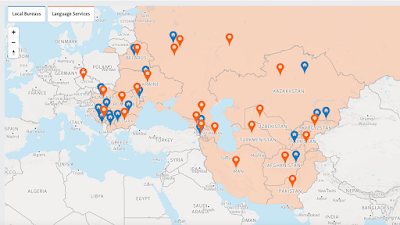
Today, RFE/RL broadcast to 23 countries in 27 languages.  Its headquarters remain in Prague even though no content is produced in Czech.  Here's where they currently produce material for.

Monday, January 27, 2020

Back in Skopje, North Macedonia

I was back in the Balkans and spent this past weekend in Skopje.  While it was my second time in Skopje it was my first time in North Macedonia.  Greece and Macedonia finally came to an agreement on the name issue and in February 2019, Macedonia became North Macedonia.  I don't think that I get to count this as a new country.

With the name issue sorted, 27 years later, North Macedonia will now be able to move forward with joining NATO and the EU.  

When I was here in 2011 the government had just kicked off its Skopje 2014 project to give the capital a more classical look.  A lot of construction took place and it definitely felt like I was visiting a new city.  Although I think they went a bit overboard on the statues.  Sometimes less is more.

The "Alexander the Great" monument had been erected to celebrate the countries 20 years of independence from Yugoslavia.  Today, it is known as the "Warrior on a Horse".  It's still huge and cost €7,5 million.

There's now the Warrior monument and fountain.  Many believe that it is supposed to represent Philip II of Macedon.  The statue is 15 meters (49 feet) tall and it was unveiled in 2012.  It cost about €2 million.

The Museum of Archaeology also houses the Constitutional Court and the National Archives.  Construction cost over €7 million.  The bridge leading to the museum, with its 28 sculptures cost another €2,5 million.

The new Saints Cyril and Methodius statue was only €540.000.

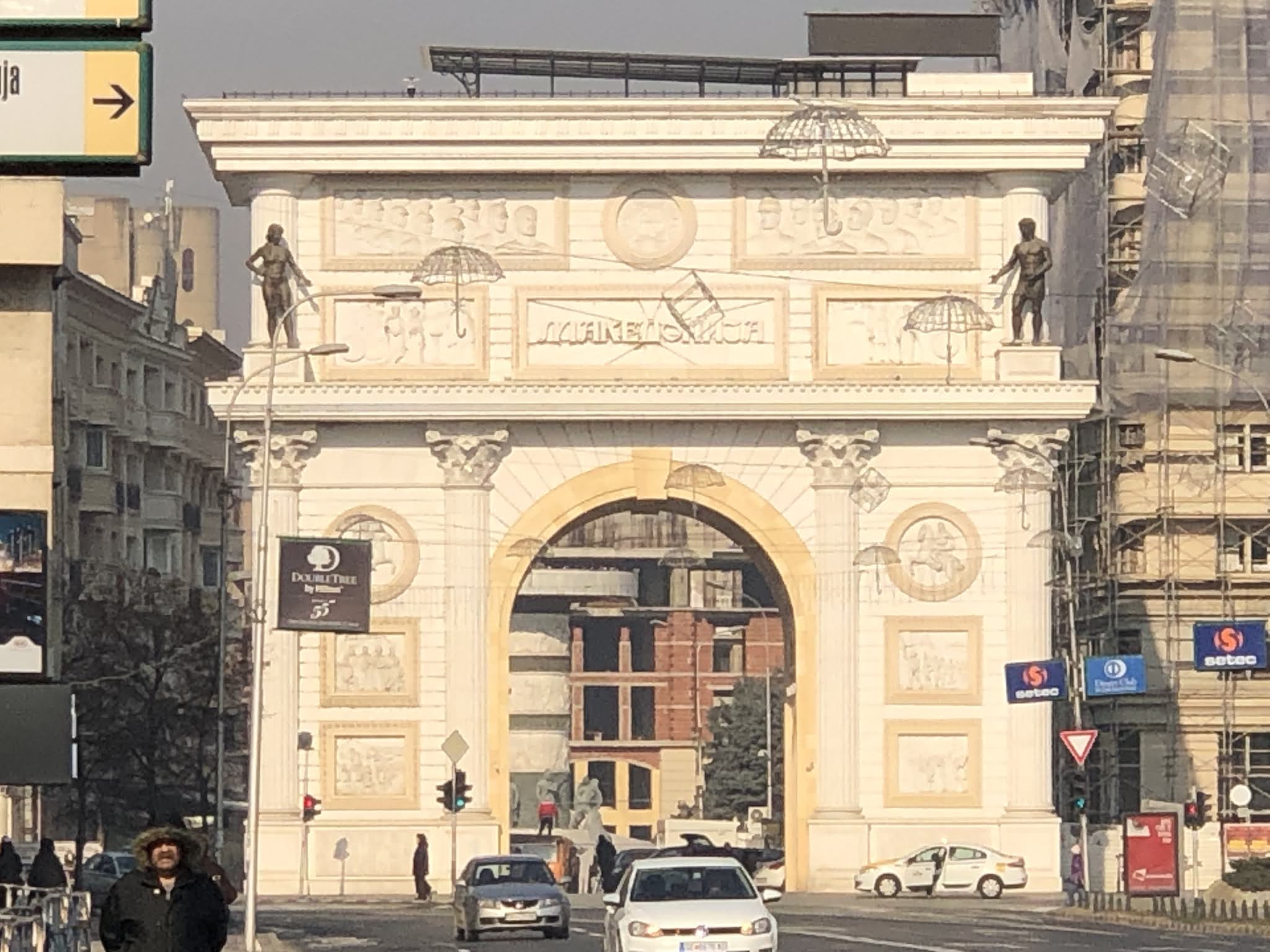
There's now a triumphal arch called the Porta Macedonia that commemorates the long struggle for Macedonian independence.  It was opened to the public in 2012 and cost an estimated €4,5 million.

A statue went up in front of the parliament building that cost €715.000.
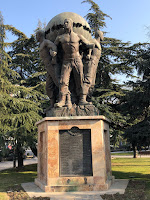
Across from the parliament is Žena Borec Park which got several monuments.  The Defenders of Macedonia cost around €300.000

The monument for the Anti-Fascist Assembly for the National Liberation of Macedonia (ASNOM) was €1,9 million.

The statue of the Founders of the Internal Macedonian Revolutionary Organization cost €1,2 million.

The Fallen Heroes of Macedonia memorial is home to an eternal flame.  This one cost €2,3 million.

The statue of Pitu Guli was a bargain because it was just €118.000.

The Museum of the Macedonian Struggle for Statehood and Independence opened in 2011.  The cost of the museum was around €10 million.

The statue of Karposh, the rebellion leader cost €540.000.

The Macedonian National Theatre replaced the former one which was destroyed in the 1963 earthquake that levelled the city.  Reconstruction of the theatre actually began in 2007.  The cost of reconstruction has been estimated to have been between €6 million and €30 million.

The Boatmen of Thessaloniki, also known as the Assassins of Salonica, cost €970.000.


The marble monument of Justinian I was unveiled in 2011.  It cost over €1 million.
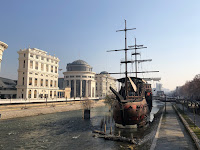

Four boats have been permanently built into the riverbed of the Vardar River.  The boats are used for restaurants and cafes.


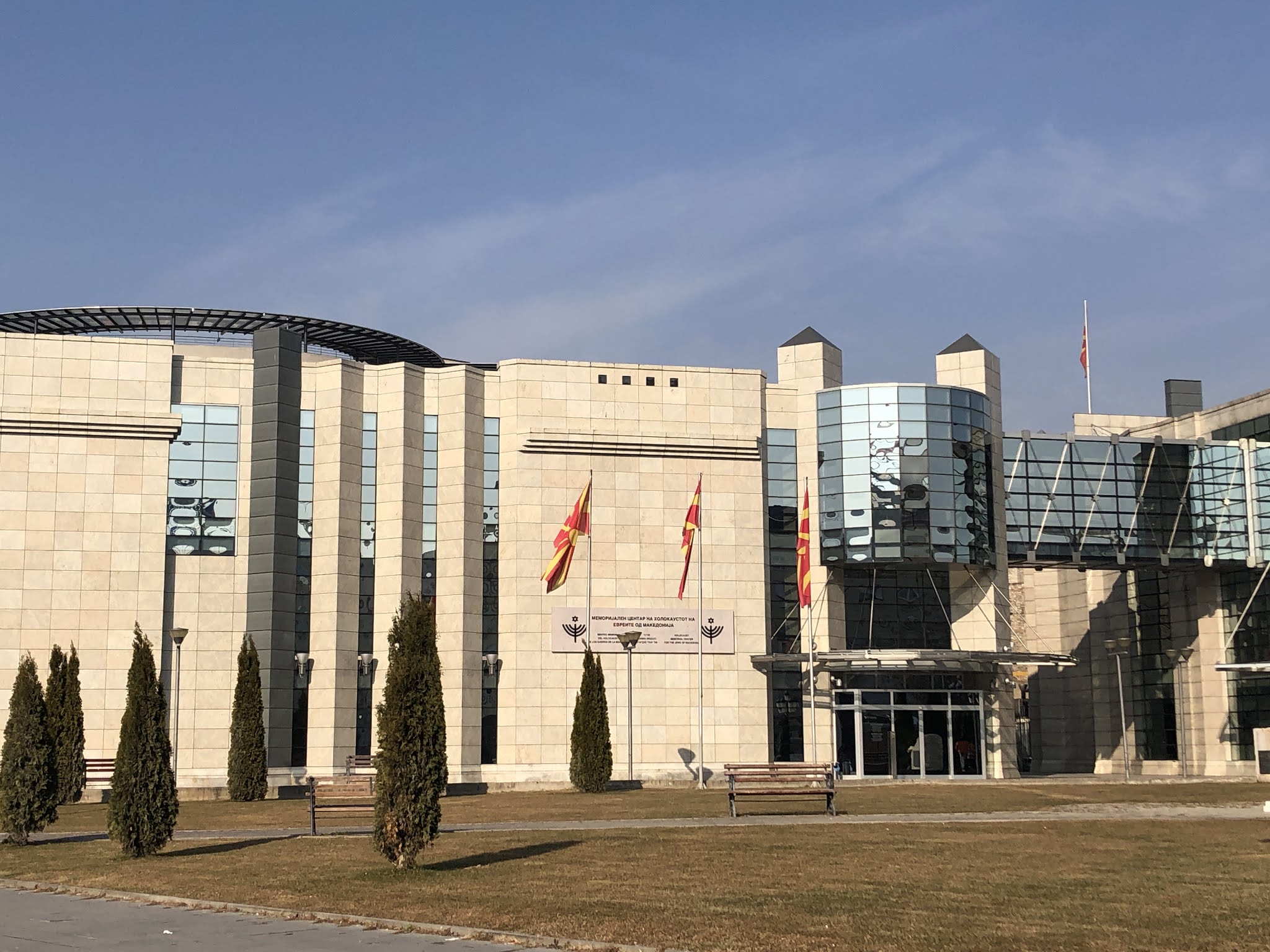
The Holocaust Memorial Centre for the Jews of Macedonia is a memorial for the 7.148 Macedonian Jews who perished in WWII.


The city purchased 202 double-decker buses for its transportation system.  Who knows what that must have cost?
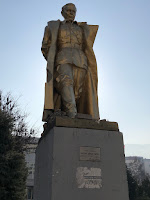
It's not like the city didn't have any monuments before.  I did come across an old statue of Tito.

This whole Skopje 2014 project was massive.  Something like 136 structures were built at a cost well over €800 million.  It's amazing to me that the country spent so much on this.  It's not like this isn't the 6th poorest country in Europe.

Update:  Here's a video I found out on YouTube that talks about the money spent on Skopje 2014.

©Journeyman Pictures

Friday, August 16, 2019

CEFTA

The Central European Free Trade Agreement, or CEFTA, was formed in 1992 by the Visegrád countries - Czechoslovakia, Poland, and Hungary.  After the Velvet Divorce both Czech Republic and Slovakia became independent members.  The purpose was to work together towards integrating political, economic, security, and legal systems with western free-market economies.

Over the years, other countries have joined CEFTA.  However, once a country joins the European Union it must leave CEFTA.  Former members include Bulgaria, Croatia, Romania, and Slovenia.  Basically being a CEFTA member servers as good preparation for eventually joining the EU.

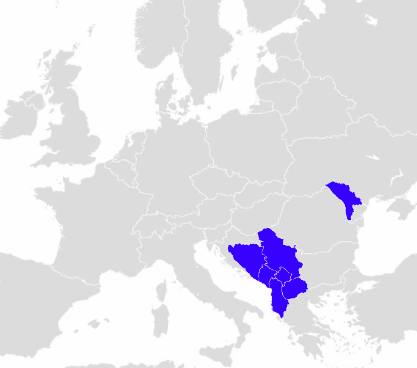
Current CEFTA members
CEFTA seems less "Central Europe" and more "Balkans" to me.  The seven current members are Albania, Bosnia and Herzegovina, Kosovo, Moldova, Montenegro, Macedonia, and Serbia.  Combined the CEFTA countries have a combined population of about 21,5 million people and a GDP over $290 billion.

Wednesday, June 26, 2019

The Warsaw Pact

The Warsaw Pact was the communist version of NATO.
Officially it was the Treaty of Friendship, Cooperation, and Mutual Assistance.

In 1955, West Germany joined NATO so a military alliance was established to counter it.


Like NATO, one of the main principles was that an attack on one country was an attack on all members of the alliance.  The Warsaw Pact countries were the Soviet Union, Poland, East Germany, Hungary, Romania, Bulgaria, Albania, and Czechoslovakia.

When I grew up the Cold War was NATO vs the Warsaw Pact.

Ironically, its largest military engagement wasn't against NATO but "Operation Danube" which was the invasion of Czechoslovakia that put down the Prague Spring.
Romania and Albania didn't participate in the invasion.  Shortly afterwards, Albania left the alliance.

At the last minute it was decided that East Germany would not invade because it was the 30th anniversary of Germany annexing the Sudetenland.  

Here's a video I found out on YouTube called "March of the Warsaw Pact".  The lyrics are in Russian but there are English subtitles.  It's basically the alliance's anthem but I find it interesting that the East Germans aren't mentioned.

©YugoslavianHeros 1943

The Warsaw Pact became less relevant following the fall of communism in 1989 and the breakup of the Soviet Union in 1991.  Except that there were still Soviet troops stationed across Eastern Europe.  East Germany left the pact in 1990 following the reunification of Germany.

It's fitting that the Warsaw Pact was formally ended, in Prague, on 1 July 1991 by Czechoslovak President Václav Havel

Over the next 20+ years former Warsaw Pact countries ended up joining NATO.  Czech Republic, Hungary, and Poland joined in 1999.  Slovakia, Bulgaria, and Romania joined in 2004, along with the former Soviet Baltic states Estonia, Latvia, and Lithuania.  Albania joined in 2009.  

NATO just celebrated its 70th anniversary and continues to expand.

Update 2025: Here's a short video I found that explains, prior to the Warsaw Pact, the USSR actually tried to join NATO.  Who know?

©History Matters

Thursday, October 9, 2014

New €10 Banknote

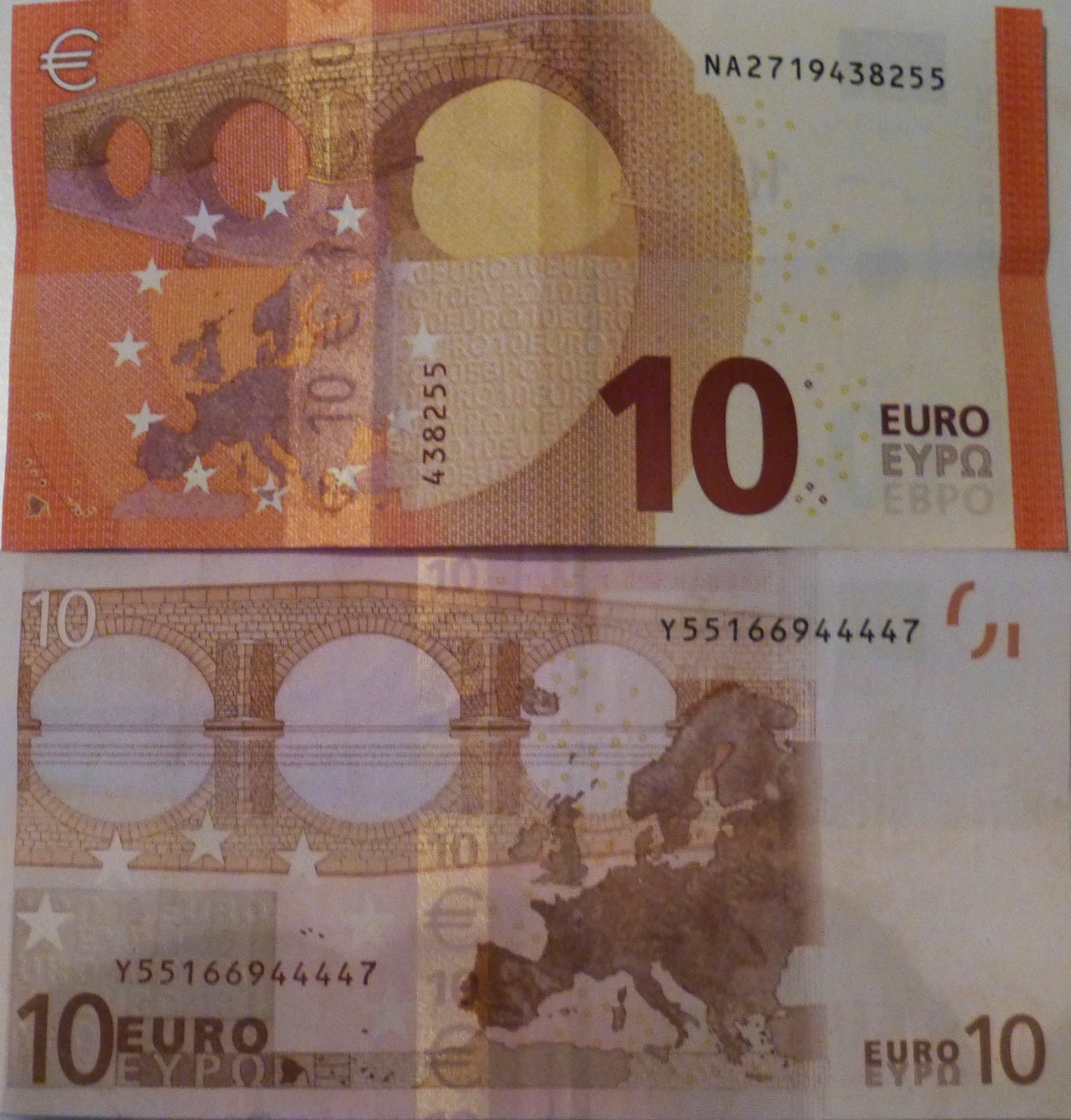
Circulation of the new €10 banknote began on 23 September.  The new €5 banknote launched last year so I assume that the new €20 banknote will be released in 2015.

Like the fiver, the new tenner also has some new security features built in to the banknote.

Front side


Here's a comparison of the new and old banknotes.

The new version is on top and the old version is on the bottom.

Back side


The old banknotes used to have "EURO" and "ΕΥΡΩ" on them since all of the Eurozone countries used either the Latin or Greek script.  Although Bulgaria has yet to adopt the Euro it will eventually have to since the country has joined the European Union.  So now all of the new banknotes include the Cyrillic "EBPO".

Here's a commercial I found on YouTube about the new banknotes.

  ©European Central Bank

Thursday, May 1, 2014

10 Years in the EU

Today is 1 May and it's a public holiday.  Today is also the 10th anniversary of Czech Republic joining the European Union.

In 1952, six countries (Belgium, Italy, Luxembourg, France, Netherlands, and West Germany) formed the European Coal and Steel Community.  In 1953, Denmark, Ireland and the UK also joined.  This eventually developed in to a European common market.

Greece joined in 1981 and Portugal and Spain both joined in 1986.  After German reunification in 1990, the EU picked up what used to be East GermanySweden, Finland, and Austria all joined in 1995.
2004 was a big year for the EU.  The single largest EU expansion (number of countries, territory, and population) occurred in 2004.  The EU welcomed Cyprus, Czech Republic, Estonia, Hungary, Latvia, Lithuania, Malta, Poland, Slovakia, and Slovenia.

In 2007, Bulgaria and Romania joined.  Last year, Croatia became the newest member.  Today, the EU contains 28 countries and more than 500 million people.

Still, not every country in Europe is an EU member.  Norway, Andorra, Monaco, San Marino, Vatican City, Liechtenstein, and Switzerland are not members.  Iceland, Macedonia, Montenegro, Serbia, and Turkey are all candidates to join the EU.  Albania, Bosnia and Herzegovina, Kosovo, and Ukraine are not yet even candidates to join. 

Czechs have gained economically from joining the EU.  Plus it's a heck of a lot easier for Czechs to travel now.  However, many Czech people consider EU legislation as a negative and only around 20% or so of the people want to give up the Crown for the Euro.

Update:  Here's a video I found out on YouTube about the European Union.
©CGP Grey

Update:  15 years in the EU.
Update:  The UK officially left the EU on 31 January 2020.

Update:  Here's a short 5½-minute video on how the EU works.
©CNBC International

Update 2025:  Here's a short video about the EU.

©EU Made Simple

Wednesday, March 12, 2014

15 Years in NATO

Today was the 15th anniversary since Czech Republic joined NATO. 


NATO is the North Atlantic Treaty Organization.  The organization came about after WWII.  It is a military alliance where all members agree to mutual defense.  An attack on one NATO member is considered an attack on all members.

The alliance is headquartered in Brussels.  

Back in 1949, the alliance began with 12 members - Belgium, Canada, Denmark, France, Iceland, Italy, Luxembourg, Netherlands, Norway, Portugal, the United Kingdom and the USA.  

Greece, Turkey and West Germany joined in the 1950s and Spain joined in 1982.

Czech Republic, Hungary and Poland joined in 1999 becoming the first former Warsaw Pact members to join the alliance.

Seven new members joined in 2004 - Bulgaria, Estonia, Latvia, Lithuania, Romania, Slovakia and SloveniaAlbania and Croatia both joined in 2009.

Today there are 28 members.  Bosnia and Herzegovina, Montenegro and Macedonia are all in the process of joining as well.  Georgia is another aspiring member.  Given the problems in Crimea, I'm sure that Ukraine wishes it was currently a member.

Macedonia fulfilled the requirements to join at the same time as Albania and Croatia, but its membership was blocked by Greece over the country name of Macedonia.    

Here's a NATO video timeline I found out on YouTube.
©NATO
 
I also found a video from 2011 showing Czech NATO troops training police recruits in Afghanistan.

©NATO 

Update: Montenegro joined in 2017.
Update: 2019 is the 20th anniversary of joining NATO.

Update: 2019 - Here's the Czechia is NATO - We Are NATO video.

©NATO 

Update: North Macedonia joined in 2020 becoming the 30th NATO member.

Update:  September 2022 - Here's a short video I found on YouTube about how a country joins NATO.

©NATO

Update: 4 April 2023 - Finland became the 31st member of NATO.

Sunday, February 23, 2014

A Show of Support for Ukraine

There was a show of support earlier today, in Brno, for the Maidan protesters in Kyiv.  The people there are protesting against the current pro-Russian president and there have been violent clashes with police.

The show of support should not come as a surprise.  Obviously, because it is the right thing but also given the huge Ukrainian population in Czechland.  At 30%, Ukrainians make up the largest group of registered foreigners in the country.  There are more Ukrainians here than Slovaks.

Many people were at náměstí Svobody (Freedom Square), waiving flags and holding candles.  There was an Orthodox priest and a video was shown.  Everything was in Ukrainian so I didn't understand much.

I know the blue and yellow Ukrainian flag but I hadn't seen the red and blag one before.  I found out later that the red and black flag is that of the Ukrainian Insurgent Army (UPA) which fought a military campaign against the Nazis and later against Soviet forces. 

Ukrainians aren't getting support only in Brno.  Someone painted the Soviet War Memorial in Sofia again.  This time in support of Ukraine.

Thursday, August 22, 2013

Bulgaria Apologizes

Soviet soldiers in 1968
August 20th was the 45th anniversary of the 1968 Soviet-led invasion of Czechoslovakia.  The invasion was to put down Alexander Dubček's liberal reforms known as the Prague Spring.

The invasion was carried out by the Soviet Union, East Germany, Poland, Hungary and BulgariaRomania was the only Warsaw Pact country not to participate.

Yesterday, someone painted the Sofia Soviet WWII memorial pink.  "Bulgaria apologizes" was painted in both Bulgarian and Czech.


Update:  Romania wasn't the only Warsaw Pact country not to participate.  Albania left the Warsaw Pact shortly after the invasion.  East Germany only provided minor support because it was too close to the 30th anniversary of Nazi Germany annexing the Sudetenland.

Monday, January 7, 2013

Merry Orthodox Christmas

Most people celebrate Christmas on December 25 as based on the Gregorian calendar which Pope Gregory XIII replaced the Julian calendar with in 1582.

However, Christians in many Eastern Orthodox countries still observe Christmas using the Julian calendar which puts it on January 7th.

The Orthodox Church is the second largest Christian church, after the Roman Catholic Church, in the world.  There are an estimated 225-300 million followers.  Most of whom are in Eastern and Southeastern Europe, as well as, in the Middle East.

Orthodoxy is by far the largest faith in Russia, Belarus, Ukraine, Moldova, Georgia, Romania, Serbia, Montenegro, Macedonia, Bulgaria, Greece and Cyprus.  There are also large populations in Lebanon, Jordan and Syria.

Orthodox Churches in Greece, Bulgaria, and Romania celebrate Christmas on December 25th.  But today is Christmas for all of my friends and colleagues from Russia, Ukraine, Serbia, Macedonia and Moldova.  So Merry Christmas!!