The Union of Soviet Socialist Republics (USSR), the Soviet Union, was established in 1922 and lasted until its dissolution in 1991. It was the world's largest country and it spanned eleven time zones from Europe to Asia. It was a federal union, consisting of 15 republics, all ruled by the Communist Party of the Soviet Union. The capital was Moscow.
 Everything started with the October Revolution in 1917 when the Bolsheviks overthrew the provisional government following the fall of the Russian Empire. The Russian Soviet Republic became the world's first communist state. Following a civil war, the Soviet Union eventually came in to being. Its republics had previously belonged to the Russian Empire. Prior to WWII, under Josef Stalin, the Soviet Union annexed the Baltic countries of Estonia, Latvia, and Lithuania and made them all new Soviet Republics.
 The dissolution of the Soviet Union singled the end of the Cold War. I grew up during the Cold War so it's incredible to think about how different the world looks.
The Berlin Wall fell and East Germany became part of a unified Germany. Czechoslovakia split in to the Czech Republic and Slovakia. Except for Russia, every member of the Warsaw Pact joined the EU and is now a member of NATO. Even three former Soviet republics are even NATO members.
 In 1990, Lithuania was the first Soviet Republic to declare independence. Kazakhstan was the last republic to leave in December 1991. Many of the former Soviet republics joined new unions and alliances with Russia such as the Commonwealth of Independent States (CIS), the Collective Security Treaty Organization (CSTO), the Eurasian Economic Community, the Eurasian Customs Union, the Eurasian Economic Union, and the Union State. Some, without Russia, joined GUAM and the Baltics joined the EU.
Here's a bit about the former Soviet republics.
 The Armenian Soviet Socialist Republic, in the Caucasus, became independent in on 21 September 1991. It was the second smallest republic and was home to about 3,3 million people. Armenia was the world's first Christian state. I always thought it was kind of ironic that religion was banned during Soviet times. Following independence, Armenia and Azerbaijan have been at war over the Nagorno-Karabakh region.
 The Azerbaijan Soviet Socialist Republic declared independence on 30 August 1991. It is the largest country in the Caucasus and is rich in oil and natural gas. Since the fall of the USSR, Azerbaijan has been ruled by a single family. It is still at odds with Armenia over the Nagorno-Karabakh region.
 The Byelorussian Soviet Socialist Republic, with just over 10 million people, was the 5th largest republic. Belarus declared independence on 10 December 1991. President Lukashenko has ruled since 1994 and Belarus is considered the last dictatorship in Europe.
 The Estonian Soviet Socialist Republic declared independence on 20 August 1991. It joined the EU and NATO in 2004 and in 2011 it replaced its currency with the Euro. Today, Estonia is a parliamentary republic and it was the first country in the world to allow citizens to vote online. When Estonia gained independence, citizenship was only granted to those who could prove family ties prior to 1940 when the Soviet Union annexed the country. Russians who came to Estonia between 1941 - 1991 were allowed citizenship only if they could pass an Estonian language test. About 25% of the population are ethnic Russians and Estonia does not permit dual citizenship.
 The Georgian Soviet Socialist Republic declared independence on 9 April 1991. Most of the 1990s was filled with civil unrest and economic hardship with the Rose Revolution in 2003. Georgia has two breakaway republics - Abkhazia and South Ossetia.

Georgia considers there regions to be under Russian military occupation. The country is working hard to join NATO which makes Russia uneasy. That's also one of the reasons that Russian troops are stationed in the breakaway republics.
 The Kazakh Soviet Socialist Republic became part of the USSR in 1936 and on 16 December 1991 it was the very last republic to leave the union. Kazakhstan is huge, more than four times the size of Texas, and today it is the largest country in Central Asia and with 18 million people it is the world's 9th largest country. During the 1950-60's, many Russians and people deported from other republics were sent to Kazakhstan to work he fields. Today, ethnic Russians make up about a quarter of the population.
 The Kyrghiz Soviet Socialist Republic became part of the USSR in 1936. Kyrgyzstan became independent on 31 August 1991. It is a poor country that is heavily dependent on agriculture and minerals extraction. Due to high unemployment Kyrgyzstan is a source of migrant labourers especially in Russia.
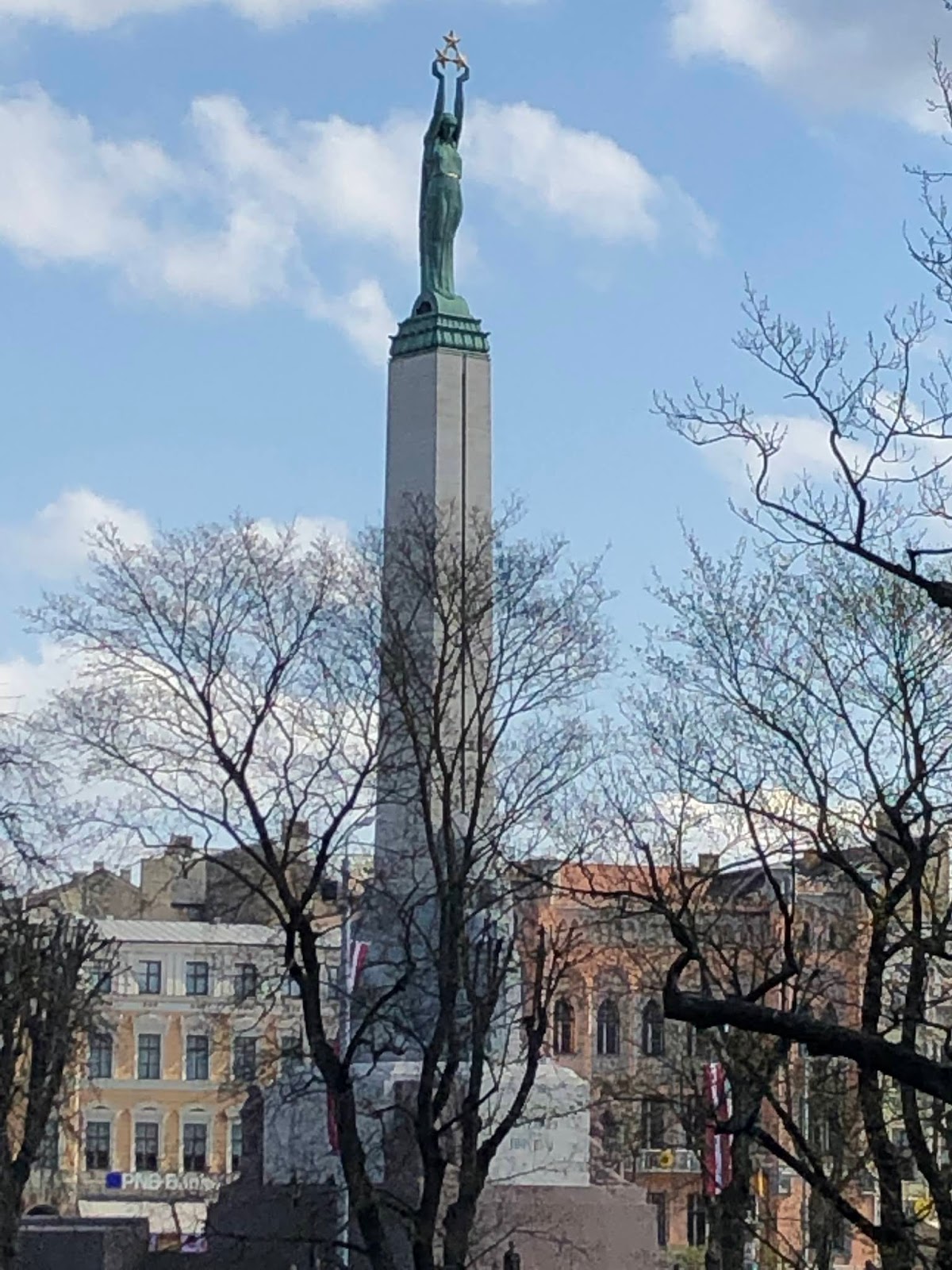
 After WWI Latvia broke away from the Russian Empire but in 1940 it was forcibly incorporated into the USSR as the Latvian Soviet Socialist Republic. Latvia gained independence on 4 May 1990. It joined the EU and NATO in 2004 and the Eurozone in 2014. Citizenship was granted only those who could prove Latvian citizenship prior to 1940. About 13% of the population still doesn't have Latvian citizenship and the country doesn't allow dual citizenship.
 Lithuania became an independent country in 1918, after WWI, when it broke away from the Russian Empire. In 1940, it was annexed by the USSR and became the Lithuanian Soviet Socialist Republic. On 11 March 1990, Lithuania became the first of the 15 Soviet republics to declare independence. A full year before the Soviet Union actually broke up. Lithuania joined the EU and NATO in 2004 and joined the Eurozone in 2015. Like the other two Baltic countries it is also part of the Schengen area. Also like Estonia and Latvia, Lithuania doesn't allow for dual citizenship.
 After WWI, Moldova was part of Romania. In 1940, the area was annexed by the USSR and it became the Moldavian Soviet Socialist Republic. After WWII, the Soviets began migrating Russians, Belorussians, and Ukrainians in to the area.
In 1990, an independent Pridnestrovian Moldavian Soviet Socialist Republic was declared. This small area was afraid that Moldova would leave the USSR and try to become part of Romania.
Moldova declared independence from the USSR on 27 August 1991. Fighting broke out between Moldovan forces and separatists in March 1992. Transnistria considers itself an independent country but only Russia recognises it. The Russian 14th Army has 1200 troops in Transnistria that Moldova wants recalled. As part of the ceasefire agreement that has been in place since July 1992 states that if Moldova tries to merge with Romania then Transnistria will be allowed to go its own way.
Moldova is one of the poorest countries in Europe. Many Moldovans have left the country as migrant workers. Money from abroad accounts for almost 38% of the country's GDP. In 2013, Moldova entered an agreement with the EU, placing it on a path to future membership. This is not something that Russia is happy about.
 The Russian Soviet Federative Socialist Republic was the largest of the 15 Soviet Republics. It contained over half the entire USSR's population and dominated the country. On 12 December 1991, it declared independence.
Russia, officially the Russian Federation, is the largest country in the world, stretching from Northern Europe to the Caucasus and from Eastern Europe to Asia. It covers 1/8th of the world's inhabited land area. It spans nine time zones and it's larger than Pluto.
The Russian Federation is made up of 46 provinces, 22 republics, 9 territories, 4 autonomous district, 1 autonomous province and 3 federal cities.
Russia inherited the USSR's seat on the UN Security Council.
Russia claims to have a right to intervene in former Soviet republics to protect all Russian speakers. This was used to invade Georgia in 2008 in the five-day war in South Ossetia as wells as to annex Crimea from Ukraine in 2014.
 The Tajik Soviet Socialist Republic became a republic in 1929. Tajikistan declared independence on 9 September 1991. Almost immediately a civil war broke out that lasted from 1992 to 1997. Tajikistan is the poorest of all the former Soviet republics.
 Turkmenistan was annexed by the Russian Empire in 1881. In 1925, it became the Turkmen Soviet Socialist Republic. Turkmenistan declared independence on 27 October 1991. Turkmenistan is home to the world's 4th largest reserves of natural gas.
It is a very closed off country. A visa is required to visit and tourists are only allowed in as part of a group tour.
 Over the centuries Ukraine has been ruled by Lithuania, Poland, the Ottoman Empire, the Austro-Hungarian Empire, and the Russian Empire. It was an independent country for a few years following WWI but then in 1922 it became the Ukrainian Soviet Socialist Republic and a founding member of the USSR.
Under Stalin, Ukrainian nationalism was put down. Forced collectivisation and unrealistic quotas for farmers caused Holodomor, The Great Famine, where millions of Ukrainians were starved to death. Another 7-8 million more people died during WWII.
Ukraine declared independence on 24 August 1991. In 1994, it became the first former Soviet republic to experience a peaceful transfer of power via the ballot box.
Ukraine is the second-largest county in Europe. When the USSR broke up, Ukraine was a nuclear power. In 1996, Ukraine surrendered all of its Soviet-era nuclear weapons to Russia. This was under the condition that Ukrainian territory would be respected. That hasn't worked out so well.
Ukraine wants to eventually join the EU and NATO. Obviously this doesn't sit well with Russia. In 2014, Russia illegally annexed Crimea. Russia has also supported separatists in the Donbas region of Eastern Ukraine. The Donetsk People's Republic and the Luhansk People's Republic border Russia and both unilaterally declared independence on 7 April 2014. Ukraine regards both as terrorist organisations. After seven years of fighting the Ukrainian government has made progress but there are both separatist controlled areas with constant fighting.
 Uzbekistan was conquered and incorporated in to the Russian Empire during the 19th century. In 1924 it became the Uzbek Soviet Socialist Republic. Uzbekistan declared independence on 31 August 1991.
Uzbekistan is one of only two double-landlocked countries in the world and it is the only country that borders all of the "Stans".
I've managed to visit 13 of the 15 former republics. I had originally planned on visiting Turkmenistan this year but Covid put that on hold. Here's a short video I found out on YouTube about the breakup of the USSR.
©Seeker
Update 2025: Here are a couple of short videos about Lithuania being the first, and Kazakhstan being the last, republics to leave the Soviet Union.
©History Matters
©History Matters
Update 2025: Here's another short video about the last ditch attempt to save the Soviet Union.
©History Matters











 Czech Koruna Exchange Rate


 Posts
Posts


