Showing posts with label Kosovo. Show all posts

Tuesday, September 13, 2022

KFOR

KFOR, Kosovo Force, is a NATO-led international peacekeeping force in Kosovo.  Following the breakup of Yugoslavia and the wars in the Balkans, the UN Security Council passed a resolution in 1999 which among other things authorised an international with substantial NATO participation in Kosovo.  Two days after the resolution, on 11 June 1999, KFOR entered the country.

The main tasks of KFOR are to ensure a safe and secure environment and the freedom of movement for all communities in the country.  

At its height, KFOR was made up of 50.000 troops from 30 NATO and non-NATO countries.  Today are are just over 3700 troops from 27 countries in Kosovo.

The Czech Armed Forces have participated as part of KFOR since 1999.  In 2011, they ended their deployment and left its base in Sajkovac.  However, there are currently eight Czech soldiers serving at KFRO Headquarters in Prishtina.

The USA has just over 560 soldiers currently deployed to KFOR.

KFOR is gradually transferring responsibilities over to Kosovo's Security Force.

Here's a six-minute video I found on YouTube about KFOR.

©NATO

Update March 2023:  Here's a 9½-minute video about the evolution of KFOR.

©NATO

Monday, June 27, 2022

EU and NATO Enlargement

When Russia invaded Ukraine, Putin wanted to prevent EU and NATO expansion in the east.  Well four months into the war and he's accomplished the opposite of what he wanted.  
Ukraine and Moldova have formally applied to join the EU and both are now official candidate countries.  Georgia has also applied and is now a potential candidate member.

Ukraine and Georgia were on track to apply in 2024 but the war has fast tracked their applications.

Joining the EU is not an easy thing to do and it takes years.  Türkiye applied in 1999, North Macedonia in 2005, Montenegro in 2010, Serbia in 2012, and Albania in 2014.  

Slovakia applied on 27 June 1995 and Czechland appleid on 17 January 1996.  Both joined on 1 May 2004.  So over eight years and neither country had Russian troops occupying part of their territories.

©The EU made SIMPLE

What's really significant is that Finland and Sweden have now both officially applied to join NATO.  While both countries are part of the the Partnership for Peace programme, both countries have long histories of neutrality.  Russia's invasion of Ukraine has really changed things.

©CNBC

©WSJ

Russia really can't be surprised that countries want to join NATO.  Take a look at the countries that the Soviet Union or Russia has invaded in the last 100 years.

Я за Україну. Я за Україною. Слава Україні  Stojím za Ukrajinou!  I stand with Ukraine. 🇺🇦

Update:
 The USA approved both Finland's and Sweden's NATO applications on 3 August 2022.  Czechland approved both on 27 August 2022.

Update:  December 2022 - Bosnia and Herzegovina is now an official candidate member for EU membership.

Update: 4 April 2023 - Finland became the 31st member of NATO.

Saturday, May 29, 2021

Radio Free Europe

Radio Free Europe (RFE) was established in 1949 and Radio Liberty (RL) was established in 1951.  In 1976 the two organisations merged together.  These radio stations were run by the United States and they broadcast American propaganda in Eastern Europe during the Cold War.  The goal was to inspire independence movements within the Warsaw Pact countries and to counter Soviet propaganda within these countries.

During the Cold War, Radio Liberty targeted the Soviet Union while Radio Free Europe broadcast to Czechoslovakia, East Germany, Hungary, Poland, Romania, Bulgaria, and the three Soviet Baltic states.  The communist governments weren't keen on American propaganda and they routinely tried to jam the transmissions.  In 1959, an StB agent attempted, but failed, to poison the salt shakers in RFE's cafeteria.  

RFE was headquartered in Munich, West Germany until 1995.  In 1995, the headquarters were moved to Prague.

Here's an old 1960's or 1970's public service announcement about RFE broadcasting to Hungary that I found out on YouTube.

Following the end of the Cold War, operations in Europe were decreased.  RFE stopped broadcasting to Czechoslovakia in 1992 but Czech programming lasted until 2002 and Slovak programming ended in 2004.

Broadcasts to Hungary ended in 1993 while broadcasts to Poland ended in 1997.  Broadcasts began in 1994 in Bosnian, Croatian, and Serbian to the former countries of Yugoslavia.  In 1999, Albanian broadcasts began in Kosovo.  In 2000 broadcasts began in Montenegrin and Macedonian broadcasts began in 2001.  In 2004, broadcasts ended in Estonia, Latvia, Lithuania, Slovakia, Croatia, Montenegro, Bulgaria, and Romania.  In 2019, programming resumed in Bulgaria and Romania.  In 2020, programming resumed in Hungary.

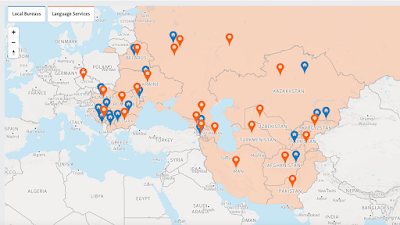
Today, RFE/RL broadcast to 23 countries in 27 languages.  Its headquarters remain in Prague even though no content is produced in Czech.  Here's where they currently produce material for.

Monday, September 30, 2019

Council of Europe

The Council of Europe was founded in 1949.  It is an international organisation that promotes democracy, protects human rights and is committed to the rule of law in Europe.  Its headquarters are in Strasbourg, France.

It's important to realise that the Council of Europe is not the same thing as the European Union.  Which can be confusing because the EU actually adopted the flag that the council created in 1955.  The council now puts an "e" on the flag to differentiate it from the EU.

The EU doesn't control the council as they are independent.  But no country has ever joined the EU without first being a member of the council.

The Council of Europe can't make binding laws but it can enforce certain agreements made by European states.  It runs the European Court of Human Rights.

The official languages are English and French.  Certain bodies also use German, Italian, and Russian.

Ten countries formed the Council of Europe in 1949 and today there are 47 member countries.  Basically every country in Europe except for Belarus, due to concerns over human rights and the use of the death penalty), Kazakhstan, due to human rights concerns, Kosovo, due to limited recognition, and the Vatican, for being a theocracy.

The "eastern block" countries didn't start joining until after the fall of communism.  Hungary was the first to join in 1990, followed by Czechoslovakia and Poland in 1991, Bulgaria in in 1992 and Romania in 1993.

Czechoslovakia was replaced by Czech Republic and Slovakia following the Velvet Divorce.  East Germany never joined because the the former territory basically joined following the reunification of Germany in 1990.  Yugoslavia wasn't ever a member.  Following the breakup, Slovenia became the first ex-Yugoslav country to join in 1993.  The Soviet Union was never a member either.  The first former Soviet republics to join were Estonia and Lithuania in 1993.  Other former republics joined later on and Russia joined in 1996.    

Montenegro was the most recent country to join back in 2007.

The Vatican does have observer status.  As does Israel, the USA, Canada, Japan, and Mexico.  The council of Europe has observer status with the United Nations.

The death penalty is abolished in member countries.  There's criticism of the USA and Japan each having observer status since the death penalty is still in practice.

Again, since the Council of Europe is not the same thing as the EU, Brexit doesn't apply.  While the UK is leaving the EU it will remain in the Council of Europe.

Here's a video I found out on YouTube that explains more about the Council of Europe

©Council of Europe

Friday, August 16, 2019

CEFTA

The Central European Free Trade Agreement, or CEFTA, was formed in 1992 by the Visegrád countries - Czechoslovakia, Poland, and Hungary.  After the Velvet Divorce both Czech Republic and Slovakia became independent members.  The purpose was to work together towards integrating political, economic, security, and legal systems with western free-market economies.

Over the years, other countries have joined CEFTA.  However, once a country joins the European Union it must leave CEFTA.  Former members include Bulgaria, Croatia, Romania, and Slovenia.  Basically being a CEFTA member servers as good preparation for eventually joining the EU.

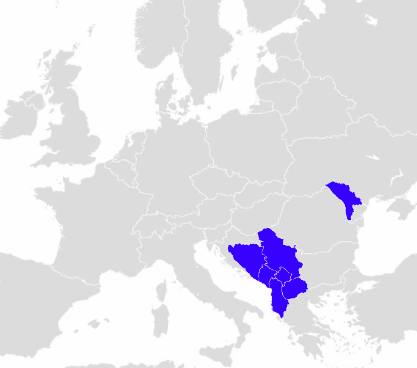
Current CEFTA members
CEFTA seems less "Central Europe" and more "Balkans" to me.  The seven current members are Albania, Bosnia and Herzegovina, Kosovo, Moldova, Montenegro, Macedonia, and Serbia.  Combined the CEFTA countries have a combined population of about 21,5 million people and a GDP over $290 billion.

Sunday, June 1, 2014

50 in 5

It's no secret that I've done quite a bit of traveling since I began my expat adventure in Czechland almost five years ago.  While I've been to a whole lot of places I have yet to visit every country in Europe.  At least not yet.  Sooner or later I will visit every country in Euroland at least once.

So how many countries have I been to?  Well that's a great question.  I've met lots of fellow travelers on my many adventures and it seems that everyone has their own definition of what counts as a visited country.  Some make more sense to me than others.
  1. It doesn't count unless you get a passport stamp.  Schengen did this one in.  There are no more passport stamps between member countries.  Besides, when I went to Reykjavík last year, I flew from the UK (non-Schengen) to Norway (Schengen) then on to Iceland.  I got a Norwegian stamp in my passport since I entered the Schengen zone from the UK but I only spent 30 minutes in the airport before my flight.  I don't think it counts.
  2. It doesn't count if you just drive through the country.  I agree with this one.  But does it count if you stop along the way, have a meal, buy some gasoline and keep on driving?  I don't think so.  When I travel to Vienna airport, and buy a latte or something along the way I never count that as a trip to Austria.  
  3. You have to spend a night in order for it to count.  I don't necessarily think this is right either.  What about a day trip where you spend several hours?  If you've spent money there, supporting the local economy, then I think that counts.  
  4. It doesn't count unless you have sex in the country.  This is probably the craziest guideline I've heard.  Does it have to be with a local?  What if you hook up with a tourist, not from the country you're visiting, does it still count?  I'll just leave this one alone.
  5. It has to be an internationally recognized country.  This gets a little trickier.  I don't count Transnistria because it's a break away republic and only other break away republics consider it another country.  While most of Europe has recognized Kosovo as an independent country, it is not a member of the United Nations (because Russia has veto power and is allied with Serbia).  I count Kosovo.  The Vatican isn't a UN country member but is a non-member observer state.  I count Vatican City as a separate country.
So now how many countries are there in Europe?
  1. As already mentioned, I count Vatican City and Kosovo but exclude Transnistria.
  2. I count England, Scotland, Wales and Northern Ireland, collectively, as one country - the United Kingdom.  If Scotland votes for independence, then any visits prior to an independent Scotland will still count as a visit to the UK.  
  3. Turkey is generally considered to be part of Europe.  After all, it is trying to join the EU.
  4. Some consider Georgia, Armenia, and Azerbaijan to be part of Europe.  Some consider them to be part of Central Asia.  Some consider them to be Eurasia.  It's a bit of a stretch but, given the Eurasia argument, I'll count the Caucasus as part of Europe.
So in my book there are 50 countries in Europe.  According to how I define "visiting a country" then I say I've been to 44 countries.  The only ones remaining are Belarus, Cyprus, Latvia, Lithuania, Norway and Ukraine.  I still haven't made it to Wales yet either but again, all four parts of the UK still only count as "1" in my book.

44 countries so far
July 1st will be my five-year anniversary of my arrival in Europe.  I don't see that I'll visit all 50 countries by then.  I'm going to use up practically all of my holiday time this year when my family comes in a few months so I don't see myself getting to all 50 countries by the end of the year either.  But maybe by the end of 2015.  So while it won't be 50 European countries in my first five years it could still be "50 countries in five years".

I always wanted to visit Charleston, South Carolina.  I've always heard how beautiful it is.  It's only about a four-hour drive there from Atlanta.  But in 13 years, I never once made it to Charleston.  It was always one of those things that I meant to do.  When I started this little adventure I vowed that I would not have "another Charleston".  I want to go everywhere.

Of course it's much more than just "collecting" countries.  If I was only concerned about collecting countries then I would have for sure already hit all 50 by now.  If the "50 in 5" was all that motivated me then I would not have gone to Italy, Croatia, France, Poland or Germany so many times.  I could have easily skipped going to Sicily and spent a weekend in Riga in order to pick up Latvia.  It's not about putting a tick in a box.  It's about visiting places that I've only read about before.  It's about trying to understand history.  It's about figuring out another culture.  It's about meeting locals and fellow travelers along the way.  It's about getting out of my comfort zone, and having wonderful adventures along the way.

No matter if my "50 in 5" is reached in 2014, 2015 or beyond, it won't stop me from continuing to travel.  There are still plenty of places that I want to see, in countries that I've already been to (most more than once).  When it does come time for my adventure here to end, and who knows when that will be, there's no way that I'll have another "Charleston". 


Update:  I finally made it to all 50 countries in 2016.  Just over seven years.

Monday, December 12, 2011

Postcards

I always send six postcards back to the USA when I travel. Part of my routine is that I find a nice little cafe somewhere, have a latté, and write out my postcards. It helps me focus my thoughts for possible blog posts later. With every card I actually try to write something of substance as opposed to "Greetings from where ever" and "Bye".

At times, the biggest challenge is just getting stamps. Every country is a little different. Sometimes you can buy stamps from a postcard kiosk on the street. Sometimes you buy stamps at a tobacco shop or a newsstand. Sometimes you can purchase stamps in hotel lobbies. And other times you have to go to the post office. When I arrive at a new destination, one of the first things I find out about is the post situation. Especially if I arrive someplace on a Saturday morning because you never know at what time the post office will close.

In Kosovo, the only place you can buy stamps is at the post office which, of course, is closed on Sundays. In Prishtina, I even went to the Grand Hotel to see if they possibly had stamps I could purchase. They did sell stamps. Great. However, on Sundays, the stamps are locked away upstairs and no one on duty had the key. Not so great. So my Kosovo postcards were all mailed from Albania.

I always ask for a postcard stamp to North America. Some countries charge different prices depending on where the postcard is going. For example, in Germany an international postcard stamp costs €0,75 regardless if it goes next door to Austria or all the way to Australia.

France charges €0,75 for the European Union and Switzerland but €0,89 for the rest of Europe or the USA.

Italy is expensive. There it's €0,75 for Europe, €1,60 for the USA and €2 for Australia.

In the Czech Republic, it's 20 Kč for Europe and 21 Kč (~$1.10) for the USA. I just budget in $20 for stamps and postcards on every trip I take and I'm covered.

There are normally mail boxes at airports and train stations. Most hotels will also mail things off for you, if you don't have time to find a box or the actual post office. In Albania, there are no mail boxes. The only mail boxes in the entire capital are in front of the post office so you have to go to the post office to mail anything.

My niece has a map of the world on her bedroom wall and she tacks up all of the post cards I send her. Someone else has a special album filled with the cards I've sent. My mom had the most creative idea. She pastes recipes on the back side of any postcard she receives and then puts them in an actual post card rack. Pretty clever.

Update:  2014 - Czech Post raised the price of a postcard to the USA to 30 Kč ($1.50).

Sunday, October 23, 2011

2011 Balkan Trip Summary

I made it back from my latest Balkan adventure. I traveled well over 1,200 km (745 miles) and I managed to do it all by bus.

Sofia was my starting and ending point. Bulgaria was fine except for that confusing head nod thing that they do. The next time I fly to Sofia it will be to visit Plovdiv, about 150 km (~93 miles) away. On the east side of the country, on the Black Sea, I still want to see Bourgas and Varna.

Macedonia was fine and Skopje made a good one-day visit. I'll wait and see what the capital looks like after all of the construction is completed.

I wasn't that impressed with Kosovo. Prishtina wasn't what I expected. I can see going back to Kosovo to visit Prizren. But that would be the only reason why.

Albania was interesting because I really didn't know too much about it before. Tirana was fine, except for having to dodge cars. I'll go back one day to visit Shkodër, Krujë and Berat. And of course, to see the completed museum exhibition. But, if Durrës is any indication then I can guarantee I won't be planning any beach holidays in Albania.

For me, the best part of the whole week was the brief time I spent at Lake Ohrid. For some reason it took me a while to get the name right. I kept saying Orhid or Orchid. But it is pronounced "Oxh-rid". You can bet that now that I've got the name down, I'll be back there for sure.

Overall, this was a good little adventure. Four new countries (again, all by bus), four currencies, and three languages (none of which I know). It was worth it. But it felt so good to sleep in my own bed last night. At least I'll be able to do that for a few more days. Then I'm headed back to Slovenia for a couple of days and then a road trip to Italy and San Marino.

Friday, October 21, 2011

Burek

One of the good things about traveling in the Balkans is the burek. Burek is popular for breakfast, but it also makes a great snack or midday meal.


It originated in Turkey but is popular in all of the countries of the former Yugoslavia.

The pastry consists of layers of thin, flaky phyllo dough that is filled with various ingredients and then baked or fried. Normally it has a type of feta cheese or ground meat & onions. While not as popular as the meat or cheese variety, my favorite is the spinach burek. In Ljubljana you can even find apple burek. I never tried the apple because to me that sounds less like burek and more like strudel.

You can find burek at most bakeries. You can even find dedicated burek stands. Burek and a cup of plain yogurt makes for a great, cheap breakfast.

Monday, October 17, 2011

Republic of Albania

Albania is a mystery to most people. All that I really knew was that we went to war with them in the movie Wag the Dog. Fiction aside...here's what I have discovered.

In Albanian the country is called Shqipëria. The Republic of Albania is a bit smaller than Maryland. Its capital city is Tirana. Albania sits in Southeast Europe and has a population close to 3 million people. It shares borders with Montenegro, Kosovo, Macedonia and Greece. Italy is only 72 km (45 miles) away across the Adriatic. For a long time Albania was the most isolated country in Europe.

Albanians are descended from Illyrians who came to the Balkans around 2000 BC. Ancient Illyria fell to Rome in 165 BC and then came under Byzantine rule in 395 AD when the Roman Empire split in two. Albania was part of the Ottoman Empire from 1385-1912 during which time most of the people converted to Islam. In 1912, Albania finally became an independent state.

In 1939, Italy invaded and occupied the country until the Germans took over in 1943. After WWII, the communists, led by Enver Hoxha, took over and that's when things get weird. Under Hoxha, Albania became an ultra-Stalinist state. In 1948, Albania broke off relations with Yugoslavia because of Yugoslav desires to absorb the country. It was a close ally of the Soviet Union until 1961 when Albania broke off diplomatic relations and became allies with China.

Like China, Albania had its own cultural revolution in 1967. People were transferred to remote areas while younger party members were given leading positions. Agriculture was completely collectivized. There was such a huge clamp down on religious activity that Albania declared itself the world's 1st atheist state. People were unable to give their children religious names without having to answer to the authorities.

In 1968, Albania quit the Warsaw Pact in protest of the Soviet-led invasion of Czechoslovakia. Albania then embarked on a self-reliant defense policy. People had to construct concrete bunkers from where they could defend the country from an external invasion. The country is still littered with around 700,000 of these things. Then in 1978, the Albanian-Chinese alliance came to an end and Albania became even more isolated.

Hoxha died in 1985 and the system continued to fall apart. In 1992, the first free elections ended 47 years of xenophobic communist rule. In 1999, the struggling country had to deal with 465,000 refugees escaping the Serbian ethnic-cleansing campaign in Kosovo.

Today Albania is a parliamentary democracy and has joined NATO. Albania wants to join the EU but its application for candidate status was rejected because it has not yet met all of the requirements to join. The country needs to continue fighting organized crime and government corruption, reform property rights, encourage media freedom and protect minority rights. Although the population is mostly secular, Albania, along with Kosovo and Turkey, is one of the only three Muslim-majority countries in Europe. Albania is still one of the poorest countries in Europe.

Update 2025:  Here's a short video I found on YouTube about Albania and China.

©History Matters

Sunday, October 16, 2011

Prishtina, Kosovo

Prishtina is Kosovo's capital and it has around 200,000 people. A lot of construction has taken place since the war. I've never been here before so I can't tell if things are getting better or if they are getting worse. There are lots of brand new, very modern, government office buildings. But at the same time there are statues, less than 12 years old, which are already crumbling.


I'm not quite sure what I expected from Prishtina. Granted, I did arrive on a Sunday and most everything was closed. But I still managed to walk around and see most of the city. This isn't difficult to do because there's not a whole lot to see.

I think that the best-known landmark is on Bill Clinton Boulevard. There is a large billboard of President Clinton and a three meter (nine foot) bronze statue which was unveiled in 2009. The statue shows him holding the 1999 agreement that permitted U.S. troops to enter Kosovo.


The "Newborn" obelisk, in front of the Palace of Youth and Sports, was inaugurated for Kosovo's independence in 2008. For some reason, Kosovo's president and prime minister signed the thing. Then others started signing it and now it's just covered in graffiti. I can't stand tagging.

At the end of the city center are several government buildings. On one of the fences are the Photos of the Missing. There are nearly 1,900 people who are still missing from the Kosovo conflict with Serbia in the 90s.

The Skanderberg monument is for the Albanian king who, in the 15th century, fought off the Ottomans for decades. The statue was designed in 2001.


Zahir Pajaziti was a commander in the Kosovo Liberation Army (KLA). He was killed in action in 1997. In 2008, he was declared a Hero of Kosovo.


Mother Teresa was born in Skopje but she was an ethnic Albanian. I guess the Mother Teresa statue makes sense because around 88% of Kosovo is Albanian.

Down the road there is the new Mother Teresa Cathedral. It was consecrated in September 2010 and is still under construction. Albanians abroad raised €1 million for the construction. Since the majority of the population is Muslim I'm surprised that there's really a huge need for a full on Catholic cathedral.


The National Library was unveiled in 1982. It is covered in a metal "fishing net" which makes it pretty groovy looking. I was told that it once held a huge amount of Albanian literature but that a lot of it was destroyed in the early 1990s by ethnic Serbs under Slobodan Milošović.

The bus from Skopje to Prishtina is only €5 ($6.75). It only takes about 20 minutes to get to the Kosovo border and then another couple of hours to get to Prishtina. This was the easy part. The difficult part was getting to where I was spending the night.

There are no hostels in Prishtina. At least not yet. There are plenty of hotels but you can find a couple of guest houses in town that are much cheaper. Through Hostelworld I found a couple of students with a private room for €10. The apartment is at a block of flats between the Bill Clinton statue and the Mother Teresa Cathedral. The address written on the building in pen was a nice touch. Do you know how difficult it is to find a place when the address is only written on the building in pen!?!? Yes, the building did look a bit run down, and the elevators don't work at all, but inside the flat was fine.

I wanted to visit Prizren on my way to Albania. The problem is that there is no luggage storage at the bus station there and I really don't feel like walking around town for several hours as I drag along my suitcase. So instead I'll just skip Prizren and go directly to Tirana. I'm off to bed now because my 6 hour-long bus leaves at 5 AM.

Republic of Kosovo

History plays a big role in Kosovo. But damn! At what point is enough enough? Here's the high, high-level run down.

The central Balkan region was part of the Roman Empire and then part of the Byzantine Empire. In the 7th century ethnic Serbs migrated to what is now Kosovo. In medieval times Kosovo became the center of Serbian culture and home to many Serbian Orthodox monasteries.

In 1389, the Serbs were defeated at the Battle of Kosovo which led to 500 years of Ottoman rule. During this time many Turks and Albanians moved in to the area and by the end of the 19th century Albanians became the dominant ethnic group.

The Ottoman Empire lost Kosovo to Serbia in 1912. After WWII, Kosovo became part of Yugoslavia as an autonomous province of Serbia. In the 1980s Albanian nationalism increased and demanded full republic status for Kosovo. Slobodan Milošević fanned Serb nationalism and revoked Kosovo's status as an autonomous province of Serbia.

In the early 1990s the Kosovars used passive resistance to gain international recognition for an independent Kosovo while Serbia repressed Kosovo. Albanians who were tired of passive resistance formed the Kosovo Liberation Army (KLA) and fought back. Serbia hit back hard and ethnic cleansing began. Over 800,000 Albanians were forced from their homes.

In March 1999, NATO began a three-month operation against Serbia that forced them to remove their military and police forces from Kosovo. The UN Security Council placed Kosovo under UN control. Today, several thousand NATO-led KFOR peacekeepers (including Czech forces) continue to maintain the peace between the Albanian majority and the Serb minority in Kosovo.

In February 2009, Kosovo declared itself independent and over 70 countries have recognized the Republic of Kosovo. Several countries can't recognize an independent Kosovo because it opens a Pandora's box at home.

If Spain recognizes Kosovo then what about Basque claims of independence? Israel can't recognize Kosovo and deny independence for Palestine.  Russia would have problems with Chechnya. China has Tibet.

Clearly Serbia doesn't recognize Kosovo's independence which causes problems for travelers. No one can get in to Serbia if they first travel to Kosovo. If you enter Kosovo from Montenegro, Albania or Macedonia then you have to leave Kosovo and enter Serbia directly without going through Kosovo. It's a real pain in the ass.

Kosovo is a little larger than Delaware and has a population of 1.8 million. The capital city is Prishtina.

Even though Kosovo isn't part of the Eurozone it uses the Euro as its official currency.

The dominant language here is Albanian but lots of people here speak either English or German. I can't use my Czech here because some people assume it is Serbian which isn't too popular.

Update: This month (October 2011) the Czech military ended their mission as part of the Kosovo Force (KFOR). Over 8,000 Czech soldiers were deployed over the course of operations there. Currently 90 Czech reservists will remain but all will probably leave by the end of 2012.