Showing posts with label Vatican City. Show all posts

Monday, April 25, 2022

Partnership for Peace

NATO has something something called Partnership for Peace (PfP).  It's a bilateral cooperation programme between NATO and Euro-Atlantic partner countries that lets partners build up an individual relationship with NATO.  PfP started in 1994 as a way to build security relationships between NATO and non-NATO countries.  Participating countries choose their own priorities for cooperation and the both the level and pace of progress.

The programme allowed NATO to reach out to former Warsaw Pact and Soviet Republics following the end of the Cold War.  The programme allows countries to build closer relationships with NATO without actually becoming a NATO member.  It's important to remember that the PfP programme has nothing to do with NATO's article 5 which says that an attack on one NATO country is an attack on all.  So while Ukraine is a PfP member it is not a member of NATO.  

Here's the list of when countries joined the PfP programme.  Many went on to officially join NATO later on.  

Romania - 26.01.1994
Lithuania - 27.01.1994
Poland - 02.02.1994
Estonia - 03.02.1994
Hungary - 08.02.1994
Ukraine - 08.02.1994
Slovakia - 09.02.1994
Bulgaria - 14.02.1994
Latvia - 14.02.1994
Albania - 23.02.1994
Czechia - 10.03.1994
Moldova - 16.03.1994
Georgia - 23.03.1994
Slovenia - 30.03.1994
Finland - 09.05.1994
Sweden - 09.05.1994
Azerbaijan - 04.05.1994
Turkmenistan - 10.05.1994
Kazakhstan - 27.05.1994
Russia - 22.06.1994
Armenia  05.10.1994
Uzbekistan - 13.07.1994

Belarus - 11.01.1995
Austria - 10.02.1995
Malta - 26.04.1995
Macedonia - 15.11.1995

Switzerland - 11.12.1996

Ireland - 01.12.1999

Croatia - 25.05.2000

Tajikistan - 20.02.2002

Montenegro - 14.12.2006
Serbia - 14.12.2006

In 1999, Czechland, Hungary, and Poland became the first three PfP countries to join NATO.

In 2004, NATO saw its largest expansion when seven PfP countries joined - Bulgaria, Estonia, Latvia, Lithuania, Romania, Slovakia, and Slovenia.

Malta joined the programme in 1995 but left in 1996 and rejoined in 2008.

In 2009 - Albania and Croatia joined NATO.  Montenegro joined NATO in 2017 and North Macedonia joined in 2020 as the 30th NATO member.

In 2014, when Russia first invaded Ukraine, NATO suspended practical cooperation with Russia.  It's hard to picture Russia as a Partnership for Peace member considering it invaded Ukraine to keep it from joining NATO in the future.  But by doing do, I don't think it will be long until Finland and Sweden decide to join NATO.

Traditionally neutral countries such as Austria, Finland, Sweden, and Switzerland are all PfP members.  For Austria, the programme allows for cooperation with NATO without joining because under the country's constitution, Austria is prohibited from entering into military alliances and no foreign military bases may be on Austrian territory.  

Andorra, Liechtenstein, Monaco, San Marino, and Vatican City are all neutral micro states that are surrounded by NATO members.  They are all a part of the OSCE but they do not participate the PfP programme.

Cyprus is the only EU member that isn't a member of either NATO or the PfP programme. Kyrgyzstan is the only former Soviet republic that didn't join the PfP programme.  It did join the CSTA with Armenia, Belarus, Kazakhstan, Russia, and Tajikistan.

Update: 4 April 2023 - Finland became the 31st member of NATO.

Monday, September 30, 2019

Council of Europe

The Council of Europe was founded in 1949.  It is an international organisation that promotes democracy, protects human rights and is committed to the rule of law in Europe.  Its headquarters are in Strasbourg, France.

It's important to realise that the Council of Europe is not the same thing as the European Union.  Which can be confusing because the EU actually adopted the flag that the council created in 1955.  The council now puts an "e" on the flag to differentiate it from the EU.

The EU doesn't control the council as they are independent.  But no country has ever joined the EU without first being a member of the council.

The Council of Europe can't make binding laws but it can enforce certain agreements made by European states.  It runs the European Court of Human Rights.

The official languages are English and French.  Certain bodies also use German, Italian, and Russian.

Ten countries formed the Council of Europe in 1949 and today there are 47 member countries.  Basically every country in Europe except for Belarus, due to concerns over human rights and the use of the death penalty), Kazakhstan, due to human rights concerns, Kosovo, due to limited recognition, and the Vatican, for being a theocracy.

The "eastern block" countries didn't start joining until after the fall of communism.  Hungary was the first to join in 1990, followed by Czechoslovakia and Poland in 1991, Bulgaria in in 1992 and Romania in 1993.

Czechoslovakia was replaced by Czech Republic and Slovakia following the Velvet Divorce.  East Germany never joined because the the former territory basically joined following the reunification of Germany in 1990.  Yugoslavia wasn't ever a member.  Following the breakup, Slovenia became the first ex-Yugoslav country to join in 1993.  The Soviet Union was never a member either.  The first former Soviet republics to join were Estonia and Lithuania in 1993.  Other former republics joined later on and Russia joined in 1996.    

Montenegro was the most recent country to join back in 2007.

The Vatican does have observer status.  As does Israel, the USA, Canada, Japan, and Mexico.  The council of Europe has observer status with the United Nations.

The death penalty is abolished in member countries.  There's criticism of the USA and Japan each having observer status since the death penalty is still in practice.

Again, since the Council of Europe is not the same thing as the EU, Brexit doesn't apply.  While the UK is leaving the EU it will remain in the Council of Europe.

Here's a video I found out on YouTube that explains more about the Council of Europe

©Council of Europe

Monday, June 17, 2019

Taiwan

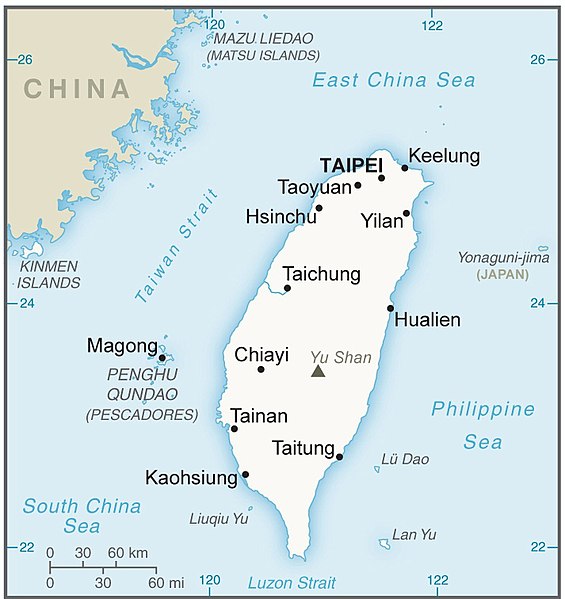
Taiwan, officially the Republic of China (中華民國), is an island state in East Asia.  It is the biggest state, and the largest economy, not recognised as a country by the UN.  Taiwan is south-east of China, south-west of Japan, and north of the Philippines.
The island is about the size of Maryland and Rhode Island combined.  Taiwan is home to more than 23,5 million people.  Taipei is the capital and its largest city.

Indigenous people settled the island about 6.000 years ago.  In 1542, Portuguese sailors passed by the island.  They never stopped by noted it on their maps as Ilha Formosa, ("beautiful island"), and up to the early 20th century many Europeans refereed to it as Formosa.

In 1683 the island was annexed by the Qing dynasty until 1895 when it was ceded to Japan.  Taiwan was a Japanese island for 50 years until the end of WWII in 1945 when it was then given to the Republic of China (which overthrew the Qing dynasty in 1911.

There was a civil war in China between the Nationalists and the Communists that was interrupted by WWII.  It continued after the war until the Communists took the mainland in 1949 and two million Nationalists fled to Taiwan.  Beijing declared itself the capital of the People's Republic of China and Taipei became the temporary capital of the Republic of China.  Both insisting to be the one and only true China.

©Test Tube News

©ABC News

The Nationalist Kuomintang government declared martial law in 1949 and it remained in place until 1987.  This time is referred to as the "White Terror" when 140.000 people were arrested, tortured, and/or killed for being perceived as either anti-nationalist or pro-communist.  Since then Taiwan has moved from a single-party military dictatorship to a multi-party democracy with a semi-presidential system.  In 2016 Tsai Ing-wen became the first female president.

In 1971, the UN recognised the PRC as China and Taiwan lost its seat.  Taiwan has official diplomatic relations with only 14 of the 193 UN countries, plus the Holy Sea.  These countries are Eswatini, Belize, Guatemala, Haiti, Honduras, Nicaragua, Paraguay, Saint Kitts and Nevis, Saint Lucia, Saint Vincent and the Grenadines, Nauru, Palau, Tuvalu, and the Marshall Islands.  Not exactly the most powerful countries.  That's because the PRC claims Taiwan as part of China and it refuses to have diplomatic relations with countries that recognise Taiwan.

So Taiwan has to maintain unofficial relations via Taipei Economic and Cultural Representative Offices which function as de facto embassies and consulates.  In most international organisations like the World Health Organization, where China participates, Taiwan ends up being called Chinese Taipei.
Chinese Taipei, 中華台北is the name the country competes under at the Olympics.

Mandarin Chinese is the official language.  However, the traditional Chinese charters are used whereas China uses the simplified characters.  Meaning that someone from Beijing and someone from Taipei could speak with each other but would have problems reading a letter from each other.

Taiwan has an industrialised economy and is the 21st largest in the world.  The New Taiwan Dollar, NT$, is the official currency.


On 24 May 2019, same-sex marriage became legal.  This makes Taiwan the first country in Asia to recognise gay marriage.

The biggest problem Taiwan has is China's claim on the island.  I can understand that both sides can't continue to claim to be the sole legitimate China.  In my humble opinion enough time has gone by that the PRC is China and Taiwan is Taiwan.  It seems odd to me that China lays claim to the island when it had only been a part of mainland China from 1945 to 1949.  Here's a video I found out on YouTube about how powerful Taiwan is.

©Test Tube News

Czechland has unofficial relations with Taiwan.  Zdeněk Hřib is the mayor of Prague who, when he was studying to become a doctor, did his medical training internship in Taiwan.  He doesn't always get along with Miloš Zeman, the Czech President, who is a big supporter of China.

Update: In October Prague ended its sister city agreement with Beijing over a dispute.  On 12 December 2019, Prague Mayor Zdeněk Hřib signed a new sister city agreement with Taipei. 

Update 2022:  Here's a bit more on cooperation between Czechland and Taiwan.

Monday, August 4, 2014

Emergency Numbers

In the USA, if you need to make an emergency call for the police, fire department or an ambulance you dial 911.  In Europe, each country has their own emergency numbers.  For example, in Czechland you call:

150 for fires, natural disasters, accidents and emergencies
155 for health problems, injuries or accidents requiring medical attention
156 for the municipal police
158 for disturbances of public order and safety, traffic accidents or to report a crime

And that's just for Czechland.  To get an ambulance in Spain you dial 061, in Austria it is 144, in Italy it is 118, in Croatia it is 94, in Hungary the number is 104, while both the UK and Ireland use 999.  The list of numbers goes on and on. 

It can be a real problem if you don't know the emergency number in the country you're visiting.  So the European Union came up with the 112 number.  Aside from the local numbers, anyone in any EU country can dial 112 for any emergency - police, fire, ambulance.  112 even works in some non-EU countries such as Andorra, San Marino, Liechtenstein, Monaco, Vatican City, Iceland, Macedonia, and Serbia.

112 is a free call from either land line or mobile phones and can be used even without a SIM card.  The 112 number is awesome because the operators are prepared to dispatch calls in foreign languages.  So no need to speak Czech if you need the police.

Here's short video I found out on YouTube about the 112 emergency number.
 

Sunday, June 1, 2014

50 in 5

It's no secret that I've done quite a bit of traveling since I began my expat adventure in Czechland almost five years ago.  While I've been to a whole lot of places I have yet to visit every country in Europe.  At least not yet.  Sooner or later I will visit every country in Euroland at least once.

So how many countries have I been to?  Well that's a great question.  I've met lots of fellow travelers on my many adventures and it seems that everyone has their own definition of what counts as a visited country.  Some make more sense to me than others.
  1. It doesn't count unless you get a passport stamp.  Schengen did this one in.  There are no more passport stamps between member countries.  Besides, when I went to Reykjavík last year, I flew from the UK (non-Schengen) to Norway (Schengen) then on to Iceland.  I got a Norwegian stamp in my passport since I entered the Schengen zone from the UK but I only spent 30 minutes in the airport before my flight.  I don't think it counts.
  2. It doesn't count if you just drive through the country.  I agree with this one.  But does it count if you stop along the way, have a meal, buy some gasoline and keep on driving?  I don't think so.  When I travel to Vienna airport, and buy a latte or something along the way I never count that as a trip to Austria.  
  3. You have to spend a night in order for it to count.  I don't necessarily think this is right either.  What about a day trip where you spend several hours?  If you've spent money there, supporting the local economy, then I think that counts.  
  4. It doesn't count unless you have sex in the country.  This is probably the craziest guideline I've heard.  Does it have to be with a local?  What if you hook up with a tourist, not from the country you're visiting, does it still count?  I'll just leave this one alone.
  5. It has to be an internationally recognized country.  This gets a little trickier.  I don't count Transnistria because it's a break away republic and only other break away republics consider it another country.  While most of Europe has recognized Kosovo as an independent country, it is not a member of the United Nations (because Russia has veto power and is allied with Serbia).  I count Kosovo.  The Vatican isn't a UN country member but is a non-member observer state.  I count Vatican City as a separate country.
So now how many countries are there in Europe?
  1. As already mentioned, I count Vatican City and Kosovo but exclude Transnistria.
  2. I count England, Scotland, Wales and Northern Ireland, collectively, as one country - the United Kingdom.  If Scotland votes for independence, then any visits prior to an independent Scotland will still count as a visit to the UK.  
  3. Turkey is generally considered to be part of Europe.  After all, it is trying to join the EU.
  4. Some consider Georgia, Armenia, and Azerbaijan to be part of Europe.  Some consider them to be part of Central Asia.  Some consider them to be Eurasia.  It's a bit of a stretch but, given the Eurasia argument, I'll count the Caucasus as part of Europe.
So in my book there are 50 countries in Europe.  According to how I define "visiting a country" then I say I've been to 44 countries.  The only ones remaining are Belarus, Cyprus, Latvia, Lithuania, Norway and Ukraine.  I still haven't made it to Wales yet either but again, all four parts of the UK still only count as "1" in my book.

44 countries so far
July 1st will be my five-year anniversary of my arrival in Europe.  I don't see that I'll visit all 50 countries by then.  I'm going to use up practically all of my holiday time this year when my family comes in a few months so I don't see myself getting to all 50 countries by the end of the year either.  But maybe by the end of 2015.  So while it won't be 50 European countries in my first five years it could still be "50 countries in five years".

I always wanted to visit Charleston, South Carolina.  I've always heard how beautiful it is.  It's only about a four-hour drive there from Atlanta.  But in 13 years, I never once made it to Charleston.  It was always one of those things that I meant to do.  When I started this little adventure I vowed that I would not have "another Charleston".  I want to go everywhere.

Of course it's much more than just "collecting" countries.  If I was only concerned about collecting countries then I would have for sure already hit all 50 by now.  If the "50 in 5" was all that motivated me then I would not have gone to Italy, Croatia, France, Poland or Germany so many times.  I could have easily skipped going to Sicily and spent a weekend in Riga in order to pick up Latvia.  It's not about putting a tick in a box.  It's about visiting places that I've only read about before.  It's about trying to understand history.  It's about figuring out another culture.  It's about meeting locals and fellow travelers along the way.  It's about getting out of my comfort zone, and having wonderful adventures along the way.

No matter if my "50 in 5" is reached in 2014, 2015 or beyond, it won't stop me from continuing to travel.  There are still plenty of places that I want to see, in countries that I've already been to (most more than once).  When it does come time for my adventure here to end, and who knows when that will be, there's no way that I'll have another "Charleston". 


Update:  I finally made it to all 50 countries in 2016.  Just over seven years.

Sunday, November 18, 2012

Athens, Greece

Nat and I decided on a quick weekend getaway to Athens.  With 19 °C (66 °F) it was a nice little break from the 8 °C (46 °F) in Brno.  We had a really nice time but aside from the Acropolis there really isn't that much to see. You can check out pretty much everything in a day.  Whilst I still want to go back to Greece to visit Iraklion, Kos, Mykonos, Santorini and Thessaloniki, I don't have any burning desire to go back to Athens anytime soon.  I was there in 1993 and now in 2012; so perhaps in another 20 years.

 
Athens, Αθήνα, is the capital city and the largest city in Greece.  With around 3,400 years of recorded history it is one of the oldest cities in the world.  Today, the metro Athens area has around 4 million people which makes it the EU's 4th largest capital city and the 7th largest city overall.

In 1896, Athens hosted the first modern Olympics.  The Panathenaic Stadium, Παναθηναϊκό στάδιο, was rebuilt from the remains of an ancient Greek stadium.  It is one of the oldest stadiums in the world and it is the only one in the world that is built entirely out of white marble. 


Omonoia Square, Πλατεία Ομονοίας, is Athens' oldest square.  It's in the northern corner of downtown.  The "Five Circles" was erected in 2001.  It is a 15-meter (49 feet) tall stainless steel mobile that runs with water.


The Metropolitan Cathedral of the Annunciation, Καθεδρικός Ναός Ευαγγελισμού της Θεοτόκου, is simply known as the Mētrópolis.  It is the archbishop's church of Athens. 


Construction began in 1842 and it was completed in 1862.  Marble from 72 demolished churches was used to build the church walls.  The church is home to the tombs of two different saints who were killed by Turks during the Ottoman Empire.  The church is currently undergoing renovation. 

Syntagma (Constitution) Square, Πλατεία Συντάγματος, is the city's largest square.  The square was built from 1836 to 1840.  It is home to the Greek Parliament which used to be the Royal Palace.  With everything going on in Greece right now, this is a main spot for protests.  Every hour on the hour you can see the changing of the presidential guards at the tomb of the Unknown Soldier.


The Zappeion, Ζάππειον Μέγαρο, is located at the National Gardens.  It was the first building that was constructed specifically for the modern Olympic Games.  At the 1896 Summer Olympics it was the site of the fencing competition.  It was the press center during the 2004 Summer Olympics.  Today it is a meeting center used for official ceremonies.

Hadrian's Arch, Αψίς του Ανδριανού, is a gateway that was built in honor of Roman Emperor Hadrian.  It dates back to 131 or 132 AD.  It is solid marble; no cement or mortar was used.  It is 18 meters (59 feet) high.

The arch is near the Temple of Olympian Zeus, Ναός του Ολυμπίου Διός.  The temple was dedicated to Zeus, the king of the Greek gods.  Construction on the temple began in the 6th century BC but wasn't completed until the 2nd century AD around 638 years.  It was once the largest temple in Greece.  The column on the ground collapsed in 1852.

Hadrian's Library is on the north side of the Acropolis.  It was built in 132 AD.

The Theater of Dionysus is one of the earliest preserved open-air theaters in Athens.  It was dedicated to Dionysus who was the Greek god of wine and the patron of drama.  Excavation of the theater began in 1838 and lasted over 100 years.  Local area remains around the theater date back to the 6th century BC.  A partial restoration is underway and the $9 million project is scheduled to finish in 2015.

The Tower of the Winds is located in the Roman Agora.  It is an octagonal marble clock tower.  It is a combination sundial, water clock and wind vane.  The tower is 12 meters (39 feet) tall and has a diameter of about 8 meters (26.25 feet).  It was excavated in the 19th century.

The Temple of Hephaestus, Ναός Ηφαίστου, was inaugurated in 416-415 BC.  It was built for Hephaestus who was the Greek god of metal working and craftsmanship.  From the 7th century to 1834 it served as the Greek Orthodox church of St. George Akamates.

The Odeon of Herodes Atticus, Ωδείο Ηρώδου του Αττικού, is a stone theater on the side of the Acropolis that was used for music concerts.  The 5,000 seat theater was built in 161 AD.  It was renovated in 1950.

The new Acropolis Museum, Μουσείο Ακρόπολης, is really well done.  It was built in order to house every artifact found on and around the Acropolis.  It opened in June 2009.  It is 14,000 sq meters (~150,700 sq ft) and is currently home to around 4,000 objects.  Admission is only €5 and everything is in Greek and English – Yeah!

The Acropolis, Ακρόπολις, is the most famous landmark in Athens.  It is a UNESCO World Heritage Site.  Many people seem to use the words "Acropolis" and "Parthenon" interchangeably.  The Acropolis is the big flat hill that overlooks the city.  The Parthenon sits on top of the Acropolis.

The Parthenon is a temple that was built from 447 to 438 BC to honor Athena, the patron goddess of the city.  It is quite large at 30.9 meters by 69.5 meters (111 feet by 228 feet) and is considered to be the world's finest example of Doric-style architecture.


Hotel room view of the Acropolis
Over the centuries it was also a church and then a mosque.  During the Turkish Occupation of Greece it was used as a munitions depot.  In 1867, there was an explosion that occurred during a battle with the Venetians which caused most of the damage seen today.  There is a lot of work being done on the Parthenon but estimates are that it will take another 20 years and €70 million to complete the restoration.  So again, perhaps I'll head back in another 20 years.

Update: March 2023, the Vatican has returned three pieces of the Parthenon to Greece.

©BBC News

Friday, February 17, 2012

Italian Republic

Tomorrow I've got a day trip planned to Venice, Italy.  So here's a little bit about the Italian Republic.  Italy is easy to find on the map because it looks like a boot.  It also includes the islands of Sardinia and Sicily.  The population is over 61.25 million people and the country is slightly larger than Arizona.

Italia is also home to two independent countries.  San Marino is in the north and the Vatican is located within Rome, Italy's capital city.  There are no border checks, everyone speaks Italian and uses the Euro.

In 1861, the regional states on the peninsula, plus Sardinia and Sicily, became a nation under King Victor Emmanuel II.  In the early 1920s, Mussolini's Fascist dictatorship ended parliamentary government and eventually placed Italy as an Axis power.  Italy was defeated in WWII and a democratic republic replaced the monarchy in 1946.  Italy was a founding member of NATO and the European Union.

There is a big difference between the north and the south.  On average, people in the north earn more than the EU average while people in the south earn less.  The north is more industrial with lots of private companies driving the economy.  The south is less developed, is more agricultural, has higher unemployment and a larger dependency on government welfare.

Way cool that the Italian €1 coin features an image from Da Vinci.
Italy is part of the Schengen zone so there is open travel with the rest of the EU.  However, the country's long coastline makes it a target for illegal immigration from southeast Europe and northern Africa.  Other persistent problems for the country include organized crime, corruption, a large underground economy and a public debt that is ~120% of its GDP.  The current government is rolling out various austerity measures in an effort to turn things around.

But for all of its problems, Italy is still a major player.  It has the fourth-largest economy in Europe behind Germany, France and the United Kingdom (3rd in the Eurozone because the UK still uses the £).  Globally it is the seventh-largest economy and it holds the world's third-largest gold reserves.

The country is absolutely beautiful!  The food is amazing.  And how can you not love a country that produces the most wine in the world?  So far, I've made it to Milan, Florence, Pisa, Siena, San Gimignano and Rome.  But there are still so many more places to visit on the mainland, in addition to Sardinia and Sicily.  Naples, Bologna, Verona, Turin, Bari, and Padua are all on my list.  The country is rich in history and it is home to the largest number of UNESCO World Heritage Sites.

Update 2025:  Here's a couple of short, interesting videos that I found on YouTube about why Italy wasn't occupied after WWII and why the country abolished its monarchy.

©History Matters

©History Matters

Friday, September 23, 2011

Vatican Post

Ever since Vatican City became an independent country in 1929 it has had its own postal service.


All of the Vatican mail is sent directly to Switzerland to be routed worldwide. I'm sure that everything is billed at the international rate. I mean there can't be that much internal mail when the country is only 0.2 square miles.

Not all of the mail is from tourists. Italian mail is notoriously slow. Lots of Romans make weekly trips to the Vatican to send important letters and packages.

Since Vatican City is a separate country you can't use Italian stamps in the yellow Vatican post boxes. And you can't use Vatican stamps in the red Italian post boxes.


More letters are sent each year, per inhabitant, from Vatican City than from anywhere else. Not too bad for the world's smallest country.

Thursday, September 22, 2011

St. Peter's Basilica, Vatican City

The biggest attraction at the Vatican is Basilica Papale di San Pietro in Vaticano (St. Peter's Basilica).


Until 1989 it was the largest church in the world. It still has the largest interior of any Christian church and can hold 60,000 people.


St. Peter's is regarded as one of the holiest Catholic sites. This is where St. Peter, who was one of Jesus' twelve apostles and who was the first pope, was crucified and buried. His tomb is directly below the basilica's altar.

The original 4th century basilica was begun by the Roman Emperor Constantine from 319 - 333 AD. Construction of the current basilica began in 1506 and was completed in 1626.

The church is amazing! Vatican City is a UNESCO World Heritage site. We even managed to attend mass, in Italian, in one of the side chapels. There is a strictly enforced dress code - no shorts, bare shoulders or short skirts. Even if you make it past the fashion police at the security check, the attendants at the door will turn away anyone that is showing too much skin.

The apartment that we rented during our Roman holiday was only about a seven minute walk to St. Peter's Square. Anyone who does not get up and go early in the morning is a big fool!! We were there by 7:30 AM and it felt like we had the place all to ourselves. By 10:30 the place is crowded and waves of tour groups begin taking over. We really enjoyed our early morning walks as we watch the sun come up over the square.

Around the corner is the Vatican Museum. Again, if you go early then the crowds aren't bad and you don't have to worry about purchasing tickets in advance.

The Roman Catholic Church has an amazing art collection. I really enjoyed all of the sculptures. Of course the highlight of the museum is the Sistine Chapel. The museum is pretty liberal about letting people take pictures except, of course, when it comes to the chapel. There is a strict no camera policy. Here are a couple of photos I found on the Internet of the chapel. It is much more impressive in person.