Showing posts with label Czech Military. Show all posts

Tuesday, March 28, 2023

Emil Boček, R.I.P.

General Emil Boček turned 100 years old on 25. January.  He was a Brno native and the last remaining airman of Czechoslovak Royal Air Force.  On 25. March he passed away.

When he was 16, he illegally escaped the Protectorate of Bohemia and Moravia and he joined the Czechoslovak foreign army in France.  Later he became one of the youngest recruited in to the RAF.

He was an aircraft mechanic in the 312th Fighter Squadron.  From 1944, he served as a fighter pilot in B Squadron of the Czechoslovak 310th Fighter Squadron.  He was credited with 26 operational flights, flying almost 74 hours. 

Although he was a hero and fought in the resistance, the Communists frowned that he was a member of the non-communist resistance and he left he military in 1946.

He had owned a car repair shop in Brno but he had to give up ownership when Czechoslovakia nationalised private property following the 1948 coup.  He continued to work at the shop and was never persecuted by the state.

The general was awarded the Order of the White Lion of Military Group, 3rd class in 2010.  In 2017 he was awarded the Order of the White Lion of the First Class Military Group for extraordinary services to the defence and security of the state and excellent combat activities.

Following his passing, Prime Minister Fiala said that "General Boček was fighting for our country to be democratic, free and independent."  

Here are two short videos, in Czech, that I found out on YouTube.

©TV Nova

©sleduju37p

Update April 2023:  Here's a video from the funeral, showing military honours, that I found on YouTube.

©Petr Komůrka

Wednesday, February 1, 2023

New Czech President

The results are in and Czechland is getting a new president.  Petr Pavel will replace incumbent president Miloš Zeman.  When he takes office in March he will be country's fourth president.

Here's what's gone over here.  Following the election in 2021,  Petr Fiala became prime minister and Andrej Babiš was out of a job.  For some reason he decided to run for president.

The first round of presidential elections took place on 13-14 January.  General Pavel ran as an independent candidate and won the first round of elections with 35,4% of the vote.  Babiš came in second with 34,99%.

Most of the other candidates put their support behind Pavel and he won the second round of voting with 58,33%.  He won by more than a million votes.  There was just over 70% voter turnout which was the highest turnout in any national election since 1998.   

President-elect Pavel enlisted in the Czechoslovak People's Army after graduating high school in 1983.  Following the Velvet Divorce, he served in the Czech Army and from 2012 to 2015 he was the Chief of the General Staff of the Czech Armed Forces. From 2015 to 2018 he was the Chairman of the NATO Military Committee; the first military officer from the former Warsaw Pact to hold the position.

While he doesn't have any political experience he does have a master's degree in international relations from King's College London and speaks English, French, and Russian. 

Pavel is a social progressive who supports gay marriage, euthanasia, and rejects the death penalty.  He is pro-Western, pro-EU, pro- NATO, and he supports Ukraine.  He was endorsed by Spolu, the centre-right governing alliance.

Following the Velvet Revolution, people chanted "Havel na Hrad" ("Havel to the Castle") for Václav Havel to become president (because Prague Castle is the official office of the president).

During the campaign, it became "Pavel na Hrad".

Babíš was endorsed by outgoing president Zeman and the Communist Party of Bohemia and Moravia.  Babiš tried to portray Pavel as a warmonger.  Babiš also caused additional controversy when he said that if Poland was attacked by Russia, then he would not comply with NATO's article 5, and would not go to Poland's defence.

Here's a short video I found on YouTube about the election.

©Al Jazeera

Thursday, September 15, 2022

EUFOR

The European Union Force Bosnia and Herzegovina (EUFOR) is a military deployment to help keep the peace in Bosnia and Herzegovina (BiH).  At least it used to be called EUFOR.  Now it is Operation ALTHEA.


The United Nations put a peacekeeping force called UNPROFOR in BiH  back in 1992.  As part of the 1995 Dayton Peace Accords between BiH, Croatia, and Serbia (with Serbia also representing Srbska Republika), there was a one-year mandate for a multinational peace enforcement force.  The Implementation Force (IFOR), which replaced UNPROFOR, was led by NATO under the codename Operation Joint Endeavour.  

After the one year, IFOR was replaced by the Stabilisation Force in Bosnia and Herzegovina (SFOR).  SFOR was another NATO-led peacekeeping force, with several non-NATO countries contributing troops.  IFOR was replaced by EUFOR in December 2004.


NATO handed over its peacekeeping mission to the EU which is how EUFOR took over in 2004.  Operation ALTHEA ensures compliance with the Dayton Peace Agreement and contributes to safe and secure environment in BiH.

There are about 1000 troops currently stationed in BiH from 19 different countries, including Czechland.  The countries are all EU and/or NATO member states with the exception of Chile which isn't either.  In December 2020, the UK withdrew its troops from EUFOR after 16 years due to Brexit

The EU also has an Intermediate Reserve Force based in Europe that can be deployed on short notice to reinforce EUFOR in BiH if needed.

The first five years each saw a commanding general from a different country.  For some reason, since December 2009, each year the commanding general comes from Austria.

Here are a couple of short videos I found on YouTube.

©EUFOR Althea
©EUFOR Althea

Update March 2023:  Here's the new EUFOR video.

©EUFOR Althea

Tuesday, September 13, 2022

KFOR

KFOR, Kosovo Force, is a NATO-led international peacekeeping force in Kosovo.  Following the breakup of Yugoslavia and the wars in the Balkans, the UN Security Council passed a resolution in 1999 which among other things authorised an international with substantial NATO participation in Kosovo.  Two days after the resolution, on 11 June 1999, KFOR entered the country.

The main tasks of KFOR are to ensure a safe and secure environment and the freedom of movement for all communities in the country.  

At its height, KFOR was made up of 50.000 troops from 30 NATO and non-NATO countries.  Today are are just over 3700 troops from 27 countries in Kosovo.

The Czech Armed Forces have participated as part of KFOR since 1999.  In 2011, they ended their deployment and left its base in Sajkovac.  However, there are currently eight Czech soldiers serving at KFRO Headquarters in Prishtina.

The USA has just over 560 soldiers currently deployed to KFOR.

KFOR is gradually transferring responsibilities over to Kosovo's Security Force.

Here's a six-minute video I found on YouTube about KFOR.

©NATO

Update March 2023:  Here's a 9½-minute video about the evolution of KFOR.

©NATO

Saturday, December 25, 2021

Czechs vs Santa Claus

Again, 24 December in Central Europe is Christmas.  In the USA, and the UK, the 24th is Christmas Eve and the 25th is Christmas Day.  In the UK, the 26th is Boxing Day which isn't a thing in the U.S.

In Czechland, and Germany, the 24th, the 25th and the 26th of December are public holidays.  Like all public holidays you hope that they don't fall on the weekend because then you lose the free day off.

In Germany, the 25th and 26th are Erster Weihnachtstag and Zweiter Weihnachtstag, respectively the First and Second Christmas Day.  The 26th is also Stephanstag (St. Stephen's Day).

In Czechland, the 24th is Štědrý den.  The 25th is první vánoční svátek and the 26th is druhý vánoční svátek, the First and Second Christmas Day with the 25th also called Boží hod vánoční (the Christmas Feast) and the 26th also being Svátek svatého Štěpána (St. Stephen's Day).

Today we started out with Oma's typical German breakfast.  This is coffee with fresh bread rolls, meats, cheeses, butter, home made jams, and hard-boiled eggs.

We went for a walk around town for a couple of hours and then just relaxed for the rest of the day.  There are always fairly tales on German TV and of course we had to watch Drei Haselnüsse für Aschenbrödel which is the German version of Popelka.  It's always on TV in what used to be East Germany.  It's not as popular in Western Germans.  Also for some reason, in the east, Cinderella is "Aschenbrödel" but in the west they say "Aschenputtel".

This afternoon Oma put out another Christmas feast.  

We had duck and goose, with potatoes and gravy, dumplings, red and green cabbage.  It was delicious!  

Dinner was way better with everyone here in Berlin than it was during last year's Covid Christmas where I joined them for dinner on Skype.

While we were celebrating Christmas last night with the Weihachtsmann it seems that the Czechs were fighting with Santa Claus.


On 24 December, NORAD (the North American Aerospace Defence Command) tracks Santa Claus' trip around the globe.  They've been doing this since 1955.

Řízení letového provozu ČŘ, Air Traffic Control of the Czech Republic, is responsible for the airspace above Czech territory.  They put out a video on Twitter that Supersonic Ježíček submitted his flight plan and was doing Mach 9 (11.113 km/hr or 6905 mph) through Czech airspace.

©ŘLP ČŘ

Remember that Santa doesn't bring the presents.  Ježíček does.  In the following video I found out on YouTube, the Czech military shoots Santa out of the sky and then tanks surround him.  At the end of the video there is a disclaimer that neither Santa or any reindeer were injured in the making of this video.  You'e got to love the dark Czech sense of humour.

©tvarmycz

The Czech police went even darker.  They put out a public service video to illustrate the dangers of driving while SMSing (texting).  In the video, Santa gets distracted while driving and has an accident.  The Czech police come to the rescue by taking over his delivery route.

©Policie ČR

Wednesday, October 20, 2021

State Decorations

One of the responsibilities of the Czech President is to confer state decorations to those individuals who the state recognises as significantly contributing to building a free democratic society, professional accomplishments, distinguished service to defend the country, heroism or other exceptional deeds.

There are two different types of state decorations - orders and medals.  Orders are higher than medals and both may be awarded to both citizens or non-citizens of the country.  The rules governing the issuance, protocol, etc., are all codified in Czech law.
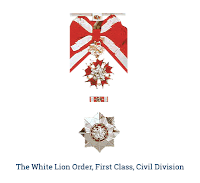
Řád Bílého lvl, the Order of the White Lion, is the highest decoration that may be bestowed upon individuals in recognition of superior accomplishments contributing to the welfare of the Czech Republic. There are five classes of this award.  There are slight differences in the appearance of the award depending on if it is award to a civilian or if it is a military award.


The fifth and fourth class are crosses.  


The third class is an order that is worn around the neck, the second class is an order that is worn around the neck with a chest star, while the first class is a grand cross, with a sash with the badge and a star.  


There's also a supreme grade which is the same as the first class but it is accompanied with a gold neck chain.  However, the supreme grade can only be awarded to heads of state.

Czech law says that the President is entitled to the supreme award after leaving office following a joint resolution by both the Chamber of Deputies and the Senate.  

On 28 October 2014, Present Zeman awarded the First Class honour to Sir Nicholas Winton who, at the onset of WW2, organised the rescue of 669 Jewish children from Czechoslovakia to England.  The British press dubbed him the "British Schindler".  Including the offspring of those 669 children, around 6,000 people owe him their lives.   

The Order of the White Lion isn't only state honour that he received.  In 1998, President Václav Havel awarded him the Order of Tomás Garrigue Masaryk, Fourth Class.  He had also been awarded the Cross of Merit of the Minister of Defence, First Class.  In 2008, the Czech government nominated him for the Nobel Peace Prize.
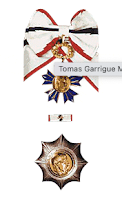
Řád Tomáše Garrigua Masaryka, the Order of Tomáš Garrigue Masaryk, is the second highest award after the Order of the White Lion.  It is named after the the first president of Czechoslovakia and recognises eminent contributions to the development of democracy, humanity and human rights.  The order was established in 1990 after the Velvet Revolution and re-established in 1994 following the Velvet Divorce.  There are five different classes and they may be awarded to both Czech citizens and foreigners.

Medaile Za hrdinství, the Medal of Heroism, is the country's third highest honour.  It recognises heroism in combat and deeds performed by individuals at the risk of their own lives with the view of saving other human lives or substantial material values.  It's mainly a military award but it has been occasionally awarded to civilians.  This is the only state honour that doesn't have different classes.

Five Czech soldiers were posthumously awarded the medal for their actions during the 2014 Bagram Airfield bombing in Afghanistan.

Medile Za zásluhy, the Medal of Merit, is Czechland's fourth highest honour.  It is awarded to those who have provided meritorious service to the state, or a territorial self-governing entity, in the fields of economy, science, technology, culture, arts, sports, enlightenment and education, defence and security of the state and the people.  There are three different grades of this award.

Some previous recipients of the the Medal of Merit include:

Sunday, January 3, 2021

Significant Days

The Czech government has 15 days which are designated as významné dny which translates to "significant days."  These are days worth paying attention to but they are not public holidays.  In other words, there's no day off as these are all working days.  

16 January is Jan Palach Remembrance Day.  It commemorates his self-immolation in 1969.

27 January is Holocaust Remembrance Day and the prevention of crimes against humanity.  It remembers the 1945 liberation of the Nazi concentration and extermination camp Auschwitz-Birkenau.

8 March is International Women's Day.  

9 March is Remembrance Day for the Victims of the Extermination of the Terezín Family Camp in Auschwitz-Birkenau in 1944.

12 March is the Day of Accession of the Czech Republic to the North Atlantic Treaty Organization.  This commemorates the day Czechia joined NATO in 1999.

28 March commemorates the birth date of Jan Amos Komenský in 1592.

7 April is Education Day.  It commemorates the founding of Charles University in Prague in 1348.

5 May remembers the May Uprising of the Czech People which took place in 1945.

15 May is International Family Day.

10 June is the Memorial Day for the Victims of the Extermination of Lidice which took place in 1942.

18 June is the Day of the Heroes of the Second Resistance which commemorates the fight in Prague's Church of Saints Cyril and Methodius that took place in 1942.

27 June is Memorial Day of the Victims of the Communist Regime and pays respect to the 1950 execution of Milada Horáková.

21 August is Remembrace Day for the Victims of the Invasion and Subsequent Occupation by Warsaw Pact Troops.

8 October is Memorial Day of the Falconry.  In 1941 the Nazi Reich Protector Reinhard Heydrich issued a decree in 1941 for the dissolution of the Czechoslovak Sokol community.

11 November is War Veterans Day.  It commemorates the end of WWI in 1918.  This is the same as Armistice Day.

Update:  There's now a 16th significant day, the Day of Czechs Abroad.

Thursday, January 9, 2020

Czech Citizenship Exam: History of the Czech Republic Since 1989

Here are the 10 study questions for the Czech Citizenship exam from section 28: History of the Czech Republic Since 1989. 


1.  When was the independent Czech Republic established?

1 January 1993.


2.  The Czech Republic has been a member of NATO since 1999.  What is this organisation for?

For military cooperation.


3.  When did the Czech Republic join the European Union?

In 2004.


4.  Which two states emerged after the disintegration of Czechoslovakia in 1993?

The Czech Republic and the Slovak Republic.

5.  When is the Day for the Struggle for Freedom and Democracy celebrated in the Czech Republic?

17 November.

6.  Which of these functions did Václav Havel perform?

The function of the President of the Republic.

7.  Which day is the national holiday for the Day of the Restoration of the Independent Czech State celebrated?

1 January.


8.  Who became the Czech president after Václav Havel in 2003.

Václav Klaus.


9.  Who became the Czech president after Václav Klaus in 2013?

Miloš Zeman.

10.  The Czech Army participates in various foreign missions.  In which country has it been operating in this way since 2002?

In Afghanistan.

Wednesday, July 24, 2019

Czech University of Defence

There's always something going on at náměstí Svobody.  It turns out that it was practice for the University of Defence graduation ceremony.  I hear that jets will fly over the square during the real ceremony.  Here's a bit about the university.


Univerzita obrany (UO) is the only military academy of the Czech Armed Forces.  It was established on 1 September 2004 by combining three former military collages - the Brno Military Academy, the Military University of the Ground Forces in Vyškov, and the Purkyně Miliary Academy in Hradec Králové.

There is an NBC Defence Institute in Vyškov.  In Brno, there's a language centre, a physical training and sports centre, and the Security and Military Strategic Studies Centre.

The university consists of three faculties - Military Leadership, Military Technology, and Military Health Sciences.  Students can earn complete bachelor, master, and doctoral degree programmes in military management, economics, engineering and health care.

Friday, April 12, 2019

70 Years of NATO

Last month Czech Republic celebrated 20 years in NATO but last week NATO turned 70.

I'm sure that Russia isn't exactly happy that NATO is still going strong.  It's ironic that not only former Warsaw Pact countries like Czechland & Slovakia, Hungary, and Poland are NATO members, but so are the Baltic countries which used to be part of the Soviet Union.

It looks like North Macedonia will probably be the next country to join.  Bosnia and Herzegovina, Georgia, and Ukraine are all potential members as well.

Here are a couple of short videos I found out on YouTube about NATO and the 70th anniversary.

©Radio Free Europe

The second video has comments from Tomáš Petříček, the Czech Minister of Foreign Affairs.

©Newsy

Here's a 2015 video about how powerful NATO is.  It's even more powerful now.

©Test Tube News

Update: North Macedonia joined in 2020 becoming the 30th NATO member.

Wednesday, March 20, 2019

20 Years in NATO

Last week was the 20th anniversary of the Czech Republic joining NATO.

Along with Poland and Hungary, they were the first Eastern Bloc countries to join.  Slovakia completed the Visegrád Group when it joined five years later, when all four joined the European Union.

As part of NATO, Czech soldiers have been deployed in Afghanistan for 16 years.

Next month is the 70th anniversary of the founding of NATO.

The Minister of Foreign Affairs awarded the new Medal of Merit Award for Diplomacy, Medaile za zásluhy za diplomaciii, to 14 people.
The medal was created at the end of 2018.  It is awarded to individuals who significantly contribute to the development of relations between the Czech Republic and other countries.

One of the medals was awarded to former US Secretary of State Madeleine Albright who was a leading voice in expanding NATO to Central Europe.

Here's a short video I found out on YouTube about the 20th anniversary.
©UATV English

Wednesday, March 14, 2018

Emil Boček

Emil Boček, Strach jsem si nepřipouštěl (Emil Boček, I Didn't Accept Fear), is a new book by Jiří Plachý.  He's the last living Czechoslovak pilot that flew with the British Royal Air Force in WWII.

Today a colleague scored me a book autographed by Emil Boček.  This one will be a challenge for me to read in Czech but I'll definitely give it a try.

Emil Boček was born in Brno in 1923.  In 1939, at the age of 16, he snuck out of the Protectorate of Bohemia and Moravia.  He made his way to Beirut and in the summer of 1940 he wound up fighting in France.  He then received pilot training in the UK and was admitted to the RAF.

He was a mechanic with the 312th Fighter Squadron.  He went for training in Canada in 1943.  From October 1944 he was a fighter pilot with the Czechoslovak 310th Fighter Squadron and had 26 operational flights.  In 1946 he left the Air Force.

In April 1990 he was promoted to captain and in October 1990 he was promoted to major.  In March 1993 he was promoted to colonel.  In May 2014, President Zeman appointed him Brigadier General.  In May 2017, he was promoted to Major General.  I don't understand how one gets military promotions decades after leaving the military.  Maybe the details are in the book.

In 2010 he was awarded the Order of the White Lion for extraordinary merit of defence and state security and excellent combat activity.

In 2016, he got the opportunity to fly in a spitfire again.  Here's a video of it I found out on YouTube.

©Forces TV

Update September 2022:  There's a General Emil Boček RAF museum in Ivančice. 
Update March 2023:  General Boček passed away.

Monday, August 7, 2017

10-Z Nuclear Shelter

During WWII, the Nazis established a bunker under Špilberk Castle as an air-raid shelter from American and Soviet bombing runs.  In 1946, it was used as a wholesale wine store.  Two days after the 1948 communist coup the government confiscated the bunker.

By 1959, it was one of the most secret nuclear fallout shelters.  It was designed to shelter up to 500 people for three days.  The shelter would have only provided shelter the most important communist party members.

The Czech military had control of the shelter until 1993 during which time it was still classified a top secret installation.

In 2016, the facility was opened to the public.  There's a tour available that focuses on the shelter's various technical aspects like the diesel unit, filter room and telephone exchange.

The shelter even operates as a hostel.  A single economy room, with shared bathroom facilities, and a continental breakfast will run 895 Kč (~$40) on booking.com.  It seems a bit pricey to me but where else can one spend the night in an old, formerly top secret, nuclear shelter?

The tour was quite interesting.

There's a retro café that I need to check out sometime.