Showing posts with label WWI. Show all posts

Monday, February 6, 2023

Strážnice, Czech Republic

Kája and I spent the weekend in Strážnice which is about a two hour train ride from Brno.  

Strážnice is home to 5.400 people and is 65 km (40 miles) from Brno, close to the Slovak border.  While Neolithic pottery has been found here, the it was first written mention of the town was in 1302.  It was one of the most populated towns in Moravia at the start of the 17th century.

The old city gate bastions date back to the 16th century.  They were used to protect the town from Turkish invasions.


Behind these gates is a chapel that was consecrated in 1917.  The story goes that it was built as thanks to the men who returned in good health from WWI.


The stone cross near the gate dates back to 1769.  The baroque monument is one of the oldest in the town and marks one of the places that city executions used take place.


The nearby city cemetery dates back to 1895.


Inside the cemetery is a tombstone dedicated to the Red Army that liberated the city in April 1945.


February isn't the time of year to see storks but here's a stork nest for when the season comes.  I'm told that nearby is one of the last places in Central Europe where a forest colony of White Storks can still be seen.

The shrine at Radějovská street dates back to the first half of the 19th century.


The town hall is a protected cultural monument that dates back to the 17th century.

The Strážnice Castle, is less castle and more chateau, is from the mid-19th century.  The castle is home to the National Institute of Folk Culture and a library with over 13.000 books.


The castle is in the middle of a large park where there's an amphitheatre.  


The Parish Church of St. Martin was a Gothic church in the 15th century but it burnt down several times.  In the 1720s it was renovated in the Baroque style.  


The Strážnice Museum of the Villages of South-East Moravia is an. open-air folk museum that opened in 1981.  


The Church of the Assumption of the Virgin Mary was built in 1747.


The synagogue was built in 1804 and renovated in 1879.  It was damaged in 1941 and it was then used as a warehouse.  In 1991 it was returned to the Jewish community.  Today, it is part of the Strážnice Museum.

Next to the synagogue is the Jewish cemetery which was founded in the mid-17th century.  It is 5000m² (1.2 acres) with around 1500 gravestones.


The town is located on the Baťa Canal and it's possible to take boat rides during the summer.


In front of the city museum is a statue of the philosopher and educator Jan Amos Komenský.  He studied here in 1604-1605.

Of course no Czech town is complete without a statue of Tomáš Garrigue Masaryk, the first president of Czechoslovakia.  Apparently he had studied here.  

Strážnice is also the home of really good potato chips (crisps).  

I hear that the factory is the town's biggest employer.

Here's a short video I found on YouTube showing the factory and how the crisps are made.

©Strážnické brambůrky Hobža

Update:  Every year, Strážnice hosts an international folklore festival.

Monday, November 21, 2022

Saint Helier, Jersey

Saint Helier is the capital of the Bailiwick of Jersey.  With its almost 36.000 people, St. Helier is home to more than a third of the entire island, and it is the island's only town.  As St. Helier is also the name of the parish, most people just call it "town".


St. Helier, located on the south coast of the island, was founded sometime in the mid-12th century.


King George II gave £200 to St. Helier towards construction of a new harbour.  In gratitude, a statue of him was erected in 1751 at Royal Square.  

The statue is the Jersey's zero milestone from which all distances on the island are measured.


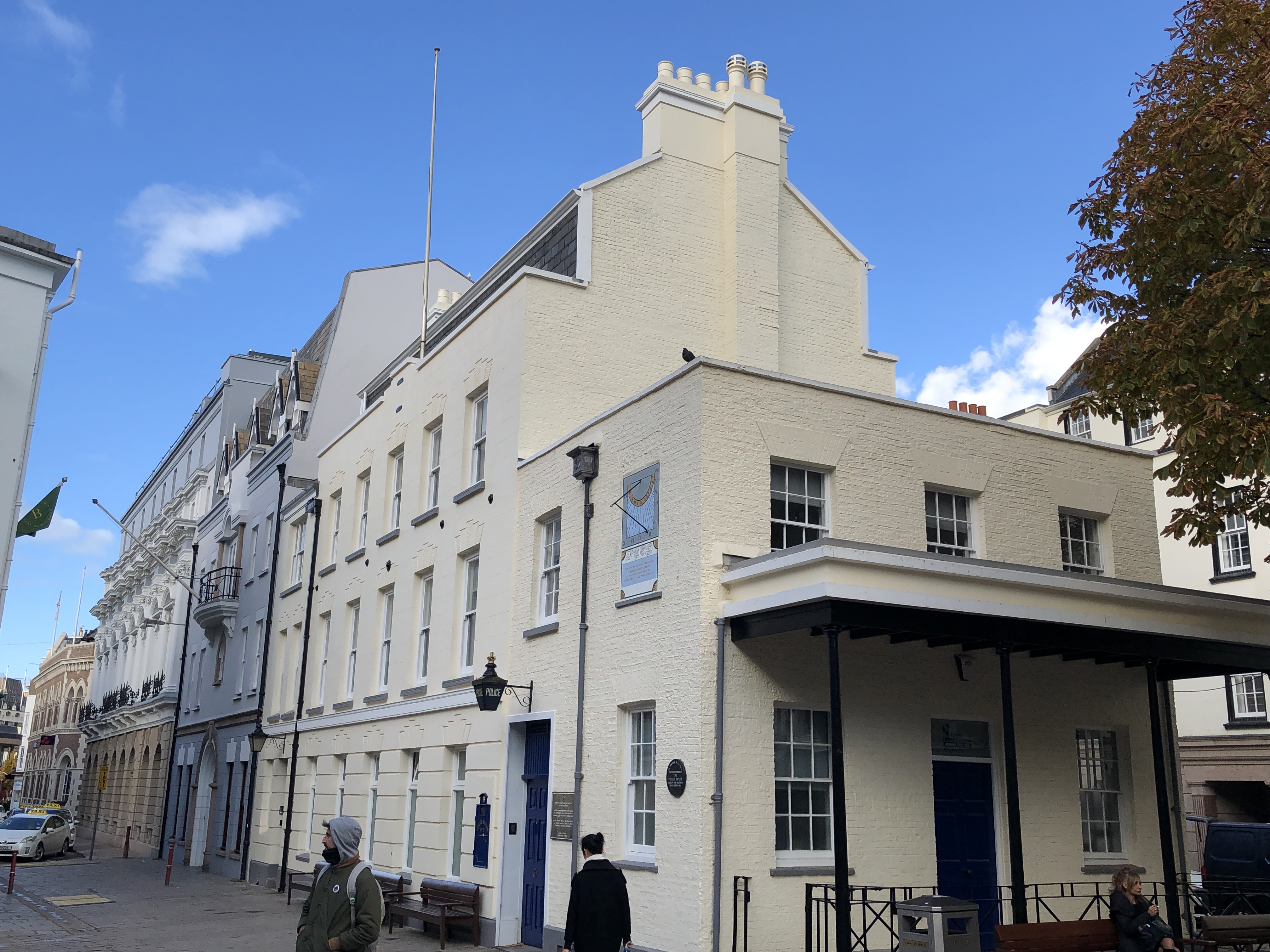
Piquet House was used by the military police unit 1924.  The building hasn't been used for anything for a few years.


The States Assembly is Jersey's parliament building.  It shares a complex with the Royal Court, the Bailiff's Chambers, and the Judicial Greffe.


The Parish Church of St. Helier is an Anglican Church that was first built in the 11th century.  For unknown reasons the church was reconsecrated in 1341.

The Jersey Museum and Art Gallery is also home to the Société Jersiaise.  

The Société Jersiaise was founded in 1873 and is committed to preserving Jèrriais - the Norman French dialect spoken on the island.


An obelisk was built in 1855 to commemorate in memory of Pierre Le Sueur, who was elected constable five times, providing the town with clean water and who died in office form overwork.


The toad monument was erected in 2004 at Charing Cross to commemorate Jersey's 800 years of allegiance to the English Crown.


La Croix de la Reine commemorates the Queen's Silver Jubilee in 1977.


There was an open market on this site for 78 years before being demolished.  The market reopened in 1882.

Liberation Square used to be the eastern terminus of the Jersey Railway which opened in 1870. 

From the rear of the building, 1.186 English-born residents were deported to Germany in September 1942.  

The Liberation sculpture was unveiled in 1995 on the 50th anniversary the end of the German occupation.


Parade Gardens used to be the drilling grounds for the island's garrisoned troops in the early 19th century.  Today is is a popular park in the centre of St. Helier.

The cenotaph was unveiled in 1923 for Armistice Day to honour those soldiers killed in WWI and later WWII.

All Saints Church is an Anglican Church at Parade Gardens.

Howard Davis Park opened in 1939.  There is a walled rose garden and a pond.

At the other end of the park is the Jersey War Graves Cemetery.


The cemetery was dedicated on 26 November 1943 and has graves of American and British servicemen killed in WWII.

On the south side of the park, next to the cemetery, is St. Luke's Church.  It is an Anglo-Catholic Church.  I've never heard of an Anglican/Catholic Church combo before but I guess it's a thing.


The Jersey Opera House opened in 1900 and the current building is a 1922 renovation of the original.  The theatre reopened in 2000.


Havre des Pas is the part of the coastline that was historically used for ship building.  


Today it is beach with some shops and private residences along the coast.


The Havre des Pas Bathing Pool was built by the Jersey Swimming Club and it opened in 1895.


Fort Regent was originally built as a Napoleonic Fort at the top of Mont de la Ville.  It is currently a sports and leisure venue.  Glacis field is a grassy field on the south end with views of the harbour and of the castle.


Elizabeth Castle is a 16th-century castle that sits on a tidal island off the coast of the town.  Today it is a museum.


Freedom Tree
was unveiled by Queen in 2005.  It was commissioned to commemorate the 60th anniversary of the Jersey's liberation.

Victoria Pier


There was lots to see and do in St. Helier but I wasn't here at the best time.  Tourist season finishes as the end of October so I wasn't able to visit the Jersey War Tunnels because they don't open again until March.  It would have been nice to take a boat trip out to les Minquiers but this too is only available during season.  I'm really glad that I was able to take the island tour on Friday.  I guess that a return visit is in order.