Showing posts with label Czech Education. Show all posts

Tuesday, May 2, 2023

Žabovřesky Walk

A while ago I found a map for a self-guided walk of Žabovřesky at the Tourist Information Office.  Since yesterday was Labour Day so decided to get some fresh air and go for a walk.  


Žabovřesky is one of Brno city districts, next to where I live, that covers 4,35 km² (about 1.7 miles²).  It dates back to the Middle Ages.  It was an independent municipality until it was annexed to Brno in 1919.  The name translates to "Frog screams."

Kounicovy koleje are student dormitories that were built in 1922.  Following the Nazi occupation of Czechoslovakia, on 17 November 1939, about 200 students were taken from the dormitory and sent to Sachsenhausen Concentration Camp.  From 1940, the Gestapo used the facilities for interrogations and as a prison.  Tens of thousands of prisoners passed through the prison and at least 800 people died here.

After Brno was liberated, it became a prison for Nazis and collaborators from May to September 1945.  During this time at least 300 people died there from torture and were buried in mass graves at the Central Cemetery.    

In 1978, the dorms were declared a national cultural monument and in the garden is a memorial for the victims and to victory over Fascism.  

Since 1999, the dorms belong to the Brno University of Veterinary and Pharmaceutical Sciences.


Across the street from the dormitories is the headquarters of the Národní úřad pro kybernetickou a informační bezpečnost (NÚKIB).  The National Office for Cyber and Information Security is the central office for cybersecurity and cryptography.  NÚKIB has jurisdiction over the National Security Centre (NCKB).

Bohuslav Fuchs House was built in 1928, by the renowned architect who worked from a private studio in his villa.


In 1929, he resigned from his position as the city's main architect but continued to work from his home office.  He then connected his villa to the neighbouring house. 


Kino Lucerna is began screening films on 29 May 1915.  The single-storey Art Nouveau building still functions as a single-screen movie house.  It is the oldest operating cinema in Brno and the second oldest in Czechland.  


The Church of Our Lady Help of Christians was built in 1994 and consecrated in 1995.  The 500 seat church was built on the original site of Church of the Salesian Order.  The original church was built in 1939 but the order was banned in the 1950s by the Communist regime.

Sono Centrum is a multi-purpose facility that opened in 2016. The  "Death Star" is a nine-story building that combines a hotel, a music club, a conference hall and a restaurant.  


The Masaryk University Faculty of Law opened in 1919 and is one of four law schools in the country.  The present building opened in 1932 until 1939 when the Gestapo made it their headquarters until 1945.  Classrooms were used as cells and interrogation rooms.  Eventually the building was used by the Military Academy until after the Velvet Revolution in 1989 when it was returned to the Law Faculty. 

In 2010, a monument of former President Edvard Beneš was unveiled in front of the faculty.  The statue cost 1,6 million Kč (~$77K) and ame at the request of members of the Czechoslovak Legionnaires' Association and the Association of Czechoslovak Foreign Pilots 1939-1945.  Although not at some controversy as the Beneš Decrees played a significant role in relocating ethnic Germans from Czechoslovakia after the war. This is locally know as the Brno Death March.  Later this year it will be 75 years since he passed away.

The Chapel of St. Wenceslas was built in 1906 and is dedicated to the patron saint of Czechland.  The chapel facade is a protected cultural monument and the the building was renovated in 2018.


The Dušan Jurkovič Villa was built in 1906 by one of the best 19th century architects in Central Europe.  

Wilsonův les, Wilson's Forest, is a 34,4 hectare (85 acre) forest park on the southern edge of the Žabovřesky.  In 1888 it was called Kaiserwald, the Imperial Forest, to honour Emperor Franz Joseph I who was celebrating the 40th anniversary of his reign.  In 1918, it was renamed in honour of American President Woodrow Wilson who supported the establishment of an independent Czechoslovakia.  During WWII it was called Kaiserwald again and from 1953 to 1991 it was known as Jirásek's Forest after writer Alois Jirásek.  I guess having a forest named after an American President isn't something that would have been something favoured by the Communist regime.

From the hill you get a great view of the city.

There's quite a bit to see just walking around Žabovřwsky.  Of course I supposed it couldn't be called "Frog Screams" if there wasn't some kind of frog motif.  


The art nouveau building, built in 1908, has a golden frog at the entrance.


The weather was perfect so it was great to walk around the neighbourhood all day.  Definitely need to explore some other Brno neighbourhoods as well.

Friday, April 7, 2023

Charles University

Today is the 675th anniversary since the founding of Charles University in Prague back in 1348.

Univerzita Karlova was founded by Emperor Charles IV, and it is the oldest, and largest, university in Czechland.  It was modelled after the universities in Bologna and Paris.  It was the 31st university in Europe and the first in Central Europe.

There were four faculties when the university opened: theology, law, medicine, and arts.  Today there are more than 51.000 students studying in 17 different faculties.

While universities in Brno are well regarded, Charles University is the only Czech university to rank among the top 250 universities worldwide, amongst the top 1,5% of 17.000 universities worldwide.

Here's a short English-language video about Charles University that I found on YouTube.

©Univerzita Karlova

Monday, January 23, 2023

Mendel University

Mendel University, MENDELU, was founded in 1919, making it the country's oldest independent specialised university.

It was originally established as the University of Agriculture in Brno.  It 1994 it was renamed the Mendel Agricultural and Forestry University in Brno.  From 2010, it has been Mendel University, named after Johann Gregor Mendel - the father of modern genetics.

MENDLU is a public institution with more than 12.000 students studying for bachelors, masters, and doctorate degrees in five faculties and one university institute.

Faculty of Agronomy
Faculty of Forestry and Wood
Faculty of Business Administration and Economics
Faculty of Horticulture
Faculty of Regional Development and International Studies
Institute of Lifelong Education

It is a public university and degrees offered in Czech are free.  Some programmes are taught in English but students have to pay for this.  

In June 2020, for the first time, MENDELU made the QS World University Rankings top 1000.  It placed #701-750.  Here's a short English-language video I found on YouTube about the university.

©Mendelova univerzita v Brně

The university has just run into some trouble.  The National Accreditation Office for Higher Education (NAÚ), has withdrawn accreditation for the Faculty of Business Administration and Economics for doctoral studies in economics.  This only impacts doctoral studies in the one faculty.  Apparently there have been some discrepancies due to plagiarism and some foreign (paying) students have been able to complete doctorate degrees within 30 months.  Normally a doctorate degree should take around 48 months or more to complete.  It appears that the decision to withdraw accreditation isn't final and the university will be able to appeal.

Monday, December 12, 2022

Czechoslovak Hussite Church

Czechland has its own church.  The Czechoslovak Hussite Church (CČSH) is a Christian church that split away from the Roman Catholic Church and was established in 1920 following the end of WWI and creation of Czechoslovakia.

It started out as the Czechoslovak Church but in 1972, the name was changed to to emphasise the values of Jan Hus, the former Catholic priest who was burned at the stake in 1415, and creator of the Czech alphabet.  I understand the church is a sort of Presbyterian and Episcopal mixture.  

The most recent census results showed that there are less than 25.000 members of the church.  In Czechland the church has 304 congregations that are divided in to five dioceses - Prague, Plzeň, Brno, Olomouc, and Hradec Králové.  There are three congregations in the Bratislava Diocese in Slovakia.

The head of the church is called 'Patriarch' and clergy can be men or women.  More than half of the priests are women.  Future priests undergo training at the Hussite Faculty of Theology at Charles University.

Husův sbor, the Hussite Church building, at Botanická, is one of the first functionalist church buildings in Central Europe.  It is the oldest functionalist building in Brno and this year celebrates 93 years.


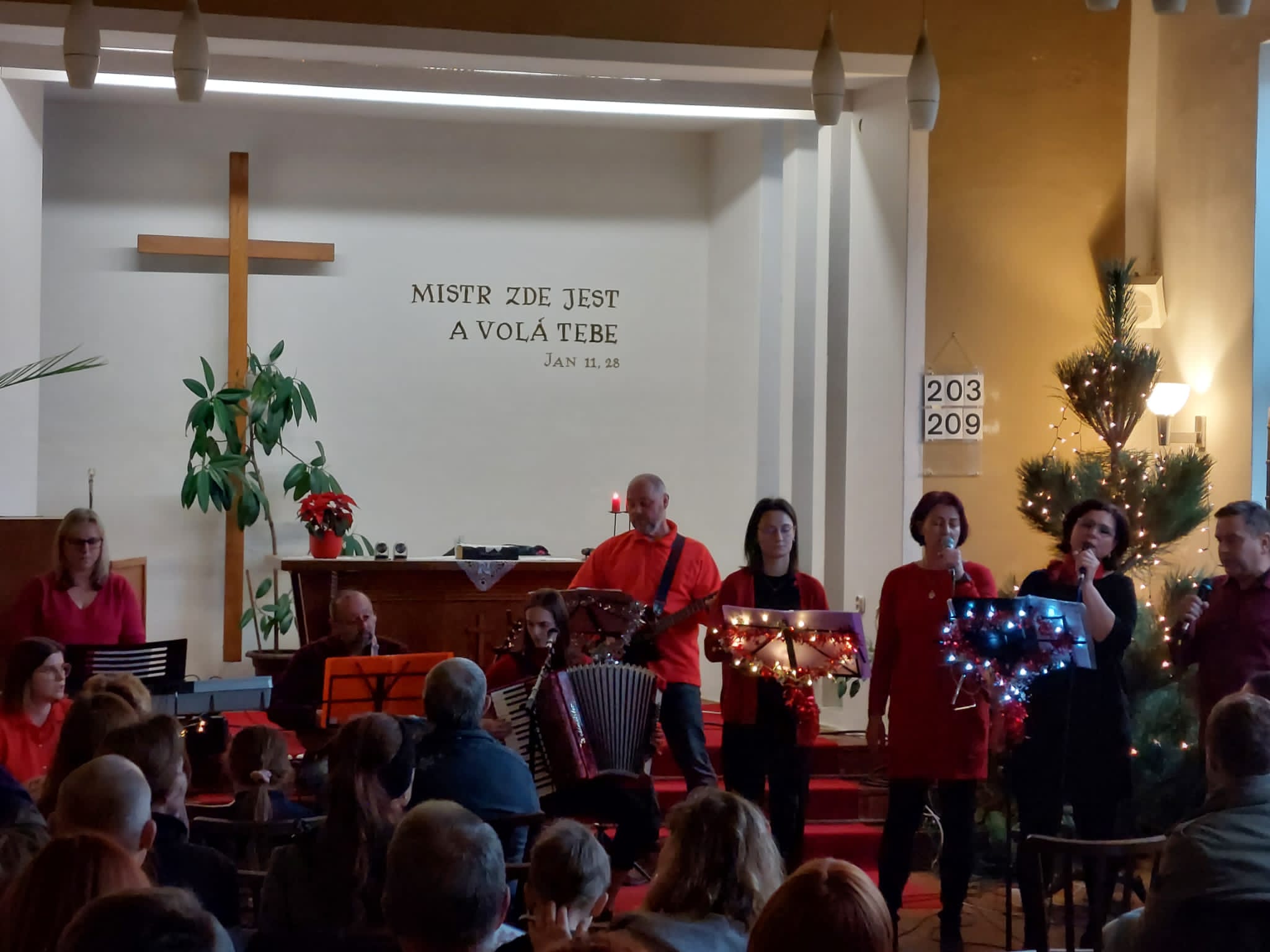
Yesterday, Kája and I went to attend an afternoon Christmas concert.  The concert was nice but I have to admit that I didn't understand everything.  


There were a lot of Czech Christmas songs that I'd never heard before.  The traditional English-language Christmas songs that I know, were sung in Czech. 


Thursday, September 1, 2022

2022-2023 Academic Calendar

The annual school calendar in Czechland is determined by the Ministry of Education, Youth, and Sports.  

The dates are the same for all schools throughout the country except for the spring holidays which depend on the county, municipality or city district.

School principles have the ability to declare extra days off due to "serious organisational or technical reasons."  They usually do this to bridge public holidays with the weekend.

Teachers start the last week in August.  This is a preparation week for the teachers and school administrators.  Parents can make appointments to speak with teachers.  During this week, any students who failed any compulsory subjects are re-examined to determine their advancement in the upcoming school year.

Today, 1 September, is the start of the school year.  The first day of school pretty much lasts an hour.  

First grade students and their parents are officially welcomed and there is a meet-the-teacher ceremony.  Students in other grades have a 45-minute with their teacher and they have registration forms to fill out.  In the USA, the first day of school is a full day.

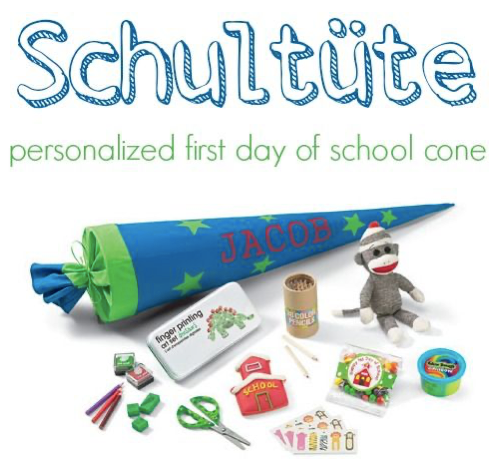
In Germany, all first-graders get a Schultüte, a personalised cone filled with school supplies.  I remember Claudia spending so much time putting Tünde's cone together.  I think that they do it in Austria too but I'm pretty sure that the tradition doesn't exist here in Czechland.


During the first two weeks of school, there is a meeting for parents and the classroom teacher.  The teacher explains how the school year is organised.  These meetings usually take place after school once the parents are off from work.  For the first six weeks, from September to mid-October, students are able to join after-school activities and clubs.  Many of the clubs are sponsored by organisations outside the school.

28 September is a public holiday for St. Wenceslas Day and Statehood Day.

This year, 26-27 October is the Autumn break for all public schools.  This break with the 28 October holiday for Independent Czechoslovak State Day, and the weekend, gives students a 5 day break.

Schools have open-door days from November to January.  These are for students, and their parents, to help decide which gymnázium, conservatories, or vocational school they will apply to.

17 November is the public holiday for Freedom and Democracy Day.

30 November is the deadline for students to submit their applications to schools that that specialise in art, drama, dance, music, language, or sports.

23 December - 2 January is the Winter/Christmas holiday.  Students return to school on 3 January.

By 1 January, schools have to list the criteria for secondary school applications on their websites.  

31 January marks the end of the first semester.  Students receive report cards.

3 February is a one-day school holiday to mark completion of the first semester.

1 March is the final day for students to submit applications to gymnáziums, specialised high schools, or vocational schools.  

Spring break is determined by region so not every student is off the same week across the country.  In Brno, Spring break will be 13-19 March.

6 - 10 April is the Easter holiday.  Students get Thursday off, plus Good Friday and Easter Monday.

In April, parents have to register their children for 1st grade and preschool (kindergarten).

1 May and 8 May are public holidays.

1 June is Children's Day.  It isn't a public holiday but many schools celebrate the day with cultural activities or field trips.

30 June is the last day of school and students receive their report cards.

Summer holiday runs from 1 July to 3 September.  The first day of school for the 2023-2024 year will be 4 September.

Saturday, August 27, 2022

English in Czechland

English is the most common spoken language across the EU.  About 44% of people in the EU can speak English.  And that's post-Brexit, as now only 1% of the EU are native English speakers.  However, Czechs rank among the worst in Europe at foreign languages.

Czechs are among the least likely Europeans to know a foreign language.  While about 45% can communicate at some level of English, only one in 10 Czechs have minimal English-language skills.  Just 7% speak English proficiently.

The only countries worse at English than Czechia are France, Italy, and Spain.  The top five countries with the best English foreign language skills are the Netherlands, Austria, Norway, Denmark, and Belgium.

One of the primary staffing agencies here has confirmed that English is required for four of to 10 job offers here.  English is demanded five times more than all other foreign languages combined.  After English, the top requested languages by employers are German, French, Italian, and Dutch.

The Czech Statistical Office, ČSÚ,  states that only a minimum of Czechs speak English at a professional level.  30% can't speak a foreign language.  

English is most frequently taught foreign language in EU secondary schools, followed by Spanish, French, German, and Italian.  

In Czechland, by law, students are taught two foreign languages.  English is the most popular, followed by German.  

There has been some controversy in the press about the new government's ability to speak English.  Five of 18 cabinet ministers have admitted to only being able to speak "tourist level" English only.  This is a big deal now that Czechland currently holds the rotating presidency of the EU.  

The new prime minister, Petr Fiala, speaks both English and German fluently.

Jana Černochová, the defence minister, and Zbyněk Stanjura, the finance minister have admitted to having weak English skills but both have at least passive Russian and Polish.

Monday, November 29, 2021

A New Prime Minister

As of yesterday, Czech Republic has a new prime minister.  Petr Fiala, the chairman of the Civic Democratic Party and head of the SPOLU alliance, was appointed as the new prime minister by President Miloš Zeman.

The new prime minister is a Brňák meaning that he's from Brno.  The country's first prime minister from Brno.  He was born here.  He studied history and Czech language at Masaryk University and in 2002 he became the country's first professor of political science.  In 2004 he was the dean of Masaryk's Faculty of Social Studies and became head of the entire university.  

In 2012 he was the Minister of Education, Youth and Sports.  In 2013 he was elected to the Chamber of Deputies and in 2014 he became chairman of the Civic Democratic Party (ODS).

©EuroNews

SPOLU, the Together coalition, is made of the Civic Democratic Party, the Christian Democrats (KDU-ČSL) and TOP 09.  SPOLU won the recent general election with the ANO party coming in second followed in third place by an alliance between the Pirate party and the Mayors and Independents party (STAN).  In fourth place was the Freedom and Direct Democracy party (SPD) which is anti-EU.  SPOLU took 108 of the 200 seats in the Chamber of Deputies.  No other party gained enough votes to earn a seat which is why the Communist party is out.

SPOLU signed an agreement with the Pirate and STAN alliance to create a new majority government with Petr Fiala as the leader.  

©EuroNews

Premiér, or ministerský předseda, is the prime minister who is the head of the government of the Czech Republic.  The prime minister is the most powerful office as they lead the executive branch of government, chairs the cabinet and selects the cabinet ministers.  

The Czech President selects the prime minister whose term is four years and there are no terms limits.  Well, sort of.  Czechland is a parliamentary democracy so the prime minister and their government are accountable to the Chamber of Deputies.  The prime minister is usually the leader of the largest political party, or a coalition, in the Chamber of Deputies.  So it's pretty straight forward who the president will select as prime minister.    

The Czech Constitution states that the prime minister was gain and maintain the confidence of Parliament. As soon as the prime minister looses the the support of the majority of the Chamber of Deputies, the prime minister is forced to resign and the president must select a new prime minister.  So there's no guarantee that a prime minister's term will last the full four years.

The Czech president is the country's head of state, represents the country internationally and is commander-in-chief of the military.  As the prime minister runs the executive government, the president's role is mostly ceremonial.  The president is responsible for appointing the prime minister but it's pretty straight forward that the PM is the leader of the largest party, or the largest coalition, in the Chamber of Deputies.  However the president is responsible to appoint members of the Czech National Bank and to nominate justices to the Constitutional Court, but this is subject to Senate approval.  In Czechland, "professor" is the highest academic degree and the title is appointed by the president, but countersigned by the prime minister.

The Czech Statistical Office reported that more than 65% of eligible voters participated in the election about seven weeks ago.  This is the highest turnout in a legislative election since 1998.

The now former prime minister was Andrej Babiš and he held the role from 2017 to now.  Prior to that, from 2014 to 2017, he was the Deputy Prime Minister and the Minister of Finance.


He entered politics 2012 by forming his own political party - ANO 2011.  "ANO" stands for Akce nespokojených občanů, the Action of Dissatisfied Citizens.  "Ano" is also the Czech word for "yes".  

Andrej Babiš is from Slovakia.  He moved to Czech Republic after the Velvet Revolution.  He was a businessman prior to entering politics and is the second richest man in Czechland.

He is the oldest and wealthiest person to ever become prime minister.  He was the country's first prime minister to not be from the ODS or ČSSD parties.  He was the first prime minister who was born outside of the Czech Republic.  He is the first to hold dual citizenship and the first whose native language isn't Czech.

He has Czech and Slovak dual citizenship.  One of the things that came out of the Velvet Divorce was that anyone who was a citizen of the Czech and Slovak Federative Republic on 31 December 1992, could chose if they wanted to be a citizen of either the new Czech Republic or the new Slovak Republic.  This is called "declaration".  In 2000, he obtained Czech citizenship by declaration, but he maintained his Slovak citizenship by descent as his parents are Slovak citizens.

This is still something that's odd to me.  In the U.S., you can't be President unless you were born a citizen, and you can't hold dual citizenship either.  The best case of this is probably Madeline Albright when she was Secretary of State.  In the US, the order of succession for the President is (1) the Vice-President, then (2) the Speaker of the House, (3) the President pro tempore of the Senate, followed by (4) the Secretary of State.  Since Madeline Albright wasn't born a U.S. citizen she was not eligible to become a presidential successor.

Babiš is Slovak, with Czech citizenship.  In my head I just can't understand how you can be the leader of a country when you weren't born a citizen.  Or how do you ensure that the leader is working in the best interest of the country when he holds citizenship, and loyalty, to another country?  But that's just one of the differences between the Czech and American systems.

One of the many controversies about him was that during the 1980s, he was an StB agent.  Documents at the National Memory Institute in Slovakia show that Babiš collaborated with the StB under the code name agent Bureš.

He was accused of illegally obtaining €2 million of EU subsidies designed for small businesses by concealing his ownership of a company that received funds.

On 16 November 2019, the Million Moments for Democracy protest group held a protest demonstration against Babiš that was attended by over 250,000 people which was the largest protest since the Velvet Revolution.

The national debt in 2020 was 367,4 billion Kč (over $15 billion) which is the largest in the country's history.  In spite of all of the controversies around Babíš he's still leaving with a 30% approval rating.

The new prime minister has promised to reform and stabilise the growing national debt.

In July 2022, the Czech Republic will assume the 6-month Presidency of the Council of the European Union.

Thursday, April 29, 2021

English Language Seminar

I'm not quite sure how I got talked in to this but somehow I agreed to co-present a webinar for Masaryk University.  There was some talk about doing this after the IT Nightmares presentation back in 2019 but then Covid hit last year so it never happened.  The university reached out to IBM and I agreed to present.

One of my Dutch colleagues presented with me to about 10 undergraduate and graduate students today.  The topic was on the use of English in social, educational and business situations.  We tried to keep it as interactive as possible and shared a few anecdotes to make it seem less like a boring university lecture.

It seemed to go fine.  Well, at least I hope it went fine.  I'm curious to see the results of the student evaluations.

Tuesday, April 20, 2021

ECHR Ruling on Mandatory Childhood Vaccinations

In Czechland, there are obligatory vaccinations for nine diseases - whooping cough, polio, tetanus, diphtheria, hepatitis B, haemophilus influenzae type b (Hip), measles, mumps, and rubella.  This is laid down in Act no. 258/2000 Coll., on Public Health Protection.  Those that don't comply with the vaccine schedule may be fined up to 10.000 Kč ($464).  

No one here can be forcibly vaccinated against their will.  But there are other implications.  Children under five years of age can not attend public kindergarten (preschool) if they have not been fully vaccinated.  A kindergarten that admits an unvaccinated child can be fined up to 500.000 Kč ($23,200).  

From age five, unvaccinated children can attend kindergarten because this preschool year is part of the country's compulsory education.  While unvaccinated children can attend school they are not allowed to take part in school trips, camps, etc.  If an unvaccinated child participates in a school trip or camp then the organiser can be fined up to 30.000 Kč ($1,392).   

Vaccines are free as they are covered by the state.

The European Court of Human Rights, in Strasbourg, France, is connected with the Council of Europe with 47 member countries.  The court rules on complaints filed against member counties with regards to their obligations under the 1953 European Convention on Human Rights.  

A couple of weeks ago the European Court of Human Rights ruled on the case of Vavřička and Others v. the Czech Republic.  The primary case was a Czech who refused to have his son and daughter vaccinated against polio, hepatitis B, and tetanus.  The father was fined.  Then there were four other cases where children were not allowed to enter kindergarten because they were not vaccinated.  All of these cases were submitted before the pandemic so this has nothing to do with Covid-19.    

The court ruled 16-1 that the Czech Republic is within its rights to require compulsory vaccination of preschool children and that it did not violate and human rights rules.  The judgement is final and can not be appealed.  This is the first time that the court has ever ruled on this issue.

Here's a 15-minute video I found out on YouTube that talks about the court and what it does.

©European Court of Human Rights

Other countries have vaccinate rules as well.  Italy saw a surge of measles cases so in 2019 a law was passed that without proof of vaccination children up to the age of six are excluded from preschool and kindergarten.  Parents who send their unvaccinated children to school can be fined up to €500 ($593).

Germany passed a law in 2020 that requires parents to vaccinate their children against the measles.  Parents can be fined up to €2500 ($2,970) for failing to comply.  

Sunday, April 4, 2021

Erasmus

Brno is a student city and, under more normal times, there are many foreign students here under the Erasmus Programme.  Erasmus is the EU student exchange programme that was established in 1987.  It provides educational exchanges across the EU.  Some non-EU countries like Turkey, Iceland, Serbia, Norway, and Macedonia pay to participate in the programme as well.  Erasmus is the acronym for the EuRopean Community Action Scheme for the Mobility of University Students.  

In 2014, all of the EU's programmes for education, training, youth and sport were combined under Erasmus Plus.

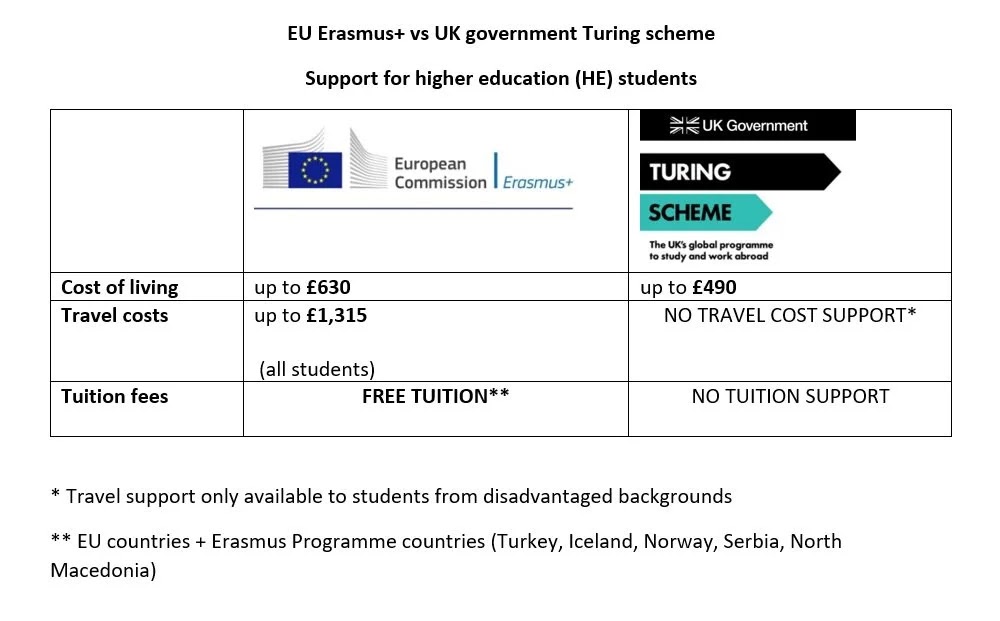
Under Erasmus Plus students don't pay any more tuition than what they pay at their home institution.  Students receive grants to help cover living expenses to study abroad and for work placements/internships.  Teachers and educational staff are also able to attend training courses across Europe.  

Every year around 300.000 students participate in the programme at over 4.000 institutions in 37 countries.  Spain sends the most participants followed by France, Germany, and Italy.  The most popular receiving countries are Spain, Germany, Italy, and France.

I don't know how true it is but I've heard that some 25% of Erasmus participants meet their future spouse/partner while on the programme.

After Brexit the United Kingdom decided to no longer participate in Erasmus.  So UK students can no longer study in the EU and EU students aren't able to study at UK institutions.  The UK has rolled out the Turing Scheme, named after Alan Turing, as its replacement for Erasmus.  It will allow up to 35.000 UK students to study and work worldwide.   

Erasmus provides more money to students than Turing to subsidise their foreign placements.  

Ireland has announced that it will fund students from Northern Ireland to continue to participate in Erasmus even though the UK pulled out of the programme.

Monday, January 20, 2020

Gymnázium

A friend's daughter is applying for gymnázium which is a comprehensive school that prepares students to go on to university study.  Basically it's a Czech high school but there are several different flavours so here's a bit about secondary education here in Czechland.

First comes základní škola, basic school, which is compulsory.  Students enter the 1st grade at the age of six.  Basic school has two levels.  The first level is grades 1-5 and the second level is grades 6-9.  Students then have a few different options.  For students wanting to study music, dance, drama, or art then they have the option to study at a conservatory.

There are vocational and trade schools, which often include apprenticeships, and students graduate with certifications allowing them to enter the work force.  Typical fields include electrician, carpentry, plumbing, mechanics, hotel management, and culinary arts.  These graduates will not be able to later on apply for university.  

Some students will attend a lyceum which is a kind of professional high school.  It is similar to a vocational school where students learn skills to a specific profession but it includes general academic subjects like history, geography, foreign languages, etc.  There are lyceum for business, health care, IT, technical engineering, and education.  Students graduate with a maturita (a high school diploma) that qualifies them to be able to find a job in their field.  Students are also qualified to pursue advanced studies if they want to but they don't qualify to enter university.

Then there's the gymnázium.  This is a comprehensive school with the sole focus of preparing students to enter university.  The curriculum is tough but when students graduate with a maturita they aren't qualified for any kind of work.  They are just ready to enter a university and begin a degree programme.  A bachelor's degree is 3 years, law is 3 or 4 years, and medicine is 5 years.

Traditionally, after the 9th grade, students would enter gymnázium for four years.  Remember that the Czech education system goes to the 13th grade.

The competition for university has increased and now students have the option of starting gymnázium after the 7th grade for a six-year programme or after the 5th grade for an eight-year programme.

Here's where it gets tricky.  First, you need to find the gymázium that you want to attend.  Although all students take every subject, some schools have more of an emphasis on mathematics and science while others concentrate more on humanities and languages.  Then there's the challenge that most gymnasiums only open up one or two classes (up to 30 students each) per year.  Potential students and parents are able to attend open days in November, December and January, to get a feel for which school is the best fit.  

Students' marks received in their previous two semesters of school are reviewed and they have to pass entrance exams. The entrance exams have three parts.  One section is on Czech language and grammar.  The second section covers mathematics and the third section covers Czech literature, history, social sciences and logic.  There is a state-wide two-day exam period every April.  

Some may also have an additional language requirement because I have friends who attended bilingual schools Brno where half of their subjects were taught in either French, Spanish, or German.  While English is a popular foreign language I don't know if there are any bilingual Czech-English schools here in Brno.  

Applications to gymnáziums have to be submitted by mid-March.  Students can only apply to a maximum of two schools.  I believe that there is an application fee but I don't know how much it costs.  If a student doesn't get in then there is a second round of selections.  There is serious pressure on getting accepted to the best gymázium, both for the students and the parents.

Friday, January 3, 2020

Czech Citizenship Exam: New Age History

Here are the 10 study questions for the Czech Citizenship exam from section 25: New Age.

1.  At the turn of the 16th and 17th centuries, Prague became the cultural centre of Europe.  What was the name of the monarch who ruled in Bohemia at that time?

Rudolf II.

2.  Which family began to rule the Czech Kingdom in 1526 and ruled until 1918?

The Habsburgs.

3.  In 1618, Czech non-Catholic nobles opposed the emperor.  This event started a war that spread almost throughout Europe.  What is this war called?

Thirty Years' War.

4.  In which city does the legend of the Golem, created by Rabbi Löw, take place?

In Prague.


5.  Jan Amos Komenský was an important Czech philosopher, theologian and writer who lived in the 17th century.  In which field did he become most famous?  

Pedagogy.


6.  What was the name of the famous Empress who ruled in the Czech lands in the 18th century?

Marie Terezie.  

7.  The Czech lands have been part of Austria-Hungary since 1867.  When did Austria-Hungary cease to exist?  

In 1918.

8.  What is the name of the development of Czech Culture in the 19th century?

National Revival.

9.  What is the name of the town where the Battle of White Mountain took place in 1620?

Prague.

10.  Which monarch introduced compulsory school attendance for children in the Czech lands?

Marie Terezie.