Former members include Azerbaijan, Georgia, and Uzbekistan.
Here's a short video I found out on YouTube about the CSTO.
©Test Tube News
Former members include Azerbaijan, Georgia, and Uzbekistan.
Here's a short video I found out on YouTube about the CSTO.
Today the CIS consists of Armenia, Azerbaijan, Belarus, Kazakhstan, Kyrgyzstan, Moldova, Russia, Tajikistan, and Uzbekistan. In 2005, Turkmenistan became an observer member. In 2008, Afghanistan and Mongolia became observer members.
Georgia withdrew its membership in 2008 following the five-day war when Russia invaded and took control of South Ossetia.
The three Baltic states, Estonia, Latvia, and Lithuania, chose not to participate because they viewed their being in the Soviet Union was an illegal occupation.
Headquarters for the CIS are in Minsk, Belarus.
The goal of the CIS is to coordinate policies regarding its members' economies, foreign relations, defence, immigration policies, environmental protection, and law enforcement.
The CIS spawned three organisations.
The Collective Security Treaty Organization is a military alliance. Kind of like the new Warsaw Pact but made up of former Soviet republics.
The Eurasian Economic Union is basically the Eurasian version of the EU but only consisting of Armenia, Belarus, Kazakhstan, Kyrgyzstan, and Russia.
The Union State is the union of Belarus and Russia with the goal of common government, flag, currency, etc.

The Union of Soviet Socialist Republics (USSR), the Soviet Union, was established in 1922 and lasted until its dissolution in 1991. It was the world's largest country and it spanned eleven time zones from Europe to Asia. It was a federal union, consisting of 15 republics, all ruled by the Communist Party of the Soviet Union. The capital was Moscow.


The Berlin Wall fell and East Germany became part of a unified Germany. Czechoslovakia split in to the Czech Republic and Slovakia. Except for Russia, every member of the Warsaw Pact joined the EU and is now a member of NATO. Even three former Soviet republics are even NATO members.


Here's a bit about the former Soviet republics.


Georgia considers there regions to be under Russian military occupation. The country is working hard to join NATO which makes Russia uneasy. That's also one of the reasons that Russian troops are stationed in the breakaway republics.


In 1990, an independent Pridnestrovian Moldavian Soviet Socialist Republic was declared. This small area was afraid that Moldova would leave the USSR and try to become part of Romania.
Moldova declared independence from the USSR on 27 August 1991. Fighting broke out between Moldovan forces and separatists in March 1992. Transnistria considers itself an independent country but only Russia recognises it. The Russian 14th Army has 1200 troops in Transnistria that Moldova wants recalled. As part of the ceasefire agreement that has been in place since July 1992 states that if Moldova tries to merge with Romania then Transnistria will be allowed to go its own way.

Moldova is one of the poorest countries in Europe. Many Moldovans have left the country as migrant workers. Money from abroad accounts for almost 38% of the country's GDP. In 2013, Moldova entered an agreement with the EU, placing it on a path to future membership. This is not something that Russia is happy about.

Russia, officially the Russian Federation, is the largest country in the world, stretching from Northern Europe to the Caucasus and from Eastern Europe to Asia. It covers 1/8th of the world's inhabited land area. It spans nine time zones and it's larger than Pluto.
The Russian Federation is made up of 46 provinces, 22 republics, 9 territories, 4 autonomous district, 1 autonomous province and 3 federal cities.
Russia inherited the USSR's seat on the UN Security Council.
Russia claims to have a right to intervene in former Soviet republics to protect all Russian speakers. This was used to invade Georgia in 2008 in the five-day war in South Ossetia as wells as to annex Crimea from Ukraine in 2014.


It is a very closed off country. A visa is required to visit and tourists are only allowed in as part of a group tour.

Under Stalin, Ukrainian nationalism was put down. Forced collectivisation and unrealistic quotas for farmers caused Holodomor, The Great Famine, where millions of Ukrainians were starved to death. Another 7-8 million more people died during WWII.
Ukraine declared independence on 24 August 1991. In 1994, it became the first former Soviet republic to experience a peaceful transfer of power via the ballot box.
Ukraine is the second-largest county in Europe. When the USSR broke up, Ukraine was a nuclear power. In 1996, Ukraine surrendered all of its Soviet-era nuclear weapons to Russia. This was under the condition that Ukrainian territory would be respected. That hasn't worked out so well.

Ukraine wants to eventually join the EU and NATO. Obviously this doesn't sit well with Russia. In 2014, Russia illegally annexed Crimea. Russia has also supported separatists in the Donbas region of Eastern Ukraine. The Donetsk People's Republic and the Luhansk People's Republic border Russia and both unilaterally declared independence on 7 April 2014. Ukraine regards both as terrorist organisations. After seven years of fighting the Ukrainian government has made progress but there are both separatist controlled areas with constant fighting.

Uzbekistan is one of only two double-landlocked countries in the world and it is the only country that borders all of the "Stans".
I've managed to visit 13 of the 15 former republics. I had originally planned on visiting Turkmenistan this year but Covid put that on hold. Here's a short video I found out on YouTube about the breakup of the USSR.
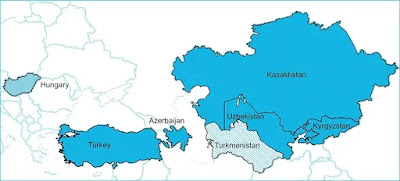
In 2019, Uzbekistan joined the council.
In 2021, Turkmenistan also joined as an observer member so now, except for Tajikistan, four of the five of the "Stans" are members of the council.
Earlier this year, the Islamic Republic of Afghanistan applied for observer status but no decision has been made public yet.
While not an official language, English is a working language of the council.
 My first visit to "the Stans" went pretty well. I was only there for nine days so some things felt a bit rushed but overall I had enough time. I learned a few things for the next visit.
 The only problem I had in Bishkek was that it took me forever to find an ATM that would work for me. I wasn't able to pull out any cash on my Czech or American debit cards. I had €150 with me that I could change but not having any local currency handy started to worry me. I finally found that I could withdrawal cash from DemirBank. No other bank ATMs would work for me. Lesson learned: always have a few U.S. Dollars or Euros handy to exchange when visiting the far off lands.
 |
| 70th anniversary of the end of WWII |
 The people were very friendly. I even received a high-five from an ethnic Korean because I was an American who could speak basic Russian.
 |
| Kazakh registration card |
 Astana was much more interesting. When it comes to architecture it's like the Dubai of Central Asia. There is so much to see. On the 19th, me and my FitBit walked all over the city - a new personal best 34,17 km (21.23 miles).
 |
| Kazakh WWII 70th anniversary poster |
 About 25 km (~15.5 miles) southeast of Bishkek is the Ata-Beyit Memorial Complex in Chong-Tash.
 As part of Joseph Stalin's Great Purge the NKVD, the precursor to the KGB, executed people all across the Soviet Union. In Central Asia is was a means of cracking down on nationalist movements. In 1938 the NKVD secretly brought 137 "counter revolutionaries" from the capital to here. They were shot and the bodies were dumped into an underground kiln.
  For more than 50 years no one knew what had happened.
  |
| Memorial with the victims' names |


 Bishkek is the capital of Kyrgyzstan and with 937,000 people it is also the country's biggest city.
 Originally Pishpek, it started out as a small fort, in 1825, as a stop on the Silk Road through the Tian Shan mountains. In 1862 the Russians set up a garrison here. The name was changed to Frunze in 1926 and in 1936 it became the capital of the Kyrgyz Soviet Socialist Republic.
 |
| Mikhail Frunze statue |
 Бишкек isn't really known for its sightseeing. It's a typical Soviet style planned out city. There are lots of monuments throughout the capital.

 In 1974 the People's Friendship Monument was unveiled to honor the 100th anniversary of Kyrgyzstan's entry to the Russian Empire.
 |
| Museum of Fine Arts |
 The Victory Monument was completed in 1984 to commemorate the 40th anniversary of the Soviet victory over Nazi Germany in the Great Patriotic War (WWII).


 Manas the Great is the national hero. The Bishkek Airport is now Manas International.
 Behind the museum is a statue of Lenin. It used to be where the Manas statue is but was moved several years ago. I think it's one of the last Lenin statues still up in Central Asia.
 Not far away from Lenin, in Oak Park, is a statue of Karl Marx and Frederick Engels.

 The Red Guards Memorial is a mass grave for those who died in the war. In 1970 an eternal flame was added but it currently isn't lit.
 Kurmanjan Datka was a military leader and stateswoman. She also served as a colonel in the Russian Imperial Army. The monument of her was unveiled in 2004.
 The granite monument of Friendship and Glory of Labor was erected in 1974 to celebrate the 50th anniversary of the Kyrgyz Communist Party.
 Aaly Tokombaev was a national poet who wrote under the pseudonym Balka (Hammer) and contributed to modern Kyrgyz literature. His monument was erected in 1996.
 Jumabek Ibraimov was the mayor from 1993 to 1995. He served as the country's prime minister from 1998 until his death from stomach cancer in 1999. He was the first PM who publicly spoke out about corruption high within the government.
 Since becoming independent there have been two revolutions in Kyrgyzstan. This monument is in memory of those killed in 2002 and 2010 and it symbolized the victory of good over evil.
 The Frunze Museum contains the home of General Mikhail Frunze who was born in Bishkek. He was a close associate of Lenin and played key roles in the revolutions of 1905 and 1917. The city bore his name until it was changed to Bishkek.
 Panfilov Park contains more memorials, some nice paths, and lots of rides for the kids. Although some of the rides looked as if they hadn't been serviced in quite some time.
 The monument for Nasirdin Isanov was installed in 2003 as part of the
city's 125th anniversary. Isanov was the country's first prime
minister.
The monument for Nasirdin Isanov was installed in 2003 as part of the
city's 125th anniversary. Isanov was the country's first prime
minister. Toktogul Satylganov was a poet, singer and musician. This 1974 granite monument shows him with his traditional instrument, the komiz.



 Posts
All Comments
Posts
All Comments


 Czech Koruna Exchange Rate


