Showing posts with label United Arab Emirates. Show all posts

Sunday, September 11, 2022

WhatsApp

When I was in hospital I would give a daily update to my parents in Arizona, my sister in California, Claudia in Berlin, Natalie in Wellington, and Kája.  I couldn't use iMessage because Nat and Kája are Android users and everyone is on Apple.  I couldn't use WhatsApp because my parents and sister don't use it.  So I had to go old school and use SMS (text message). 

SMS is Short Message Service but in the USA we call it a "text message" and we use "to text" as the verb.

The USA is one of the few big countries where SMS remains the usual way to chat.  SMS/Text message travel over telephone lines rather than over the Internet.

If you use an iPhone then and you want to message someone else who also has an iPhone then you send them an iMessage.  The message goes over the internet.  If you want to message someone who uses an Android phone then you send them an SMS.

The benefit of SMS is that it works with any phone.  However, there are security flaws, you don't get notifications when the recipient has read your message and you can't start a video call from a text message.  SMS messages are up to 160 characters.

WhatsApp is a free instant messaging and voice-over-IP (VoIP) service that was purchased by Facebook in 2014 for $19.3 billion.  It's the most popular way to message people in most of Europe, Africa, Latin America and most of India.

It's heavily used across Europe.  Mainly because it's free.  In the USA, SMS is usually priced at a flat rate and most carriers include text messaging as part of your mobile package.  In Czechland, a single SMS is usually around 1 Kč (5¢) which over a month can add up to a good chunk of change.  On the other hand, most U.S. mobile providers charge a heavy fee for international text messaging.

To use WhatsApp you just need an internet connection.  With WhatsApp you're not limited to 160 characters per message, you can send images, videos, audio files and documents, there are read notifications when the recipient has seen the message, you can use it to video call, group chats and calls are no problem and it uses end-to-end encryption which means that only the sender and the recipient of the message can see its contents.  Plus, it's free.

Spain uses it the most.  Something like 90% of mobile users use WhatsApp.  In the USA, only about 1/3rd of users have downloaded the app.  I bet that a good chuck of the users have it to communicate with family and friends in parts of the world where SMS is expensive.

In China, WeChat is the go-to messaging tool while in Japan, Line is number one, and Telegram is popular in Russia.  WhatsApp is banned in China, North Korea, Syria, Qatar, and the UAE.

Here's a short video I found on YouTube that talk about why Americans don't use WhatsApp.

©Digital Trends

Tuesday, September 14, 2021

Expat or Immigrant?

So what's the difference between an expat and an immigrant?  Both terms apply to people who live outside of their native country.  An expatriate, or expat for short, is usually someone living and/or working in a foreign country, usually temporarily and for work reasons.  Most of the time, expats either return to their native country, or move on to another, but not always.  When I would hear "expat" I would immediately think of American authors James Baldwin or Ernest Hemingway living in France.  

This blog is "Christopher's Expat Adventure" because I came to Brno for a two to three year gig with the intention of going back to the USA.  Then after five years I got permanent residency which meant that I could stay in Czechland without having to continually apply for new visas every couple of years.  In my head I was still an expat.

An immigrant, just like an expat, is a person who lives and/or works in a foreign country.  Usually with the intent to remain for good and not return back to their home country.  Now that I'm going to apply for Czech citizenship I suppose that I'm officially an immigrant.  Or am I an expat until I get Czech citizenship?


Quite often it seems that the difference between an expat and immigrant comes down to race, social class, economic status and country of origin.  Expats tend to describe usually white, educated, financially well off professionals working abroad while people working in less prestigious positions are immigrants or even migrant workers.  A well educated person from North Africa working in Europe would more likely be considered an immigrant rather than an expat.

Someone from the Philippines working as a maid in Hong Kong would not be considered an expat.  She most likely wouldn't even be an immigrant but rather a migrant worker.

During the migrant crisis I remember talking to my friends and mentioning that I too was an economic migrant in Europe.  They simply told me that I was the good kind of migrant.  Hmmm...  Yet I still remember that anti-imigrant flyer I received by Zeman supporters.

There are an estimated 6,32 million Americans and 4,7 million British expats living overseas.  I don't know about the British but the majority of Americans living abroad are in Canada and Mexico.

Qatar, the UAE, Kuwait, Jordan, and Singapore are the top five countries with the highest percentage of foreign workers based on their total populations.

Back in 2018, foreigners in here in Czechland made up about 4,7% of the population.  The top three groups coming from Ukraine, Slovakia, and Vietnam.  Brno was home to more than 30.000 foreigners from 150 countries.

In Brno there are around 40.000 Slovaks but I don't think that Czechs really consider Slovaks as foreigners.  For one thing, Slovaks do not have to register for residence like other EU citizens here on work contracts.  So skipping the Slovaks, the biggest groups of foreigners in Brno come from Ukraine, Russia, Vietnam, Romania, India, and Turkey.  All of the American expats are in Prague.

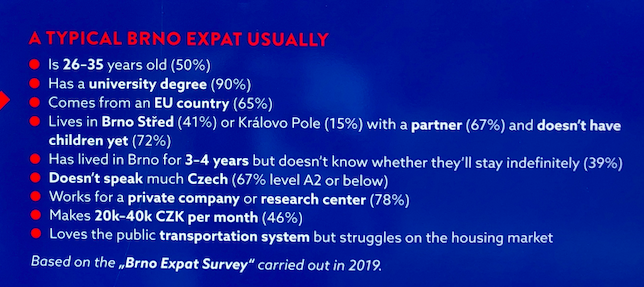
According to the "Brno Expat Survey" that was conducted in 2019 here are some details about the typical Brno expat.

I came to Czechland as an expat and ended up an immigrant.  Hopefully I'll get Czech citizenship and become an American Czech in Brno.  Or would that be a Czech American in Brno?

Thursday, June 21, 2018

State of Qatar

The State of Qatarدولة قطر  is located on the Persian Gulf in the Middle East.  Qatar is a little smaller than Connecticut.  It borders Saudi Arabia, and is across the sea from Bahrain and the UAE.  Saudi Arabia just announced a bid to build a canal on the border which will basically turn Qatar into an island nation.


Qatar is home to 2,6 million people but only 12% are Qatari citizens.  There are 2,3 million expats, mostly non-Arab, living and working in the country.  You're a Qatari citizen only if your father was a citizen.  It takes at least 20 years for a foreigner to get citizenship.

The Al Thani dynasty has ruled Qatar since 1825.  Once a part of the Ottoman Empire, it became a British protectorate and gained independence in 1971.

The country is an absolute monarchy and Islam is the official religion.  Qatar has a mixed legal system blending civil law with Sharia (Islamic law) when it comes to family and personal matters.  Political bodies and trade unions are not permitted by law.

This is not a place to be if you're gay.  Homosexuality is illegal and is punishable by fines, up to 7 years in prison or even the death penalty.  

©Test Tube News

Arabic is the official language.  With so many expats, English is a common foreign language.

Until 1966, the Indian Rupee was used as the country's currency.  It briefly spotted the Saudi Riyal before adopting the Qatar and Dubai Riyal.  In 1973 the Qatari Riyal became the official currency and it is pegged to the U.S. Dollar.

Due to having the world's third-largest natural-gas reserves and oil reserves, Qatar is a very rich country.  It has the highest per capita income in the world.

Qatar is home to the Al Jazeera television station which opened in 1996. 


Qatar Airways is the state-owned national carrier and it began operations in 1994.  Hamad International Airport opened in 2014 and is the airline's hub which provides routes to more than 150 international destinations.  In 2013 the airline joined Oneworld.  The airline is using Doha to compete with Emirates and it's Dubai base.

Qatar is probably the most open country in the Middle East when it comes to travel.  Citizens of more than 80 countries are able to visit without needing to arrange a visa in advance.
©Al Jazeera

In 2017, Saudi Arabia, the UAE, Bahrain, and Egypt broke diplomatic ties with Qatar.  This included closure of their seaports and airspace which makes flights in and out of Doha longer.  The countries have accused Qatar of supporting terrorism which Qatar denies.  Here are a couple of YouTube videos I found that talks about the 1-year anniversary of the blockade and the impact of the economic blockade.

©France24

©Al Jazeera

Thursday, January 11, 2018

The Middle East

There are no hard rules about where exactly the Middle East is.  Some consider it to be a geographical term and others consider it a political one.  The term "Middle East" began as a Eurocentric term for the area separating Europe from the Far East.  Most agree that the area consists of the transcontinental region from Turkey to Central Asia, plus the Gulf Area.  Many also include Egypt due to its territory in the Sinai Peninsula.  Others consider North Africa to be part of the Middle East as well.

Definite Middle East countries include: Bahrain, Cyprus, Egypt, Iran, Iraq, Israel, Jordan, Kuwait, Lebanon, Oman, Palestine, Qatar, Saudi Arabia, Syria, Turkey, United Arab Emirates, and Yemen.

North African countries that often get lumped in are Libya, Tunisia, Algeria, Morocco, Mauritania, and Sudan.

Middle East history goes all the way back to ancient times.  It is the birthplace of Judaism, Christianity, and Islam.  Many other ancient belief systems such as Zoroastrianism were also established here.

Islam is the largest religion in the area.  Almost every country, except Cyprus and Israel, have Muslim majorities.  Iran, Iraq, and Bahrain are mostly Shia while most of the other countries are predominately Sunni.  Islam plays a huge role here as the legal systems in most of these countries are influenced by Islamic law.

©Test Tube News

It's a scary place for gays.  Being gay is illegal and punishable by imprisonment in Egypt, Kuwait, Oman, Qatar, and the U.A.E.  In Iran, Iraq, Saudi Arabia, Syria, and Yemen, it is punishable by death.   Most of these places aren't high on my travel bucket list anyway.

Arabs are the largest ethnic group in the Middle East.  The five most spoken languages are Arabic, Farsi, Turkish, Kurdish, and Hebrew.

With such a large region there are of course many problems.  One of the biggest problems is the Israeli-Palestinian conflict.  One of the biggest mistakes lately was President Trump, going against years of U.S. prescient and recognising Jerusalem as the Israeli capital.  Almost every other country in the world recognises Israeli occupation of East Jerusalem as illegal which is why all of the foreign embassies are in Tel Aviv.  Here's an NBC video I found out on YouTube showing some of the reaction to the U.S. action.

©NBC

There's currently a big regional power struggle in the Middle East between Iran and Saudi Arabia.  Each wants to be calling the shots in the region.

©Test Tube News

Update 2025:  Here's a short YouTube video about why didn't the Arab world unite.

©History Matters

Saturday, August 9, 2014

Toilet Adventures

Using the facilities can be an adventure in Euroland.  Firsts things first.  What do you call the facilities?  In the USA we say "restroom" or "bathroom".  In the South you might also hear it referred to as the "powder room."  Over here you will see it labeled as WC (water closet).  In the UK and Ireland it is called the "loo."  In most of Europe you call it the "toilet."

In the USA, we call the porcelain item a "toilet bowl" but we never say that "I'm going to the toilet."  To an American, saying that one is going to the toilet sounds vulgar.  For our sensitive ears it is much better to say that "I'm going to the restroom."  In Europe, no one has any qualms about letting you know they are going to the toilet.

In Euroland you normally have to pay to use the WC.  Some places are free such as in a restaurant, pub, movie theater, airport, office building, etc.  But almost everywhere else, like shopping malls, train or bus stations, public parks, etc., you will have to pay.  Normally the price is 10 Kč ($0.50).  There is usually an attendant who you pay the money to as you enter.

TP on the wall before you enter
All restrooms will have toilet paper.  It did throw me one time when I was at a school and there was no paper in the cabin.  There was a large dispenser on the wall and you had to tear off the amount needed prior to going in to the cabin.  

In every cabin you will find a toilet brush.  It is not there just for the attendant.  Use it.  It is really bad form to leave a commode with any visible trace that it had been used.

Occasionally in Czechland you will find a place with two prices, 5 Kč or 10 Kč, depending if you only need to stand or if you need to sit down.  If you pay to sit then you will be given a few sheets of toilet paper as you enter.

Paying for the loo seemed really dumb to me when I first moved here.  However now it just seems normal.  The fee isn't that expensive and public restrooms here are always very clean.  In my opinion it is well worth the 10 Kč.

It's also no big deal over here for a female attendant to go in to the men's room while it is in use.  This includes men's locker rooms at the gym.  Yes, it can be a bit distracting at first when the cleaning lady starts sweeping around your feet while you're standing at the urinal but you eventually get used to it.  The women are just doing their jobs.  Besides it's nothing they haven't seen before.

Most toilets in Europe are designed to conserve water so you will usually find two buttons.  A small button if you only need a small flush and a bigger button for when you need a larger flush.

Some toilets have a washout shelf
Most of the commodes here are similar to the ones in the USA.  Mainly that when you sit down, you are sitting over water.

Austrian shelf toilet
In Germany and Austria it is common for there to be a shelf in the bowl where "everything" lands.  This makes inspection much easier.  Don't ask me why.  When you flush the toilet "everything" on the shelf is washed away. 

Turkish squat toilet
In Turkey, parts of Greece, and parts of Italy, I've come across the squat toilet.  Sometimes they flush and sometimes there is a pitcher of water that you pour into after use.  These are not my favorite as it takes a bit of balance.

In some places, the plumbing may be frail so you can't flush the toilet paper.  In this case you have to put the used paper into a bin.

It's not a drinking fountain
Very rarely will you ever see a bidet in the USA but they are quite common in Europe.  For those that don't know, a bidet looks kind of like a toilet but it shoots up a stream of water from the base.  After you use the toilet, you then use the bidet to clean yourself.  This gets you cleaner than just using toilet paper and it saves paper but it can be tricky to use the first few times.
Shower/bidet combo


One hotel in Portugal had a combination shower & bidet.  I've never run across this again.

The douchette


In the UAE and Azerbaijan I came across the douchette which looks like a dish sprayer.  Sort of like a "bidet pistol".  This one must take practice to use and not hose down the entire room.

I guess this about covers everything.  I'm sure someone will leave a comment if I've missed something.

Friday, April 19, 2013

Visas

Since moving to Euroland in July 2009, I've been to 37 countries.  So far I've been fortunate that I haven't really had to deal with obtaining visas.  A visa is a common requirement, depending on your citizenship, to be able to visit a particular country.  There are tourist visas, transit visas, business visas, student visas, residence visas, etc., and each visa is good only for a specific period of time.  Visas can be for a single entry, double entry or multiple entries.  Visas usually take up one whole passport page which is a downer.  We're talking prime passport real estate.

Visas fees are all over the place.  There's this reciprocity thing where countries tend to charge tit-for-tat.  For example, the USA charges Uzbeks $180 for an American tourist visa so Uzbeks turn right around and require Americans to pay $160 for a visa to Uzbekistan whereas they only charge $60 to someone with a Danish passport and $4 for someone from Tajikistan.

Sometimes the more obscure the country the higher the visa fees.  It seems to me that lower visa fees would encourage more tourists to visit Country X and spend their money there. 

Henley & Partners is a law firm that publishes an annual list ranking the ease of travel by citizenship.  The higher the score then the more countries one can visit without needing a visa.  In 2012, Denmark came in 1st place.  If you hold a Danish passport then you can visit 169 countries without needing a visa.  The USA tied for 4th place with Italy and Luxembourg at 166 countries.  The Czech Republic came in 15th place with 152 countries not requiring visas for Czech citizens.  Afghanistan scored the lowest with only 26 countries not requiring visas.

Arrival visa stamps for UAE & Oman
Now these numbers are for countries that do not require visas.  This does not include the "visa on arrival".  The UAE requires Americans to have a visa but it is given as you pass through immigration.  And it was free so for me I still consider this as a non-issue.

Turkish on arrival visa sticker


Americans need a visa for Turkey, but it too is available on arrival.  It only costs €15 and I didn't have to apply in advance at the nearest embassy.

This is what's so nice about the Schengen area.  Once you're in, you can travel around and not have to deal with visas and passport control as you cross borders.

Full page Czech residency visa
Most times the visa application process can be extremely complicated and time consuming.  I decided against going to Belarus because the application process was more than I was willing to deal with this year.  I've been told by many of my Eurocrew that getting a visa to visit the USA is super difficult and often requires an in-person interview at the embassy.

Traditionally, applying for a Russian tourist visa was a pain in the arse.  A single entry visa is $180.  However, as of last year, Americans can now apply for a 3-year, multiple entry visa, for only $235.  Hmmm...I might need to start planning some trips to Russia.

My Armenian E-Visa
Nest week I'm off to the Caucasus.  I don't need a visa for Georgia.  Americans do need a visa for Armenia but they have this nifty e-visa.  You apply on-line and the visa is e-mailed to you.  I just have to print it out and take it with me.  The e-visa costs $40 but the cool thing is that it won't take up a full page in my passport.  The trick will be getting an Azeri visa.  Apparently, it order to visit Azerbaijan, there's a requirement for foreigners to jump through bureaucratic hoops like trained circus poodles.

Update: In 2019, Uzbekistan implemented an e-visa, and for an American, a single-entry visa for 30 days is only $20.

Wednesday, April 17, 2013

UAE & Oman Trip

I'm back from my little get away to the United Arab Emirates and Oman, and away from the Czech cold.  It was great.  And the weather was nice and sunny.  35°C (95°F).  Thank goodness for plenty of SPF 55.

I flew in to Abu Dhabi and made my way the 2.5 hours to Sharjah.  It's basically a suburb of Dubai.  With all of the traffic it's a little more than an hour to Dubai from Sharjah but I guess that's what happens when gas is so cheap.


The next day was my day trip to Khasab.  This was by far my favorite day.  It was absolutely brilliant!  I loved cruising down the fjords in an Omani dhow.


Dubai wasn't quite what I was expecting.  I think it's like when you're the last person to see a new movie.  Everyone has built it up so much that by the time you get around to seeing it, you're like ehhh, whatever.


It wasn't bad but not quite what I expected.  It was very smoggy while I was there so the mega skyscrapers were impressive but not as much as they could have been.  The Dubai metro isn't really geared for tourists.  Every cool building seemed to be an hour away, from each other, on the other side of town.

Plus it didn't really feel like the Middle East.  I did come across people in traditional Arab dress but it wasn't the majority.  Almost everyone working in the UAE is an expat with most coming from India, Pakistan, the Philippines, and parts of Africa.  On the upside there were plenty of really good Indian restaurants and almost everyone spoke English.


It was kind of fun though seeing Baskin-Robbins, Hardee's, Pizza Hut, KFC, etc., advertised in both English and Arabic.

I preferred Abu Dhabi to Dubai.  Even though it is the capital, Abu Dhabi seems to be the underdog since Dubai normally gets all of the attention.  And I tend to root for the underdog.  Abu Dhabi had more of a Middle East feeling.  And with the amount of construction going on there I'm sure that it will out marvel  Dubai in a few short years.

With the whole gay thing being illegal in the UAE, I know that my mother is glad that I'm now back in Euroland.  But it's not like I was there to hook up or to lead a parade or something.  However, I was curious to see to what extent censorship runs.  It's there alright.  I wasn't even able to log in to a gay chat room.

So overall, the trip did what it was supposed to do.  I got to relax for a few days.  There was plenty of sunshine.  I got to enjoy some very cool architecture.  I extended my travel adventures from Europe to the Middle East.  And with Dubai checked off the list I can now look at visiting Israel sometime in the next year or two.  

Monday, April 15, 2013

Abu Dhabi, United Arab Emirates

Abu Dhabi is the largest of the seven emirates of the UAE.  The city of Abu Dhabi, أبو ظبي, is the capital and second largest city in the country, after Dubai.  The city lies on a T-shaped island less than 250 meters (820 feet) from the mainland.  Abu Dhabi is home to 921,000 people.

Back in 2007, Abu Dhabi was ranked as the richest city in the world.

The Abu Dhabi Plan 2030 encourages the development of new skyscrapers over the next decade.

There is so much construction going on over here.  I get the feeling that Abu Dhabi is tired of Dubai getting all of the architectural attention.  I've included several YouTube videos which give lots of details about some of the awesome buildings here.

The best known architectural landmark in Abu Dhabi is the Sheikh Zayed Mosque.  It is named for the late president and founding father of the United Arab Emirates.  The mosque has 1,000 columns, 80 domes, the world's largest chandelier and the world's largest carpet.  It took over 12 years and $545 million to build.  It is the 8th largest mosque in the world and can accommodate about 41,000 people.  It's absolutely beautiful!! 


In 2007, the Abu Dhabi flagpole, at 404 feet, was the world's tallest flagpole.  Today it is only the 5th or 6th tallest.

Etihad Towers


The Emirates Palace is a luxury hotel.  It must be nice because it cost over $5.98 billion to build.  The hotel opened in 2005.

Capital Gate is known as the Leaning Tower of Abu Dhabi.  The 35 story skyscraper is 160 meters (520 feet) tall and inclines 18 degrees westward.  The tower was completed in 2011.  The Guinness Book of World Records certifies it as the "World's furthest leaning man-made tower."


The Al Bahar Towers are twin office buildings.  They feature an intelligent sunscreen system which helps reduce energy and cooling costs.

©CNN


Ferrari World, on Yas Island, is the world's largest indoor theme park.  It is also home of the world's fastest roller coaster.


The Aldar headquarters building is pretty cool.  It was completed in 2010.  It is the first circular building of its kind in the Middle East.