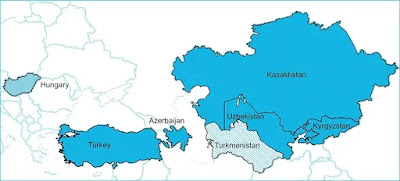
The Turkic Council is an organisation of independent Turkic countries whose aim is to promote cooperation among Turkic-speaking countries. The council was founded in 2009 by Azerbaijan, Kazakhstan, Kyrgyzstan, and Turkey. The council's headquarters are in Istanbul.
In 2018, Hungary joined the council as an observer member. Hungary isn't a Turkic nation so, to me, it seems real odd that Hungary is a part of the club. Hungarian Prime Minister Viktor Orbán probably did it to taunt the EU. I suppose Orbán needs additional allies and the Turkic countries aren't exactly known for being liberal democracies. Besides, Orbán has a track record of going on about how Europe has a Christian history and he's not known as being exactly welcoming to Islam. All of the other council member countries are more Muslim than not.
In 2021, Turkmenistan also joined as an observer member so now, except for Tajikistan, four of the five of the "Stans" are members of the council.
Earlier this year, the Islamic Republic of Afghanistan applied for observer status but no decision has been made public yet.
While not an official language, English is a working language of the council.
Here's a short video I found out on YouTube that talks about the council.
A friend had a cookout today and asked if I would bring real American cheesecake. Well as "real" as possible given that the ingredients here in Euroland aren't exactly the same. I originally thought that this would be a simple post about me making cheesecake but it's going to be way more complicated than just that so bare with me.
There are two types of cheesecake, the kind you bake and the no-bake kind. I prefer the no-bake version. The key ingredient to cheesecake, at least in the USA, is Philadelphia cream cheese. Which of course you can't get over here in Czechland.
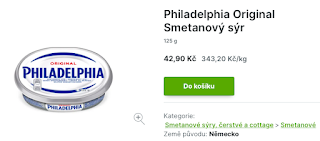
What you can get is Philadelphia cream cheese spread. First, the spread is not the same thing as regular cream cheese. I do know people who make cheesecake with the spread but it doesn't taste the same. A 125g (4.4oz) container here costs 43Kč ($2). This would be kind of pricey to use for cheesecake plus it's not the right ingredient so it would not turn out right.
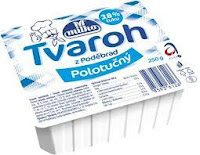
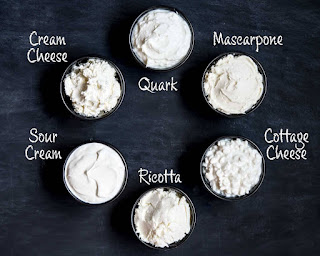
In Czechland most people use tvaroh which is kind of like American cottage cheese but drier and not as milky. Tvaroh is used heavily for baking here. One of my favourite dishes are plum or apricot dumplings with tvaroh.
Tvaroh
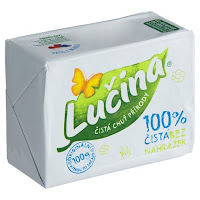
The closest thing I've found to cream cheese is lučina. Lučina entered the Czechoslovak market in 1981. It's almost like cream cheese but a little drier and a bit tangier than traditional cream cheese
I use lučina for all of my U.S. recipes that requires cream cheese. Lučina comes in little 100g (3.5oz) blocks for 23Kč ($1.08).
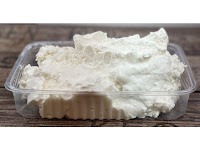
In Germany, people use quark. Quark always messes with people because there is no translation for it. When you type the German word "quark" into Google Translate the English translation you get back is "quark". Quark is kind of like cream cheese but not really. It's a soft, fresh cheese that can be used for either cream cheese, ricotta, or even sour cream.
Side note...every child in the USA learns the nursery rhyme about Little miss Muffet.
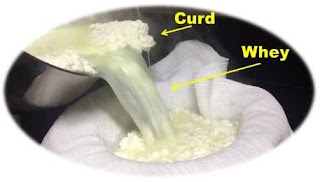
Little miss Muffet, sat on her tuffet, eating her curds and whey
Along came a spider who sat down beside her
And frightened miss Muffet away
The kick is that kids in the USA don't know what curds and whey are. When kids ask what are curds and whey we just say it is cottage cheese.
OK...now back to the cheesecake. The other key ingredient that doesn't exist over here are graham crackers. A graham cracker is a sweet cracker made with graham flour that originated in the USA and dates back to the 1880s.
Graham flour is just whole wheat flour that is ground more coarsely. It has just slightly less protein than white wheat flour.
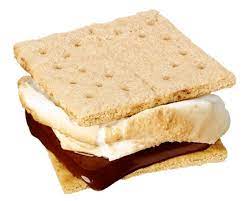
Graham crackers are eaten as a snack. They are often flavoured with honey or cinnamon but they are most famous for being one of the key ingredients to make s'mores. No camping trip or bonfire is complete without s'mores. You roast a marshmallow over an open fire. You then put the marshmallow and a piece of Hershey's chocolate between two graham crackers and enjoy the ooey gooey treat. The reason that it's called a s'more is because once you'e had one you always want some more.
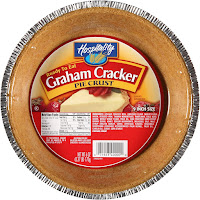
Graham crackers are one of the most popular pie crusts in the USA. You can even buy pre-made graham cracker pie crusts that come in a disposable aluminium pie pan.
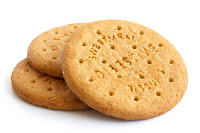
With no graham crackers over here, people use digestive biscuits. Now comes the British English.
What we call a 'cookie' in the USA is called a 'biscuit' in the UK. Sušenka in Czech. What the USA calls a 'biscuit' is almost a 'scone' in the UK. No equivalent of either in Czechland.
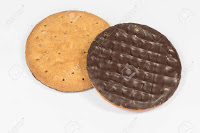
A digestive biscuit is a semi-sweet "cookie" that dates back to 1839 in Scotland. The "digestive" part was that they acted like an antacid because they were first baked with sodium bicarbonate. The digestive biscuit is one of the most popular biscuits in the UK. I prefer the ones with chocolate on side. They are perfect for dunking in to your tea.
In Euroland, people grind up digestive biscuits to use for pie crusts.
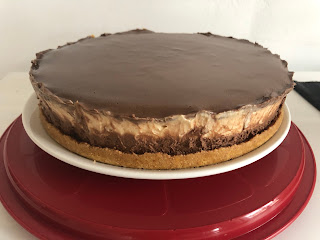
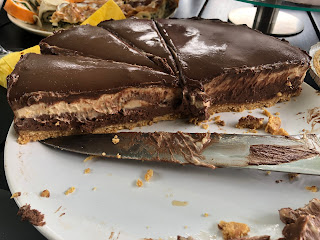
The first cheesecake I made for my friend's party was a chocolate peanut butter cheesecake. I used a recipe that I found on YouTube. Here's the video but to be fair I did make a couple of changes.
I didn't use digestive biscuits for the crust. I have a bag of graham cracker crumbs from a care package so I did make a proper graham cracker curst for the cheesecake.
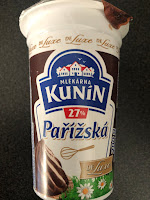
When it came to making the chocolate layer, I didn't use regular cream. Instead, I used pařížská which is chocolate cream.
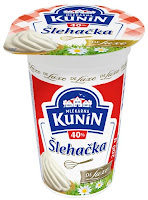
The regular cream, šlehačka, that I used in the peanut butter layer was 40% but the chocolate was only 27%. This helped make it even more chocolatey tasting.
This thing took hours to make but it turned out really well.
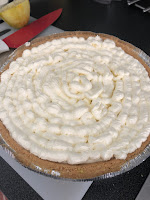
I also made a smaller vanilla lemon cheesecake. Whipped cream in a can here isn't the same as it is back in the USA. In the USA it is sweet but not here. Here it tastes more like air. I took the šlehačka, whipped it up, added a little vanilla and put it in a bag and piped it on top of the cheesecake.
I also used one of the pre-made graham cracker pie crusts that I had from another care package.
Both of the cheesecakes were popular but the chocolate peanut butter one was the winner.
I've written before that Czech names can be a complex thing. One of the key differences is that surnames don't always match up. Due to some patriarchal rules for names, and the lovely Czech grammar that treats surnames like adjectives, a husband will have a different last name than the wife. A mother will not have the same last name as her son while a father and daughter will also have different names.
Mr. Novotný and his sons will be called Novotný while his wife and daughters will be called Novotná. That's because Novotný is the grammatically masculine version and Novotná is the grammatically feminine version.
Most of the time, the feminine suffix is -ová. So Mr. Novák and Mrs. Nováková. The -ová is so common that the Czech press adds -ová to women's names automatically. For example, German Chancellor Angela Merkel is written as Angela Merkelová.
Personally, I still see it as odd that a parent and child don't have the same last name. Czechs aren't the only ones to do this. It's the same in all of the Slavic countries, and I believe the Baltic countries, too.
Until 2004, every woman in Czechland was required to adopt the feminine version of her husband's last name. There were few exceptions allowed in order to avoid the whole -ová thing. Foreign women marrying foreign men in Czechland were exempt. Czech women who married a foreigner whose name ended in a vowel were also off the hook. Czech citizens with permanent residence abroad or women who had plans to live abroad could also request not to get the -ová. I don't know how much but there was a fee for this.
A proposed amendment to the Registry Act made it past the Chamber of Deputies, 91-to-33, that would give women the right to utilise the masculine version of her husband's name. The Senate had 30 days to debate the topic and if passed it would go to the President to be signed in to law. Well, it passed. So most likely in January 2022, women can choose to take her husband's masculine-form surname. So both spouses will have the same last name.
Grammatically the -ová indicates ownership. So a woman either belongs to her husband or a daughter belongs to her father. Some view this as kind of sexist and archaic. Others just view it is tradition and important for Czech grammar.
In Czech every noun is either masculine, feminine or neutral. So a last name needs to be either masculine or feminine. The argument is that if you can't decline a last name correctly then this could lead to miscommunication.
I have a Czech colleague who took her Czech husband's (masculine) last name a couple of years ago. I need to ask her how she did it. I do believe that their daughter has the -ová form. She's said that it really hasn't been a problem other than a few times on the telephone when people stumble a bit thinking the last name is an -ová when it isn't.
A few things that I found out...
The mandatory -ová thing is relatively new. It only became mandatory in 1945.
Slovakia allowed women to decide on the -ová suffix several years ago. The vast majority of women still go with the feminine form.
Poland also gave women the right to decide on the -ová suffix a few years. It wasn't that disruptive.
Men can take their wive's name but they only get the masculine version. There's no -ová for men.
If someone wants to change a surname then there is a 1000 Kč (~$47) fee. The fee is waived following a divorce or a sex change.
A person can change their first name if the name is "derogatory, eccentric, ridiculous, distorted, or foreign". The fee is 100 Kč (~$5).
I get how this all applies to women when they marry. I don't know if the -ová thing will still apply when a child is born. Can the parents now decide if their newborn daughter will take the -ová form or not?
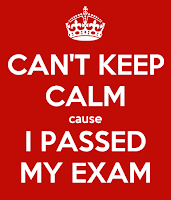
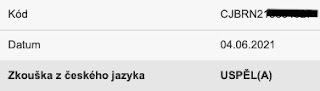
I passed! Happy happy joy joy I passed. What a relief that I passed my B1 Czech language exam on the second try. The results are supposed to be available 30 days after the exam. I took the exam on 4. June and with the 5th and 6th of July being public holidays I figured that I would not get the results until next week. Obviously I was quite happy that they were available today and even more so because I passed.
When you don't pass the exam, they provide you with the breakdown of your scores in the four areas. However, when you pass all they tell you is that you passed. No scores are given.
I wrote an e-mail to ÚJOP asking for my scores and they replied back with my marks. Overall I did better this time than I did last time. My overall score last time was 61% and this time I scored 65,5%.
On the the reading comprehension I scored 80% which was way better then the 68% I received last time.
On the written section I scored 60% again. Right on the border but I'll take it.
I didn't do as well on the speaking section as I did before. Last time I scored 76% and this time I dropped to 70%.
It was the listening comprehension that did me in last time. Previously I only scored 40% but this time I scored 65%. I got 13 questions right which is exactly what I needed to pass this portion of the exam. Had I missed just one more question then I would need to take the exam for a third time. Oh the shame if I had to take it a third time.
I still say that the listening comprehension portion of the exam is unnecessarily difficult. It is more of a short-term memorisation exercise than anything else. But it's over and done with. I should receive my certificate in a couple of weeks. Now I can start thinking about all of the paperwork I need in order to apply for Czech citizenship.
Today is 12 years in Czechland. 12 years!?! It's already been two years since my ten year party. I really don't know where the time goes.
Coming here is still one of the best decisions that I ever made. Next year will be 13 years which means I will have lived in Brno just as long as I had lived in Atlanta. So when someone asks me where I'm from will I still say Atlanta? It would be weird to say that I'm from Brno. When I lived in Atlanta, the answer was that I was from California. Maybe that will be the correct answer. Who knows? Besides I've got a whole year to try to figure it out. For now, happy Czech-iversay to me.
I received my second Pfizer BioNTech vaccine yesterday morning. Like last time I had a 10 am appointment at the Brno Exhibition Centre. I had to show my health insurance card at the initial registration again. This time the woman looked at my name and said that she thought that she knew me. Kind of hard to tell I guess as we were both wearing masks. I assumed that it must have been from IBM but then the mention of IBM triggered that she knew me from my blog. I thanked her for reading the blog and went on to the next station to see the nurse.
The nurse verified my insurance information, took my temperature and told me that I had to get in a separate line for foreigners. This was different from last time. Six weeks ago there was just one line. Of course the place was busier this time because more people were here. Last time everyone was getting their first vaccine. This time some people were here for their first vaccine and some were here for their second vaccine. In the past six weeks the government has sorted out the administration of vaccines for foreigners here in Czechland who have self-paid health insurance. This mostly applied for English teachers and the like who are technically independent contractors. Now that these foreigners could finally get their first vaccine it meant that there were more now more foreigners here so I guess that was the reason for a Czech line and a foreigners line.
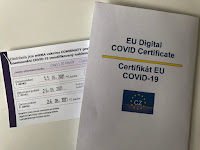
So it was busier than last time but still very well organised. From start to finish it took me about 45 minutes and I walked out with my stamped vaccination card. I was given a weblink so that at home I could print out a digital vaccine card. Kind of funny to print out a digital card but whatever. The important thing is that now I'm fully vaccinated and I didn't have any side effects. I'm sure that at some point I'll probably have to go for a booster shot. Now how soon before I can travel somewhere?
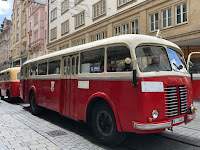
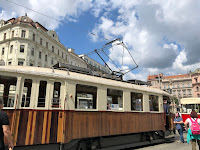
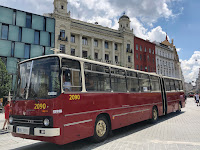
The historic tram is always popular and this one can still be ridden today.
The Golden Tram wasn't on display but then again it's not exactly historic.
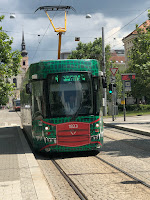
Again, not historic but I like the Brno dragon šalina. Leave it to the Czech sense of humour to have a dragon tram and with the dragon wearing a rouška to support the preventative measures to reduce Covid-19.
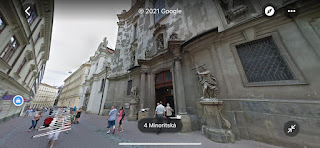
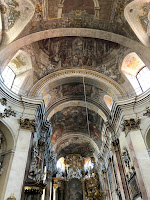
Yesterday my friend Vašek and I went for a walk to the centre to do a bit of shopping at H&M. When we went past the church at Minoritská he asked if I had ever been inside before. I hadn't. I've passed it countless times over the past 13 years but I never bothered to go inside before. What a fool I was. Who knew that it was actually a 17th century Minorite monastery?
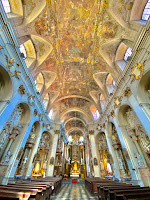
The Church of St. John the Baptist and St. John the Evangelist, also called the Church of St. Johns, belongs to the Minorite monastery and was founded around 1230. The site had been used continuously for almost 800 years. The Church of St. John was consecrated in 1257. In the 18th century the church and the monastery were rebuilt in the Baroque style.
The complex has been on the list of cultural monuments since 1958, I'm a bit surprised that the communists actually put a monastery and church on the cultural monuments list. It's well worth a visit because the inside is gorgeous. I can't believe I've walked right on past it all these years. I need to start figuring out what else I've missed out in Brno.
I'm still keeping up with my Czech while I wait for the results of my B1 exam. Fingers crossed that I pass it. I need B1 in order to apply for citizenship but I'll keep studying until I reach the B2 level which is the level required for someone to study at university. I'm not planning on attending uni but I want to get my Czech to this level. However, I have zero intentions of taking the B2 exam. I'll be happy enough to pass my B1 exam.
Learning Czech verbs is both easy and a pain in the arse. They are easy in that there are only three verb tenses - past, present, and future. The past tense gets a little more difficult than in English because in Czech the past tense acts like an adjective so it has to agree in number and gender.
It gets way more complicated with aspect which is basically a concept of completeness. Since verbs are either imperfective or perfective it means that Czechs use two different verbs where English just uses one verb but with lots of different tenses.
In English we use different prepositions to change the meaning of a verb. For example, there's a difference between to to, to go into, to go out of, to go around, to go through, etc. Czechs also use prepositions but there are also different prefixes which can change the meaning of the verb.
The different prefixes are do-, o-, od-, na-, po-, pod-, pře-, před-, roz-, u-, v-, vy-, z-, za-. If you learn the meanings of the various prefixes it can help you guess the meaning of the verb. This is doesn't help 100% of the time but the prefixes can point you in the right direction.
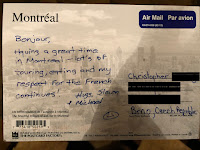
Back in 2018, Steven and Michael took a trip to Canada and sent me three postcards from Québec. I don't know why but for some reason Steven put Michael in charge of posting them. Michael put the "air mail" sticker on each card but forgot to put an actual stamp on each postcard. The Canadian post office must have felt sorry for him because I ended up receiving two of the three postcards in Brno even though they didn't have any stamps.
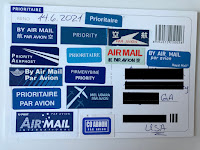
Obviously, a stamp is always required when you mail a postcard. The air mail sticker is optional. When I was still travelling, pre-COVID, I would ask the post office clerk for a few extra air mail stickers. Sometimes the post office had them and sometimes they didn't but when they did, no country's post office has ever not given me a few extra stickers.
Just to have a laugh, I sent them a postcard this week that was chockablock with nothing but different air mail stickers from across the world. Here's the card I sent prior to buying a stamp at the post office. I'm sure that they'll get a chuckle out of it.








 Czech Koruna Exchange Rate


 Posts
Posts


