Showing posts with label Monastery. Show all posts

Sunday, October 1, 2023

Salt Mine and Hiking Tour, Romania

On Saturday we took an all-day tour to see some of the sights near Cluj.  It was a full day, with just us, another couple, and our guide Tudor.

We started off at the Turda Salt Mine about 35 km (21 miles) from Cluj.


Table salt was continuously produced here from the Middle Ages until 1932.  It reopened in 1992 as a salt therapy centre.  It was renovated in 2008 and opened for tourists in 2010.

There's an underground layyrinth carved out of salt, numerous chambers with historic mining equipment, and an underground lake to explore.  


Less of a salt mine and more of an underground theme park.  There's a Ferris wheel, miniature golf, table tennis, bowling, and boats to keep people entertained. 


After the salt mine we headed to Cheile Turzii, the Turda Gorge about 30 minutes away.  


The Turda Gorge is a 3 kilometre limestone canyon that's home to 1000 plant and animal species.  There are caves here that were inhabited since Neolithic times.

We spend about two hours doing a 9 kilometre (5.5 mile) hike.  The views were lovely and it felt good to do some hiking.

After our hike we visited a small village called Rimetea which used to be an important mining town. 

Rimetea has been inhabited since Roman times and is now home to about 1000 people.  

Although a Romanian village, the population is about 85% ethnic Hungarian.  In Hungarian, the village is called Torockó.


The former local administrative budding was built in 1889.  In 1952 it became an ethnographical museum.


The Orthodox Monastery of the Holy Archangels Michael, Gabriel, and Raphael was built in 1933.


The interior was absolutely stunning.  Well worth a visit.

Sunday, June 20, 2021

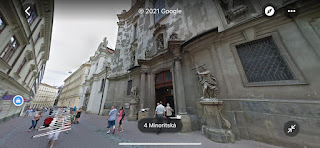
Brno Minority Monastery and Church of St. Johns

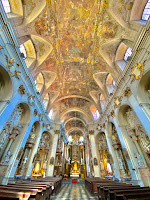
Yesterday my friend Vašek and I went for a walk to the centre to do a bit of shopping at H&M.  When we went past the church at Minoritská he asked if I had ever been inside before.  I hadn't.  I've passed it countless times over the past 13 years but I never bothered to go inside before.  What a fool I was.  Who knew that it was actually a 17th century Minorite monastery?

The Church of St. John the Baptist and St. John the Evangelist, also called the Church of St. Johns, belongs to the Minorite monastery and was founded around 1230.  The site had been used continuously for almost 800 years.  The Church of St. John was consecrated in 1257.  In the 18th century the church and the monastery were rebuilt in the Baroque style.

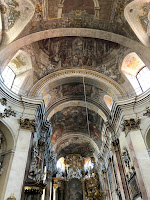
The complex has been on the list of cultural monuments since 1958,  I'm a bit surprised that the communists actually put a monastery and church on the cultural monuments list.  It's well worth a visit because the inside is gorgeous.  I can't believe I've walked right on past it all these years.  I need to start figuring out what else I've missed out in Brno.

Sunday, October 31, 2010

Bruges, Belgium

Bruges (pronounced Bruzh) was founded in the 9th century and is the capital of Belgium’s West Flanders province. With most of its medieval architecture intact the city looks like something out of a fairy tale. Since 2000, the historic city centre has been listed as a UNESCO World Heritage site. Among the city’s claims to fame is that the first book in English ever printed was published in Bruges.
The Minnewater is a canalized lake with a small park with plenty of swans. The story goes that in 1488 the people of Bruges executed one of the town administrators. The administrator’s last name was Lanchals which means ‘long neck’ and his family coat of arms featured a white swan. Maximilian of Austria punished the town for the execution by ordering the town to care for swans for eternity.
The guinage of Bruges was founded in 1245. In 1937 it became a monastery for the nuns of the Order of Saint Benedict.

The town is often called “The Venice of the North” because of its canals. A 30-minute canal ride is only €8 and it’s a great way to see Bruges from a different perspective.


Onze-Lieve-Vrouwekerk (The Church of Our Lady) is the world’s second highest brick tower. The steeple is 122.3 meters (401.25 feet) tall. It took 200 years to complete the church, from the 13th – 15th century.
Inside is the marble sculpture Madonna and Child created by Michelangelo around 1504. It is the only one of his statues to leave Italy during his lifetime. It had been purchased by two wealthy brothers and donated to the church in 1514. It has been taken twice by foreign invaders. In 1794, the statue was ordered to Paris but was returned after Napoleon’s defeat. In 1944, German soldiers smuggled it to Germany, hidden in mattresses in a Red Cross ambulance. Two years later is was found and returned to Bruges.
Bruges is a city with two town squares. The largest one is Grote Markt and this was the commercial center of medieval Bruges. The main monument is the 13th century belfry tower. It is 83 meters (~272 feet) tall and is supposed to have a great view of the city. Unfortunately, I didn’t have enough time to make it to the top of the belfry. Around the square are guild houses.
 
Burg is the second square and is the administrative section of town. There are some great looking buildings from various architectural styles. In the corner of the square is the Heilig-Bloedbasiliek (The Basilica of the Holy Blood).
It was built from 1134 to 1157 as the chapel for the Count of Flanders. It was became a minor basilica in 1923. The relic of the Holy Blood (Christ’s blood) was brought to Bruges from the Holy Land in 1150 after the Second Crusade. Every year there is a mile-long religious procession and many people dress as medieval knights.
Seeing Ghent and Bruges made for a long day trip from Brussels. Both cities are well worth a visit. But after a while it all becomes information overload. It’s probably best to spend a full day in each city as opposed to trying to see both in one day. I originally thought about trying to squeeze in a half-day visit to Antwerp but I’m glad I didn’t. This way I have an excuse to visit Belgium again. Maybe next year if I manage to make it to the Netherlands.

Friday, July 30, 2010

Hvar, Croatia

Hvar is the second largest Croatian island in the Adriatic Sea off of the Dalmatian coast. It’s been ranked as one of the ten most beautiful islands in the world. I totally agree. Hvar has become a hub for every globetrotter with a sailboat. The island is filled with palm trees, orange and lemon groves, olive plantations, vineyards, and fields of lavender, rosemary and sage. It’s Croatia’s sunniest island getting over 300 days of sunshine per year.

My flight from Prague was delayed and I just barely caught the last ferry of the night to Hvar with 5 minutes to spare. The ferry from Split to Stari Grad (47 Kuna = ~$9) took just under two hours and then it was a 20 minute bus ride to Hvar Town.

Hvar Town is a small medieval town on the southwest of the island. There is a citadel on a hill above town that was built in the 16th century. From the top of the citadel there is an awesome view of the city and the Pakleni Islands.


On the east side of the town’s main square is the Cathedral of St. Stephan. The cathedral and bell tower dates back to the 16th and 17th centuries. It was built on the site of a 6th century church.

The arsenal was built in the 13th century. On the first floor of the arsenal is a theater that was built in 1612. It is one of the oldest in Europe, as well as, the first municipal theater.

In the 15th century the Franciscan monastery was built as a retreat for sailors.

Hvar is known for its nightlife which tends to go well in to the next morning. But the beaches are the best! Directly opposite Hvar town is the Pakleni archipelago and a roundtrip water taxi is only 33 Kuna ($6) to Saint Jerolim Beach.

These wooded islands with rocky beaches and clear blue water are absolutely beautiful. The only drawback is the constant hum of the crickets. It sounded like those annoying vuvuzela horns that were so popular during the World Cup matches. But armed with a book and my iPod, I was able to block it out and just enjoy the sun and the water. Hvar has been very relaxing and a great way to start off my Croatian vacation. Now off to Split

Sunday, July 18, 2010

Capuchin Crypt

Near the Cabbage Market is the 17th century Capuchin Monastery. It was built from 1648 – 1651. Baroque sculptures decorate the front side that date back to 1765. In the monastery’s basement is the crypt. People from all levels of society were buried in the crypt. Apparently the composition of the ground and the dry air under the church made it easy to mummify dead bodies. This was a cheap way to dispose of bodies. Given their vows of poverty, the monks would recycle the same coffin, over and over, for all funerals. After a church service the monks would carry the coffin down to the crypt. The coffin had a false bottom so the body came out and was left on the ground to dry out. This went on until 1787 when the emperor, Joseph II, prohibited burying the dead inside of town limits. There are several bodies in on display in the crypt. In one room, the bodies are laid on display. In Czech, there is a sign that translates to “As you are now, we once were, as we are now, you shall become.”