Showing posts with label Czech Politics. Show all posts

Monday, November 29, 2021

A New Prime Minister

As of yesterday, Czech Republic has a new prime minister.  Petr Fiala, the chairman of the Civic Democratic Party and head of the SPOLU alliance, was appointed as the new prime minister by President Miloš Zeman.

The new prime minister is a Brňák meaning that he's from Brno.  The country's first prime minister from Brno.  He was born here.  He studied history and Czech language at Masaryk University and in 2002 he became the country's first professor of political science.  In 2004 he was the dean of Masaryk's Faculty of Social Studies and became head of the entire university.  

In 2012 he was the Minister of Education, Youth and Sports.  In 2013 he was elected to the Chamber of Deputies and in 2014 he became chairman of the Civic Democratic Party (ODS).

©EuroNews

SPOLU, the Together coalition, is made of the Civic Democratic Party, the Christian Democrats (KDU-ČSL) and TOP 09.  SPOLU won the recent general election with the ANO party coming in second followed in third place by an alliance between the Pirate party and the Mayors and Independents party (STAN).  In fourth place was the Freedom and Direct Democracy party (SPD) which is anti-EU.  SPOLU took 108 of the 200 seats in the Chamber of Deputies.  No other party gained enough votes to earn a seat which is why the Communist party is out.

SPOLU signed an agreement with the Pirate and STAN alliance to create a new majority government with Petr Fiala as the leader.  

©EuroNews

Premiér, or ministerský předseda, is the prime minister who is the head of the government of the Czech Republic.  The prime minister is the most powerful office as they lead the executive branch of government, chairs the cabinet and selects the cabinet ministers.  
The Czech President selects the prime minister whose term is four years and there are no terms limits.  Well, sort of.  Czechland is a parliamentary democracy so the prime minister and their government are accountable to the Chamber of Deputies.  The prime minister is usually the leader of the largest political party, or a coalition, in the Chamber of Deputies.  So it's pretty straight forward who the president will select as prime minister.    

The Czech Constitution states that the prime minister was gain and maintain the confidence of Parliament. As soon as the prime minister looses the the support of the majority of the Chamber of Deputies, the prime minister is forced to resign and the president must select a new prime minister.  So there's no guarantee that a prime minister's term will last the full four years.

The Czech president is the country's head of state, represents the country internationally and is commander-in-chief of the military.  As the prime minister runs the executive government, the president's role is mostly ceremonial.  The president is responsible for appointing the prime minister but it's pretty straight forward that the PM is the leader of the largest party, or the largest coalition, in the Chamber of Deputies.  However the president is responsible to appoint members of the Czech National Bank and to nominate justices to the Constitutional Court, but this is subject to Senate approval.  In Czechland, "professor" is the highest academic degree and the title is appointed by the president, but countersigned by the prime minister.

The Czech Statistical Office reported that more than 65% of eligible voters participated in the election about seven weeks ago.  This is the highest turnout in a legislative election since 1998.

The now former prime minister was Andrej Babiš and he held the role from 2017 to now.  Prior to that, from 2014 to 2017, he was the Deputy Prime Minister and the Minister of Finance.


He entered politics 2012 by forming his own political party - ANO 2011.  "ANO" stands for Akce nespokojených občanů, the Action of Dissatisfied Citizens.  "Ano" is also the Czech word for "yes".  

Andrej Babiš is from Slovakia.  He moved to Czech Republic after the Velvet Revolution.  He was a businessman prior to entering politics and is the second richest man in Czechland.

He is the oldest and wealthiest person to ever become prime minister.  He was the country's first prime minister to not be from the ODS or ČSSD parties.  He was the first prime minister who was born outside of the Czech Republic.  He is the first to hold dual citizenship and the first whose native language isn't Czech.

He has Czech and Slovak dual citizenship.  One of the things that came out of the Velvet Divorce was that anyone who was a citizen of the Czech and Slovak Federative Republic on 31 December 1992, could chose if they wanted to be a citizen of either the new Czech Republic or the new Slovak Republic.  This is called "declaration".  In 2000, he obtained Czech citizenship by declaration, but he maintained his Slovak citizenship by descent as his parents are Slovak citizens.

This is still something that's odd to me.  In the U.S., you can't be President unless you were born a citizen, and you can't hold dual citizenship either.  The best case of this is probably Madeline Albright when she was Secretary of State.  In the US, the order of succession for the President is (1) the Vice-President, then (2) the Speaker of the House, (3) the President pro tempore of the Senate, followed by (4) the Secretary of State.  Since Madeline Albright wasn't born a U.S. citizen she was not eligible to become a presidential successor.

Babiš is Slovak, with Czech citizenship.  In my head I just can't understand how you can be the leader of a country when you weren't born a citizen.  Or how do you ensure that the leader is working in the best interest of the country when he holds citizenship, and loyalty, to another country?  But that's just one of the differences between the Czech and American systems.

One of the many controversies about him was that during the 1980s, he was an StB agent.  Documents at the National Memory Institute in Slovakia show that Babiš collaborated with the StB under the code name agent Bureš.

He was accused of illegally obtaining €2 million of EU subsidies designed for small businesses by concealing his ownership of a company that received funds.

On 16 November 2019, the Million Moments for Democracy protest group held a protest demonstration against Babiš that was attended by over 250,000 people which was the largest protest since the Velvet Revolution.

The national debt in 2020 was 367,4 billion Kč (over $15 billion) which is the largest in the country's history.  In spite of all of the controversies around Babíš he's still leaving with a 30% approval rating.

The new prime minister has promised to reform and stabilise the growing national debt.

In July 2022, the Czech Republic will assume the 6-month Presidency of the Council of the European Union.

Friday, April 30, 2021

Jsme fér

Jsme fér (We are fair) is a coalition of non-profit organisations that started in 2017 and campaigns for same-sex marriage here in Czechland.  It is made up of Amnesty International Czech Republic, Logos Czech Republic, Mezipatra, PROUD, Prague Pride, and Queer Geography.

The Equal Marriage Bill was introduced to the Parliament in November 2018 but it has continued to stall for years.  As of yesterday it was finally put to a vote that begins the legislative process.  This is great news but I doubt anything will happen before the next parliamentary elections in October 2021.

Czechland was the first post-Iron Curtain country to provide any sort of legislative protection for gays when it allowed for registered partnerships back in 2006.  While this was an important step it is not the same thing as marriage.  There are more than 100 legal differences that exist between marriage and registered partnerships.

The promising thing is that support for equal marriage has increased dramatically over the years with currently about 67% of the country in favour of it.

Personally I think it would be great for Czechland to become the first post-Communist country to have equal marriage.  Once behind the Iron Curtain, the nation can be the first to break from the "Rainbow Curtain" and join the 16 other European countries that have equal marriage.

Thursday, January 9, 2020

Czech Citizenship Exam: History of the Czech Republic Since 1989

Here are the 10 study questions for the Czech Citizenship exam from section 28: History of the Czech Republic Since 1989. 


1.  When was the independent Czech Republic established?

1 January 1993.


2.  The Czech Republic has been a member of NATO since 1999.  What is this organisation for?

For military cooperation.


3.  When did the Czech Republic join the European Union?

In 2004.


4.  Which two states emerged after the disintegration of Czechoslovakia in 1993?

The Czech Republic and the Slovak Republic.

5.  When is the Day for the Struggle for Freedom and Democracy celebrated in the Czech Republic?

17 November.

6.  Which of these functions did Václav Havel perform?

The function of the President of the Republic.

7.  Which day is the national holiday for the Day of the Restoration of the Independent Czech State celebrated?

1 January.


8.  Who became the Czech president after Václav Havel in 2003.

Václav Klaus.


9.  Who became the Czech president after Václav Klaus in 2013?

Miloš Zeman.

10.  The Czech Army participates in various foreign missions.  In which country has it been operating in this way since 2002?

In Afghanistan.

Saturday, August 24, 2019

Million Moments for Democracy

Milion chvilek pro demokracii, Million Moments for Democracy, is a Czech protest group that formed in January 2018.  It was founded by Mikuláš Minář and Benjamin Roll, who were theology students at Charles University in Prague.

It started off with a challenge to get one million signatures supporting the resignation of Czech Prime Minister Andrej Babiš.  Among the reasons for protesting against the PM are alleged corruption, his staying in office while under police investigation and that he was an StB operative under the communist regime.

The group is not affiliated to any particular political party.
They have organised demonstrations across the country.  On June 2019, with over 250,000 people, they staged the largest protest since the Velvet Revolution in 1989.

Friday, January 26, 2018

Seriously?!?!

So here's the deal.  On 12-13 January, Czechs went to the polls to elect a president.  In order to run for president a candidate needs either 50,000 signatures from the public, 10 signatures from senators or 20 MP signatures from the Chamber of Deputies, plus file applications at least 66 days prior to the election.  Of the nine qualified candidates, none won enough votes so the top two finishers face each other in a run off election this week.

The two candidates are the incumbent President, Miloš Zeman, and Jiří Drahoš, the former President of the Czech Academy of Sciences.

I don't get a vote but I'd definitely prefer Drahoš.  Anyway, Zeman supporters left this flyer in my mailbox today.
 
Stop Immigration and Drahoš supporters.  This country is ours.
Vote Zeman!

Seriously!?!?!  Czechland has population of 10,597,473 people with only 4,95% foreigners.  43,6% of all foreigners come from Slovakia and Ukraine.  The country has only admitted 14 refugees.  So what exactly is the immigration problem?

Update:  Well Zeman won re-election.  President Zeman won with 51,36% of the vote and will remain president until 2023.  Voter turnout was 66% and the entire election came down to a difference of 160,000 votes.

Drahoš took 48.63% of the country.  But in Brno he won 57,58%.

Wednesday, May 10, 2017

Brno Girl Scout

The 1st of May is May Day, or Labour Day, and it is a public holiday here in Czechland.  Last week there was demonstration and march organised by the DSSS Workers' Party which is a Neo-Nazi, far-right party here in Czech Republic.

DSSS is Dělnická strana sociální spravedlnosti which basically translates to the Workers' Party of Social Justice.  They are an anti-EU, anti-Nato, anti-USA, pro-Russia political party that is not represented in any legislative body.  They usually take less than 1% of the vote.

The demonstration last week was about 150 people supporting the far-right.  But there were around 300 counter demonstrators who showed up.

One of the opponents was a 16 year-old girl scout named Lucie Myslíková.  The photo of her standing up to a skin head went viral.  We should all be so very proud of this young lady.

©Vladimír Čičmanec

Here's a short video I found out on YouTube that has some footage from the day.  At 21 seconds in you can catch a quick glimpse of her standing her ground with him.

Tuesday, January 21, 2014

#11

In January, the Czech President appointed Bohuslav Sobotka as the new prime minister. 

Sobotka is the former finance minister and chairman of the Czech Social Democratic Party (ČSSD).

He wants to raise pensions and the minimum wage while keeping the budget deficit below 3% of GNP.  He also favors closer links with the rest of Europe and potentially adopting the Euro around 2020.  But that's six years away and he's the 11th prime minister since 1993.   

Sunday, January 27, 2013

New Czech President-Elect

The run-off vote for the 1st direct presidential election is complete and Czech Republic has a new president.  Miloš Zeman took 54.18% of the vote to beat Karel Schwarzenberg's 45.19%,  Polls were open Friday and Saturday and there was a 59.11% voter turnout.

President-elect Zeman will take office in March at the start of his five-year term.  The Czech president doesn't have a lot of executive power.  The president represents the ČR internationally.  After a general election, the president has the power to pick the prime minister and to make appointments to the board of the Central Bank.  The president also appoints judges to the Constitutional Court, with the approval from the Upper House of Parliament.

I think that people realized it was going to be an interesting election when Karel Schwarzenberg's own vote was thrown out because he didn't cast his ballot properly.

I had to laugh when I saw what one of my mates wrote as his Facebook status...

"New President has been elected - luckily it was the hard drinking chain smoking ex commie that was as opposed to the gout ridden, geriatric Austrian ;) Hurrah for democracy in ze Ost bloc!"

Sunday, January 13, 2013

2013 Round One Election Results

Well the first direct elections for the Czech presidency have come and gone.  Since no one won with more than 50% of the vote, there will be a run-off election on January 25th and 26th for the top two finishers.

In the first round, former Prime Minister Miloš Zeman won 24.21% and Foreign Minister Karel Schwarzenberg won 23.4%.

Former Prime Minister Jan Fischer led the polls back in November but finished in third place, and out of the second round, with only 16.35% of the vote.  "Avatar" came in fifth place.

There were 8,435,522 registered voters and voter turn out was 61.31%.

The Czech President serves a five-year term and represents the country internationally and appoints candidates to the constitutional court and to the central bank.  However, there is not much day-to-day power.  That belongs to the prime minister.

Schwarzenburg is a 75-year old titled prince.  As a native German speaker his Czech is sometimes a bit rustic and he can't properly pronounce Ř.  However, he is very popular with young, urban voters.  I've already noticed these flyers out on Facebook to go vote for Karel in the next round.

Friday, January 11, 2013

1st Czech Presidential Election

Today, Czechs go to the polls to elect a new president.  This is the first time ever.  Previously, the president was chosen by the Chamber of Deputies and the Senate because it was thought that the popularly elected president might weaken a government led by the prime minister.  The Czech President serves for a 5-year term.  The current president is Václav Klaus and he has to step down because he is finishing his second term and a third term is not permitted.

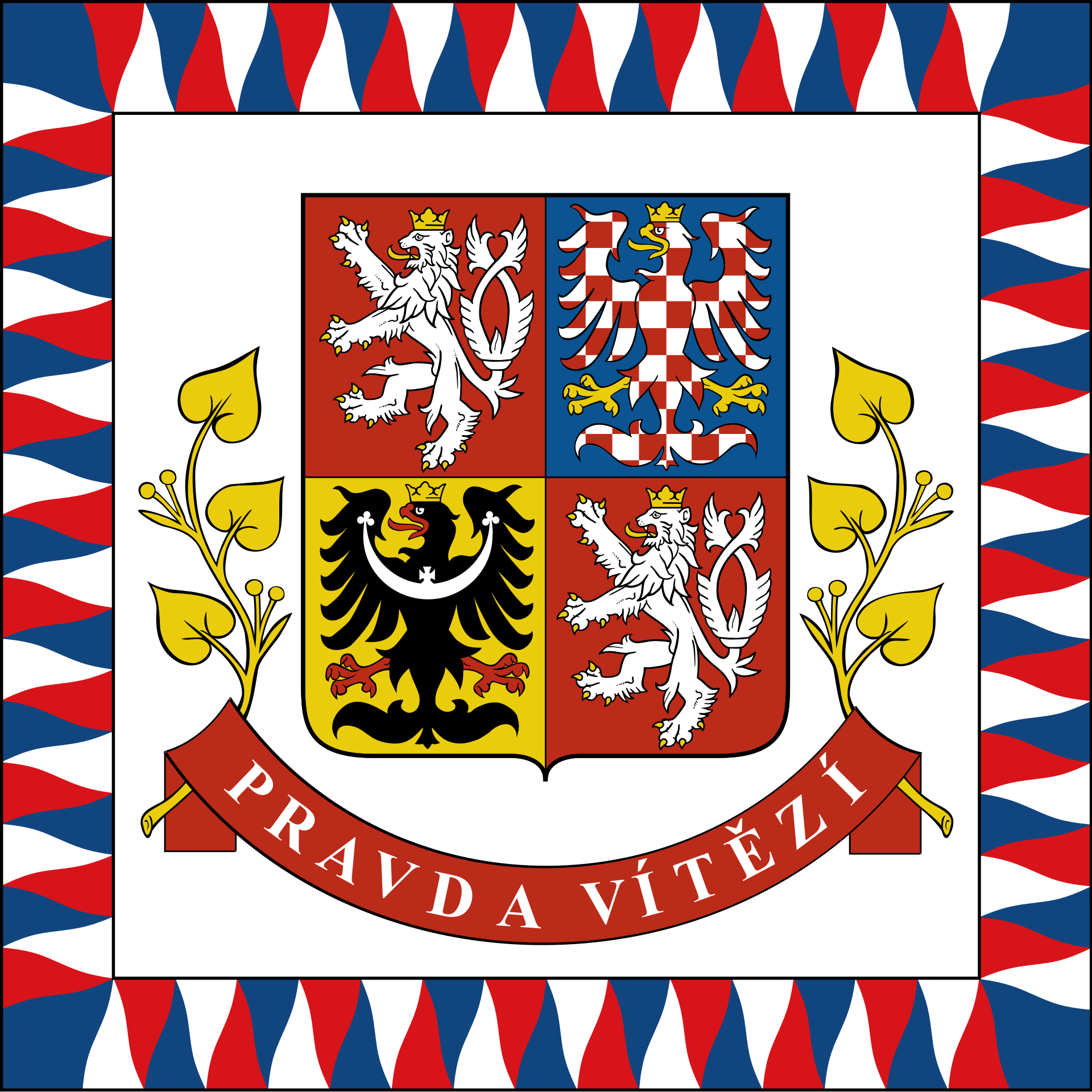
Czech President's Flag
Twenty people tried to get on the ballot but in order to become an official candidate a person needs to get 50,000 signatures or be nominate by 20 deputies or 10 senators.  Nine people qualified.  Czechs get two days to vote, this Friday and Saturday, but if no one gets more than 50% of the vote then there will be a run-off election on January 25-26 between the top two finishers.  Here are the candidates...

Jana Bobošíková is the leader of the Sovereignty party.  She used to be a journalist for Czech TV and was a member of the European parliament.  She is a Euro-skeptic and wants to restore border controls.

Jiří Dienstbier Jr., was born in the USA and holds dual citizenship.  His father was a well-known dissident.  He was a lawyer and is a senator.  He is the Deputy Chairman of the ČSSD, the Czech Social Democratic Party.  He is the youngest of all of the candidates.

Jan Fischer is an independent candidate and one of the favorites.  He was president of the Czech Statistical Office and was the Czech Prime Minister, from May 2009 to June 2010, where he led a caretaker government.  He is pretty much a moderate but is often criticized for being a member of the communist party from 1980 to 1989.  If elected, he would be the world's first popularly-elected Jewish president outside of Israel.

Táňa Fischerová is an independent candidate and a former dissident.  She is an actress, writer, television host and a civic activist.  She was a member of parliament from 2002 to 2006.  

Vladimír Franz graduated from law school but is a painter and opera composer.  He is a professor of dramatic arts in Prague and wants to bring education, culture and tolerance to politics.  He is an independent candidate and is very popular, especially with the youth.  The 53-year old is known for his extensive tattoos which cover 90% of his body, including his face.  His nickname is "Avatar" because in photos he often comes out dark blue.

Zuzana Roithová was a physician and represents the KDU-ČSL, the Christian and Democratic Union - Czechoslovak People's Party.  She was once the Minister of Health and is a former senator.  Currently she is a member of the European Parliament.

Karel Schwarzenberg is the leader of the TOP 09 party and is currently the Minister of Foreign Affairs.  He has served in the Chamber of Deputies and as a senator.  He is a prince.  I don't mean that he is a swell chap, I mean that he is a royal prince.  His full name is Karl Johannes Nepomuk Josef Borbert Friedrich Antonius Wratislaw Mena Fürst zu Schwarzenberg.  After the communists took over in 1948, his family fled the country.  He grew up in Austria but has dual citizenship with CZ and Switzerland.  He returned to Prague in 1990 after the Velvet Revolution.  He is extremely popular and always sports a bow tie.  He is the oldest candidate and, at 75, some people wonder, if elected, how long he would actually be able to serve as President.  He has been known to sleep during parliamentary sessions.  

Přemysl Sobotka was a physician before becoming a politician.  He is the candidate for ODS, the Civic Democratic Party.  ODS was founded by the outgoing president, Václav Klaus, and is the largest conservative political party in the country.

Miloš Zeman is among those with the most experience.  The hard drinking, chain smoking economist was the Prime Minister from 1998 to 2002 and led the Social Democratic Party.  He was the Speaker of the Chamber of Deputies from 1996 to 1998.  In October 2209, he founded Zemanovci, the Party of Civic Rights.  He is best known for his arrogance and his belligerent rhetoric with political opponents and journalists.

By law, the candidates can spend up to 40 million Kč (~$2.08M) during the first round of elections.  In the event of a run-off, the two top candidates may spend up to 10 million Kč during round two.  Here's a quick video I found out on YouTube about the upcoming elections.


©France24

Wednesday, June 22, 2011

Stravenky

In the Czech Republic (and Slovakia), lunch is normally the most important meal of the day. Most restaurants offer a discounted lunch consisting of soup and an entree from a menu of 2 - 4 different entrees.

Around 60 - 70% of employees receive stravenky (meal vouchers) as a benefit from their employer. It is the most common benefit offered to employees in the ČR & Slovakia. The employee and the employer split the cost of the stravenky. The employee pays 45% and it is deducted from the monthly net salary. The employer pays 55% and gets a tax deduction up to 70 Kč (~$4) per voucher.

The vouchers can be used at participating restaurants including most canteens, fast food chains and some grocery stores. The vouchers can only be used for food items, so no alcohol or tobacco can be purchased. The maximum amount of change that can be given back from a purchase is 5 Kč (30¢).

Places that accept vouchers have stickers on the door similar to credit card logo stickers. There are several companies that issue stravenky in various denominations. They sell the vouchers to the employers and then buy back the redeemed ones from restaurants at a discount.

As part of the proposed tax reform, the tax breaks given to companies providing vouchers would be revoked and employees would instead receive an annual tax break of 3.000 Kč (~$178). I don't know how well this will go over because these vouchers are like "sacred cows" to many Czechs. I've never received stravenky as a benefit so it doesn't make any difference to me.

Sunday, June 19, 2011

Transportation Strike

There was supposed to be a nationwide transportation strike on Monday, June 13th. However, the Prague Municipal Court banned the strike because the organizers failed to give the required three working day notice.

The unions organized the strike to protest a number of government education and health care reforms. The two biggest issues that have everyone riled up is a pension plan reform that would raise the retirement age from 65 to 69 and will level the VAT to 17,5% on most food and medicines.

The trade unions then moved the strike from Monday to Thursday, from 00:00 to 24:00. No trains ran at all across the country on Thursday. I wonder how much money this cost Czech Railways? Public transportation strikes (metro, trams & buses) were held in Prague, Brno, Ostrava, Opava, Ústí nad Labem and Zlín.

I originally planned on just working from home but it wasn't a complete shutdown in Brno. On Thursday, 4 trams, 4 trolleybuses and 3 buses ran in 10 minute intervals from 05:00-10:00 and again from 14:00-19:00. My tram line was one that was still operational so I just went in to the office.

Sunday, May 30, 2010

2010 Parliamentary Elections

This was a big election weekend here. Czechs voted on Friday and Saturday for the 200 seats in the Parliament’s Chamber of Deputies – the lower house. Yeah, they get two days to vote. But from what I understand, they really don’t have the option of absentee ballots.

There is a party-list proportional representation election system here and deputies are elected to four-year terms. But if a party doesn’t get at least 5% of the vote then they don’t get a seat.

Voter turnout was at 61% and this was the second lowest voter turnout since the communist government fell in 1989. This was also the first time since the fall of communism that the communist party didn’t finish in the top 3. That's progress! Especially, since its only been 21 years since the Velvet Revolution.

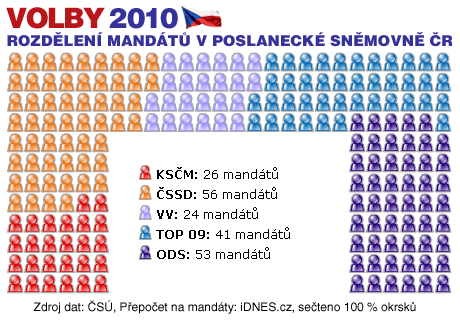
Even though the ČSSD (Social Democrats) won the most seats with 56, they probably won't be in charge. It's expected that a coalition government will be formed between the ODS (Civic Democratic Party), TOP 09 (Tradition Responsibility Prosperity 09), and VV (Public Affairs) parties.

Here's a quick guide to the parties here.

ČSSD is the Czech Social Democratic Party, left-wing

ODS (Civic Democratic Party) = “liberal conservatives”, right-wing

TOP 09 = pro-European conservatives. Founded in June 2009 as a right-wing split from the KDU–ČSL.


VV (Věci veřejné) is a center-right party.


KSČM is the Communist Party of Bohemia and Moravia. It’s interesting that they haven’t dropped the communist title from its name. Every other party in former Iron Curtain countries got rid of the word “communist”. Way left-wing.

KDU–ČSL is the Christian and Democratic Union – Czechoslovak People’s Party. They lost membership to the new TOP 09 party. In 2006, they had 7.2% and 13 seats. Now they dropped to 4.4% and lost all of their seats because they don’t have the minimum 5%.

Strana zelených (Green Party) lost their seats due to the 5% minimum rule.

There has been major campaigning going on for the last several months. Not that ignorance is bliss or anything, but I have to admit that it was kind of nice to have an election going on and not have to hear (understand) all of the rhetoric. I know that I should care more about Czech politics since I live here but it's not like I can vote or anything. At least I can still vote in the USA via absentee ballots and I don't have to listen to endless mudslinging.

Saturday, May 1, 2010

May Day

May 1st is Labor Day and it's a public holiday here. The drawback here is that when a holiday falls on a weekend you don't get an extra day off. You're just off on a day you had off anyway. You don't get to take off Friday or Monday. Oh well...

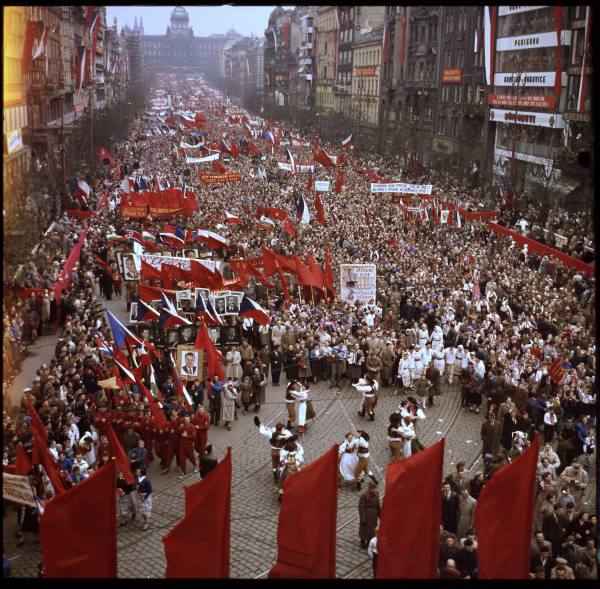
Under communism, International Worker's Day was an official occasion for military parades, flag waiving and showing solidarity against capitalism. Since the Velvet Revolution the day is generally seen as just a free day off.

There is a general election being held here in four weeks. Most of the mainstream political parties will be out campaigning in Prague today.

These pictures were taken in Prague for Life Magazine in 1956.