Showing posts with label Beer. Show all posts

Wednesday, August 31, 2022

Starobrno

Pivovar Starobrno, the Old Brno Brewery is located in here in Brno.  It was built as a successor to an earlier brewery founded in 1325 as part of a convent.  It didn't take the name of Starobrno Brewery until the second half of the 19th century. 

The date of 1872 is on the beer label which means they are now celebrating their 150th anniversary.

In 2009, Starobrno merged with the Royal Brewery of Krušovice and it is now owned by Heineken.

It's main four beers are:

  • Staré Brno - a pale 10° draught beer with 4% alcohol 
  • Starobrno Medium - a pale 11° lager with 4,7% alcohol
  • Starobrno Drak - a pale 12° lager with 5,3% alcohol
  • Starobrno Unfiltered - an unfiltered. 12° lager with 5% alcohol
Most people don't understand the degree thing with beer.  It doesn't indicate the percentage of alcohol.  Brewers use it as a measurement to track the density of certain ingredients.  10 degree beer is around 3,5% alcohol, 12 degree is usually around 4,2% alcohol and 15 degree beers are dark beers.  So the degrees don't indicate the alcohol percentage but the higher the degree the stronger the beer.
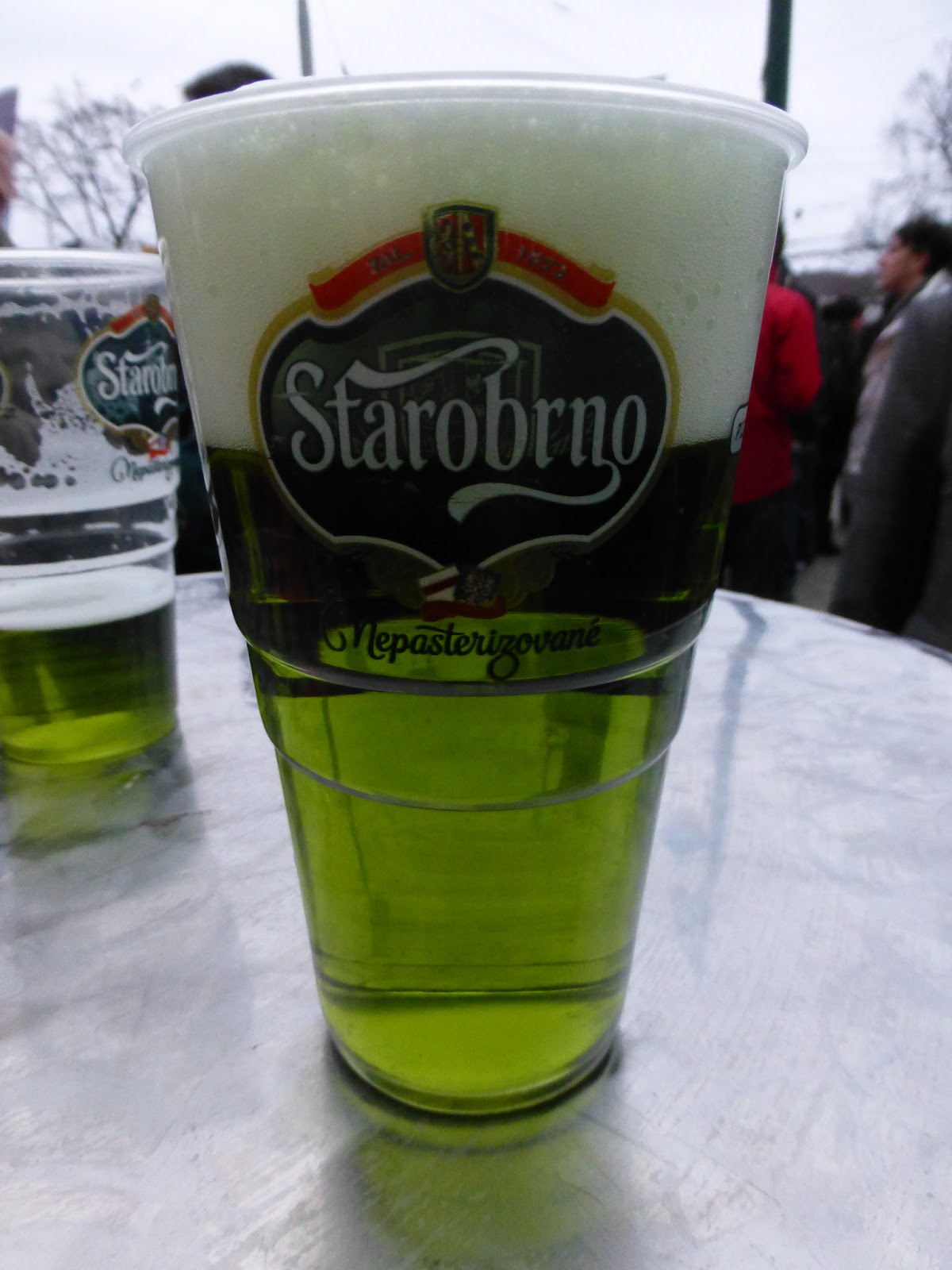
Every year for zelený čtvrtek, the brewery produces a batch of green beer.

In March 2020, the brewery released three new craft style beers.

  • Indian Pale Lager - IPL - a pale lager with 5% alcohol
  • American Pale Ale - APA - a top-fermented beer with 5% alcohol
  • RED - a cherry-flavoured beer with 3,6% alcohol

I haven't tried any of the new craft beers.  My favourite Starobrno is the nefiltrovaný.

Here are a couple of commercials that I found out on YouTube.


Here's a commercial that they ran in Hantec, the local Brno dialect, along with Czech subtitles so that the rest of the country could understand.

Saturday, February 6, 2021

Suchej únor

Czechland ranks third in the world for alcohol consumption.  The Czech Statistical Office, ČSÚ, reported that in a year the average Czech consumes 292 beers, 100 glasses of wine and 175 shots of hard spirits.  According to the World Health Organization the average Czech drinks 14,4 litres (38 gallons) of pure alcohol every year.

There's a cost to all of this drinking.  The 292 beers alone cost about 8.800 Kč ($405).  The government spends more than 56 billion Kč (~$2,58 billion) on alcohol-related health care.  Heavy drinking kills about 7.000 people each year here.

The National Institute of Mental Health, NÚDZ, reported that men drink 4 times more than women.  Due to COVID-19 it looks like Czechs are drinking about 60% more than before.

I'm actually drinking less.  Way less.  Our last virtual pub night was back in November.  I had wine with my virtual Thanksgiving and Christmas dinners but I haven't had a drink since.  It's not like I'm trying to become a teetotaller it's just I don't really see a point to drinking alone during a global pandemic.  

This year is the 9th annual Suchej únor challenge.  I don't expect that the Dry February challenge will be too difficult since I haven't had a drink since December.

But full disclosure...I'm for sure looking forward to the next lad's night at the pub.  Hopefully sometime this Spring.

Sunday, November 15, 2020

Another Virtual Pub Night

Thanks to the new state of emergency our regular pub night isn't possible.  So Friday was time for another virtual meet-up.  

I'm starting to lose it a bit I think with all of this virtual-ness.  All of my work meetings are virtual, all of my Czech classes are virtual, and we're back to pub night being virtual.  Even Czechsgiving this year will be virtual.  

As maddening as all of this is, I'm thankful that I'm healthy and that work is fine.  Busy but fine.  All of my friends and family are healthy too.  But I am so looking forward to life getting back to normal.  Whatever that will look like in the future.

Thursday, July 9, 2020

Lübbenau, Germany

On Monday morning we headed out to Spreewald for the day.

Lübbenau is a town of just over 16.000 people about 82 km (51 miles) southeast of Berlin.  

Lübbenau dates back to at least 1315.  Though excavations have turned up evidence of settlements dating back to the 8th or 9th century.

It used to be part of the Kingdom of Bohemia from 1364 to 1635.

We started off with a guided boat tour of the canals on a traditional barge.

Since 1991 the Spreewald is a protected UNESCO biosphere Reserve and there are thousands of small waterways.

Along the way we stopped off to try the local pickles and lard on dark bread.

I swear that Spreewäldgurken are the best pickles in the world.  We made sure to pick up a few small buckets of pickles to take home for later.

The St. Nickolas church is in the middle of the old town.  The Protestant church built from 1738 - 1741.

Only at Spreewald can you find a pickle radler, a green pickle beer.  It wasn't terrible but I don't have a need to try another one.

Monday, December 23, 2019

Czech Citizenship Exam: Socioeconomic Background

Here are the 10 study questions for the Czech Citizenship exam from section 22:  Socioeconomic Background.

1.  In which region is the Temelín nuclear power plant?

In the South Bohemia Region.


2.  Which of these cities connects the D1 motorway?

Prague and Brno.

3.  What is the name of the famous Czech company that makes pianos?

Petrof.


4.  Traditional brands of trucks are manufactured in Kopřivnice.  What is this brand called?

Tatra.


5.  Which brewery produces Pilsner Urquell beer?

Plzeňský Prazdroj.


6. Hops are an important raw material for beer production.  Where are hops grown?

Around the town of Žatec.

7.  Which of these materials is mined in the Czech Republic?

Brown coal.

8.  Which power plants produce the most electricity in the Czech Republic?

Coal.


9.  Which brand of cars is manufactured in Mladá Boleslav?

Škoda.


10.  The traditional Czech brand is Becherovka.  In which city is this alcoholic beverage produced?

In Karlovy Vary.

Wednesday, December 6, 2017

Still the Top Beer Drinkers

Once again, Czechs are the top beer drinkers in Europe.  In 2016 the per capita consumption in Czechland was 143 litres.  Of course it's what happens when there is such great beer here.

Germany came in second place at 104 litres and Austria was third at 103 litres.  Poland, Lithuania and Ireland round out the top six.

Wednesday, July 13, 2016

Stag Night

The other day Ján surprised the guys at work by us know that he and his girlfriend, Markéta, are getting married at the weekend.  Just a small ceremony with their families.

Well there's no way that the boys were going to let him off that easy.  You can't get married without a stag night.  So after a couple of hours they pulled together an impromptu sendoff.  Ján was told to show up and to be sure to have a helmet.

Ján and his helmet
The first event was to show up at the Starobrno brewery to ride the beer tram.

The Starobrno Brewery is the successor to brewery founded in 1325.  In the later 19th century is was remanded Starobrno, which means "old Brno".  In 2009 it became a part of Heineken.

The beer tram is exactly what it sounds like - a pub inside of a tram.  The trams sits 38 people, another 17 can stand, there are plenty of cup holders, a bar, music, Wi-Fi, and there's even a loo on board.

The tram can follow any of the tracks in Brno so you just tell the driver what part of town you want to ride in.  We booked the tram for an hour.

My first Czech stag night.  11 chaps, 30 litres of beer, and 1 hour.  Challenge accepted!

After the ride, and those 30 litres of beer, we had dinner at the brewery.  It was later followed by more traditional stag night activities, also known as going to a strip bar.  Sorry, no photos from the strip bar.

Wednesday, November 19, 2014

Cheers

Czechs drink the most beer per capita in the world.  Therefore it is important to know the rules when it comes to drinking.

For "cheers" you say na zdraví which means "to your health" and it is very, very important that you look at each person in the eye as you clink glasses.   

Be sure to never, ever cross your glass with someone else when you are clinking glasses.  Across Europe it is thought that doing so will bring seven years of bad sex. 

After you have clinked glasses with everyone then you can take a drink.  This goes for beer, wine or spirits.

In Moravia, the same rules apply for wine or shots but not beer.  Here after you have finished looking everyone in the eye and have clinked glasses, then you tap your beer mug on the table (or your beer coaster) before your first sip. 

If someone is drinking a nonalcoholic beverage then they do not participate in the cheers.  However in the USA, everyone cheers, even if it is with a glass of water or a cola.

Since living in Europe, I find that I say "cheers" quite often and it has nothing to do with drinking.  In British English people also say "cheers" for "thanks" and "good bye".

With so many friends here from all over, plus all of my travels, I've learned how to say "cheers" in many languages.

Czech - Na zdraví
Slovak - Na zdravie
Polish - Na zdrowie
Hungarian - Egészségedre
French - Santé
Dutch - Proost
Italian -  Salute / Cin cin (Chin chin)
Bulgarian - Наздраве (Naz-dra-vey)
Irish - Sláinte (Slawn-ch) 
Russian - Будем здоровы (Budem zdorovi)
Hebrew - לְחַיִּים (L’chaim) 
Greek - γεια μας (Yamas)
Catalan - Salut
Spanish - Salud
Portuguese - Saúde
Turkish - Şerefe
Estonian - Terviseks
Finish - Kippis
Icelandic - Skál
Danish, Norwegian and Swedish - Skål
Bosnian, Croatian and Serbian - Živjeli
Romanian - Noroc (No-rock)
German -  Prost / Zum wohl
Romanians love to cheers with Germans and Austrians because in Romanian "prost" means "idiot".

Saturday, September 13, 2014

Plzeň Brewery Tour, Czech Republic

Plzeň main train station
On Wednesday we took the train to Plzeň to visit the Pilsner Urquell brewery.

Plzeňský Prazdroj brewery
My aunt's foot was hurting her so we limited the amount of walking in town.


So we didn't actually get to see the city which was a bit disappointing because I know that dad would have enjoyed seeing the Patton Memorial.  But the main goal was to tour the brewery which we accomplished.

They've changed the tour around a bit so it wasn't exactly quite the same as when I went last October which was a good thing.  It's still interesting to see the factory churning out all of that delicious beer.

And of course the highlight of the tour is getting to sample the unfiltered, unpasteurized beer.   

Tuesday, September 9, 2014

Battle of the Buds

Czech vs. American Budweiser
There's been a "Battle of the Buds" going on for years.  It's more well known here than in the USA.  The battle is a trademark dispute over the name "Budweiser" between Anheuser-Busch and Budějovický Budvar, the Budweiser Budvar Brewery in České Budějovice.

Budweiser is the German word meaning from Budweis and Budějovický means the same thing in Czech.

Budějovický Budvar
Beer has been brewed in Budějovice since the city was founded in 1245.  In 1876, Adolphus Busch and a friend developed a "Bohemian-style" lager inspired by a trip to Bohemia.  Budějovický Budvar was founded in 1895.

In 1938, the companies agreed that Anheuser-Busch could use the brand name "Budweiser" only in North America.  In 1938, the Czech lawyers were probably more concerned with Germany invading the country than with fighting out the rights to "Budweiser."

Czechvar sold in the USA
The Battle of the Buds has only gotten worse since the fall of communism because now the Czech version is exported to +60 countries throughout the world.  In every country, the two companies have to fight out the trademark issue.

Czech Budweiser is sold in North America under the label Czechvar while American Budweiser in Europe is sold as Bud.

I'm an American and live in Czechland.  So which side am I on?  Honestly, I'm with the Czechs on this one.  For a few reasons...

It's like champagne or bourbon.  If it doesn't come from the Champagne region of France then it has to be called sparkling wine.  If it doesn't come from Bourbon Country, Kentucky, then it's whiskey; not bourbon.  It's odd that it's called Budweiser but the American beer isn't from Budweis.  Plus I've actually tasted both beers and the Czech version is better.

"Bud" is sold in the EU
Besides it really comes down to a David and Goliath thing.  Anheuser-Busch InBev is the world's largest brewer with 150,000 employees and it produces some 400 million hectoliters of beer.  Bedějovický Budvar and its 600 employees makes only about 3.5% as much beer.  Sometimes you just want the underdog to win.  

Tuesday, October 29, 2013

Plzeň, Czech Republic

Plzeň, in western Bohemia and with 170,000 people, is the 4th largest city in Czechland.  It is 90 km (56 miles) west of Prague.

It is most well known as the home of Pilsner beer.  It is also the home of Škoda.   

The town was established in 1295 and went on to become part of an important trade route between Bohemia and Bavaria.

Plzeň, along with Mons in Belgium, has been selected to be a European Capital of Culture in 2015.

The main site at Republic Square is the St. Bartholomew Cathedral.  The original church was completed around 1340.  It was renovated following a fire in 1507 and being struck by lightning in 1837.  The church was given cathedral status by Pope John Paul II in 1993.

The spire is 102.6 meters (336.6 feet) and is the highest in ČR.  The views make it worth a climb up to the top.

The St. Mary's plague column was built in 1681 to commemorate those lost to the "black death".

The Renaissance town hall is over 500 years old.


In front of a bank is a socialist memorial.  As well as a memorial to the communist terror from 1948 to 1989.


The brewery museum is located in a 15th-century building with an original license to brew beer. 


The historical underground is an interesting sight.  It's a network of three story cellars built in the Middle Ages.  It's necessary to wear a protective hat in order to keep from hitting your head on the low ceilings.

The Great Synagogue was completed in 1892.  It is the second largest synagogue in Europe and the third largest in the world.  It was used as a storage facility by the Nazis during the war and was closed down by the communists.  It was reopened in 1998 after three years of restoration.

General Patton's 16th Armored Division of the 3rd Army liberated Plzeň from the Nazis on May 6th, 1945.  After the communists seized power in 1948, they went to great lengths to suppress knowledge of the U.S. Army's part in liberating Western Bohemia.

WWII Monument for Czech solders
Until 1989, it was taught that the Red Army alone liberated Czechoslovakia.  There's now a memorial that says "Thanks America".

There is now an annual Liberation Festival that takes place every May 6th and many American veterans return each year.  I need to check it out next year.


The Plzeňský Prazdroj brewery has produced Pilsner Urquell since 1842.  It has also produced Gambrinus since 1869.  


The brewery tour is among the most popular things to do in town.  It's pretty interesting to see the bottling plant and the vats where the beer is produced.

Enjoying the good stuff!!


However, the best part is getting to taste the unfiltered, unpasteurized beer.