Sunday, April 4, 2021

Erasmus

Brno is a student city and, under more normal times, there are many foreign students here under the Erasmus Programme.  Erasmus is the EU student exchange programme that was established in 1987.  It provides educational exchanges across the EU.  Some non-EU countries like Turkey, Iceland, Serbia, Norway, and Macedonia pay to participate in the programme as well.  Erasmus is the acronym for the EuRopean Community Action Scheme for the Mobility of University Students.  

In 2014, all of the EU's programmes for education, training, youth and sport were combined under Erasmus Plus.

Under Erasmus Plus students don't pay any more tuition than what they pay at their home institution.  Students receive grants to help cover living expenses to study abroad and for work placements/internships.  Teachers and educational staff are also able to attend training courses across Europe.  

Every year around 300.000 students participate in the programme at over 4.000 institutions in 37 countries.  Spain sends the most participants followed by France, Germany, and Italy.  The most popular receiving countries are Spain, Germany, Italy, and France.

I don't know how true it is but I've heard that some 25% of Erasmus participants meet their future spouse/partner while on the programme.

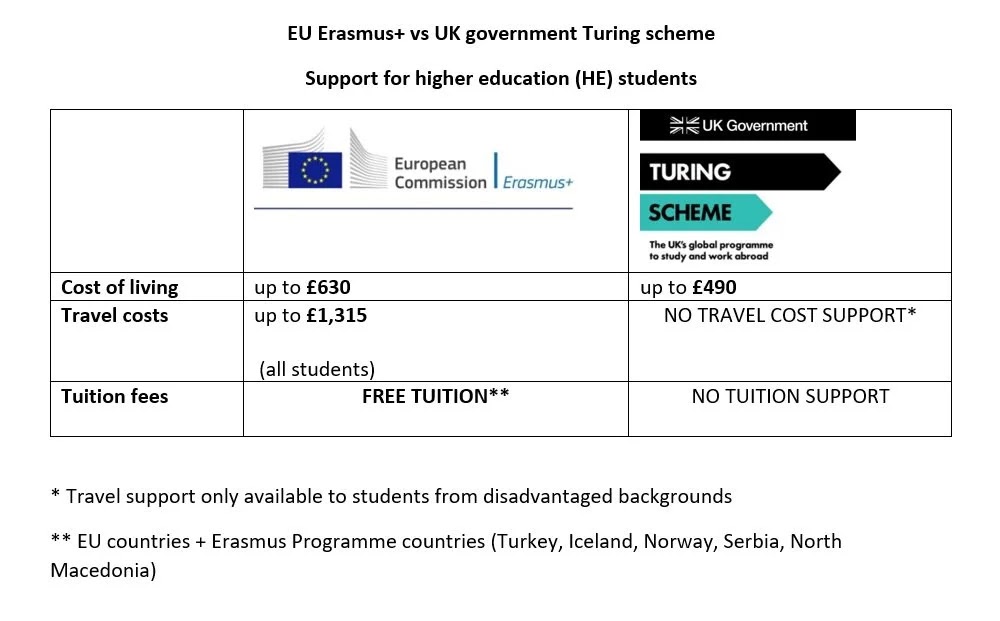
After Brexit the United Kingdom decided to no longer participate in Erasmus.  So UK students can no longer study in the EU and EU students aren't able to study at UK institutions.  The UK has rolled out the Turing Scheme, named after Alan Turing, as its replacement for Erasmus.  It will allow up to 35.000 UK students to study and work worldwide.   

Erasmus provides more money to students than Turing to subsidise their foreign placements.  
Ireland has announced that it will fund students from Northern Ireland to continue to participate in Erasmus even though the UK pulled out of the programme.

Thursday, April 1, 2021

Postage Price Increases

Česká pošta increased prices for some services today.  The price changes are mainly for registered letters, insured letters, and for money orders.  Prices didn't change for regular domestic letters or packages.

Doporučené psaní (registered letters) and cenné psaní (insured letters) up to 50 grams both increase 5 Kč (23¢).  Registered economy now costs 52 Kč ($2.40) and priority is 59 Kč ($2.73).  Insured letters are now 57 Kč ($2.64).

Normal domestic letters and post cards remain 19 Kč (88¢) for economy and 26 Kč ($1.20) for priority.  

A small package, up to 35 cm, is 89 Kč ($4.12) for economy and 99 Kč ($4.58) for priority.

There are four different types of postal money orders and they all increased 5 Kč for money orders up to 5.000 Kč ($231.19).  There are higher fees for higher value money orders.

Type A lets someone transfer the amount to a Czech bank account.  This costs 44 Kč ($2.03).

Type B lets someone send money from an account to be delivered in cash.  This costs 35 Kč ($1.62).

Type C lets someone pay in cash and have cash delivered.  This costs 53 Kč ($2.45).

Type D is a cash transfer in one working day and it costs 112 Kč ($5.18).

I don't know if it's due to Brexit but economy class is no longer available for packages going to the UK.

Monday, March 29, 2021

Czech 2021 Census

Sčítání 2021 is the national census which just began.  It runs from 27 March until 11 May.  If you don't want to deal with paper forms then you can do the whole thing online but the online submission must be completed by 9 April.  

The ČSÚ (Czech Statistical Office) anticipates that over 2/3rds of the population will complete the census online.  There are around 11.000 surveyors that will go out across the country to help those who don't have computer access.

Everyone, including foreigners, has to complete the census.  Failure to do so can result in a 10.000 Kč ($462) fine.  There will be fewer questions than last time and you can complete the census in Czech, English, German, Polish, Russian, Ukrainian, Vietnamese or Romani.

I completed the census in English.  Once question was about your mother language.  I found it funny that English wasn't an option.  You could choose Czech, Slovak, Polish, Ukrainian, Russian, German, Vietnamese, Romani, Sign Language, or Other.  I had to choose "other" and then write the Czech word for 'English'.

English wasn't an option as a mother language

I can't believe that it's been 10 years since the last census.  It will be interesting to see how different this year's results are from the 2011 results.

To mark the occasion in Brno, the Jošt statue's shield displays the Moravian emblem.  It will be displayed until 27 April.  After that I don't know if it will go back to displaying the Pahonia in support of Belarus or not.

Displaying the Moravian eagle is in support of identity and patriotism in Moravia.  It's got nothing to do with any sort of separatist movement.  There's no call for Moravia to break away from Czechland.

Saturday, March 27, 2021

Extended State of Emergency

The government has extended the state of emergency  through Sunday, 11 April.  My citizenship exam and language exam are scheduled for Saturday, 10 April.  

So I guess sometime next week I'll get notified again that my exams will be postponed.  Again. 

Update:  Wow!  I received an e-mail on 30 March that my exams on 10 April will still take place even though the state of emergency, including the ban on travel between regions, doesn't expire until 11 April.

In order to enter the building to take my exams I will have to present a negative Covid test no older than 48 hours.  

My temperature will be taken.  I will be turned away if it is above 37,5℃.

A respirator mask will have to be worn the entire time. 

I don't know if I'm more excited to finally take my exams or if it's that I actually get to travel.  My last time on a train was back in July.  In order to book a hotel I had to provide confirmation of official exams.  Fingers crossed that everything works out well.

Tuesday, March 23, 2021

Libraries

I didn't know that libraries were such a big deal here in Czechland.  There are approximately 5.410 public libraries here.  That's almost as many libraries as there are towns which is one library for every 1.900 people.

Relative to population that's about four times as many libraries than the EU average and 10 times more than in the USA.  Czechland actually has the densest public library network in the world.    

Soon after Czechoslovakia became an independent country the First Library Act was passed in 1919.  The law required that every municipality had to have a public library.  This was done to promote education and universal literacy.  Promotion of the Czech language was important as German was a dominant language of the Austro-Hungarian Empire.   

Even following the Velvet Divorce the law was still in place in Czech Republic until 2001 when the requirement was dropped in order to save money.  Since then about 11% of the country's public libraries have merged or closed.  

Brno's Jiří Mahen Library celebrates its 100th anniversary this year.  

It is the biggest public library in Moravia and the second largest in the entire country.  

Monday, March 22, 2021

Multiple Goodbyes

One thing that I've noticed about Czech and Slovak speakers is that, when it comes to ending a telephone call or video chat, they never just say "good-bye" once.  There are always multiple goodbyes.  Especially for an informal call, there's usually at least three different salutations given.

Of course, there's ahoj.  Some people say čau.  Many people say it twice - čau čau.  With my Slovaks, there's usually čauko.

With kids you'll often hear pa pa.

Nashle is a short, more casual version of na schledanou (good bye).

Zatím or tak zatím, is basically "until next time".

Měj se is pretty much "take care".

On a Friday, many people will wish you a nice weekend with hezký víkend.

Younger people may say čus which is the Czech version of tschüß which is the German version of ciao.

So at the end of a call you may hear something like "tak zatím...měj se...ahoj" or "hezký víkend...zatím...čau čau".  

One "good bye" is fine when it's face-to-face but there's usually three different versions when it's on the phone.  I've never really understood what's up with the multiple goodbyes but that's the way it is.

Sunday, March 21, 2021

Off the Wagon

So I'm off the wagon.  Well, sort of.  Not only did I make it through suchej únor I still hadn't had a drink since Christmas when I had a glass of wine with dinner.  

My friend David and I usually go out for beers every four to eight weeks.  The last time was back in October before the state of emergency closed everything again.

A couple of weeks ago we decided on a virtual pub night.  My first beer since November.  I swear it was the best tasting beer ever.  It was lots of fun catching up and we need to do it again soon.

Then on Friday night we had another lads' night.  It had been a while since our last one.  Still not the same as meeting up with everyone at the pub but it was nice to at least get caught up online.  I'm so ready for things to get back to normal.

Saturday, March 20, 2021

2020 World Happiness Report

Today is the International Day of Happiness.  The United Nations started this back in 2013 to promote the idea that feeling happy is a global human right.  Clearly 2020 was a challenging year due to COVID-19 so this year's theme is "Keep Calm.  Stay Wise.  Be Kind."

The 2020 World Happiness Report was released today.  Czechland came in at #18 and the USA came in at #19.  This is the first time that Czechland outranked the USA.  

Like last year, Finland came in #1 again and 14 of the 20 world's happiest countries are in Europe.  At #9, New Zealand is the only non-European country to crack the top 10.

Scandinavia is the happiest region in Europe with #1 Finland, #2 Denmark, #4 Iceland, #6 Norway, and #7 Sweden.

BeNeLux did well with #5 Netherlands, #8 Luxembourg, and #20 Belgium.

The only Middle Eastern country to make the top 20 was #12 Israel.  Even with Brexit the UK came in at #17.

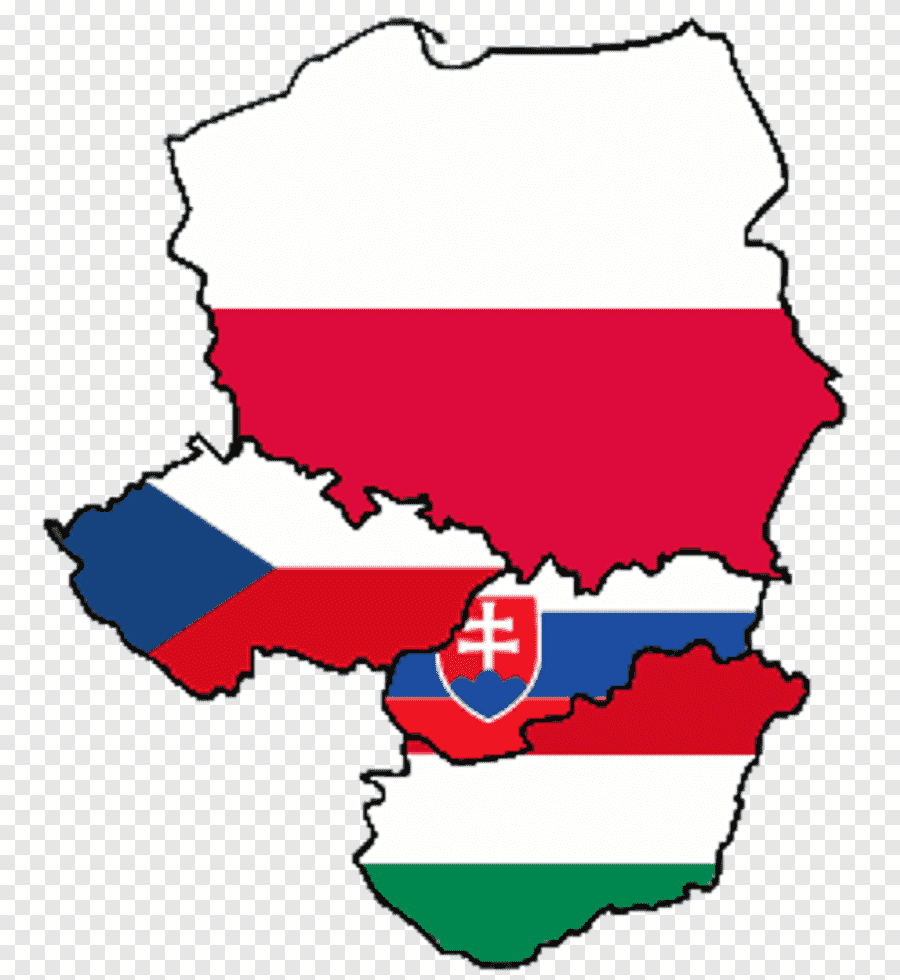
At #18 Czechland was the clear happiness leader of the Visegrad countries with #34 Slovakia, #44 Poland, and #53 Hungary.

Many of the most unhappiest counties are in East and Southern Africa including #137 Zambia, #140 Burundi, #142 Tanzania, #144 Malawi, #145 Lesotho, #146 Botswana, #147 Rwanda, and #148 Zimbabwe.

The world's most unhappiest country is #149 Afghanistan.  

The rankings are based on the combined scores for the last three years.  

Not much changes overall if you only go by the 2020 scores instead of the three year average.  Although then the USA would have been #14 and Czechland #16.

Monday, March 15, 2021

Czech Sign Language

Český znakový jazyk (ČZJ) is Czech Sign Language.  Czechland has its own sign language.  The Institute for the Deaf and Dumb in Prague opened in 1786.  It was the 5th such institution in Europe.

Every sign language has its own finger alphabet.  The Czech version is two-handed.  They have a sign for the accent marks.

There are around 10 000 people in the country that can use it.  Czech and Slovak are pretty much mutually understandable when spoken.  This does not carry over to sign language.  I'm told that Czech Sign Language isn't that close to Slovak Sign Language.  

Some Czech Sign Language Verbs

Sunday, March 14, 2021

Hantec

Hantec is the local Brno dialect.  The language was most spoken amongst the lower classes in the 19th and early 20th centuries.  Very few, mostly older people, can actually speak proper Hantec.  Many Hantec words and phrases have worked their way speech of the locals. 

It's a mix of Czech, the local Moravian dialect, German, and Yiddish.  It's been described as an "unintelligible funny German-like and alien gibberish." I find it charming.

In the rest of the country a tram is tramvaj.  Here it is a šalina whcih comes from the German "elektrische Linie".  When I'm in Prague and say šalina instead of tramvaj they instantly know that I'm from Brno.  

The Brno city centre is called Štatl which comes from the Yiddish word shtetl. The  Brno Dam is called Prýgl, Česká street is called Čáró and the train station is Roló.

Here are a few more...

Augle is eyes and čočky are eyeglasses.  Ď is thanks.  Hokna is work.   and love both mean money and kéma is friend.  Potatoes can be called krumple or erteple.  Gómat means to think. Čórka is a theft, šaškec is a madhouse and koc is a girl.  Metr doesn't mean metre, but month, so za dva metry actually means "in two months"; not in two metres.

Here's a link to an online Hantec dictionary.