Monday, October 26, 2015

Larnaca, Cyprus

Larnaca sits on the south coast of Cyprus and was originally founded in the 9th century.  Originally built on the what used to be Kition.  Today Λάρνακα is the third-largest city on the island with with a population just over 84,500.

Foinikoudes is the palm tree lined promenade along the beach.


There's a bust of Kimon the Athenian, the mid 5th century BC statesman who founded the famous Stoic school of philosophy.


The Church of Saint Lazarus was built in the late 9th century.  The church is supposed to be built over the second tomb of Lazarus of Bethany who, in the New Testament, Jesus raised from the dead.

The Medieval castle was founded in the 12th century by the Byzantines.  Today it hosts a museum and a garden theatre.


The Larnaca town hall is on the promenade between a KFC and a T.G.I. Friday's.


The Mosque of Umm Haram, also known as Hala Sultan Tekke, is a shrine on the west bank of the Larnaca Salt Lake. It was built in 1787 and it is one of the most important holy places in Islam. The mosque is built over the tomb of Umm Haram who was the Prophet Mohammed's wet nurse.

The Larnaca Salt Lake has a surface area of 2.2 km² and is a protected area.  The lake is a stop on the migratory path of the greater flamingo so it's popular with birdwatchers.  In winter the lake fills with water that evaporates in the summer leaving a crust of salt.

The Armenian Genocide Memorial marks the spot where thousands of refugees fleeing the Armenian Genocide first landed in Cyprus.  The monument was unveiled in 2008 and is dedicated to both the martyrs and survivors of the 1915-1923 Genocide.


The Panagia Angeloktisti is an 11th century Byzantine church.  Legend has it that angels came down from heaven and built the church at night.


The Kamares Aqueduct was built in 1747.  Also known as the Bekir Pasha Aqueduct, it is regarded as the most important thing constructed during the Ottoman period in Cyprus.

Sunday, October 25, 2015

Hersonissos, Greece

Hersonissos is a small town on Crete about 25 km (15 miles) from Heraklion.  It is home to about 26,000 people and is a popular with tourists for a beach holiday in Greece.

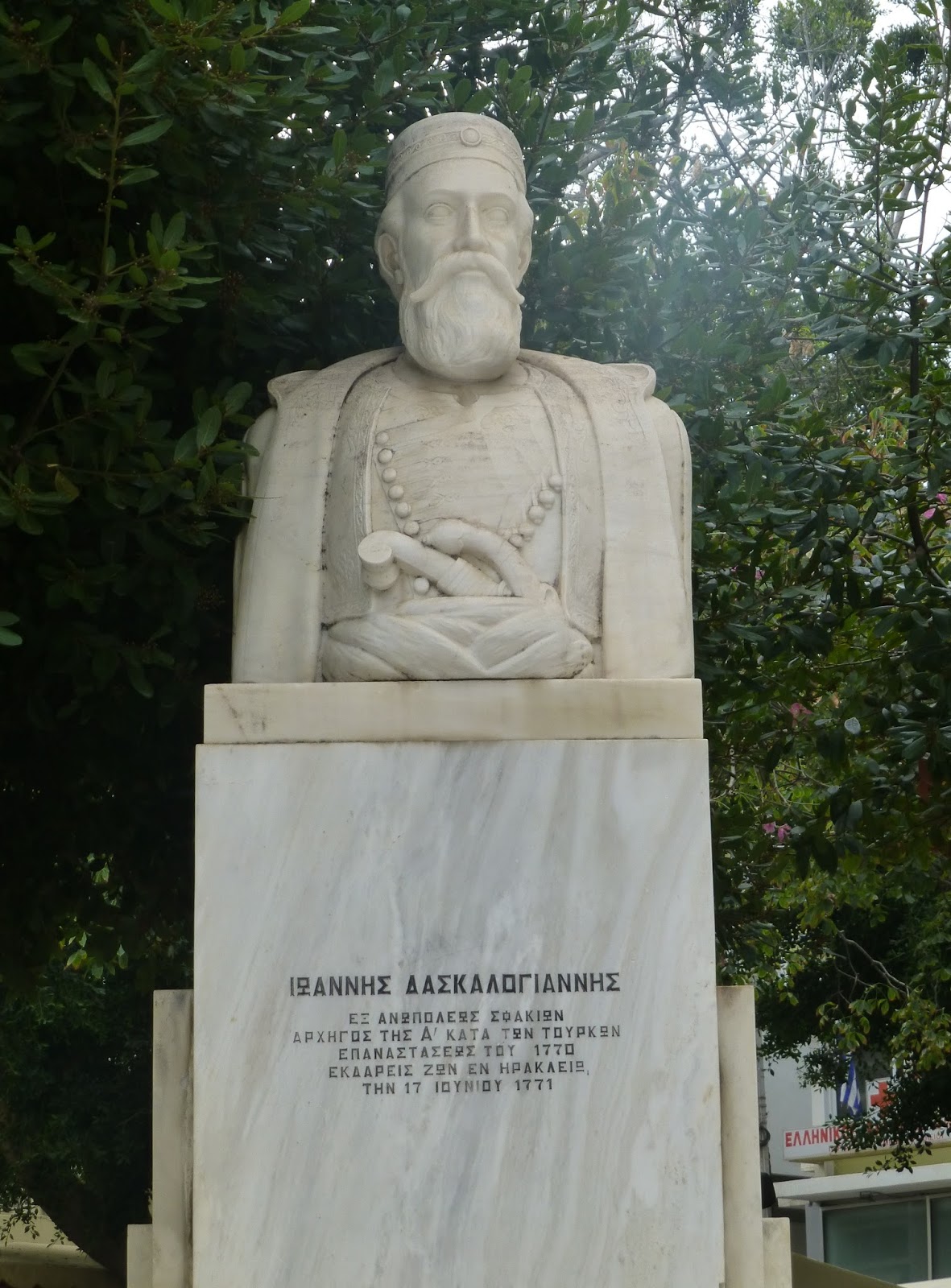
Χερσόνησος, was very popular with the troops who were stationed at Iraklion Air Station.  It is about 10 km (6 miles) from where the base used to be.

We used to call it ¨the Ville.¨
Old Roman fountain


We would go enjoy the beach during the day and go back at night to drink and party in the discos with all of the European tourists.

Saturday, October 24, 2015

Iraklion Air Station

Iraklion Air Station was 16 km (10 miles) east of Heraklion near the villages of Gournes and Gouves.  The base was in use during the Cold War from 1954 to 1993.  The facility finally closed and was turned over to the Greek government in 1994.

Iraklion was an Electronic Security Command listening post.  It was home to the 6931st Electronic Security Command and the 7276th Air Base Group.


I remember that lots of people wanted an assignment to Iraklion.  I loved that it was only a 10-minute walk from the dorms to the beach.  I was really lucky to get stationed here as my last base.

The facility is more or less abandoned.  The old base exchange is now the village's city hall and a few buildings are used as part of a school.  The main feature now is the aquarium.


The old base fire station


The rest of the place is a mess.  Lots of vandalism and graffiti with weeds overtaking everything.

Former dorms


Walking around it felt like I was in one of those zombie apocalypse movies.  The whole experience was pretty surreal especially the entry gate with no one there to check your ID.


CretAquarium
I found this old newcomer's video produced by the public affairs office out on YouTube. It was made in the late 80s or very early 90s.  I remember receiving a VHS copy of this video when I first received my orders for Iraklion.

Tuesday, October 20, 2015

Heraklion, Greece

It's been over 20 years since I was last in Heraklion, Crete.  Back when I was stationed at Iraklion Air Station not far from Heraklion.  It's been a nice visit being back and seeing how the city has changed. So here's a bit about Heraklion.


Ηράκλειο is the capital of Crete with a population of about 174,000, with more than 225,500 in the greater metro area.  It is the fifth largest city in Greece


The city was founded in 824.  Like the rest of Crete, the city has been ruled by the Byzantines, the Venetians, and the Ottoman Empire.  In 1913 Crete became part of Greece and, in 1971, Heraklion replaced Chania as the island's capital.


The best known landmark in Heraklion is probably the Venetian Fortress.  It was built in 1523 - 1540.  The inside is currently closed due to renovations.

The Basilica of St. Mark was built back in Venetian times.  Today it is home to the Municipal Art Gallery.


At the centre of Eleftherias Square is the Statue of the Unknown Soldier.


The Venetian Loggia was completed in 1628.  It used to be where the nobles of Crete used to meet but today it is city hall.


The Lion Fountain, officially the Morozini Fountain, was built in 1629.


The Agios Minas Cathedral is one of the largest cathedrals in Greece with capacity for 8,000 people.  It was built from 1862 - 1895 and is dedicated to Saint Menas who is the city's patron saint.

The Church of Ayia Aikaterini of Sinaites was probably built in the 16th century.  The church had been converted to a mosque in 1669 when the city was occupied by the Turks until the early 20th century.  The church is open every morning for visitors but a service is only held on the 25th of November for Saint Catherine's name day.


An earthquake destroyed the church of Saint Titus in 1856 and it was rebuilt as the Ottoman Vezir Mosque.  The minaret was taken down in the 1920s and it is now the Basilica of St. Titus.


About 30 minutes from the city is the Minoan Palace of Knossos.  The Bronze Age archaeological site is considered one of Europe's oldest cities.


My old base is now home to the CretAquarium.


It was fun exploring the city again but the main point of going to Crete was for some serious beach time.

Thursday, October 15, 2015

Turkish Republic of Northern Cyprus

In 1974, in response to a coup wanting to unite Cyprus with Greece, Turkey invaded the north under the guise of protecting Turkish Cypriots.  After several years of failed attempts to form a federation with the south, the north declared itself the Turkish Republic of Northern Cyprus in 1983.

Turkey is the only country to recognise it as an independent state.  The rest of the world recognises the Republic of Cyprus and sees the north as an illegally occupied area by Turkey.

Northern Cyprus takes up about 37% of the island.  Official estimates of the population are 300,000 however some people think it is much higher as there are no reliable records of how many settlers have moved in from Turkey.


There are seven border crossings between the two sides.  Nicosia is divided and it is the capital of both sides.  While both Greek and Turkish are the official languages in the south, Turkish is the only official language in the north.

Turkish Lira

All imports and exports have to go through Turkey as all of the northern air and sea ports are closed to international traffic by the south.  This and lack of international recognition makes it very dependent on Turkey.  Turkish Lira is the official currency.


Talks on reunification resumed earlier this year.  The Cyprus issue is a major blocker to Turkey's desire to join the European Union.  


There is no way that Cyprus or Greece will let Turkey join the EU while there are still Turkish troops in Northern Cyprus.

Tuesday, October 13, 2015

Republic of Cyprus

Cyprus is an island nation in the Eastern Mediterranean.  The entire island is home to about 1.16 million people with 860,000 in the southern Greek side and 300,000 in the northern Turkish side.

Whilst Turkey recognises the Turkish Republic of Northern Cyprus it is the only country to do so.  The rest of the world, including the United Nations only recognises the Republic of Cyprus.  So here's a bit about Κύπρος.

In 1974 Greek Cypriots, backed by the Greek military junta, attempted to make Cyprus a part of Greece.  Five days later Turkey invaded the island and has never left. 

According to international law, the Republic of Cyprus has sovereignty of the island and its surrounding waters.  Since Turkey controls part of the island all international air and sea ports are only in the south.  Air and sea ports in the north only operate between the north and Turkey.  Until recently the border between the two sides was closed so foreigners arriving in the north (by way of Turkey) had problems crossing between the two sides.  It reminds of the challenges with crossing between Kosovo and Serbia.  Fortunately this is no longer an issue.  But since the south isn't in full control of its border it has been unable to join Schengen.

The country is a presidential republic.  Nicosia is the capital and largest city.  The UN peacekeeping line runs through the capital so part of the capital is in the north where it is the capital of Northern Cyprus.

Greek and Turkish are both official languages.  

Cyprus became a member of the British Commonwealth in 1961 after it gained independence as a UK colony.  In 2004 it joined the European Union and in 2008 it adopted the Euro.

Things were going pretty well for Cyprus until 2009 when it entered recession from the global financial crisis.  The two biggest banks were among the largest holders of Greek bonds so the country was hit hard by the Greek financial crisis.  The country secured a bailout from the Troika (the European Commission, the European Central Bank, and the International Monetary Fund).  

Russia has had a lot of money in Cyprus.  Something like 1/3 or more of all deposits originated Russia.  When deposits were taken under the bailout Russia lost lots of money.  Still Russia has loaned another €2,5 billion with favourable terms to Cyprus.  What's interesting is that Cyprus has now agreed to let the Russian navy use Cypriot ports.  There are already two sovereign British bases on Cyprus so now there will be British, Turkish and Russian troops all on the same island.

In May 2015 the north and south relaunched talks about reunification.

Cyprus will be the 55th country I've visited in just over six years.