Showing posts with label Alps. Show all posts

Monday, February 17, 2020

Weekend in Geneva, Switzerland

After our day trip to Ferney-Voltaire we spent the rest of the weekend wandering around Geneva

Tünde wanted to ride the water taxi so we did a couple of laps across Lake Geneva. 

We also stopped by to see the Marronnier de la Treille which is the world's longest bench.  It was built in 1767 the 180 wooden boards measure 120 meters (413 feet) in length.


Of course we had to have fondue for dinner and Natalie knew a great place at Bains des Pâquis.  Fondue is always fun and this was so good.

On Sunday morning we visited Bois de la Bâtie which is city's largest zoo and Tünde enjoyed seeing all of the animals.

My flight back to Vienna was in the afternoon so I left the ladies at the train station and made my way to the airport.  I had a window seat and had a great view of the French Alps.  


At least I think these are the French Alps.  Maybe it's Switzerland but I'm pretty sure it's France.  

Either way, it was great spending time with the Chicas.

Sunday, February 16, 2020

Ferney-Voltaire, France

During Christmas we all planned to up in Switzerland to visit Natalie.  On Friday night I caught a flight to Geneva.  On Saturday morning Claudia and Tünde arrived and we spent the weekend together.  Yeah for more whānau adventures! 

After picking them up at the airport and breakfast at the hotel we went to France.  Geneva is on the French border and we caught a 10 minute bus to Ferney-Voltaire.


Ferney-Voltaire is in Southeastern France between the Jura Mountains and the Swiss border.  

Back in the 14th century is was Fernex and over the years the name changed to Fernay, Fernaj, and Fernai.  The city is home to around 9.800 people.
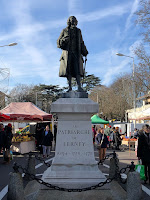
The French writer and philosopher François Marie Arouet, better known as Voltaire, lived in Geneva for almost two years.  At the time Geneva was a Calvinist city and theatre was forbidden so he moved to Ferney in 1759 where he ended up becoming the city's patriarch.  He lived here from 1759 to 1778 before returning to Paris shortly before his death.  Voltaire built the local church, a theatre, set up potteries and a watchmaking industry which helped increase the city's population to over 1000 people.  In honour of Voltiare's patronage the city changed it's name to Ferney-Voltaire in 1791.

The Church of Our Lady is the largest neoclassical religious building in the region.  It was consecrated in 1826.

The Fountain of Voltaire dates back to 1628.  In 1988 it became a registered historic monument.

The city hall and WWI monument.

WWI Memorial


It's a cute little town and well worth a short day trip.


On Saturdays there is an open market and we spent lots of time walking around and sampling lots of goodies.  


So much incredible cheese, produce, and wine.  Tünde loved the pomegranates we picked up.  


The town cemetery is less than a 10 minute walk from the centre of town.  


The town's main attraction is Voltaire's house.  The château was built from 1758 to 1766 and it is open to visitors from May to September. 

The house is interesting and well worth checking out.  

There's also a garden to stroll around.  I'm sure that it looks better in Spring and Summer.  But you can't go wrong with the view of the Alps. 


We enjoyed our short day trip to France.  After lunch at an Indian restaurant we walked across the border and caught a bus back to Geneva to continue our city break.

Monday, December 9, 2013

Salzburg, Austria

Salzburg will be forever linked to Wolfgang Amadeus Mozart and The Sound of Music.  It lies on the Salzach River, near the Alps.  With around 146,000 people, it is Austria's fourth-largest city.  In 1996, the historic Old Town was listed as a UNESCO World Heritage Site.

Salzburg was first settled by the Celts in around the 5th century BC.  Various settlements were formed in to one city around 15 BC by the Roman Empire.

Over the years it has been a part of Bavaria, the Holy Roman Empire, the Austrian Empire, and the Austro-Hungarian Empire.
Great view of the Alps

In 1967, it became a sister city with Atlanta.


Mozart was born and raised in Salzburg.  The house where he was born and the family residence are both tourist attractions.  The statue at Mozartplatz was unveiled in 1842.

The cathedral was consecrated in 1628.  The 17th century Baroque Salzburger Dom is dedicated to St. Rupert and St. Vergilius.  This is where Mozart was baptized.


The Franciscan Church was completed in 1498.  It is one of the oldest churches in the city.


The Panorama Museum is a huge round painting of historic Salzburg.  It shows what the city looked like 200 years ago.


The Mirabell Palace was built around 1606.  I bet the gardens are wonderful in spring.


The Festung Hohensalzburg is the city fortress and was built in 1077.  Over following centuries it was expanded and is the city's primary landmark.  It is one of the largest medieval castles in Europe.

Here's a Rick Steves video I found out on YouTube that tells about the fortress.


©Rick Steves

Friday, April 13, 2012

Alps Road Trip Summary

Our four-day road trip through the Alps came to an end.  Here's the recap of our little adventure. 

On Friday, at 11 AM, Nat and I caught a train from Brno to Vienna and then another train on to Graz, Austria.  After work Miran drove up from Slovenia, picked us up at the train station and drove on to Innsbruck, where we spent the night.

After a Saturday morning wander through Innsbruck it was on to Vaduz, Liechtenstein.  After a short side trip to Malbun it was then time to take on SwitzerlandSwitzerland was the 30th country I've visited since moving to Euroland in July 2009!  First a stop in Stein am Rhein followed by a visit to see the Rheinfalls.  We spent the night in Winterthur but it was dark once we got settled in, and since we left early Sunday morning for Bern, so we kind off missed out on seeing it.  Bern was really nice but I could have done without the freak snow storm we had on the way to Lucerne.

On (Easter) Monday morning we made our way to Zürich where we met up with a couple of Nat's friends from New Zealand.  Ray (she) and Kelly (he) both live in Zürich now and met us for coffee and a walk around the old town.  We had to leave at noon because everyone had to work bright and early on Tuesday morning so we headed made our way to Schaan and Balzers in Liechtenstein.  Then back to Innsbruck where we spent an hour in the mountains enjoying the view of the entire city.

Miran dropped Nat and I off at the train station in Salzburg.  I really need to go back to Salzburg because the only thing I got to see is glimpse of a castle from the main train platform.  Kind of a tease, right?  However, I've been told that I should not be allowed in Salzburg until I've actually watched The Sound of MusicI know, I know...but I just haven't ever had the time to see the movie but I promise I will soon.

From Salzburg we changed trains in Vienna and made it back to Brno at 1 AM.  Yes, it was a lot of traveling in a short period of time but it was a great way to see a heck of a lot.  There are over 1,300 photos out on Flickr now.  From Graz to Salzburg we drove 1,612 km (1,001 miles) in four days.

In the USA we equate driving to miles per gallon.  With the metric system, here gas efficiency is measured in the number of liters per 100 km.  I don't remember the exact amount but we ended up paying around €250 (~$300) for gasoline.

Zürich, Switzerland

Zürich is located, in the north central part of Switzerland, at the northwestern tip of Lake Zürich and 30 km (19 miles) north of the Alps.  With 390,000 people it is the country's largest city.  There are almost 2 million people in the metro area.

Lake Zürich
Originally it was called Turicum when it was founded by the Romans in 15 BC.  Today, it is one of the world's largest financial centers.  That may have something to do with the city always ranking so high on the list of the world's most expensive cities.

There are some nice buildings in the old town.  But the city is really known for its trio of interesting churches.

The Romanesque Großmünster church was first built around 820 AD.  According to legend it was originally commissioned by Charlemagne.  Construction on the present building began around ~1100 and it was inaugurated by ~1220.

The Fraumünster was founded in 853 AD.  The five stained glass windows in the abbey are by Marc Chagall and were installed in 1970.  Unfortunately, photography isn't allowed inside.  But take a look at the video below.

The current St. Peter's church was consecrated in 1706 as a Protestant church.  The clock face on the steeple has a diameter of 8.7 m (28.5 feet).  It's actually the largest church clock face in the world.


The Zürich Hauptbahnhof is the country's largest train station.

Since we were in Zürich on Easter Monday we got to experience Zwänzgerle.  It's a tradition where kids challenge adults to break their decorated Easter eggs with a 20-cent coin.  The kid holds out his or her egg and you try to break the egg by throwing your coin at it.  If the coin doesn't stick then the kid gets to keep your money.  If your coin gets stuck then you get to keep the egg and your money.  It's harder than it sounds but I only did it twice.  I did see one child loose his egg...he wasn't too happy about it either.


Here's a Rick Steves video from YouTube giving a bit more detail on Zürich.
©Rick Steves

Thursday, April 12, 2012

Lucerne, Switzerland

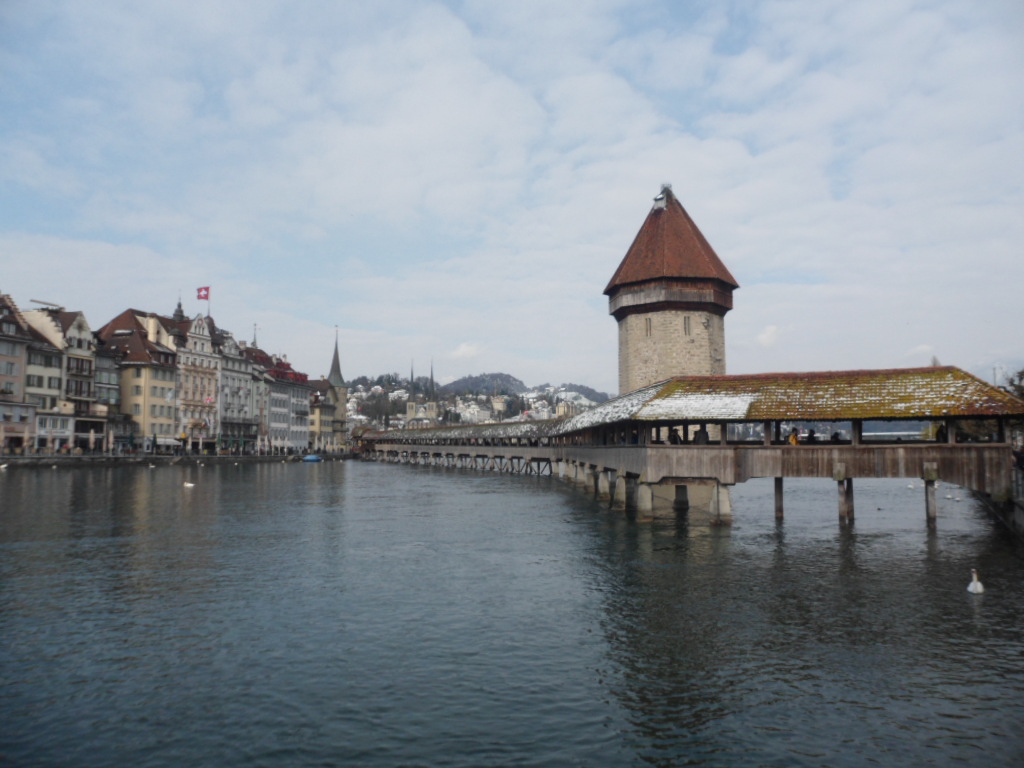
Lucerne was founded in 750 AD and is located near the Alps in north central Switzerland.  With +76,000 people it is the 8th largest city in the country.

The Reuss River runs through the city and there are a number of bridges.

The most famous bridge is the Kappelbrücke (Chapel Bridge).  It is the oldest covered bridge in Europe.  The 204 m (669 ft) long wooden bridge was originally built in 1333.

Fire damaged in 1993


However, a big portion of it had to be replaced due to fire damage sustained by a discarded cigarette in 1993.


Inside the bridge are 17th century paintings.


Nearby the Kappelbrücke is the 13th century Water Tower.  It is over 34 m (~112 ft) high and was built ~1300.  Over the years it was also used as an archive, a treasury, a prison and a torture chamber.


The Baroque Jesuit Church was built in 1666.


The Hofkirche sits on the site that used to be the first monastery in Lucerne.


The old town is quite colorful with some very cool buildings.


The coolest thing about Lucerne was the Lion Monument.  It is just awesome!  Carved out of natural rock, it commemorates the hundreds of Swiss Guards who were killed during the French Revolution when a mob stormed the Tuileries Palace in Paris back in 1792.  It was carved from 1820 to 1821 and it is massive.  It measures 6 meters high and is 10 meters long (~20 feet by 33 feet).

Apparently there is almost an exact copy of the lion at the Oakland Cemetery in Atlanta called the Lion of Atlanta which guards a field containing the remains of unknown Confederate and Union soldiers.  I'll have to try and visit it when I'm back home in September. 

 
And of course no visit to Switzerland would be complete without the mandatory fondue.  Good times!!


Here's a Rick Steves clip from YouTube to fill in any details I may have missed.


©Rick Steves