 It was quite a busy weekend. First with drinks out with the lads on Friday and Ale's 40th birthday on Saturday. Then on Sunday the boys came over for brunch.

It was quite a busy weekend. First with drinks out with the lads on Friday and Ale's 40th birthday on Saturday. Then on Sunday the boys came over for brunch.
 Yesterday was Ale's 40th birthday party. She had people over to her flat in Řečkovice. She had several friends over for Mexican food and festivities.

It also gave me an opportunity to use my Spanish which seems to be getter more and more rusty.

 Last night was a long overdue night out with the boys. I met up with Vašek, Aleš, and Filip at But Bar for drinks last night.

 After a while Kája joined and the boys got to know him a little better. We decided against making it an all nighter because we've got a full weekend planned. This afternoon is Ale's 40th birthday party and the boys are coming over to my place on Sunday for brunch.
 The European Union Force Bosnia and Herzegovina (EUFOR) is a military deployment to help keep the peace in Bosnia and Herzegovina (BiH). At least it used to be called EUFOR. Now it is Operation ALTHEA.

 After the one year, IFOR was replaced by the Stabilisation Force in Bosnia and Herzegovina (SFOR). SFOR was another NATO-led peacekeeping force, with several non-NATO countries contributing troops. IFOR was replaced by EUFOR in December 2004.

There are about 1000 troops currently stationed in BiH from 19 different countries, including Czechland. The countries are all EU and/or NATO member states with the exception of Chile which isn't either. In December 2020, the UK withdrew its troops from EUFOR after 16 years due to Brexit.
The EU also has an Intermediate Reserve Force based in Europe that can be deployed on short notice to reinforce EUFOR in BiH if needed.
The first five years each saw a commanding general from a different country. For some reason, since December 2009, each year the commanding general comes from Austria.
Here are a couple of short videos I found on YouTube.
 So, what to do on a Tuesday night in Brno?
  Last night's performance was Popelka, which is the Czech version of Cinderella. It was a new interpretation of the story so it wasn't the American version of Cinderella or the classic version of Popelka that I'm used to, but good nonetheless.
 During the intermission we had champagne and chlebíčky. I swear, only in a Czech theatre can you get champagne and chlebíčky. So cool.


The arts scene in Brno really is world class and there's always something going on. I think I need to try a Czech language play sometime. Most likely a drama. I'd prefer a comedy but humour is usually pretty difficult to catch on to in a foreign language.
 KFOR, Kosovo Force, is a NATO-led international peacekeeping force in Kosovo. Following the breakup of Yugoslavia and the wars in the Balkans, the UN Security Council passed a resolution in 1999 which among other things authorised an international with substantial NATO participation in Kosovo. Two days after the resolution, on 11 June 1999, KFOR entered the country.
The main tasks of KFOR are to ensure a safe and secure environment and the freedom of movement for all communities in the country.
 At its height, KFOR was made up of 50.000 troops from 30 NATO and non-NATO countries. Today are are just over 3700 troops from 27 countries in Kosovo.
The Czech Armed Forces have participated as part of KFOR since 1999. In 2011, they ended their deployment and left its base in Sajkovac. However, there are currently eight Czech soldiers serving at KFRO Headquarters in Prishtina.
 The USA has just over 560 soldiers currently deployed to KFOR.
KFOR is gradually transferring responsibilities over to Kosovo's Security Force.
Here's a six-minute video I found on YouTube about KFOR.
My 2000th blog post. I can't believe that I've been at this for over 13 years or that people still seem interested in my Czechland adventure. Thank you to everyone who continues to follow along.
 Eurocorps is a European army, of about 60.000 troops, that can be deployed on very short notice. It was founded in 1992 by France and Germany and it went operational in 1995. This month it celebrates its 30th anniversary. Eurocorps' headquarters are in Strasbourg, France.
There are six framework nations - France, Germany, Belgium, Luxembourg, Spain, and Poland.
Any EU country can join with the unanimous approval of the framework countries. There are also five associated nations - Austria, Greece, Türkiye, Italy, and Romania.
Finland was an associated member from 2002 - 2006 and Canada was from 2003 - 2007. Czech Republic isn't a member but I believe that they have participated is some military exercises with Eurocorps in the past. I'm not aware of Czechland having any plans to join.
Eurocorps has participated in peacekeeping missions in the Balkans as part of SFOR in Bosnia and Herzegovina and KFOR in Kosovo. It was deployed to Afghanistan as part of the UN's International Security Assistance Force (ISAF). It's even been deployed to Africa as part of EU training missions in Mali and the Central African Republic.
Poland became the newest framework member this year in January. From 2023-2025, a Polish general will take command of Eurocorps. With all of the support Poland has given Ukraine during the Russian invasion, I'm sure that Russia isn't thrilled with Poland soon to lead Eurocorps.
What's interesting to me Austria and Türkiye being associate members. Türkiye is a member of NATO but not the EU so until it actually becomes an EU member, if ever, then it can't be one of the framework nations. Austria's constitution prohibits it form entering into military alliances. So I guess that by being an associate member it can participate in Eurocorps without violating its constitution, in the same way that it is a member of NATO's Partnership for Peace programme without being a NATO member.
Here's a France24 video I found on YouTube from 2009 that talks about Eurocorps.
 When I was in hospital I would give a daily update to my parents in Arizona, my sister in California, Claudia in Berlin, Natalie in Wellington, and Kája. I couldn't use iMessage because Nat and Kája are Android users and everyone is on Apple. I couldn't use WhatsApp because my parents and sister don't use it. So I had to go old school and use SMS (text message).
 SMS is Short Message Service but in the USA we call it a "text message" and we use "to text" as the verb.
The USA is one of the few big countries where SMS remains the usual way to chat. SMS/Text message travel over telephone lines rather than over the Internet.
 If you use an iPhone then and you want to message someone else who also has an iPhone then you send them an iMessage. The message goes over the internet. If you want to message someone who uses an Android phone then you send them an SMS.
The benefit of SMS is that it works with any phone. However, there are security flaws, you don't get notifications when the recipient has read your message and you can't start a video call from a text message. SMS messages are up to 160 characters.
WhatsApp is a free instant messaging and voice-over-IP (VoIP) service that was purchased by Facebook in 2014 for $19.3 billion. It's the most popular way to message people in most of Europe, Africa, Latin America and most of India.
 It's heavily used across Europe. Mainly because it's free. In the USA, SMS is usually priced at a flat rate and most carriers include text messaging as part of your mobile package. In Czechland, a single SMS is usually around 1 Kč (5¢) which over a month can add up to a good chunk of change. On the other hand, most U.S. mobile providers charge a heavy fee for international text messaging.
To use WhatsApp you just need an internet connection. With WhatsApp you're not limited to 160 characters per message, you can send images, videos, audio files and documents, there are read notifications when the recipient has seen the message, you can use it to video call, group chats and calls are no problem and it uses end-to-end encryption which means that only the sender and the recipient of the message can see its contents. Plus, it's free.
 Spain uses it the most. Something like 90% of mobile users use WhatsApp. In the USA, only about 1/3rd of users have downloaded the app. I bet that a good chuck of the users have it to communicate with family and friends in parts of the world where SMS is expensive.
In China, WeChat is the go-to messaging tool while in Japan, Line is number one, and Telegram is popular in Russia. WhatsApp is banned in China, North Korea, Syria, Qatar, and the UAE.
Here's a short video I found on YouTube that talk about why Americans don't use WhatsApp.
 The average gross monthly wage here in Czechland is 40.086 Kč ($1,860) which in the USA would be $22,320 per year. By comparison the average monthly salary in the USA is $6,228 (134.248 Kč).
The 40.086 Kč is 4,4% higher that it was a year ago but once you factor in inflation, Czech wages have decreased in real terms by 9,8%. Basically, people in Czechland are able to buy one-tenth less with the same wages that we earned a year ago.
 Five years ago I had my first Czech hospital experience. I spent a week at FN Bohunice having my tonsils removed. About six weeks later I was back for a second surgery. Now I've just had my next hospital experience with a two-week stay at St. Anne's.
 A normal room was for three patients with shared toilet and shower facilities down the hall. So the first thing I did was book the nadstandardní pokoje, "the above standard room."

 I knew to bring my pyjamas, a robe, and house shoes. I brought an extra pillow and, along with my toiletries, I brought my own toilet paper so that I didn't need to use the generic TP. I did notice here that the hospital provided patients with pyjamas and a robe if they didn't bring their own. I was more comfortable with my own. They also issued me a knife, a fork, and a spoon to use during my stay and I needed to wash them after every meal. They gave me a one-litre pitcher and drinking glass, which they changed out every three days.
 Just like at Bohunice, there was all of the chamomile tea that you could drink. It always tastes better when it's cold so I was glad to have a refrigerator. Since I had a kettle, Kája brought me a coffee mug from home and instant coffee packets. Due to Covid, visiting hours were only 14:00 to 18:00 on Wednesdays and Sundays. Since I had a private room the nurses didn't really care.


 Breakfast was usually a few slices of bread with butter, either some ham or cheese, and maybe an apple, yogurt, or cottage cheese.
It's a teaching hospital so there were interns making the rounds with the doctors. What a difference five years makes because this time when the doctors performed rounds everything was in Czech. If there was a word or something that I didn't understand then the doctor would say it in English but overall everything was done in Czech.

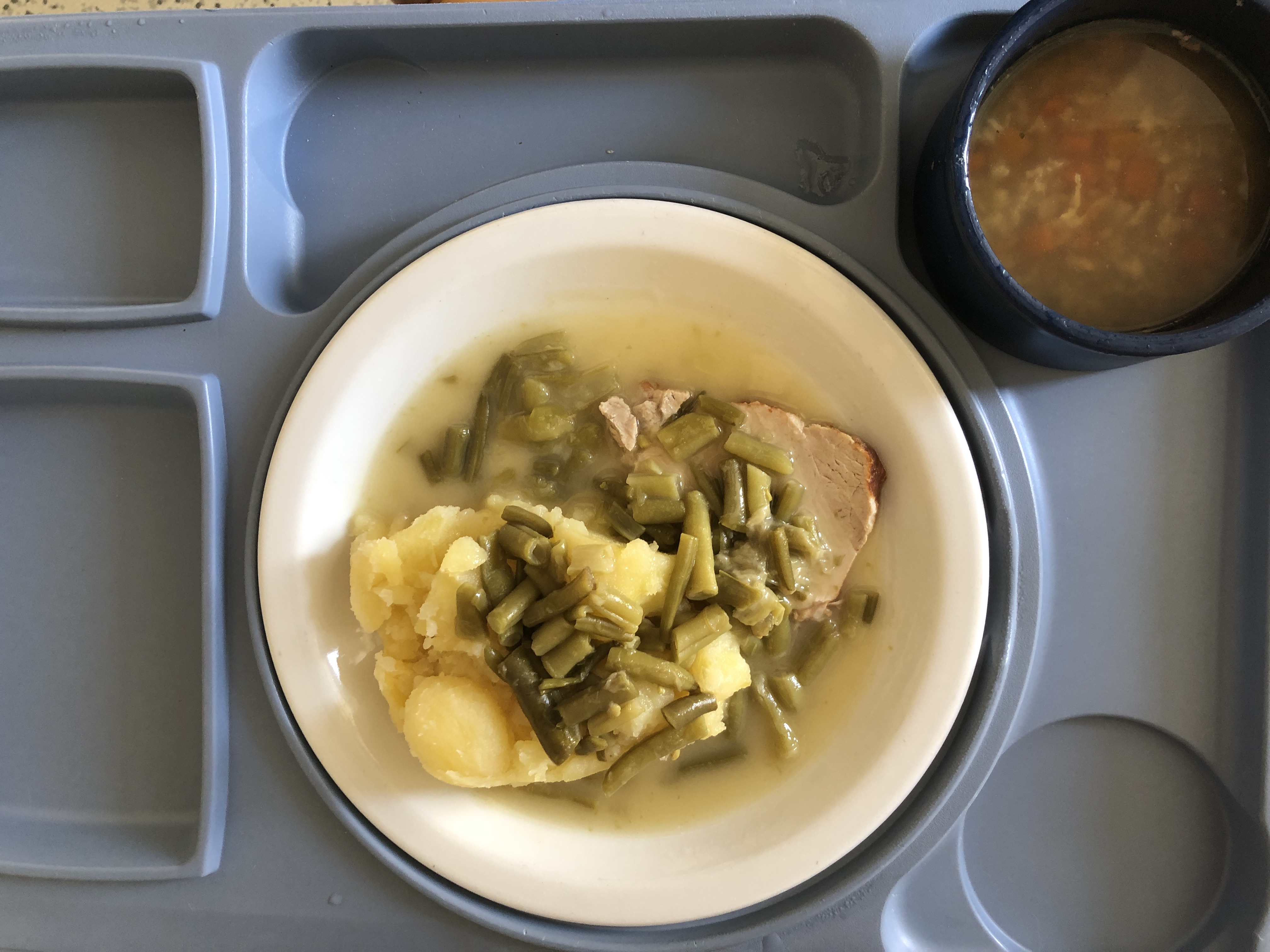
Lunch was the main meal of the day and it was usually served at 12:00.
Typical Czech, there was always a soup with lunch.


 It was usually meat and potatoes or rice. Sometimes there would be another soup but not usually.
 From 21:00 to 06:00 were quiet evening hours. Usually around 21:00, one of the doctors would pop in just to see if I was OK and then everything started all over again the next day.
 The doctors and nurses were awesome. Again, I am amazed by how good the Czech healthcare system is. The USA has a lot to learn. On my way out I left boxes of chocolates for the nurses and doctors. I gave a box to the last group of students on rounds. There was one woman who cleaned my room twice a day and she worked at least 10 or 11 days in a row. I gave her a box of chocolates and it really seemed to make her day.



 Posts
All Comments
Posts
All Comments


 Czech Koruna Exchange Rate


