Showing posts with label Tuscany. Show all posts

Tuesday, November 1, 2011

2011 Tuscan Road Trip Summary

My first proper European road trip went really well. From Murska Sobota, Miran and I drove to Tuscany.

Our first destination was San Gimignano, followed by Siena and then the regional capital, Florence. From there we headed to San Marino before eventually making our way back to Slovenia.

Toscana, Italian for "Tuscany", is probably the most photographed and romantic region in Italy. It is known for its beautiful landscape and is regarded as the birthplace of the Italian Renaissance. Tuscany has been home to some very influential people such as Michelangelo, Leonardo da Vinci, Puccini, Dante, Botticelli, Machiavelli, Galileo Galilei and Amerigo Vespucci.

Tuscany is home to six UNESCO World Heritage Sites. Roughly 10% of World Heritage is found in Tuscany.

San Marino made for a great day trip. It is Europe's 3rd smallest country and the world's oldest republic.

The four day road trip came out to around 1,800 km (1,120 miles). Gas in Slovenia is cheaper than in Italy so we made sure to fill up before we left. However, gas still ran us about €210 ($275) and the Italian road tolls came to €70 ($91). This was a wonderful trip and all of the photos are already posted on Flickr.

Sunday, October 30, 2011

Back to Florence, Italy

The third stop on our tour of Tuscany was Florence. I guess rubbing Porcellino's snout last year must have worked. Yeah Porcellino!!

Florence is the capital of Tuscany and is one of the world's most beautiful cities. It's no wonder why it's a UNESCO World Heritage site. It was so nice to come back even if only for a day.

My favorite square is still the Piazza della Signoria. You've got to love all of the free art.

Most people climb to the top of the Duomo for a great view of the city. The line was way too long today for a trip to the top.

However, the best panoramic view of Florence's famous sights, including the Duomo, is a 25-minute walk away at Piazzale Michelangelo, high above the city.

The square was built in 1869 and there's also a bronze copy of David here. Plus you don't have to pay €8 (~$10.50) to enjoy the view.

It was a great day in Florence. And you can be sure that I went back to rub Porcellino's snout to insure another visit.

Saturday, October 29, 2011

Siena, Italy

After San Gimignano, our second stop of the day was Siena. During the Middle Ages it was an independent city-state until it was defeated by Florence. Afterwards, for a few hundred years, it was so poor that it could not afford to tear down its medieval buildings and replace them with more modern ones. Today, it is a beautifully preserved city right in the heart of Tuscany. Siena was built on three hills, has winding cobbled streets, and is more or less still surrounded by 13th century walls. The historic center was declared a UNESCO Word Heritage site.

The Piazza del Campo is one of the greatest medieval squares in Europe. It is shaped like a shell with scalloped edges. This is where the Palazzo Publico (city hall) and the Torre del Mangia are. At 102 meters (334 feet), the bell tower is the city's second tallest structure. When it was built in 1848 it was the exact same height of the Duomo to show that the state and church had equal amounts of power. We wanted to visit the tower but unfortunately we got there right after it closed. Next time.

The white marble Fonte Gaia (Fountain of Joy) was built in 1419. The original is in a museum somewhere in the city. However, the fountain in the square, which all of the tourists take pictures of, is an exact replica of the original from the mid-19th century.

The Cathedrale di Santa Maria is Siena's cathedral and is simply called Duomo. It was completed in the 13th century. In the 14th century, work began to make the Duomo as grand as St. Peter's Basilica in Rome. However, the plague put an end to that effort in 1348.


It is gorgeous!!
The façade is white, red and a dark greenish-black marble. The interior has the same greenish-black and white marble. The main attraction inside is the marble inlaid floor with ornate mosaics that cover the entire floor.


Inside is the Piccolomini Library with beautiful frescoes and old choir books.


Il Battistero di San Giovanni
is the baptistery. The 14th century building is right behind Il Duomo.

During the Middle Ages, Italian cities were made of districts/wards called contrade. Siena used to have 59 contrade but consolidation over time has left the city with 17. Each of the 17 contrade has its own name, coat of arms, traditional colors, etc.

Siena is best known for the Palio a horse race that is held twice a year on July 2nd and August 16th. Ten horses and riders, dressed in the colors of each respective contrada, race against each other. The race is bareback, three times around the Piazza del Campo and lasts about 90 seconds.

Only 10 of the 17 contrade get to participate in each race. The honor goes to the seven that didn't get to ride in the previous Palio and three more chosen in a drawing. I've heard that the pageantry and rivalries between the contrade are not to be missed. Who knows? Maybe one day I'll be back in Siena again on a July 2nd or August 16th.

It was 72 km (~45 miles) from Siena to Florence. The drive through Tuscany this afternoon was so beautiful!!

San Gimignano, Italy

Last night, Miran, his friend Brane, and I began our Italian road trip to Tuscany and San Marino. We left Murska Sobota at 6 pm and spent the night in Monselice. It's in northeast Italy, about 20 km (12 miles) from Padua, near Bologna and Venice. We didn't have any time to explore Monselice but it looked like a cute little town and I'll be sure to put it on the list of places to visit. Possibly next year since I hope to visit Venice in 2012. Anyway...moving on.

From Monselice we made our way down to Tuscany. Our first stop of the day was the small town of San Gimignano. The town looks like a little medieval metropolis with its 14 preserved stone towers. San Gimignano is sometimes called the "Medieval Manhattan".

The city was founded in the 3rd century BC by the Etruscans. During the Middle Ages and Renaissance era it was an important stop for Catholic pilgrims on the way to Rome and the Vatican. The city did well until 1348 when, like the rest of Europe, it was hit hard by the plague. It wasn't until the 19th century that San Gimignano became popular as a tourist destination.

San Gimignano is a beautiful hilltop city but you can pretty much see everything in just a few hours. At the Piazza del Duomo is the cathedral, town hall and the Torre Grossa.


The best part for me was the Torre Grossa which, at 177 feet, is the tallest tower in town. Once you climb up to the top of the bell tower you have a great view of the city and the surrounding vineyards.


In 1990, San Gimignano's historic city center was listed as a UNESCO World Heritage site.


One of the best things about being in a car, as opposed to taking a bus tour, was that we were able to explore the surrounding hills to find a great view of the town's towers.

After we took all of our photos it was time to drive about 45 minutes to Siena.

Rick Steves does a far better tour that I do so here's his video on San Gimignano which I found out on YouTube. Enjoy!


©Rick Steves

Tuesday, June 22, 2010

Pisa, Italy

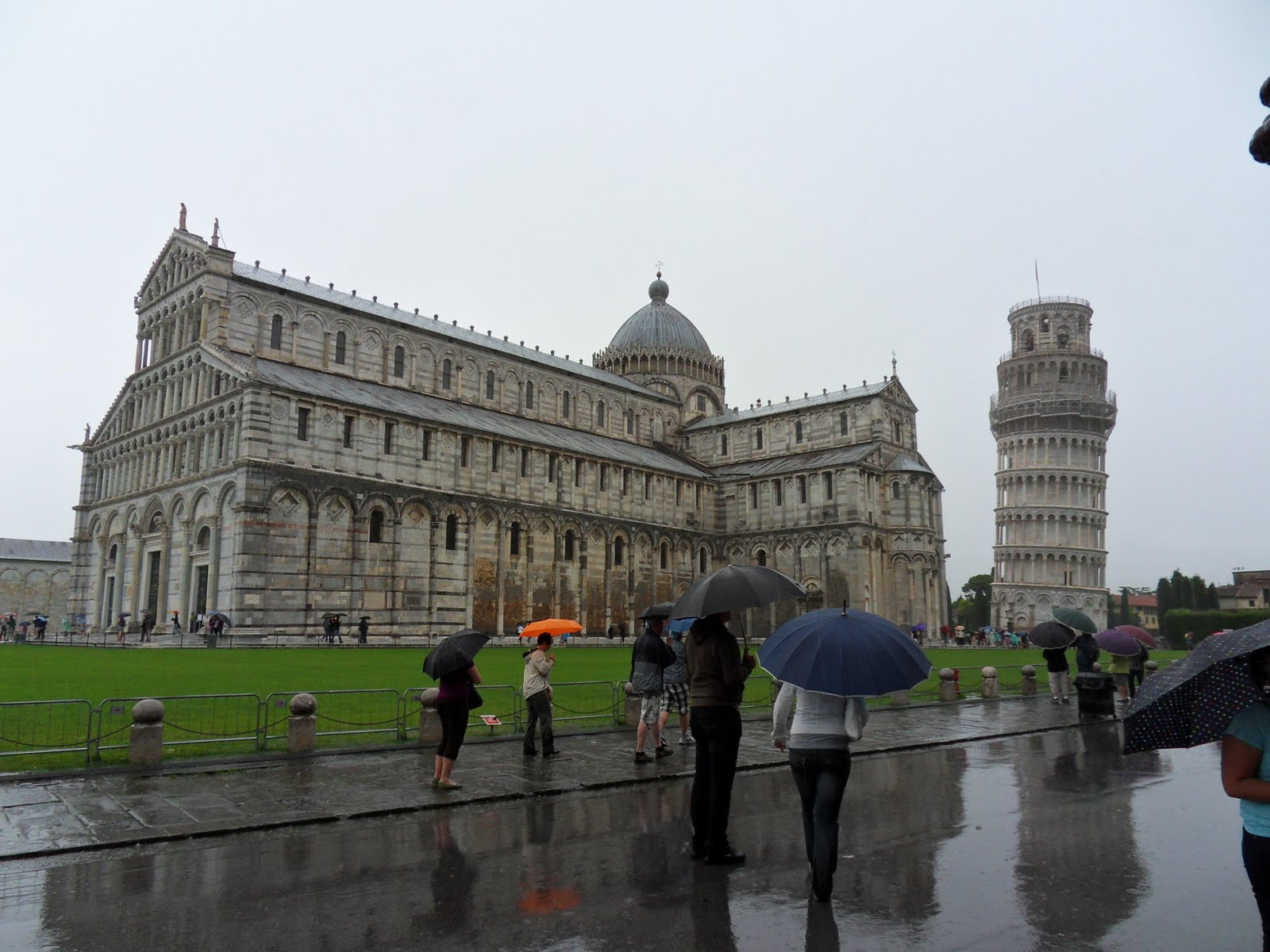
On Saturday morning, I took the 70-minute bus ride to Pisa. I figured I could hit the city highlights in one day since I had a 7 AM flight Sunday morning. There was a slight drizzle as I left Florence but the sky was clear on the ride back. Then it poured down rain just as soon as I made it to the main city square. I had an umbrella but that really didn’t help much and I wasn’t able to get in to my hostel for another couple of hours. So I went and had some lunch as I tried to wait out the storm. After about an hour, the rain was still coming down but I was able to check out some sights.

I looked like a wet dog by the time I made it in to my room. Everything in my back pack was soaked including the post cards I had already written and stamped. I tried to dry everything out as much as I could. If you received a warped postcard from me from Italy then this is why. About an hour later the sun came out. If I had taken the bus two hours later then I wouldn’t have had a problem. Go figure! But I can’t really complain because there are far worse places than Italy to be stuck in a rain storm.
The Piazza del Duomo, also known as Piazza dei Miracoli (Square of Miracles), is where you find the cathedral, the baptistery and the Leaning Tower. The entire square was declared a UNESCO World Heritage Site in 1987. My hostel was only a 3 minute walk away.
The Duomo di Pisa is the medieval cathedral dedicated to St. Mary of the Assumption. Construction began in 1064. The style is Romanesque but there is a strong Byzantine influence. The artwork on the ceiling is just awesome. There was a huge fire in 1595 that destroyed most of the medieval works of art.


It’s said that this is where Galileo formulated his theory about a pendulum’s movement.

The Baptistry of St. John, or il Battistero di San Giovanni (it sounds so much cooler in Italian), is the largest baptistery in Italy. It is 54.86 meters (~180 feet) high with a circumference of 107.24 meters (~351.8 feet). Construction on the marble building began in 1152 in a Romanesque style and finished in 1363 in the Gothic style.

La Torre Pendente di Pisa is one of the world’s most famous landmarks. It’s the bell tower tower for the cathedral. Construction began in 1173 and it was completed about 200 years later. It leans 5,4 meters (~17.72 feet) to the Southwest and is 8 stories tall.

When you go to Pisa you have to take the obligatory ‘hold up the tower’ photo.
Some of the other main sights were...


The Piazza dei Cavalieri (Knight’s Square). The main attraction is the Palazzo della Carovana, founded by Napoleon in 1810, which is not the Scuola Normale Superiore.


Santa Maria della Spina is a small church on the River Arno. Built in 1230, it is considered one of the most impressive Gothic structures in Europe. In 1333 it received a thorn that was supposed to be part crown worn by Jesus Christ on the cross.

Monday, June 21, 2010

La Piazza del Duomo di Firenze

Florence’s Piazza del Duomo is one of the most visited places in the world. It consists of the cathedral, baptistery and bell tower, and is a UNESCO World Heritage Site.

The Basilica di Santa Maria del Fiore is the 4th largest church in Europe. It is 153 meters (502 feet) long and 116 meters (381 feet) tall. Construction on the Gothic cathedral began in 1296 and it was completed in 1436. The exterior façade is decorated with green, pink and white marble panels.


The dome was begun in 1420 and at the time was the largest in the world. Today, it is still the largest brick dome ever built. It takes a while to make it to the top but the view is worth it.

Inside the cathedral is a one-handed liturgical clock showing the 24 hours of Italian time where the day ends at sunset – the 24th hour. The hora italica timetable was the standard until the 18th century. This clock is one of the few from that time that is still works.


There are 44 stained glass windows. Donatello designed the Coronation of the Virgin that’s in the drum of the dome.


The inside of the dome is painted with The Last Judgment. The painting is 3.600 m² (38, 750 ft²) and took 11 years to complete.


Adjacent to the cathedral is the Gothic bell tower designed by Giotto. It is almost 85 meters (~278 feet) tall, is made up of five levels and has seven bells. It is decorated in the same white, green and pink shades of marble. I had already climbed to the top of the dome for the city view, so I decided that I didn’t need to spend the €6 to climb the bell tower too.

In front of the cathedral is the Battistero di San Giovanni. The Baptistery of St. John has the status of a minor basilica. Built in Romanesque style, from 1059 – 1128, it is one of the oldest buildings in Florence.


The mosaic inside was started in the 13th century.


The east doors were done by Ghiberti and were dubbed by Michelangelo as “the Gates of Paradise”. The ten panels illustrate scenes from the Old Testament.

More pictures of Florence are already posted on Flickr.