Friday, March 16, 2012

Another Visa Check

I'm on the bus to Vienna to catch my flight to Copenhagen.  As we approached the Austrian border, the bus had to pull off to the side of the road and the Czech police got on as part of a random Schengen inspection.

This happened once before when I went to Vienna to catch my flight to Sofia.

Same as before, I just had to show my biometric ID card.  Everyone's documents were fine and we were allowed to cross in to Austria.

Next stop:  Denmark!

Wednesday, March 14, 2012

Principality of Andorra

The Principality of Andorra is a tiny landlocked country in the Pyrenees.  It is nestled between Spain and France.  It is Europe's 6th smallest country; about 2.5 times the size of Washington, DC.  Andorra's population is around 84,000.


The capital city is Andorra la Vella and, at an elevation of 1,023 meters (3,356 feet), it is the highest capital city in Europe.

The country is a parliamentary co-principality ruled by the Bishop of Urgell (Catalonia, Spain) and the President of France.  It's kind of odd to me that Andorrans don't vote in French elections but the French President gets to be one of its two princes.

The Principality of Andorra was formed in 1278.  In 1993, the political system was modified and it joined the United Nations.  Andorra is not part of the EU but it is a member of the customs union.  While it is not part of the Schengen zone it might as well be since, both Spain and France are members and, you can't get to Andorra without first traveling through either Spain or France.  Catalan is the official language but most everyone also speaks either Castilian Spanish or French.

Andorra did not have its own currency and used both Spanish Pesetas and French Francs until the Euro was introduced.  So while the country is not part of the Eurozone it still uses the Euro as its official currency.

Here's a Rick Steves video about Andorra that I found on YouTube.

©Rick Steves

Update 2025:  Here's a short video I found on YouTube about Andorra.

©History Matters

Saturday, March 10, 2012

Kingdom of Spain

Miran and I are going to Barcelona for his birthday at the end of the month.  So here's a bit about España.

The Kingdom of Spain is the second largest country in the EU and the fourth largest country in Europe after Russia, Ukraine, and France.  It is about the size of Arizona and Utah combined.  Spain shares the Iberian Peninsula with Portugal and its territory includes the Canary Islands, the Balearic Islands and two enclaves in North Africa.  The country has a population of 46.4 million and the capital city is Madrid.  Spain has 42 UNESCO World Heritage Sites, second only to Italy.

The Spanish Empire at it's height in the 1600's
Spain became a unified country in the 15th century and it became a world power in the 16th century through exploration and the conquest of the Americas.  Its vast overseas empire lasted until the 19th century when most of its colonies in the Western Hemisphere were lost.  The biggest legacy of Spain's overseas empire is that over 500 million people speak Spanish as a first language.

The Spanish Civil War lasted from 1936 to 1939 and claimed the lives of more than 500,000 people.  Another half million people fled the country, mostly going to South America.  General Francisco Franco's Nationalist forces, with support from Nazi Germany and Fascist Italy, took control of the country.  Franco's authoritarian government ruled Spain, for 36 years, until his death in 1975.

Eventually democracy was restored and it became a parliamentary constitutional monarch.  Spain joined NATO in 1982, the European Union in 1986, and is part of the Schengen zone.

One of the country's serious domestic issues has been tension in the northern Basque region.  ETA, the Basque separatist group, has led a violent campaign resulting in about 850 deaths over the past forty years.  In January 2011, ETA declared its 2010 ceasefire as permanent.  ETA has pledged an end to violence but has not given up on its goal of an independent Basque country.  The group has declared previous ceasefires but abandoned them so let's hope that this one holds.

Spain is a part of the Eurozone and has the world's 12th largest economy.  It has the 5th largest economy in the EU but is currently dealing with some rather severe problems.  The country was hit hard by the global economic crisis.  When the Spanish property bubble burst the nation fell into a severe recession.  At 23%, Spain has the highest level of unemployment in Europe.  For those under 25, the jobless rate is around 51%.  Currently one-in-four homeowners owe more on their property than what is is currently worth.  The government continues to push strict austerity measures in order to reduce the debt level which has been met by continued protests.

Here's a video I found on YouTube about Spain's current financial problems.

©Dateline Australia

Update 2025:  Here's a short video I found on YouTube about the decline of the Spanish Empire.

©History Matters

Friday, March 9, 2012

Kingdom of Sweden

The Kingdom of Sweden is the third-largest country in the EU.  It is slightly larger than California.  Most of Sweden's 9.4 million inhabitants live in the southern half of the country.  Stockholm is the largest city as well as the capital.

About 15% of the country lies north of the Arctic Circle while 65% is covered by forests.  The country shares borders with Norway and Finland.  A bridge connects Sweden with Denmark.

The Swedish Empire was one of Europe's super powers during the 17th and early 18th centuries but it fell in to serious decline during the 18th and 19th centuries.  Sweden has not been at war since it fought with Norway in 1814 and it officially remained neutral during both world wars.  Even while being neutral during WWII, Sweden helped Norwegian resistance fighters and, in 1943, it helped rescue Danish Jews from being deported to concentration camps.

How can you not love a country that gives out Nobel prizes?

Today Sweden is a constitutional monarchy with a highly developed economy.  The average income tax is 58% which pays for the country's comprehensive social welfare system that affords its people with one of the world's highest standards of living.  Swedes have one of the world's longest life expectancies and lowest birth rates.  Refugees and asylum seekers make up about 10% of the population.

Sweden finally joined the European Union in 1995.  Although it must eventually adopt the Euro it currently still uses the Swedish Krona (SEK) as its official currency.

I'm really looking forward to next week's trip to ScandinaviaCopenhagen, Denmark and Malmö, Sweden.

Update 2025:  Here are a few short videos I found on YouTube about Swedish history.

©History Matters

©History Matters

©History Matters

Thursday, March 8, 2012

International Women's Day

Today is Mezinárodní den žen (MDŽ) which is International Women's Day.

The first Women's Day was first observed in 1909 in the United States. 


It was officially adopted as a holiday in the Soviet Union following the 1917 revolution.  Afterwards it was predominately celebrated in communist countries.

The United Nations has observed March 8th as International Women's Day since 1975.

In many Central and East European countries it is still customary to give women flowers on March 8th.

Wednesday, March 7, 2012

Kingdom of Denmark

The Kingdom of Denmark is a constitutional monarchy and it has two autonomous provinces – the Faroe Islands and Greenland.  Denmark is the smallest country in Scandinavia.  It is a little bigger than Maryland and has a population of 5.5 million people.  It borders Germany and is connected to Sweden by a bridgeCopenhagen is the capital city.

Denmark is known for high taxes, its strong welfare state, a low poverty rate, almost no corruption and it is one of the most egalitarian societies in the world.  Even way back in 1989, it became the first country in the world to recognize same-sex marriage.

The country is a member of the EU, NATO and it is part of the Schengen zone.  However, it is not part of the Eurozone.  Any country that joins the EU has to eventually adopt the Euro.  As an original EU member, Denmark (along with the United Kingdom) is able to opt-out of the Euro.  So even though the country meets all of the fiscal requirements to join, it is still holding on to its national currency – the Danish Crown.  One Krone is made up of 100 øre.

The Danish flag is considered the oldest flag in the world.
Denmark has some of the highest taxes in the world but that's what funds the system.  To start with there is a 25% VAT (sales tax) on just about everything.  There is also a progressive income tax model where the more money you earn the more you are taxed.  The tax rate runs from 43% to 63%.  Then there are other random taxes.  For example, a car comes with the normal 25% VAT but then there is an extra 180% registration tax.  WOW!!  But then again, there are benefits to paying such high taxes.  The state provides health care, unemployment benefits, child care, elderly care, job retraining, and all university education is free.  This all sounds like a pretty good deal to me.  It's probably why Denmark has the strictest immigration and asylum laws in Europe.

Denmark is regularly voted the happiest country in the world.  Here's a video I found out on YouTube.

©20/20

Update 2025:  Here's a short video I found about why Denmark has Greenland.

©History Matters

Tuesday, March 6, 2012

Ping Pong Night


I've challenged my departments at work to come with new ideas for monthly team building activities.  At least, to come up with anything other than bowling.  Not that there is anything wrong with drinking beer and bowling a few games but I don't want to go bowling every time.


Well my Alps team definitely came up with something different.  Last night they organized a ping pong (table tennis) tournament at a ping pong pub.  Seriously.  There is a pub in Brno where you can go to drink beer and play ping pong.  Who would have thought of such a thing?


Every playing area is surrounded by nets to keep stray balls from getting too far away or from interfering with other people's games.  It was a lot of fun!!

One thing that cracked me up was when they started playing a game where several people all run around the table rather than only standing at one end.  It was pure comedy.  And of course over here this version is called "America".

Let's see what they come up with for next month.

Sunday, March 4, 2012

Plugs and Outlets

American plugs and outlets
In the USA, household electric voltage is 110 at a frequency of 60 Hz.  Throughout Europe, it is 220 volts and a frequency of 50 Hz.

Experienced travelers know that you need a converter to adjust the voltage so that electrical products from one continent will work in another area.  When I moved over here I didn't even bother to bring any big electronics, such as a TV, because I knew it would be better to just buy something over here.

Aside from the converter you also need to have the right kind of plug so that your power cord will fit in to the outlet.  So even though the voltage is uniform throughout Europe, the plugs and the outlets can be different.


In the United Kingdom, Ireland, Malta and Cyprus they use the British 3-prong plugs.


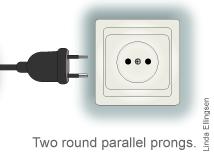
The 4 mm plug is the most versatile plug in Europe.  It is used everywhere except for where the British 3-prong outlet is used.  It can use the 4 mm or 5 mm outlets.  Most of my small appliances (iPhone charger, electric shaver, camera charger) have a 4 mm plug.

The 4 mm outlet is not grounded so it is being phased out in most of Europe.  Just the outlet; not the plug.

Through most of Europe the 5 mm outlet is used.  Again, you can use a 4 mm plug in a 5 mm outlet.  My flat has 5 mm outlets.


Italy has its own plug and outlet.  The plug looks like the 4 mm plug except that it has a grounding pin.  The good thing is that a 4 mm plug adapter will work in an Italian 3 pin outlet.

Finally there is a plug and outlet that is used in Switzerland and Liechtenstein.  It looks like the Italian version except that the grounding pin in the center is not parallel with the other pins.  A 4 mm plug adapter will work in a Swiss outlet.

None of this really causes me any trouble when I travel.  My small appliances with a 4 mm plug work everywhere except with that funky British outlet so then I just take along a UK plug adapter.  And when I'm in Italy I just make sure to bring along my 4 mm adapter so that I can plug in my laptop.

Update:  The UAE uses the UK plugs too.

Update:  SingaporeHong Kong and Macau each use the UK plugs as well.

South Africa plug
Update:  South Africa has a 3-prong plug similar to the UK plug but the prongs are all round.  The outlet also has the UK on/off toggle.

India plug


Update:  India uses a plug similar to South Africa but the prong size is a bit different.

Saturday, March 3, 2012

Scandinavia

Northern Europe is home to the Nordic countries.  There is a difference between Scandinavia and Nordics.  Although most people use the terms interchangeably.

Nordics is made up of five countries (Denmark, Norway, Sweden, Finland and Iceland) and three territories (Faroe Islands, Greenland and Åland Islands).

Scandinavia is used to reference just the three individual kingdoms of Denmark, Norway and Sweden.  The histories of these three countries are more tightly intertwined than the rest of the Nordic countries.  Scandinavia is known for high taxes, socialized health care and a high standard of living.

Denmark is the gateway to Scandinavia.  It was once the home of Viking raiders.  For years, Danes have consistently rated themselves as the happiest and most content people in the world.

Norway is the world's 5th-largest oil exporter and the second wealthiest country per GDP in the world.

Sweden was a military power back in the 17th century but has not fought in a war in almost 200 years.  Its policy of armed neutrality kept it out of both world wars.

Finland was part of Sweden from the 12th to 19th century and then was a part of the Russian Empire for more than 100 years.  While Danish, Norwegian and Swedish are very similar languages, Finnish is completely different.  I thought Czech was bad with 7 different grammatical cases but Finnish has 15 different cases.

Iceland was settled by Norwegian and Celtic (Scottish and Irish) immigrants in the 9th and 10th centuries.  It was independent for more than 300 years before being ruled by Norway and then Denmark.  Located in the mid-Atlantic it is the USA's closest European neighbor.

The Faroe Islands are about halfway between Iceland and Scotland.  The islands are a part of the Danish realm but have been an autonomous region since 1948.  It is responsible for internal affairs while Denmark is responsible for justice, defense and foreign affairs.  The islands are not part of the EU.

The Åland Islands are located in the Baltic Sea.  It has been an autonomous province of Finland since 1920.

Greenland is the world's largest island and over 80% is covered in ice.  Vikings from Iceland arrived in the 10th century.  It was colonized by Denmark in the 18th century.  Greenland is still an autonomous part of the Danish realm but Denmark is still responsible for foreign affairs and defense.

Update:  Here's a video I found out on YouTube about Scandinavia.
©CGP Grey

Friday, March 2, 2012

Müggelsee, Germany

I spent three days this week at an IBM leadership course in Berlin.  The course was held at a conference center on the Müggelsee, in east Berlin.


The Müggelsee is the biggest urban lake in Europe.  It has an area of 7.4 sq km (1.6 sq miles) and is 8 meters (26.25 feet) deep at its deepest point.

Claudia's parents live in Rahnsdorf which borders the lake.  Unfortunately, I was so busy with the course that I was unable to stop by and pay them a visit.  In fact, my days were so full that I didn't even get to go out and see the lake.  I had just enough time to grab a couple of photos on my iPhone.  It's a good thing that I've been there before.

Most people who live near the Müggelsee are against the new Berlin airport that opens in a few months.  People just still aren't happy with an expected daily average of 122 planes flying over the lake.

Update:  The new airport finally opened in December 2020.