Wednesday, September 11, 2019

On the Way to Kaohsiung, Taiwan

On Monday I took the Taiwan High Speed Rail (THSR) from Taipei to Kaohsiung in the south.

The route from the north along the west coast to Taiwan's second largest city opened in 2007.

Business class
The 362 km (225 miles) trip only took 94 minutes.

I shot this on my iPhone from the window seat.  The ride was incredibly smooth for as fast as we were moving.

Tuesday, September 10, 2019

Taipei Food Tour, Taiwan

On Saturday I did a food tour with Like It Formosa.  The three hour walking tour was NT$ 1,100 (€31 or USD $37).  It was a small international group.  A German guy living in Austria, a Polish girl from London on an international assignment in Hong Kong and me, an American living in Czechland.


We started out at an open market with plenty of fresh fruit and walked to a small restaurant where we had Taiwanese dumplings and hot & sour soup.


After a short walk we picked up some bubble tea.  Bubble tea is one of my favourite things.  You can find it sometimes in Czechland but it's not very good at all.  In Asia I tend to drink litres of it.

Then it was on to a small corner stand in the Da'an District called Tianjin that is known for the best scallion pancakes in the city.  Less of a pancake and more like a flaky grilled flatbread.  Savoury and quite tasty.

Then it was on to have some have some vermicelli soup with oyster and braised pig intestines.  Way tastier than it sounds.  It's best with some strong black vinegar and fresh corriander.

Beef noodle soup is one of the best known dishes in Taiwan.  It is made from braised beef, beef broth, vegetables and noodles.

The soup was served with some kind of "dumpling".  Basically a savoury flatbread filled with meat.

It was a lot of food.  Not full sized portions but enough to try lots of different things and feel completely full.  The few kilometres of walking helped keep us from feeling done in.


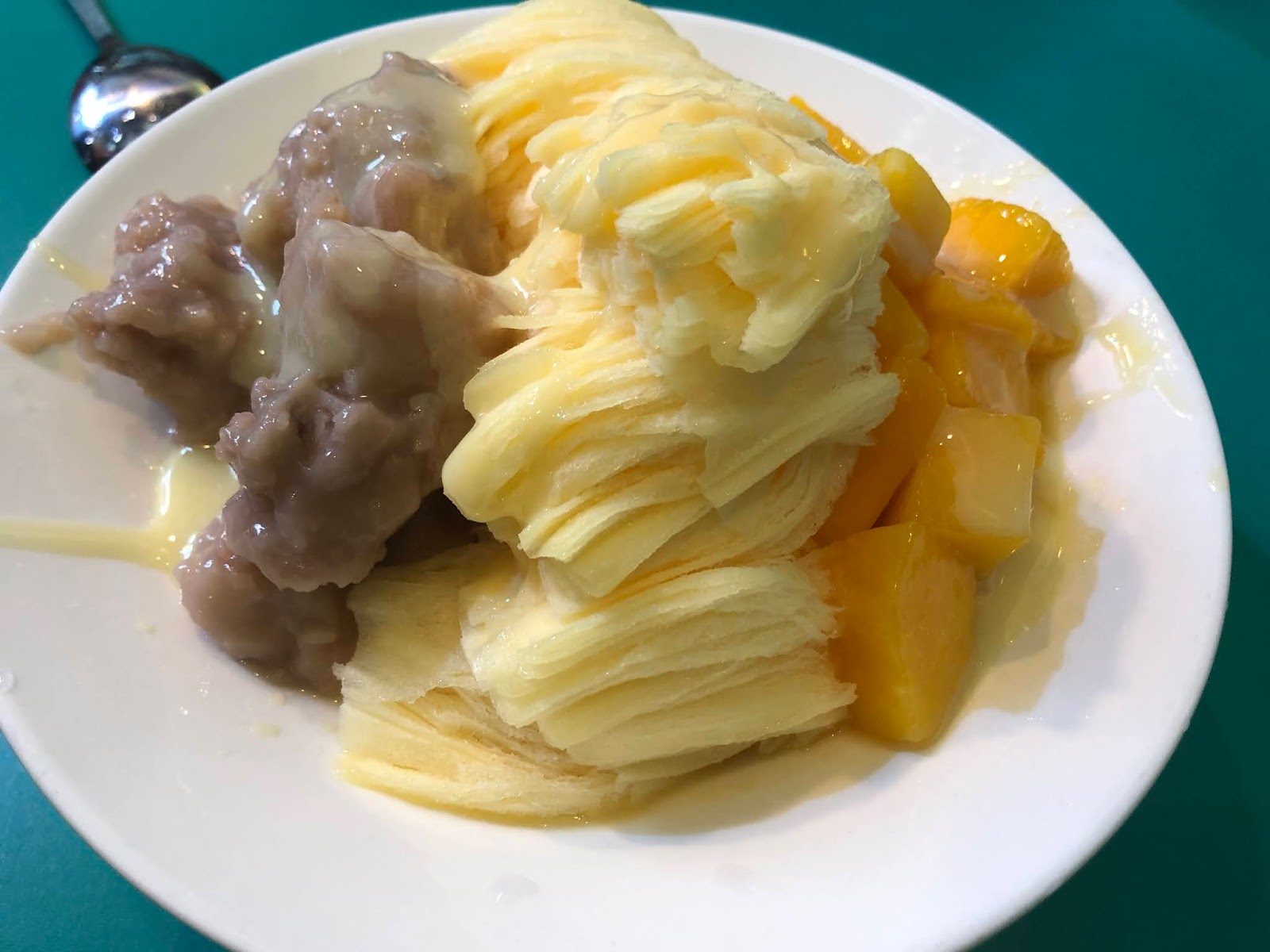
It also allowed us to have room at our final stop for some shaved ice with mango and taro.  The tour was great and highly recommended.

It's easy to eat well in Taipei.  If there's no English then you get by with hand gestures.  Although this doesn't mean that you won't have a few adventures along the way.

One day I went to a small hole in the wall place where I was the only non-Asian there.  My lesson learned here was that I had better stick to learning Czech because when I tried using limited Chinese I ended with chicken feet and some kind of mixed meat soup.  Not quite what I was going for but not bad.

Monday, September 9, 2019

Taipei, Taiwan

Taipei台北is located in northern Taiwan and is the capital.  Officially it is Taipei City and it was was first settled in 1709.  Taipei has a population of +2,65 million people while the greater metro area is home to more than 7 million people.


The area had been inhabited by aborigines until the early 18th century when Han Chinese immigrants began arriving.  The Qing Dynasty made Taipei-fu the provincial capital in 1894.  When Japan annexed all of Taiwan in 1895 the city was renamed Taihoku.  The Japanese embarked on an extensive urban planning programme and a railroad network that laid the groundwork for the city today.

In 1949, Taipei was declared the provisional capital of the Republic of China when Chiang Kai-shek and the Kuomintang fled mainland China at the end of the Chinese Civil War.  Today Taipei is Taiwan's business and financial Bub and the city is a global player in technology and electronics.

The city's landmark is Taipei 101 which was formerly known as the Taipei World Financial Centre.  The skyscraper is 101 floors and is 508 metres (1,667 feet) tall.  From 2004 to 2010 it was the world's tallest building.  Now it number 11.

However, it has next level energy efficiency and recycling making it the world's tallest green building.  The skyscraper is designed to withstand earthquakes and typhoon winds of 216 km/h (134 mph).

The North Gate was built in 1884 as part of the Taipei City Wall.  It was originally built following an attempted Japanese invasion.  It was renovated in 2017.


Lungshan Temple was built in 1738 by Chinese immigrants from Fujian during the Qing Dynasty.  The Buddhist temple has alters for several Chinese deities.

The Fa Zhu Gong Temple was built in 1869.  The temple's main god is believed to have once protected the local immigrant population from a terrible disease.  The current location was completed in 1988.

The 228 Peace Memorial Park was originally established in 1900 as Taihoku New Park.  It was the first European-style urban park in Taiwan.  In 1947, Taiwanese protestors took over the radio station that was here to protest the brutal police action of the Kuomintang (Chinese Nationalist) government.  From February 28, 1947, an estimated 5 000 to 28 000 Taiwanese died and began what was known as the White Terror where tens of thousands of other Taiwanese were killed, imprisoned or went missing.  In 1998 the former radio station became the the 228 Memorial Museum and the park was renamed.


Liberty Square was completed in the late 1970s.  The plaza is huge at more than 240,000 square meters (59 acres).


It was a gathering place in the 1990s when Taiwan transitioned from one-party rule by the Kuomintang to a modern democracy.


At the east end of the square is the National Chiang Kai-shek Memorial Hall.  The hall dedicated to the former president was completed in 1980.

National Theatre


Liberty Square is also home to two performing arts halls that were both completed in 1987.

National Concert Hall


These were two of Asia's first major modern performing arts facilities.


The Presidential Office Building was completed in 1919.  It was originally used by the Governor-General of Taiwan during the Japanese Colonisation.  The building was restored in 1950 and became the Presidential Office.

The Xiao Hai City God Temple was built in 1859.  It is only 152 square metres (1,615 square feet) but it is home to more than 600 deities.  I believe this is a popular temple to pray to the Chinese cupid for a mate.

The Ximen Red House was originally built as a public market.  There are lots of trendy local shops and bars that are popular amongst the city's LGBTQ community.


The Republic of China Armed Forces Museum opened in 1961.  Unfortunately, I didn't get a chance to go in because for some reason it's closed 10.8. - 18.10.2019.


The Taipei Dome is a multi-purpose stadium that is still under construction.  It will be primarily used for baseball but will include a shopping mall, movie theatre, a hotel and office space.  Originally construction was to begin in 2007 and be completed by 2011.  Work didn't begin until 2011 and the city ordered a halt in 2015.  There is still no date on when it will be completed.

The National Sun Yat-sen Memorial Hall was completed in 1972.  The museum covering his life is really interesting.

Every hour there is changing of the guards

Xiangshang is "Elephant Mountain" is worth a visit.  It is 183 metres (600 feet) tall with a few walking trails.  A hike up to the top provides a nice view of the city and of course another photo of Taipei 101.

The night markets are awesome.  I like the local markets but the Shilin Night Market is one of the largest and most famous.  Lots of shopping around but the food is the best part.

Scallion pancakes


The food court has over 500 different stalls and they stay open past midnight.
Oyster omelette 


Bubble Tea was invented in Taiwan.  My favourite is the brown sugar bubble tea.  Oh so good!

Soup Dumplings


All of the food in Taipei is just simply incredible.  I even did a food walking tour so that I didn't miss out on anything.

Friday, September 6, 2019

Shanghai, China

Shanghai上海市  is in east-central China and it is the biggest city in China.  Big as in huge!  It's home to 24,28 million people.  This one city is more than twice the population of Czechland, about the same as Australia.  More people live in Shanghai than in every U.S. state except California or Texas.   There are 27 countries in the EU (no UK due to Brexit) and only Germany, France, Italy, Spain, or Poland are bigger than this one city.

The area was originally settled around 4000 BC.  It was established as Qinglong Town in 746 AD.  It was once a small fishing village and today it is the country's biggest and most developed city and home to the world's busiest container port.  It's a major global hub for finance, transportation, technology and fashion.

The local native language here is Shanghainese which is the Wu dialect of Chinese; followed byMandarin.  I used a few words of Chinese when I could but managed to get by with either English or hand gestures.  Although in one place I got by with French.

The French Concession area dates back to the colonial period.  The area is pretty fashionable and is one of the city's best shopping and entertainment areas.  The former French Sports Club of Shanghai was built in 1924.  The club and gardens have been a part of the Okura Garden Hotel since 1989.


The Cathay Theatre was completed in 1930 and opened two years later.  It's the largest in the city and one of the few remaining art-deco cinemas.


Zhou Enlai became the PRC's first premier in 1949.  The house he lived in from 1949 until he died in 1976 became a memorial in 1979.  Today it is a free museum  worth checking out.


With there having been so many missionaries and foreign concessions it really shouldn't be a surprise to find a Catholic church in Shanghai.  Saint Peter's Catholic Church was built in 1995.  It replaced a church that was built in 1933.


Saint Joseph's Cathedral was consecrated in 1862.  In 1966 it was closed due to the Cultural Revolution but it reopened in 1986.


The Shanghai Grand Theatre opened in 1998.


The Shanghai Museum consists of 11 galleries with a collection of over 120,000 pieces.  The current building was opened in 1996.


The Camera History Museum is interesting.  Probably more so if you're a hardcore enthusiast but there are also a gallery and a cafe so it's a good spot to take a break and recharge.


The Propaganda Poster Art Centre was founded in 2012.  It's a private collection of more than 5.000 prints.  Lots of interesting Mao-era posters and communist propaganda.  It's located in the basement of an apartment building so it can be a bit tricky to find.


The Bund is the city's famous riverside avenue.  This is where to find the city's Western-style architecture from the 1920s.  Fun fact...due to the construction boom in the 1920s and 1930s, the city is home to among the most Art Deco buildings in the world.


The Bund is also the perfect place for views of the city's modern skyscrapers across the Huangpu River.


It is way more impressive at night with everything lit up.  That is when it isn't raining.


The Bund Bull was unveiled in 2010.  The bronze statue is 2300 kg (5000 lbs) and is the same size New York City's Charging Bull.


The skyscrapers lit up at night are pretty.  Not quite as impressive as in Hong Kong but still lovely.


The Oriental Pearl Radio & Television Tower was completed in 1995.  It's 468 metres (1,536 feet) tall and from 1994-2007 it was the tallest structure in China.


The Gutzlaff Signal Tower was built in 1907 in Art Deco style.  It provided weather reports five times a day until operation was discontinued in 1956.  The building was renovated in 1999 and the first floor is now a museum.

The Monument to the People's Heroes was built in 1933.  It commemorates the country's revolutionary martyrs and stands 24 metres (79 feet) tall.


Below the monument is the underground Bund History Museum which focuses on the city's colonial history.


At the People's Park there is the Memorial to the May 30th Movement where in 1925 the police fired into a crowd of people.


This resulted in a swell of support for the Communists.  The memorial was unveiled in 1990.


In the park is also a statue dedicated to the People's Liberation Army.


The Custom House was built in 1927.  It contains the largest clock in Asia.  
I know that there's more to see in Shanghai but due to the rain I was pretty much limited in what I was able to get out and see.  I think a return trip is in order.